


Pope Arrives in Lebanon in a Bid to Bring Hope to a War-wracked Region

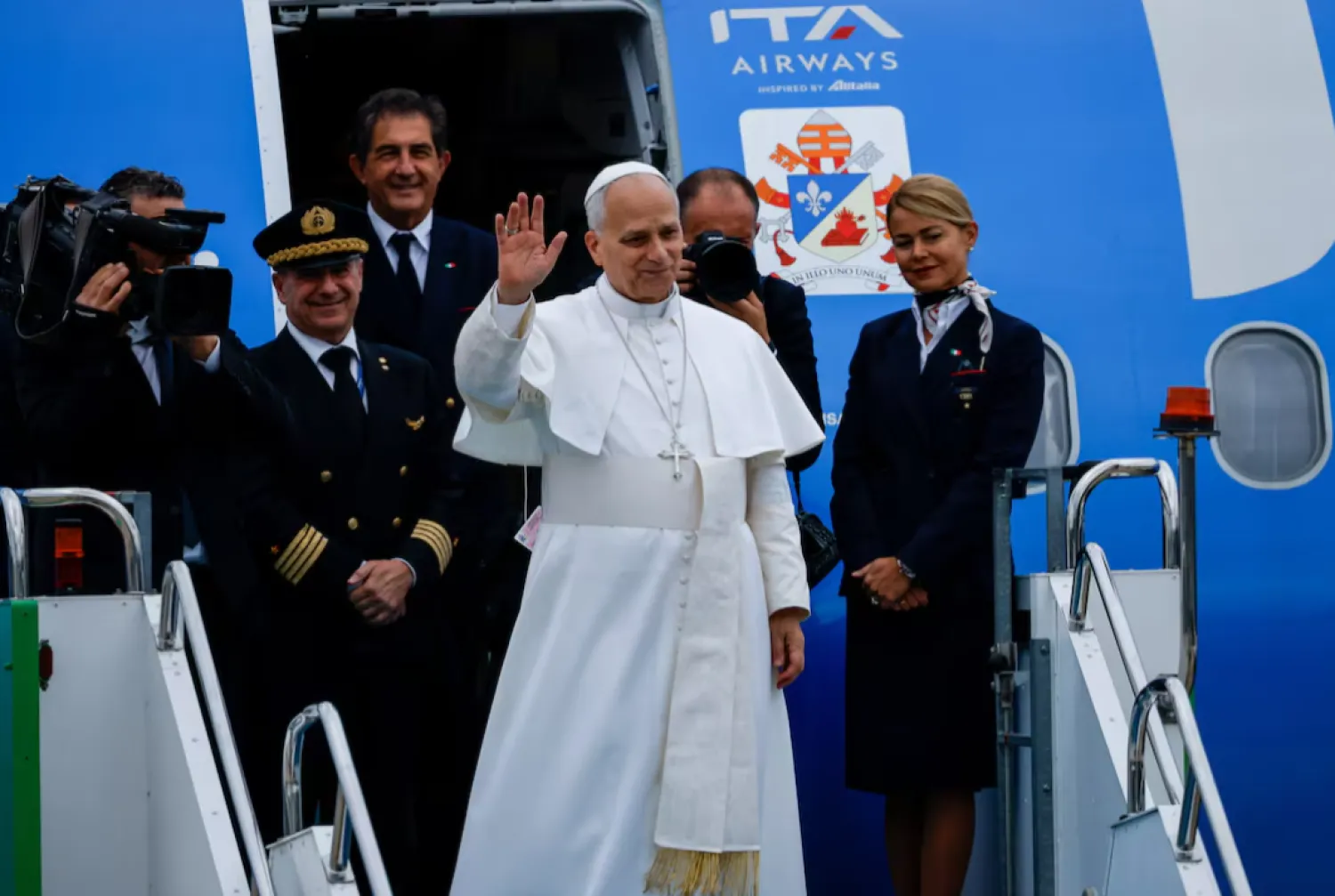
Pope Leo XIV waves while boarding the papal plane at Ataturk Airport, as he departs from Türkiye to Lebanon during his first apostolic journey, in Istanbul, Türkiye, November 30, 2025. REUTERS/Kemal Aslan
TT

Pope Arrives in Lebanon in a Bid to Bring Hope to a War-wracked Region

Pope Leo XIV waves while boarding the papal plane at Ataturk Airport, as he departs from Türkiye to Lebanon during his first apostolic journey, in Istanbul, Türkiye, November 30, 2025. REUTERS/Kemal Aslan

Pope Leo XIV landed in Lebanon Sunday, where he aimed to bring a message of hope to its long-suffering people and bolster a crucial Christian community in the Middle East.
He arrived in Lebanon at a precarious moment for the small Mediterranean country after years of successive crises. He is fulfilling a promise of Pope Francis, who had wanted to visit for years, but was unable to as his health worsened.

Lebanon is the second leg of Leo's first official foreign trip after he first visited Türkiye.

Lebanon, which has the largest share of Christians in the Middle East, has been rocked by the spillover of the Gaza conflict, as Israel and the Lebanese group Hezbollah went to war, culminating in a devastating Israeli offensive.

Leaders in Lebanon, which hosts 1 million Syrian and Palestinian refugees and is also struggling to recover from years of economic crisis, are worried Israel will dramatically escalate its strikes in coming months. Hezbollah leader Naim Qassem said on Friday that he hoped Leo's visit would help bring an end to Israeli attacks.

Lebanon's diverse communities have also welcomed the papal trip, with leading Druze cleric Sheikh Sami Abi al-Muna saying Lebanon "needs the glimmer of hope represented by this visit".

POPE VISITING FIVE LEBANESE CITIES AND TOWNS

Leo, a relative unknown on the world stage before becoming pope in May, is being closely watched as he makes his first speeches overseas and interacts for the first time with people outside mainly Catholic Italy. On Saturday, Leo visited Istanbul's famed Blue Mosque, in his first visit as pope to a Muslim place of worship. He removed his shoes in a sign of respect but did not pray at the mosque as planned, which appeared to surprise Vatican officials.

The pope attended an Orthodox Christian liturgy on Sunday morning led by Istanbul-based Ecumenical Patriarch Bartholomew, spiritual leader of the world's 260 million Orthodox Christians.

In remarks during the service, which was filled with Greek chants, Bartholomew said the world "expects a unified message of hope from Christians unequivocally condemning war and violence".

"We cannot be complicit in the bloodshed taking place in Ukraine and other parts of the world," said the patriarch. Leo, 70 and in good health, has a crowded itinerary in Lebanon, visiting five cities and towns from Sunday to Tuesday, when he returns to Rome. Leo will not travel to the south, the target of Israeli strikes.

His schedule includes a prayer at the site of a 2020 chemical explosion at the Beirut port that killed 200 people and caused billions of dollars' worth of damage. He will also lead an outdoor Mass on the Beirut waterfront and visit a psychiatric hospital, one of the few mental health facilities in Lebanon, where carers and residents are eagerly anticipating his arrival.



Israel Strikes Jamaa Islamiya Group’s HQ in Sidon, South Lebanon

Rescue workers gather in front of the destroyed center of the Jamaa Islamiya group which hit by an Israeli strike, in the southern port city of Sidon, Lebanon, Tuesday, March, 3, 2026. (AP)
TT

Israel Strikes Jamaa Islamiya Group’s HQ in Sidon, South Lebanon

Rescue workers gather in front of the destroyed center of the Jamaa Islamiya group which hit by an Israeli strike, in the southern port city of Sidon, Lebanon, Tuesday, March, 3, 2026. (AP)

Beirut, Lebanon, March 3, 2026 (AFP) - Israel struck a headquarters belonging to the Jamaa Islamiya group, an ally of Hamas and Hezbollah, in the southern Lebanese city of Sidon on Tuesday, state media reported.

"The Israeli enemy carried out an air raid a short while ago, targeting a headquarters of the Jamaa Islamiya" in the coastal city, state media said.

Sidon was largely spared of major Israeli attacks during the last war between Israel and Hezbollah, which a November 2024 ceasefire sought to end.

The strike almost entirely destroyed a seven-storey building, according to an AFP photographer, and ambulances rushed to the scene.

It caused a powerful blast in a densely populated area, as seen on local media.

The Jamaa Islamiya in a statement said no one was killed or wounded in the strike, which it called a "war crime".

The Israeli military then issued an evacuation warning for another building in Sidon, saying it will hit "Hezbollah military infrastructure... in light of its prohibited attempts to rebuild its activities in the area".

The Jamaa Islamiya had previously been the target of Israeli strikes in Lebanon after claiming responsibility for rocket launches towards Israel during the war between Israel and Hezbollah that began in October 2023.

Last month, it accused Israel of seizing one of its officials from a town near the border.

The Israeli military said that it "apprehended a senior terrorist" in the group who was then "transferred for further questioning in Israeli territory".


EU Helping Evacuate Citizens from Middle East

 European Commissioner for Preparedness and Crisis Hadja Lahbib speaks with the media as she arrives for a meeting of EU foreign ministers at the European Council building in Brussels, Monday, Feb. 23, 2026. (AP)
European Commissioner for Preparedness and Crisis Hadja Lahbib speaks with the media as she arrives for a meeting of EU foreign ministers at the European Council building in Brussels, Monday, Feb. 23, 2026. (AP)
TT

EU Helping Evacuate Citizens from Middle East

 European Commissioner for Preparedness and Crisis Hadja Lahbib speaks with the media as she arrives for a meeting of EU foreign ministers at the European Council building in Brussels, Monday, Feb. 23, 2026. (AP)
European Commissioner for Preparedness and Crisis Hadja Lahbib speaks with the media as she arrives for a meeting of EU foreign ministers at the European Council building in Brussels, Monday, Feb. 23, 2026. (AP)

The European Union has begun helping member countries Italy, Austria and Slovakia repatriate their citizens stranded due to the war in the Middle East, the bloc's crisis management chief told AFP Tuesday.

Commissioner Hadja Lahbib said the three countries were the first so far to ask Brussels to assist in funding flights from the region.

Under the EU's "civil protection mechanism" member states can get the bloc's executive to reimburse them for the bulk of the costs.

So far Slovakia has organized two flights in the coming day under the scheme, Austria has asked for space for 90 passengers and Italy is assessing how best to evacuate nationals, Lahbib said.

She said that more countries were expected to activate the mechanism in the coming days.

The US and Israeli attacks on Iran which began on Saturday, followed by Iranian counterattacks on Gulf states and Israel, have led the closure of the airspace of a number of countries.

That has caused the cancellation of at least 12,903 flights between Saturday and Monday, according to Cirium, an aviation data analysis firm, or about 40 percent of planned flights.

Some airlines on Tuesday resumed a limited number of scheduled flights -- but evacuation flights are still set to ferry more stranded passengers out of the region.

A number of EU states have already begun flying out their citizens without asking for assistance from Brussels.

Lahbib estimated that there are a total of some 500,000 EU citizens in the Middle East -- but not all of those were expected to want to leave.


Iraqi Government Seeks to Keep Country Out of Iran War Fallout

Al-Sudani chairs a meeting of the National Security Council (Prime Minister’s Office Media).
TT

Iraqi Government Seeks to Keep Country Out of Iran War Fallout

Al-Sudani chairs a meeting of the National Security Council (Prime Minister’s Office Media).

The government of outgoing Prime Minister Mohammed Shia Al-Sudani is working to distance Iraq from the escalating US-Israel war on Iran.

Tehran has responded to the military operation launched by the US and Israel with missile strikes on Gulf states and other locations, including Iraq, saying it is targeting American bases and interests.

Although Iraq has not been directly drawn into the conflict - unlike during the Iran-Iraq War (1980–1988), the 1990–1991 Gulf War, or the 2003 US-led invasion that toppled Saddam Hussein - fear is mounting as the country risks being caught between Iran and its local allies and the broader confrontation involving Washington and Tel Aviv.

There are also concerns that any disruption to Gulf shipping lanes could significantly curtail Iraq’s oil revenues.

Al-Sudani, who also serves as commander in chief of the armed forces, chaired on Monday an emergency meeting of the Ministerial Council for National Security, according to a statement from his office.

The premier instructed security agencies to prevent any actions that could undermine stability and to ensure that Iraq is not dragged into the conflict. Still, some observers say the government has been unable to stop missile attacks on Iraqi territory.

The government reiterated its commitment to protecting diplomatic missions and critical infrastructure, while affirming that freedom of expression and peaceful assembly remain constitutionally protected rights.

The statement stressed that security forces will continue safeguarding citizens, diplomatic facilities and public and private property, in line with national laws and international obligations.

The remarks appeared to reference attempts Sunday evening by groups linked to Iran-aligned armed factions to approach the US Embassy in Baghdad’s fortified Green Zone. Security forces stopped them from reaching the compound.

The council added that Iraq remains committed to preventing escalation and ensuring its territory is not used for external or internal conflicts, underscoring that decisions on national security and military action lie solely with the state and its constitutional institutions.

The council also reviewed the potential economic fallout of a prolonged and expanding conflict, particularly the risks associated with a possible closure of the Strait of Hormuz. The bulk of Iraq’s oil exports pass through the Gulf en route to the strategic waterway.

Given the country’s heavy dependence on oil income, any sustained disruption to maritime traffic would pose a serious threat to Iraq’s already fragile economy.