


Princess Aiko's Popularity Sparks Calls to Change Japan's Male-only Succession Law

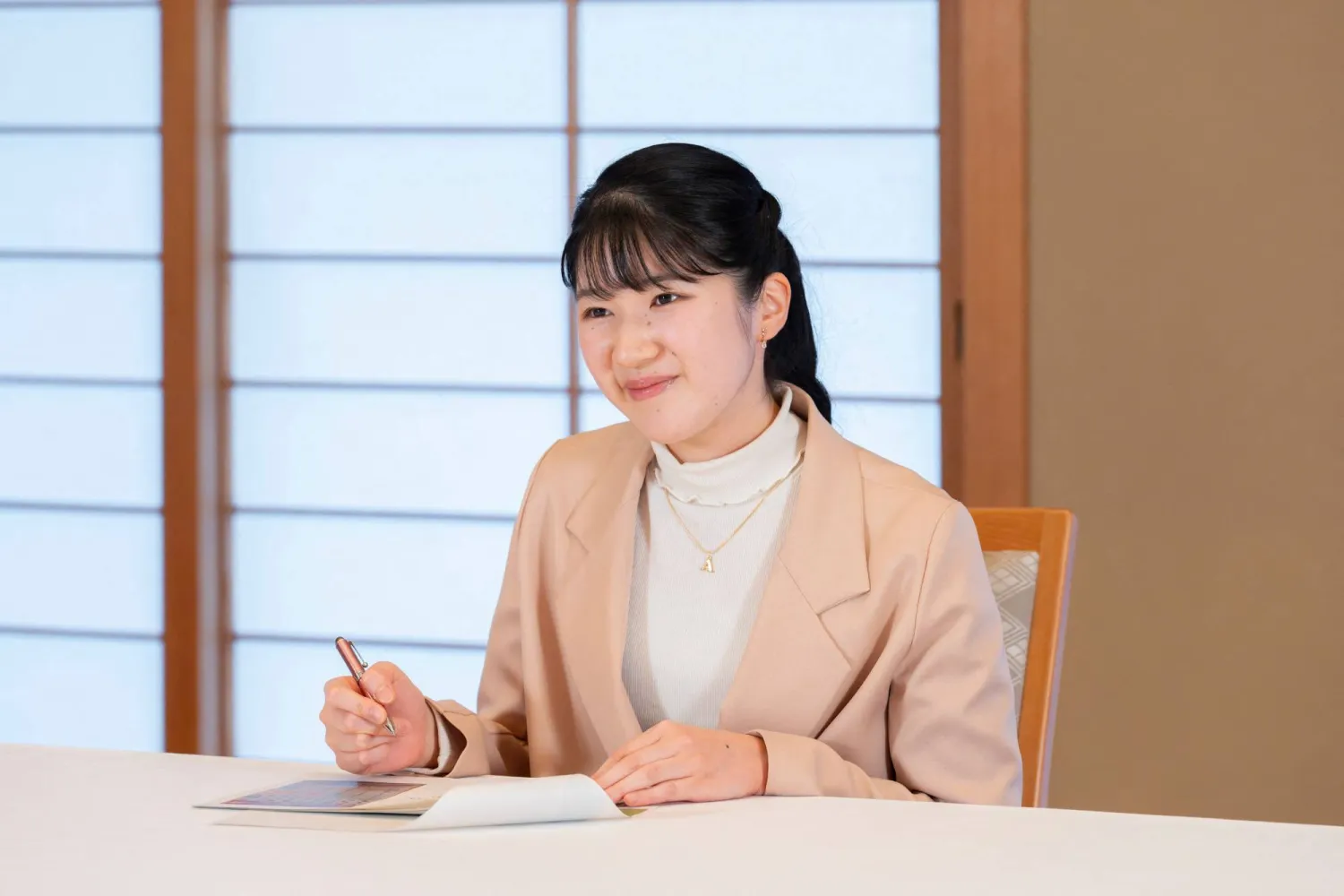
This handout photo taken on November 10, 2025 and released by the Imperial Household Agency of Japan shows Princess Aiko, the daughter of Japan's Emperor Naruhito and Empress Masako, posing for a photo at the Imperial Palace in Tokyo, ahead of her 24th birthday on December 1, 2025. (Photo by Handout / Imperial Household Agency / AFP)
TT

Princess Aiko's Popularity Sparks Calls to Change Japan's Male-only Succession Law

This handout photo taken on November 10, 2025 and released by the Imperial Household Agency of Japan shows Princess Aiko, the daughter of Japan's Emperor Naruhito and Empress Masako, posing for a photo at the Imperial Palace in Tokyo, ahead of her 24th birthday on December 1, 2025. (Photo by Handout / Imperial Household Agency / AFP)

Japan’s beloved Princess Aiko is often cheered like a pop star.

During a visit to Nagasaki with Emperor Naruhito and Empress Masako, the sound of her name being screamed by well-wishers along the roads overwhelmed the cheers for her parents.

As she turns 24 on Monday, her supporters want to change Japan's male-only succession law, which prohibits Aiko, the emperor's only child, from becoming monarch.

Along with frustration that the discussion on succession rules has stalled, there's a sense of urgency. Japan's shrinking monarchy is on the brink of extinction. Naruhito’s teenage nephew is the only eligible heir from the younger generation.

Experts say the female ban should be lifted before the royal family dies out, but conservative lawmakers, including Prime Minister Sanae Takaichi, oppose the change.

Aiko's popularity boosts demand for a female monarch Aiko has gained admirers since debuting as an adult royal in 2021, when she impressed the public as intelligent, friendly, caring and funny.

Support for Aiko as a future monarch increased following her first solo official overseas trip to Laos in November, representing the emperor. During the six-day visit, she met with top Laotian officials, visited cultural and historical venues and met with locals.

Earlier this year, Aiko accompanied her parents to Nagasaki and Okinawa. She has followed the example set by her father, who places great importance on passing down the tragedy of WWII to younger generations.

“I have always been rooting for Princess Aiko to be crowned," said Setsuko Matsuo, an 82-year-old atomic bombing survivor who came to Nagasaki's peace park hours before Aiko and her parents' scheduled arrival in the area. “I like everything about her, especially her smile ... so comforting," she told The Associated Press at the time.

Mari Maehira, a 58-year-old office worker who waited to cheer Aiko in Nagasaki, said she has seen Aiko grow up and “now we want to see her become a future monarch.”

The princess’ popularity has triggered some to pressure legislators to change the law.

Cartoonist Yoshinori Kobayashi has written comic books that push for a legal change to allow Aiko to become monarch, which supporters keep sending to parliamentarians to raise awareness and get their backing for the cause.

Others have set up YouTube channels and distributed leaflets to gain public attention on the issue.

Ikuko Yamazaki, 62, has been using social media to advocate for the succession of the emperor's first child regardless of gender. She says not having Aiko as a successor and the insistence on male-only monarchs will cause the monarchy to die out.

“The succession system conveys the Japanese mindset regarding gender issues,” Yamazaki said. “I expect having a female monarch would dramatically improve women’s status in Japan."

Aiko's upbringing The popular princess was born on Dec. 1, 2001.

Soon after giving birth to Aiko, her mother, Harvard-educated former diplomat Masako, developed a stress-induced mental condition, apparently due to criticism for not producing a male heir, from which she is still recovering.

Aiko was known as a bright child who, as a sumo fan, memorized wrestlers’ full names.

However, she also had faced difficulties: As an elementary school girl, she briefly missed classes because of bullying. As a teenager, she appeared extremely thin and missed classes for a month.

In 2024, Aiko graduated from Gakushuin University, where her father and many other royals studied. She has since participated in her official duties and palace rituals while also working at the Red Cross Society. On weekends, she enjoys taking walks with her parents and playing volleyball, tennis and badminton with palace officials.

Japan’s monarchy is at a ‘critical state’ The 1947 Imperial House Law only allows male-line succession and forces female royals who marry commoners to lose their royal status.

The rapidly dwindling Imperial Family has 16 members, down from 30 three decades ago. All are adults.

Naruhito has only two potential younger male heirs, his 60-year-old younger brother, Crown Prince Akishino, and Akishino's 19-year-old son, Prince Hisahito.

Prince Hitachi, former Emperor Akihito’s younger brother and third in line to the throne, is 90.

Akishino acknowledged the aging and shrinking royal population, "but nothing can be done under the current system.”

“I think all we can do right now is to scale back our official duties," he told reporters ahead of his 60th birthday Sunday.

Last year, the crown prince noted that royal members are “human beings” whose lives are affected by the discussion, a nuanced but rare comment. He has seen no change, though palace officials have sincerely taken his remark, Akishino said Sunday.

Aiko had also previously said she is aware of the declining royal population, but could not comment on the system. “Under the circumstances, I hope to sincerely serve every official duty and help the emperor and the empress, as well as other members of the Imperial Family.”

The shortage of male successors is a serious worry for the monarchy, which some historians say has lasted for 1,500 years. It's also a reflection of Japan’s broader problem of a rapidly aging and shrinking population.

“I think the situation is already critical,” said Hideya Kawanishi, a Nagoya University professor and expert on monarchy. Its future is totally up to Hisahito and his potential wife's ability to produce a male offspring. “Who wants to marry him? If anyone does, she would endure enormous pressure to produce a male heir while performing official duties at a superhuman capacity."

Hisahito must carry the burden and the Imperial Family’s fate by himself, former Imperial Household Agency chief Shingo Haketa said in a Yomiuri newspaper article this year. “The fundamental question is not whether to allow a male or female succession line but how to save the monarchy.”

Japan's male-only succession system is relatively new Japan traditionally had male emperors, but there have also been eight female monarchs. The last was Gosakuramachi, who ruled from 1762 to 1770.

The male-only succession rule became law in 1889 and was carried over to the postwar 1947 Imperial House Law.

Experts say the system had only previously worked with the help of concubines who, until about 100 years ago, produced half of the past emperors.

The government proposed allowing a female monarch in 2005, but Hisahito’s birth allowed nationalists to scrap the proposal.

The unfruitful search for a male successor In 2022, a largely conservative expert panel called on the government to maintain its male-line succession while allowing female members of the family to keep their royal status after marriage and continue their official duties. The conservatives also proposed adopting male descendants from defunct distant branches of the royal family to continue the male lineage, an idea seen as unrealistic.

The United Nations women’s rights committee in Geneva urged the Japanese government last year to allow a female emperor, saying that not doing so hindered gender equality in Japan.

Japan dismissed the report as “regrettable” and “inappropriate," saying the imperial succession is a matter of fundamental national identity.

“Though it’s not spelled out, what they’re saying is clearly in favor of male superiority. That’s their ideal society,” Kawanishi, the professor, said.



Caffeinated Beverages May Help Protect the Brain, Study Says

A cup of coffee and a cappuccino are seen at a Juan Valdez store in Bogota, Colombia June 5, 2019. (Reuters)
TT

Caffeinated Beverages May Help Protect the Brain, Study Says

A cup of coffee and a cappuccino are seen at a Juan Valdez store in Bogota, Colombia June 5, 2019. (Reuters)

Drinking a few cups of caffeinated coffee or tea every day may help in a small way to preserve brain power and prevent dementia, researchers reported on Monday.

People with the highest daily intake of caffeinated coffee had an 18% lower risk of developing dementia compared to those with the lowest such intake, according to a study based on responses to questionnaires by 132,000 U.S. adults spanning four decades.

The study, published in JAMA, also found that the people with the highest intake had a lower rate - by nearly 2 percentage points - of ‌self-perceived memory ‌or thinking problems compared to those with ‌the ⁠lowest intake.

Results were ‌similar with caffeinated tea, but not with decaffeinated beverages, the researchers said.

While the findings are encouraging, the study does not prove caffeine helps protect the brain, they said.

The magnitude of caffeine's effect, if any, was small, and there are other better-documented ways to protect cognitive function as people age, study leader Dr. Daniel Wang ⁠of Harvard Medical School said in a statement.

Lifestyle factors linked with lower risks of ‌dementia include physical exercise, a healthy diet ‍and adequate sleep, according to previous ‍research.

"Our study suggests that caffeinated coffee or tea consumption can ‍be one piece of that puzzle," Wang said.

The findings were most pronounced in participants who consumed two to three cups of caffeinated coffee or one to two cups of caffeinated tea daily, the researchers reported.

Those who drank caffeinated coffee also showed better performance on some objective tests of cognitive function, according to the ⁠study funded by the National Institutes of Health.

Further research is needed to validate the factors and mechanisms responsible for the findings, the researchers said.

They noted that bioactive ingredients in coffee and tea such as caffeine and polyphenols have emerged as possible factors that reduce nerve cell inflammation and damage while protecting against cognitive decline.

"We also compared people with different genetic predispositions to developing dementia and saw the same results - meaning coffee or caffeine is likely equally beneficial for people with high and low genetic risk of developing ‌dementia," study coauthor Dr. Yu Zhang of the Harvard T.H. Chan School of Public Health said in a statement.


AlUla Announces Exceptional Ramadan Experiences

These programs come as part of efforts to enhance AlUla’s tourism experience - SPA
TT

AlUla Announces Exceptional Ramadan Experiences

These programs come as part of efforts to enhance AlUla’s tourism experience - SPA

AlUla Governorate is welcoming the holy month of Ramadan this year with a wide range of diverse tourism experiences that reflect the area’s distinctive character and rich cultural heritage, reinforcing its position as one of the Kingdom’s most prominent destinations to visit during the holy month.

During Ramadan, AlUla offers an integrated experience catering to different visitor preferences, including guided stargazing experiences, cultural events, and night markets, in addition to traditional dining experiences for Iftar and Suhoor, embodying the depth of AlUla’s cultural heritage and local identity.

The Ramadan programs in AlUla include a variety of standout events, such as Ramadan experiences at Maraya Hall, a cultural market, and live performances in the atmosphere of Ashar Valley, alongside heritage tours in AlUla Old Town that narrate stories of AlUla and its Ramadan customs, including the award-winning Incense Road Experience, SPA reported.

The programs also feature seasonal art exhibitions hosted across multiple cultural venues, including Design Space AlUla, the fourth edition of Desert X AlUla, and the Arduna exhibition at AlUla Oasis, in addition to experiences combining art, nature, and stargazing at Daimumah Oasis in collaboration with AlUla Manara.

Visitors are also offered tours to prominent archaeological sites, including Hegra, Dadan, and Jabal Ikmah, to explore ancient sites dating back centuries BCE and view unique rock inscriptions, as well as adventure experiences ranging from dinner and stargazing in Sharaan, hot-air balloon rides, mountain hiking trails, and safari tours.

These programs come as part of efforts to enhance AlUla’s tourism experience during the holy month of Ramadan and provide diverse options that meet visitor expectations, contributing to the growth of tourism activity and showcasing the governorate’s natural and cultural assets.


NCW Releases over 10,000 Animals under Reintroduction Programs

The releases carried out by the center over the past years included more than 80 priority wildlife species - SPA
TT

NCW Releases over 10,000 Animals under Reintroduction Programs

The releases carried out by the center over the past years included more than 80 priority wildlife species - SPA

The National Center for Wildlife (NCW) announced that the total number of wildlife animals released under its breeding and reintroduction programs for locally threatened species has exceeded 10,000 animals, an achievement reflecting the scale of the center’s sustained efforts to develop wildlife, restore ecosystems, and enhance biodiversity across various regions of the Kingdom.

The releases carried out by the center over the past years included more than 80 priority wildlife species, including reem gazelles (sand gazelles), Arabian oryx, Idmi gazelles, mountain ibex, houbara bustards, ostriches, and sandgrouse, as part of efforts aimed at supporting the recovery of natural populations of these species and enhancing their sustainability within their environmental and historical ranges, SPA reported.

CEO of NCW Dr. Mohammad Qurban noted that release operations are among the key tools for restoring ecosystems and reducing ecological imbalance, as the return of wildlife to their natural habitats contributes to protecting biodiversity and improving environmental quality, which in turn supports habitat integrity, the continuity of plant and animal components, and the enhancement of ecosystem functions over the long term.

NCW continues to implement its strategic plans to develop wildlife, protect endangered species, and enhance the efficiency of natural habitat management through expanding breeding programs, enhancing applied scientific research, building national capacities, and applying the best international practices in biodiversity management, in addition to raising environmental awareness, engaging local communities, and supporting eco-tourism, thereby contributing to achieving the objectives of the Saudi Green Initiative and Saudi Vision 2030, and the National Environment Strategy, toward thriving and sustainable wildlife, biodiversity, and ecosystems.