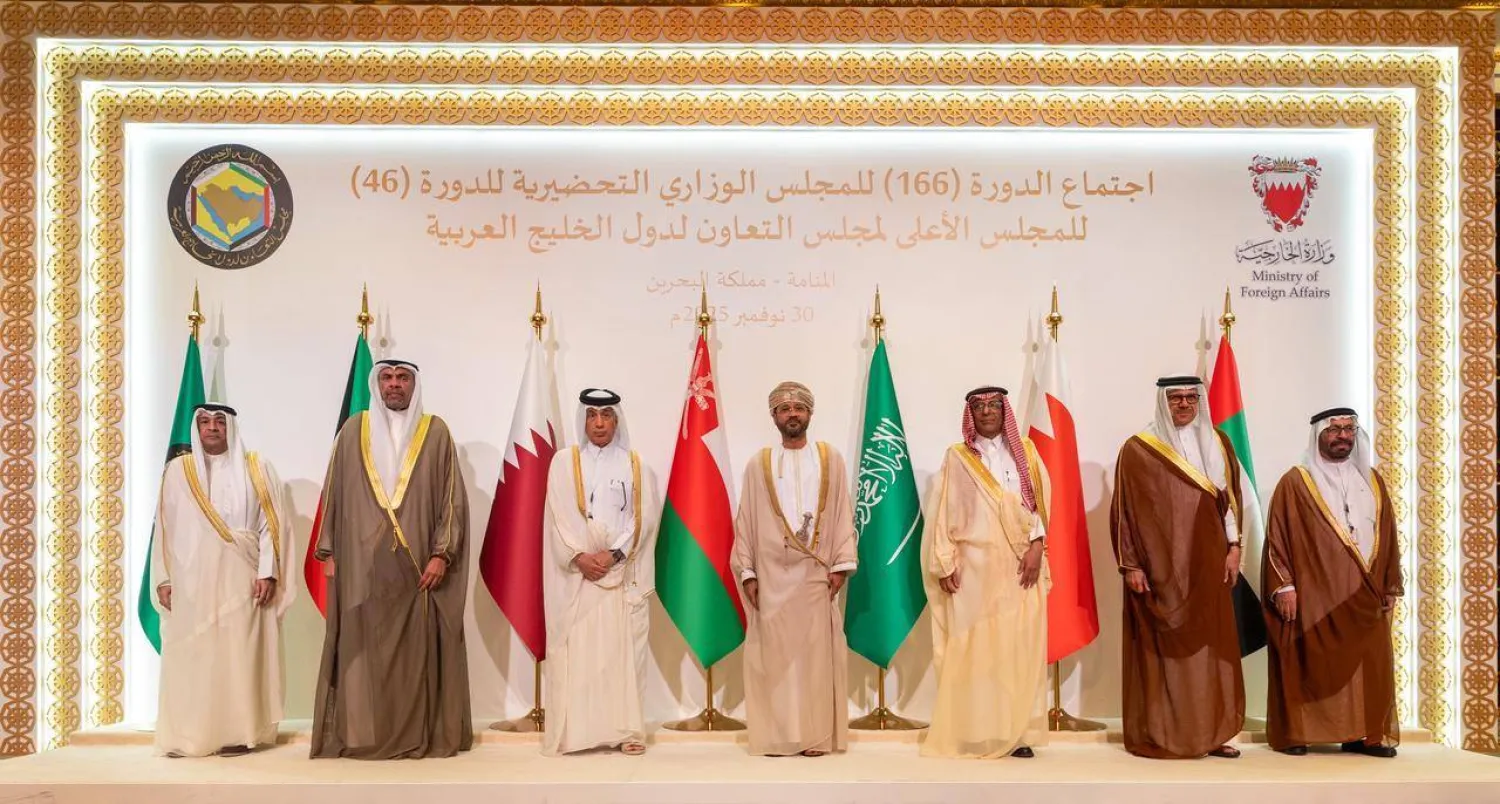

The leaders of the Gulf Cooperation Council (GCC) will convene in Manama on Wednesday during a “pivotal” moment where they transition from managing crises to reshaping “security balances” in the region, observers told Asharq Al-Awsat.
“Traditional approaches” are no longer viable in the current regional scene, they added, explaining that the region is going through security and economic changes.
Security and joint Gulf defense will likely top the summit agenda, they went on to say. The leaders will also focus on Gulf efforts, led by Saudi Arabia, in handling post-crisis Syria, Gaza and Sudan.
Dr. Hesham Alghannam, nonresident scholar at the Malcolm H. Kerr Carnegie Middle East Center, said the summit is confronted with three major files.
The first is regional security and joint Gulf defense given how the Iran-Israel conflict has turned into a direct confrontation and how its fallout has impacted the Gulf, leading to an Israeli attack on Qatar in September, he told Asharq Al-Awsat.
“Traditional deterrence is no longer enough, but the Gulf needs to consolidate an effective joint defense system and come up with deterrence that includes an early warning system and integrated roles,” he added.
Moreover, he noted that the summit must seriously address the threats to Red Sea shipping routes and Sudan.
The second file, continued Alghannam, are post-crisis Gaza, Syria and Sudan. “Gulf countries, led by Saudi Arabia, must take an active political role, not just roles as financers,” he stated. They must also work on ending Israel’s widening violations in Gaza, Syria and Lebanon.
They must support the new political path in Syria, become directly involved in Sudan given that it overlooks the Red Sea and stop the “economy of militias that fuels instability,” he stressed.
The summit is an opportunity to consolidate unified stances and the Gulf’s leading role, with Saudi Arabia at the helm. The Gulf countries can set the broad guidelines for the new phase in the region where the Gulf is part of solutions to pressing files, he explained.
The third file, said Alghannam, is related to economic and logistic integration in the Gulf in wake of a rapidly evolving international environment.
Dr. Abdulaziz Sager, Chairman of the Gulf Research Center, told Asharq Al-Awsat said the summit will focus on major regional issues, including the situation in Gaza and the Palestinian Territories and Israel’s attacks on Syria and Lebanon.
The summit is being held amid instability in Sudan, Syria, Yemen and Lebanon and as the Iranian-Israeli conflict remains unresolved, he added.
Alghannam expected the summit to approve a joint framework to bolster security dialogue with Iran and focus on mechanisms that enure the safety of international marine navigation in vital waterways.
The leaders will also underscore their united stance on the Palestinian cause, while leading regional and international efforts to revive the peace process, he added.