

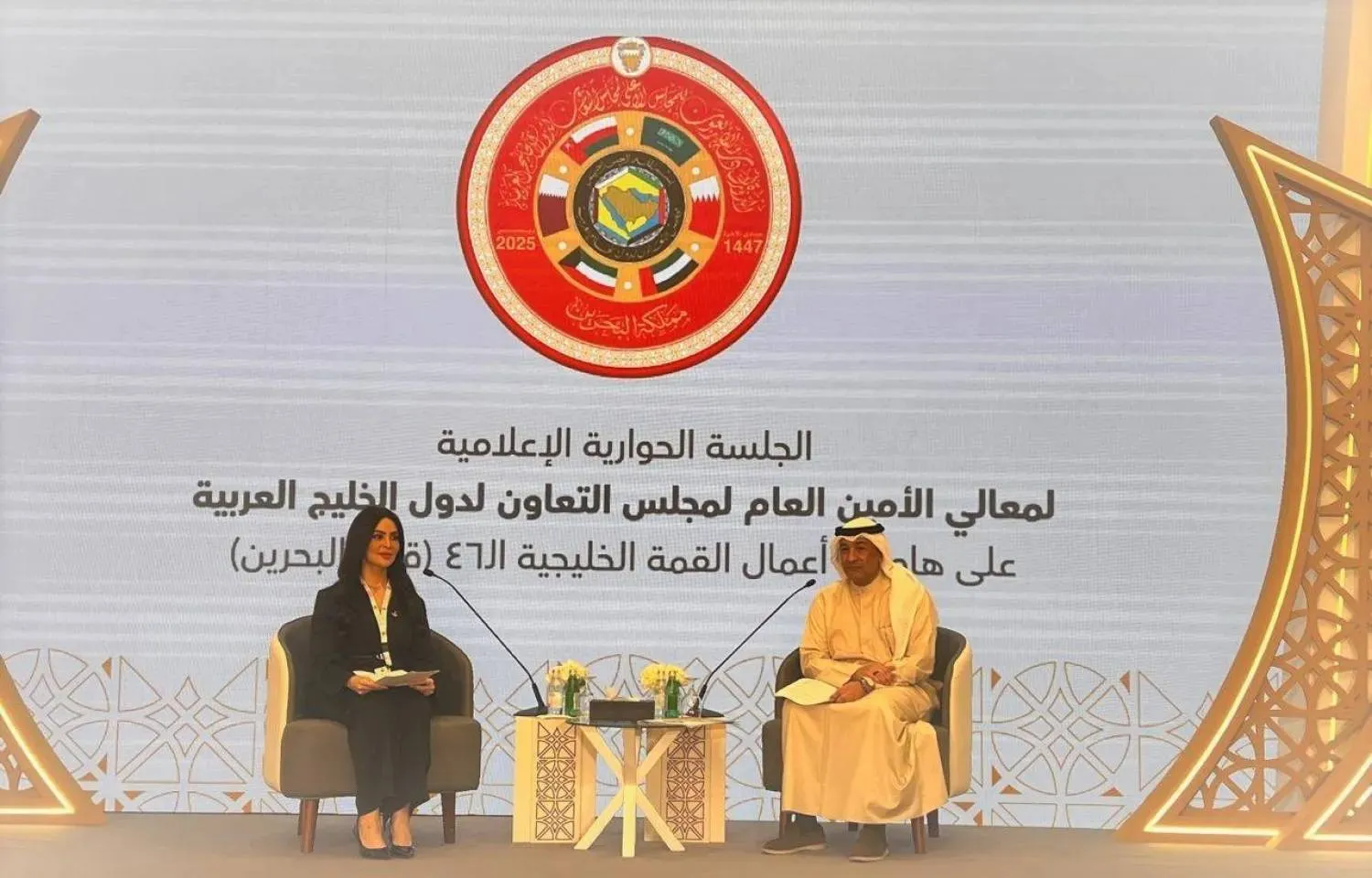

GCC Chief: Gulf States Weigh Joint Missile Shield to Bolster Defense

GCC Secretary General Jasem Mohamed Albudaiwi speaks with journalists in Manama (Asharq Al-Awsat)
TT

GCC Chief: Gulf States Weigh Joint Missile Shield to Bolster Defense

GCC Secretary General Jasem Mohamed Albudaiwi speaks with journalists in Manama (Asharq Al-Awsat)

Gulf Cooperation Council (GCC) Secretary General Jasem Mohamed Albudaiwi said on Tuesday that the bloc’s six states, days away from their summit in Bahrain, have been weighing a unified missile defense system that could serve as a protective shield for the Arab Gulf.

Speaking to journalists in Manama ahead of the forty sixth Gulf summit, Albudaiwi said joint Gulf defense is one of the most important issues that leaders will discuss at Wednesday’s meeting.

He said the summit convenes amid regional tensions, particularly after Qatar came under two attacks on its territory, one from Iran and the other from Israel.

Iran launched missile strikes on June 23, 2025, targeting several United States bases, including Al Udeid Air Base in Qatar and US positions in Iraq. The attack came in retaliation for a US strike on Iranian nuclear facilities.

On September 9, 2025, Israel carried out airstrikes on Doha using fighter jets that targeted a site used by members of the Hamas negotiating delegation in the Qatari capital.

Albudaiwi said GCC leaders, who condemned the attacks on Qatar, held a solidarity meeting in Doha and asked Gulf defense ministers to convene an extraordinary session to explore ways to protect Gulf territories from similar assaults.

Five measures

Albudaiwi said defense ministers agreed on five military measures, which he did not disclose, during their meeting in Doha. He added that the steps are intended to strengthen joint Gulf military coordination.

He also said the Gulf states have discussed creating a joint missile shield to counter attacks on their territory. These states have already held negotiations with producing countries, he said, adding that they hope for a solution soon.

Free trade

Albudaiwi said the Gulf states are working to conclude free trade agreements with countries around the world, noting that upcoming deals are expected to be signed with Pakistan, New Zealand and South Korea.

On the free trade agreement with the United Kingdom, he said the talks have made significant progress and that only a few steps remain before it is finalised.

He said the Gulf British partnership is rooted in a long history of cooperation and mutual trust and looks toward a promising future based on shared interests.

He said the partnership will include broad cooperation in political coordination, security and defense, cultural exchange, and economic and investment ties.

Forty sixth Gulf summit

Gulf leaders will discuss regional and international developments, along with efforts to strengthen joint Gulf action, during the forty sixth summit in Bahrain. It will be the eighth time Bahrain has hosted the GCC summit since the council was established on May 25, 1981.

Iraq Vows No Leniency with Parties Harming Ties with Saudi Arabia

Iraqi government spokesman Bassem al-Awadi. (INA)
TT

Iraq Vows No Leniency with Parties Harming Ties with Saudi Arabia

Iraqi government spokesman Bassem al-Awadi. (INA)

Iraq said it was ready to cooperate fully in verifying any information about an attack on Saudi Arabia that was launched from its territory, renewing its condemnation of the incident and vowing measures to prevent any breach of Iraqi sovereignty.

The Iraqi government’s latest condemnation came a day after the Foreign Ministry denounced the attacks on the Kingdom, in what observers said signaled Prime Minister Ali al-Zaidi’s new government was keen to protect ties with Saudi Arabia and other Gulf states.

Saudi Arabia’s Defense Ministry said on Sunday it had intercepted and destroyed three drones after they entered the Kingdom’s airspace from Iraq.

Iraqi government spokesman Bassem al-Awadi renewed Baghdad’s condemnation on Tuesday, saying Iraq “reaffirms its firm and historic position in support of distinguished and lasting relations with brotherly and friendly countries of the region, its commitment to the security of Arab states, the importance of supporting stability, all efforts to ease tensions, and preventing attacks, whatever their source.”

“The Iraqi government condemns the recent drone attacks that targeted Saudi Arabia and affirms its continued joint efforts to strengthen regional security and safeguard the security and sovereignty of countries in the region,” he said.

Awadi repeated that the military authorities did not detect or record any activity from the country’s airspace, stressing, however, that Iraqi institutions were fully ready “to cooperate in verifying any information related to the circumstances of the attack that targeted the Kingdom.”

He stressed Iraq’s “categorical rejection of the use of its territory, airspace or territorial waters to launch any attack on neighboring countries.”

Awadi said Iraqi security forces had taken “all necessary steps and measures to thwart and uncover any attempt in this context,” adding that there would be “no leniency toward anyone who tries to violate the sovereignty of the Iraqi state or damage relations with the Kingdom, neighboring countries or brotherly states.”

Observers are now raising questions over how Zaidi will deal with pro-Iran armed factions and confront their activities at home and abroad, particularly under continued US pressure.

In recent months, after the outbreak of the US-Israeli war against Iran, factions launched hundreds of attacks on targets inside Iraq, most of them in the northern Kurdistan region.

They also carried out attacks on more than one country in Iraq’s regional neighborhood. Those attacks stopped during the ceasefire, before resuming with three drones over Saudi territory.

Many believe the factions’ latest attacks pose a serious challenge to Zaidi’s authority. The prime minister, whose government was approved by parliament last week, has received clear US, domestic and Arab backing, a development that was not welcomed by the factions, which are seeking to embarrass him at the start of his tenure in Iraq’s top executive post.


Bahrain Suspends Entry of Foreign Travelers Arriving from Three Countries Amid Ebola Fears

A view of Bahrain's capital Manama. (Getty Images file)
TT

Bahrain Suspends Entry of Foreign Travelers Arriving from Three Countries Amid Ebola Fears

A view of Bahrain's capital Manama. (Getty Images file)

Bahrain said on Tuesday it was suspending the entry of foreign travelers arriving from South Sudan, ‌the Democratic ‌Republic of ‌Congo ⁠and Uganda due ⁠to the Ebola virus outbreak.

The suspension will be effective for ⁠30 days ‌starting Tuesday, ‌according to ‌the country's ‌state news agency.

The World Health Organization expressed deep ‌concern on Tuesday at the speed ⁠and ⁠scale of the Ebola outbreak, as the number of cases rises.


UAE Says Drones Targeting Nuclear Plant Came from Iraq

The United Arab Emirates flag flutters against the backdrop of the Abu Dhabi Skyline following a reported Iranian strike, March 1, 2026. (AFP)
TT

UAE Says Drones Targeting Nuclear Plant Came from Iraq

The United Arab Emirates flag flutters against the backdrop of the Abu Dhabi Skyline following a reported Iranian strike, March 1, 2026. (AFP)

The United Arab Emirates on Tuesday said drones that targeted its nuclear plant last week came from Iraq, from where Iranian-backed groups have launched several attacks since the Middle East war began.

On Sunday, an unclaimed drone struck an electrical generator near the Arab world's only nuclear power plant in Barakah in the emirate of Abu Dhabi, triggering a fire but causing no injuries or radiation leak. Two other drones had been intercepted.

"As part of the ongoing investigation into the blatant attack on the Barakah Nuclear Power Plant on May 17, 2026, technical tracking and monitoring confirmed that the three drones... all originated from Iraqi territory," the Emirati defense ministry said.

Authorities intercepted six drones that also came from Iraq and "attempted to target civilian and vital areas" in the past 48 hours, the ministry added.

Iraqi authorities had already condemned the attack on Barakah before Abu Dhabi announced where the drones came from.

Iran has attacked the UAE and other Gulf nations since the US and Israel launched strikes on the country on February 28, targeting US assets but also energy and civilian infrastructure.

Iran-backed groups in Iraq have not claimed any strikes since the truce came into place, though Gulf countries have reported attacks from Iraq.

On Sunday, Saudi Arabia had reported intercepting drones that came from Iraq, while Baghdad said its defense systems had not detected any drones launched from its territory toward the Kingdom.