

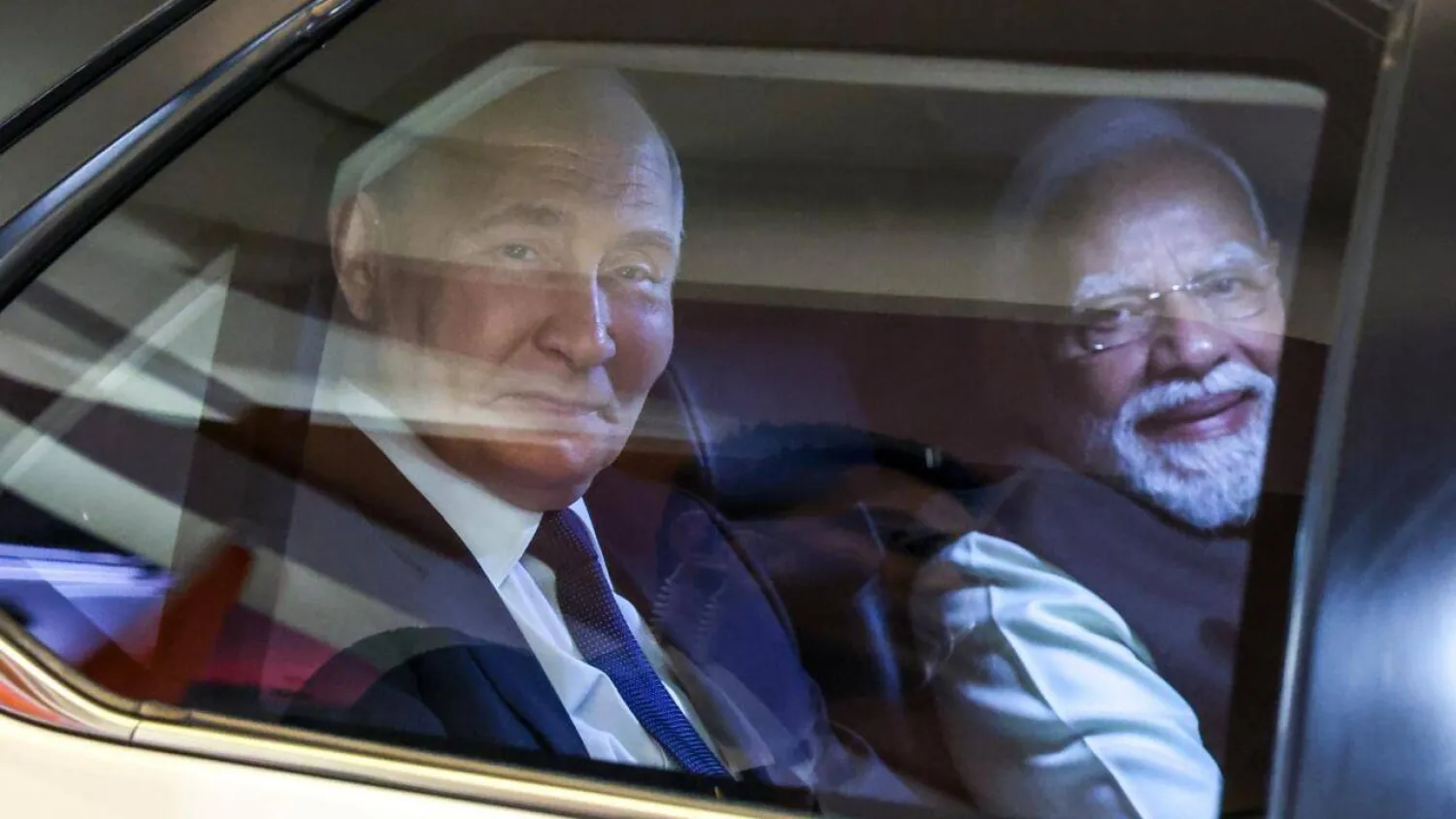

India Rolls Out Red Carpet for Russia's Putin

In this pool photograph distributed by the Russian state agency Sputnik, Russia's President Vladimir Putin and Indian Prime Minister Narendra Modi look out from a car prior to an informal dinner at Modi's residence. Alexander KAZAKOV / POOL/AFP
TT

India Rolls Out Red Carpet for Russia's Putin

In this pool photograph distributed by the Russian state agency Sputnik, Russia's President Vladimir Putin and Indian Prime Minister Narendra Modi look out from a car prior to an informal dinner at Modi's residence. Alexander KAZAKOV / POOL/AFP

India's Prime Minister Narendra Modi hosts Russia's President Vladimir Putin at a summit on Friday, with defense and trade ties taking center stage as New Delhi faces heavy US pressure to stop buying Moscow's oil.

Both leaders will also discuss the geopolitical situation in the wake of the Russian invasion of Ukraine and global trade disruptions triggered by tariffs imposed by US President Donald Trump, said AFP.

Big ticket defense sales and co-production ventures, energy purchases, and wider economic engagement are on the agenda, Putin's first visit to India since the Ukraine war.

Modi welcomed Putin at the airport on Thursday with a warm hug on a red carpet, before the two rode together in the same car to a private dinner -- mirroring a lift that Putin gave Modi when they last met in China in September.

"India-Russia friendship is a time-tested one that has greatly benefitted our people," Modi wrote in a post on social media, accompanying a photograph of them grinning together inside the vehicle.

It was a symbolic show of friendship, after US President Donald Trump imposed 50-percent tariffs on most Indian products in August, citing Delhi's continued purchases of Russian oil -- revenue Washington argues helps fund the war in Ukraine.

In an interview with India Today, Putin said he was "very happy" to be meeting "my friend" Modi.

"The range of our cooperation with India is huge," he said in remarks translated by the broadcaster, citing ship and aircraft manufacturing, nuclear energy and space exploration.

"This visit is part of India's diversification strategy, both in terms of strategic and economic, especially at a time when the US tariffs have hurt India," Ashok Malik of business consultancy The Asia Group told AFP.

On Friday, Putin is due to be given an honor guard welcome at the presidential palace in New Delhi, before meeting with Modi.

'Balancing acts'

India is walking a diplomatic tightrope -- relying on strategic Russian oil imports while trying not to provoke Trump during ongoing tariff negotiations.

"Balancing acts are second nature to Indian foreign policy making", wrote Pankaj Saran, a former Indian envoy to Russia, writing in the Times of India.

The leaders will also address business and industry leaders before Putin attends a state banquet hosted by the Indian President Droupadi Murmu.

India, the world's most populous nation, has become a major buyer of Russian oil, saving itself billions of dollars and providing Moscow with a much-needed export market after it was cut off from traditional buyers in Europe because of the war.

Putin also told India Today that Modi is "not someone who gives in to pressure", when asked about the impact of US tariffs.

The Russian share of India's arms imports fell from 76 percent in 2009-13 to 36 percent in 2019-23, according to the Stockholm International Peace Research Institute.

Besides discussions around cutting-edge defense hardware, which includes air defense systems, fighter jets, and nuclear submarines, New Delhi will push for easier access to the wider Russian market.

Bilateral trade reached $68.7 billion in 2024-25 -- almost six times higher than the pre-pandemic levels -- but Indian exports accounted for only $4.88 billion.

The two countries are expected to announce an agreement on easier mobility of Indian workers into Russia.



Australia PM Says Iran War Objectives Met, 'Not Clear' What More to Achieve

Australian Prime Minister Anthony Albanese warned the months ahead "may not be easy" because of the Middle East war. William WEST / AFP/File
TT

Australia PM Says Iran War Objectives Met, 'Not Clear' What More to Achieve

Australian Prime Minister Anthony Albanese warned the months ahead "may not be easy" because of the Middle East war. William WEST / AFP/File

Australian Prime Minister Anthony Albanese said on Thursday the original aims of the war in Iran had been met and it was not clear what more remained to be achieved.

Albanese called for de-escalation, noting that US-Israeli attacks had degraded Iran's air force, navy and military industrial base, reported AFP.

"Now those objectives have been realized it is not clear what more needs to be achieved or what the end point looks like," he said during a speech in the capital Canberra.

"What is clear is that the longer the war goes on the more significant the impact on the global economy will be."

Australia, reliant on imported fuel and holding roughly 37 days' supply of petrol, has sought to soften the impact of soaring prices by cutting petrol taxes and pledging $680 million in loans to businesses.

Albanese has previously said Australia is not a participant in the war.

Defense Minister Richard Marles said Thursday Canberra was in talks with Britain and France on how it can contribute to opening the Strait of Hormuz, through which one-fifth of the world's oil passes in peacetime.

Iran has effectively closed the vital strait since US-Israeli strikes on February 28 sparked a larger regional conflict, causing global oil and gas prices to soar.

"We have an interest in the Strait of Hormuz being open. It is a function of when conditions allow any of these steps to take place. And those conditions don't exist right now," Marles said in an interview with Sky News Australia.

Marles said Australia will attend a multi-nation meeting convened by Britain.

Albanese's comments Thursday came as US President Donald Trump gave a speech laying out his view of the war, vowing two to three more weeks of "extremely hard" strikes against Iran.

Trump said the United States was aiming to crush Iran's military, end the Iranian republic's support for regional armed groups and prevent it from obtaining a nuclear bomb.

"I'm pleased to say that these core strategic objectives are nearing completion," Trump said in a 19-minute televised speech.


Iran Fires Missiles at Israel after Trump Threatens Weeks of Strikes

US President Donald Trump arrives to speak at a televised address on the conflict in the Middle East from the Cross Hall of the White House in Washington, DC on April 1, 2026. (Photo by Alex Brandon / POOL / AFP)
TT

Iran Fires Missiles at Israel after Trump Threatens Weeks of Strikes

US President Donald Trump arrives to speak at a televised address on the conflict in the Middle East from the Cross Hall of the White House in Washington, DC on April 1, 2026. (Photo by Alex Brandon / POOL / AFP)

Israel said it came under Iranian missile fire on Thursday after US President Donald Trump threatened to bomb the Iranian republic into the "Stone Ages" with heavy strikes in the next two to three weeks.

In a speech from the White House, Trump sought to reassure war-weary Americans that the military campaign that began on February 28 was coming to an end, vowing "extremely hard" strikes against Iran.

"Thanks to the progress we've made, I can say tonight that we are on track to complete all of America's military objectives shortly, very shortly," Trump said.

The war's "core strategic objectives are nearing completion", he said, warning however that "over the next two to three weeks, we are going to bring them back to the Stone Ages, where they belong".

His address came as Britain was set to host a meeting Thursday with about 35 countries on how to reopen the strategic Strait of Hormuz that Iran has effectively blocked without a deal to end the war.

The US-Israeli strikes on Iran that started the war killed senior officials in the Iranian republic's military forces and government, including supreme leader Ali Khamenei, whose son has since replaced him.

Trump, whose approval rating is sinking over the war, indicated that talks may be possible with Iran's new leadership, which he described as "less radical and much more reasonable" than its predecessor.

He warned that if no agreement with Tehran was struck, Washington had "our eyes on key targets including the country's electric generating plants".

Despite Trump's threats, Israel's military said Iran twice fired missiles at the country after his address, part of four barrages detected within six hours on Thursday.

Iran has dismissed Washington's ceasefire overtures, describing US demands to end the conflict as "maximalist and irrational".

"Messages have been received through intermediaries, including Pakistan, but there is no direct negotiation with the US," said Iranian foreign ministry spokesman Esmaeil Baqaei, quoted by the ISNA news agency on Thursday.

Pro-government Iranians in the capital Tehran were also defiant at the funeral of a Revolutionary Guards naval commander who was killed in an Israeli strike.

"This war has lasted a month. However long it takes, we will continue," said Moussa Nowruzi, a 57-year-old pensioner.

"We will resist until the end."

- Gulf protection -

Trump also assured regional allies Israel and Gulf nations that Washington would protect them from Iranian retaliatory fire, as more attacks were reported across the region on Thursday.

He addressed Israel, Saudi Arabia, Qatar, the UAE, Kuwait and Bahrain -- all battered by Iranian drone and missile attacks -- that the United States "will not let them get hurt or fail in any way, shape or form".

As Israel prepared for the Passover holiday, which began at sunset Wednesday, air raid sirens sounded repeatedly in the Tel Aviv area.

On Thursday, the United Arab Emirates said its air defenses were again responding to missile and drone "threats".

The Revolutionary Guards also confirmed hitting an oil tanker in the Gulf they said belonged to Israel. A British maritime security agency said the vessel was struck off Qatar, reporting damage but no casualties.

In Lebanon, militant group Hezbollah said its fighters launched drones and rockets at northern Israel on Thursday, with the Israeli military's Home Front Command saying air raid sirens were activated across the border.

A day earlier, Israel killed a top Hezbollah commander, two sources told AFP, in a Beirut strike that the Lebanese health ministry said killed seven people.

Authorities in Lebanon say Israeli attacks have killed more than 1,300 people in the country since war erupted between Israel and Iran-backed Hezbollah on March 2.

- Hormuz 'courage' -

Hours before Trump's address, Iran's President Masoud Pezeshkian asked the American people whether the conflict was truly putting "America First", accusing Washington of war crimes and of being influenced by Israel.

Trump had claimed earlier Wednesday that Iran's president had sought a ceasefire, but said the Iranian republic must first reopen the Strait of Hormuz -- which he said in his address would happen "naturally" once the conflict ended.

In his speech he called for countries that receive oil through the Strait of Hormuz to show "courage" and seize the key waterway.

On Thursday, the British-led virtual meeting of dozens of nations will "assess all viable diplomatic and political measures that we can take to restore freedom of navigation" in the strait, Prime Minister Keir Starmer said.

But Trump's remarks did little to calm energy markets rocked by the waterway's de facto closure, with oil prices surging Thursday. Brent jumped more than four percent to more than $105, while West Texas Intermediate climbed three percent to hit around $103.

One-fifth of global oil normally passes through the Strait of Hormuz.

Iran's Revolutionary Guards vowed Wednesday to keep it shut to the country's "enemies".

After a wave of anti-government demonstrations that crested in Iran in January over economic grievances, some Iranians still privately long for political change, particularly after Trump himself had promised to come to their aid.

"He betrayed the Iranians," said one woman in her 30s, requesting anonymity for security reasons.

Sounding resigned, she added she no longer expects a change of government, but "if they could grant us more freedoms, we could live with that".


Trump Takes a Dig at Macron, Saying Wife Treats Him 'Badly'

France's President Emmanuel Macron (L) and his wife Brigitte Macron (R) wait for the arrival of Croatia's Prime Minister Andrej Plenkovic and his wife Ana Maslac Plenkovic at the Elysee Palace, in Paris, on December 8, 2025 ahead of a dinner. (Photo by Anne-Christine POUJOULAT / AFP)
TT

Trump Takes a Dig at Macron, Saying Wife Treats Him 'Badly'

France's President Emmanuel Macron (L) and his wife Brigitte Macron (R) wait for the arrival of Croatia's Prime Minister Andrej Plenkovic and his wife Ana Maslac Plenkovic at the Elysee Palace, in Paris, on December 8, 2025 ahead of a dinner. (Photo by Anne-Christine POUJOULAT / AFP)

US President Donald Trump made fun of the French president and his wife during a private lunch Wednesday, as he lambasted NATO allies for not joining the war against Iran that has roiled the Middle East.

"We didn't need them, but I asked anyway," Trump told a private lunch in a video posted briefly on the White House YouTube channel before access was blocked.

"I call up France, Macron -- whose wife treats him extremely badly. Still recovering from the right to the jaw," Trump said.

He was referring to a May 2025 news video that appeared to show Brigitte Macron shoving the French president's face on a trip to Vietnam, which Macron later rejected as part of a disinformation campaign, said AFP.

"And I said, 'Emmanuel, we'd love to have some help in the Gulf even though we're setting records on knocking out bad people and knocking out ballistic missiles. We'd love to have some help. If you could, could you please send ships immediately,'" Trump continued.

He then mimics a French accent to give Macron's alleged answer: "'No no no, we cannot do that, Donald. We can do that after the war is won,'" he said.

"I said, 'No no, I don't need after the war is won Emmanuel,'" Trump said.

"So I learned about NATO -- NATO won't be there if we ever have the big one, you know what I mean by the big one," Trump said, without elaborating.

He also branded NATO a "paper tiger," the latest salvo by Trump and his top officials against the transatlantic alliance since he returned to the White House last year.

On Tuesday, Secretary of State Marco Rubio said the United States "is going to have to reexamine" its relationship with NATO once the war against Iran has concluded.