Iran Holds Massive Drills in Gulf

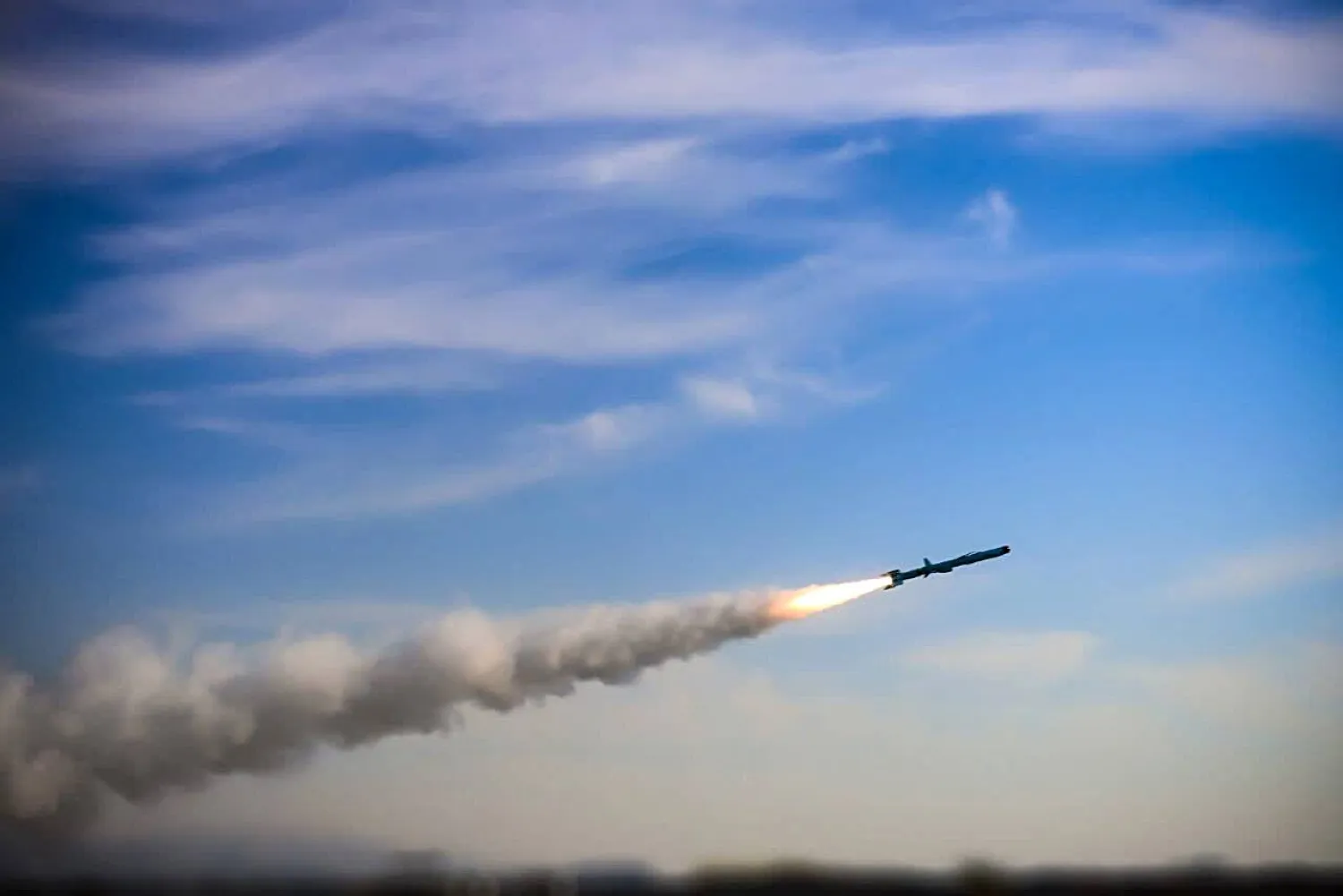
A handout photo made available on 05 December 2025 by the Iranian Revolutionary Guard Corps (IRGC) shows a missile being launched during a military drill in the waters off southern Iran coast. EPA/IRGC HANDOUT
TT

Iran Holds Massive Drills in Gulf

A handout photo made available on 05 December 2025 by the Iranian Revolutionary Guard Corps (IRGC) shows a missile being launched during a military drill in the waters off southern Iran coast. EPA/IRGC HANDOUT

Iran launched massive missiles in the Sea of Oman and near the strategic Strait of Hormuz during the second day of a naval drill, state TV reported Friday.

The report said the Revolutionary Guard launched the missiles from the depth of Iran's mainland, hitting targets in the Oman Sea and neighboring area near Strait of Hormuz in a drill that began on Thursday.

It identified the missiles as cruise Qadr-110, Qadr-380 and Ghadir that have a range of up to 2,000 kilometers. It said the Guard also launched a ballistic missile identified as 303, without elaborating.

The drill is the second one following the Israel-Iran war in June that killed nearly 1,100 people in Iran, including military commanders and nuclear scientists. Missile attacks by Iran killed 28 in Israel.

Earlier, Iran hosted an anti-terrorism drill in its northwestern province of East Azerbaijan with members of the Shanghai Cooperation Organization, which, according to state Press TV, was intended to signal both “peace and friendship” to neighboring states and warn enemies that “any miscalculation would meet a decisive response.”

The SCO, a Eurasian security and economic bloc founded in 2001 to combat terrorism, separatism and extremism, often conducts joint military exercises among its members.

The organization includes China, Russia, India, Pakistan, and several Central Asian countries, with observer and dialogue partners such as Iran, Saudi Arabia and others participating in selected operations.


Japan Marks 15 Years Since Tsunami Disaster as Takaichi Pushes More Nuclear Energy Use

People observe a moment of silence towards the sea at 2:46 p.m. (05:46 GMT), the time when the 9.0-magnitude earthquake struck off Japan's coast in 2011, with the tsunami-crippled Fukushima Daiichi nuclear power plant seen in the background in Namie, Fukushima prefecture, Japan, March 11, 2026, to mark the 15-year anniversary of the 2011 earthquake and tsunami that killed thousands and set off a nuclear crisis. (Kyodo/via Reuters)
TT

Japan Marks 15 Years Since Tsunami Disaster as Takaichi Pushes More Nuclear Energy Use

People observe a moment of silence towards the sea at 2:46 p.m. (05:46 GMT), the time when the 9.0-magnitude earthquake struck off Japan's coast in 2011, with the tsunami-crippled Fukushima Daiichi nuclear power plant seen in the background in Namie, Fukushima prefecture, Japan, March 11, 2026, to mark the 15-year anniversary of the 2011 earthquake and tsunami that killed thousands and set off a nuclear crisis. (Kyodo/via Reuters)

Japan marked the 15th anniversary of the earthquake, tsunami and nuclear disaster on its northeastern coast Wednesday as the government pushes for more use of atomic energy.

The magnitude 9.0 earthquake and tsunami on March 11, 2011, ravaged parts of the region, caused more than 22,000 deaths and forced nearly half a million people to flee their homes, most of them due to tsunami damage.

Some 160,000 people fled their homes in Fukushima because of the radiation spewed from the tsunami-hit Fukushima Daiichi nuclear power plant. About 26,000 of them haven't returned because they resettled elsewhere, their hometowns remain off-limits or they have lingering concerns about radiation.

Japan observed a moment of silence at 2:46 p.m., the moment the quake occurred 15 years earlier.

Prime Minister Sanae Takaichi, at a ceremony in Fukushima, pledged to do the utmost to accelerate the region's recovery within the next five years and reinforce “the valuable lessons we learned from the huge sacrifice of the disaster.”

Takaichi has pushed to accelerate reactor restarts and sought to bolster nuclear power as a stable energy source, in line with the major reversal of policy in 2022 that ended a decade-long nuclear phase-out plan.

Some residents in the tsunami-ravaged areas walked down to the coast early morning to pray for their loved ones and others whose remains are still missing.

More than 1 million homes, offices and schools were damaged or destroyed in the quake and tsunami in Iwate, Miyagi, Fukushima and other coastal areas. Key infrastructure has been rebuilt, but communities and local economies have been slow to recover.

The Fukushima Daiichi plant lost its power and cooling functions, causing meltdowns in three of its six reactors. The three reactors contain at least 880 tons of melted fuel debris, but details of the state inside them are little known due to the still-dangerous radiation levels.

Fuller-scale removal of melted fuel debris has been delayed until 2037 or later. At Unit 1 which just got a new roof, workers will shortly start taking out top-floor debris ahead of the planned spent fuel removal from its cooling pool, which will begin around 2027-2028.

There's also a massive amount of slightly radioactive soil, enough to fill 11 baseball stadiums, from the decontamination efforts across the area.

The government has pledged to move the soil and has sought to use some for road construction and other public works projects but has faced public resistance.


‘No Good Choice’: The Afghans Forced to Return from Iran

 An Afghan national arrives with his belongings at the Islam Qala border crossing between Afghanistan and Iran in Herat province on March 10, 2026, upon his arrival from Iran amid the Middle East war. (AFP)
An Afghan national arrives with his belongings at the Islam Qala border crossing between Afghanistan and Iran in Herat province on March 10, 2026, upon his arrival from Iran amid the Middle East war. (AFP)
TT

‘No Good Choice’: The Afghans Forced to Return from Iran

 An Afghan national arrives with his belongings at the Islam Qala border crossing between Afghanistan and Iran in Herat province on March 10, 2026, upon his arrival from Iran amid the Middle East war. (AFP)
An Afghan national arrives with his belongings at the Islam Qala border crossing between Afghanistan and Iran in Herat province on March 10, 2026, upon his arrival from Iran amid the Middle East war. (AFP)

Exhausted Afghans cross the border from Iran in a sandstorm, leaving behind a country in the grip of war to return to a homeland that is battered by conflict and humanitarian crisis.

At the Islam Qala crossing point in Herat province, western Afghanistan, Talibshah, who did not to give his family name, said he had been working in agriculture northwest of Tehran.

He was cheated by money changers at the border and was trying to figure out how to get back to Sar-e-Pol province in the north, hundreds of kilometers away on difficult, mountainous roads.

Talibshah's work in Qazvin in northern Iran helped support seven people -- his mother, father, brothers and sisters -- at a time when drought had made farming difficult, if not impossible, back home.

"I don't know whether I will be able to find a job or not. We are left without prospects," he told AFP.

"If I don't find a job here, I'll have to emigrate again. We have no choice. We can't starve," he added.

- Funding shortfall -

The United Nations has warned that nearly half of Afghanistan -- 21.9 million people -- will need humanitarian aid this year.

Since February 26, the country has been hit by fresh clashes with neighboring Pakistan to the east, which have killed at least 56 civilians and forced about 115,000 from their homes.

The UN refugee agency's representative in Afghanistan, Arafat Jamal, said there was "no good choice" for those coming back.

"They're fleeing war in Iran and coming to a country that is also itself at war," he said. "In other words, these people are coming into a country that is wracked by drought, that has unemployment, and that now has conflict inside it."

Since the war began in the Middle East on February 28, about 1,700 people have returned every day. But the UNHCR is expecting bigger numbers in the future if there is no let-up in the conflict.

The agency is ready in terms of staff and infrastructure to receive those leaving Iran but funding was lacking for the relief effort, said Jamal.

- '50 times greater' -

At the Islam Qala border post, more people arrived on Tuesday than the previous week, said an AFP correspondent on the ground.

Families crossed quickly, their faces expressionless, with one or two suitcases holding their meager belongings.

Mohammad Kabir Nazari, 48, had been working for the last 11 months as a security guard in Tehran, and was in the country during the 12-day war last June.

He described the latest strikes as "50 times greater".

"Missiles were coming from all sides, every day," he said. "For Afghans, there was no shelter. The situation was very bad."

Nazari, originally from Ghazni province in eastern Afghanistan, said he had been travelling to Iran for the last 32 years.

Then, the markets were busy around the Persian new year, Nowruz, and for the end of Ramadan but were currently empty, he added.

The slowdown in Iran's economy has consequences for the many Afghan migrant workers: one friend of Nazari told him he had been sacked with other Afghans and forced to return.

- 'Waves and waves' -

Naeemullah Rahimi, 24, was also working as a security guard at a factory in the Tehran suburbs. He said he was forced to shelter from air strikes in the basement.

"When we saw that the situation was very bad, we had to come back to Afghanistan," he said.

Jobs are scarce in his home province of Wardak in central Afghanistan.

"I don't know what to do," said Rahimi. "But if I find a job, I'll work."

The UNHCR's Jamal said "waves and waves" of people have been deported to Afghanistan from Iran and Pakistan since September 2023. Last year alone, 2.8 million Afghans returned.

"That was the largest such movement in the world," he added.

"If we start to experience similar numbers this year, will Afghanistan really be able to cope? Perhaps, but it needs international support.

"We cannot afford to let Afghanistan fail," he said, warning that forgetting the region will had an even more destabilizing effect in the world.


Report: Boeing Signs $289 Million Israel Contract for 5,000 Smart Bombs

Members of the US Air Force (USAF) prepare munitions at RAF Fairford in south-west England on March 10, 2026, after USAF B-1 Lancer bomber jets and Air Force Boeing B-52 Stratofortress bombers landed at the RAF base. (AFP)
TT

Report: Boeing Signs $289 Million Israel Contract for 5,000 Smart Bombs

Members of the US Air Force (USAF) prepare munitions at RAF Fairford in south-west England on March 10, 2026, after USAF B-1 Lancer bomber jets and Air Force Boeing B-52 Stratofortress bombers landed at the RAF base. (AFP)

Boeing ‌has signed a new $289 million contract with Israel to deliver as many as 5,000 new air-launched smart bombs, a source told Reuters on Tuesday.

The new contract is not related to the ongoing US-Israeli air strikes on Iran, with deliveries not scheduled to start for 36 months, Bloomberg News reported earlier, citing a person familiar ‌with the matter.

Boeing ‌declined to comment when ‌contacted ⁠by Reuters.

The company's ⁠Small Diameter Bomb is a guided munition that can be launched by Israeli jets at targets more than 40 miles (64 kilometers) away.

Last year, Boeing was awarded an $8.6 billion contract by the Pentagon ⁠to produce and deliver F-15 jets ‌to Israel ‌as part of a foreign military sale between the ‌governments.

The US has long been by ‌far the largest arms supplier to its closest Middle East ally.

Reuters reported last week that President Donald Trump's administration has bypassed US ‌Congress using an emergency authority to expedite the sale of more than ⁠20,000 ⁠bombs to Israel worth around $650 million.

A State Department official had said on Saturday that Israel will purchase an extra $298 million worth of critical munitions via direct commercial sales.

Earlier this year, the US State Department approved more than $6.5 billion in three separate contracts for potential military sales to Israel, which include Boeing's Apache helicopters.