


Lebanon’s Leaders Unite on Technical, Security Track in Talks with Israel

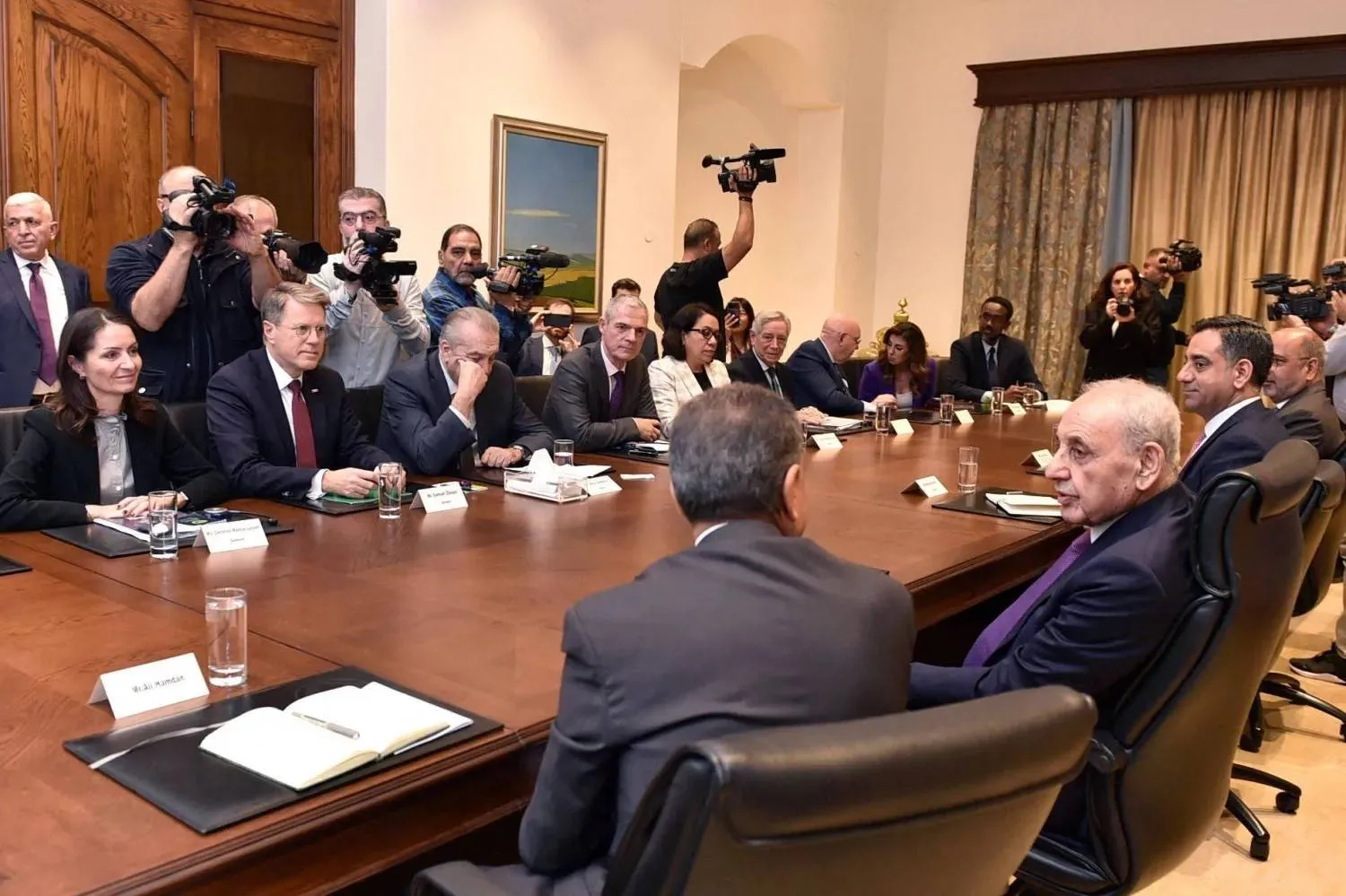
Parliament Speaker Nabih Berri meets with UN Security Council Delegation in Beirut (Lebanese Parliament)
TT

Lebanon’s Leaders Unite on Technical, Security Track in Talks with Israel

Parliament Speaker Nabih Berri meets with UN Security Council Delegation in Beirut (Lebanese Parliament)

Cabinet sources said Lebanon’s three top leaders remain aligned as negotiations with Israel move into a new phase, marked by the appointment of a civilian envoy, former ambassador to Washington and lawyer Simon Karam, to lead Lebanon’s delegation to the Mechanism Committee.

The move is intended to jolt the committee out of months of stagnation and push it toward a security agreement anchored in enforcing a cessation of hostilities, after earlier rounds were dominated by routine tallies of Israeli violations conducted with United Nations peacekeepers.

The sources said the leaders’ agreement to pull the Mechanism out of its deadlock coincided with drawing political boundaries for the talks.

These boundaries are strictly limited to ending Israeli violations and attacks, securing a withdrawal from the south, releasing Lebanese detainees, and revisiting and correcting border demarcation in response to Lebanon’s reservations over disputed points along the Blue Line that it considers part of its sovereign territory.

The sources told Asharq Al-Awsat that Lebanon insists on restricting the negotiations to non-negotiable security issues. It will not allow the talks to drift into discussions on normalizing relations with Israel or striking a peace agreement.

This position is shared by President Joseph Aoun, Prime Minister Nawaf Salam, and Parliament Speaker Nabih Berri, who was the first to propose adding civilians to the Mechanism.

The three leaders reiterated their stance ahead of the first round of talks, attended by US envoy Morgan Ortagus and joined by Karam, in defiance of the agenda set by Israeli Prime Minister Benjamin Netanyahu.

They said Netanyahu is trying to raise the stakes to provoke Hezbollah against the state and sow confusion, even as the Israeli army continues its violations to turn the group’s base against it.

This became evident in the targeting of several homes between the banks of the Litani River, despite containing no weapons depots.

The sources said Netanyahu is escalating militarily to force Lebanon to accept Israeli terms, although he knows the negotiations will not deviate from their technical and security framework.

Lebanon, they said, remains committed to ensuring that only the state holds weapons.

The sources noted Berri’s insistence that he was the first to propose adding civilians to the Mechanism and asked where Hezbollah Secretary-General Sheikh Naim Qassem stands on this proposal.

They asked whether he ever objected to his “older brother’s” suggestion, given that Qassem had declared in an open letter to the three leaders that he rejects negotiations with Israel.

Qassem later walked back parts of that letter by having a senior Hezbollah official convey a message that Berri was not its intended target, in an effort to prevent a rupture within the Shiite political camp.

The sources also questioned why Hezbollah objects to the talks if its “older brother” is the one negotiating on its behalf and was behind the United States mediated ceasefire agreement brokered by Amos Hochstein.

They said the only card Hezbollah has left is raising the ceiling of its objections, since it no longer has the ability to reset the negotiating table at a time when the balance of power has tilted in Israel’s favor, particularly after the group’s unilateral support for Gaza cost it its previous deterrence and rules of engagement.

The sources said Hezbollah lacks alternatives that would allow it to reverse the balance of power and is limiting itself to loud political objections that it cannot translate into military action.

This comes despite its insistence on keeping its weapons and its accusation that the Salam government committed a mistake by agreeing to the principle that arms must be exclusively in the hands of the state, beginning from north of the Litani to Lebanon’s international border with Syria, in parallel with progress in the negotiations.

They said Hezbollah is forced to calibrate its position, since it cannot afford to break with Aoun or jeopardize its alliance with Berri, a rupture that would leave the group exposed at a moment when it seeks internal protection.

Any strain in these relationships would also create negative repercussions for the Shiite community. The sources asked why the group does not place its cards in Berri’s hands, as he is better positioned to navigate Shiite public sentiment that seeks the liberation of the south and the return of its residents to their villages.

Berri is viewed, even by rivals, as the essential gatekeeper to any settlement that could restore international attention to Lebanon and open a path for reconstruction. He enjoys Arab and international ties that Hezbollah lacks, as the group remains reliant solely on Iran.

The sources said the negotiations’ entry into a new phase prompted United States pressure on Israel to prevent the war from expanding, after Lebanon agreed to Washington’s request to add a civilian to the Mechanism and task him with leading the delegation.

They urged Hezbollah to stand behind the state’s diplomatic choice and said the group’s fears that the talks could lead to a peace treaty with Israel are unfounded.

They noted that Berri himself was the first to support bringing civilians into the process, which should reassure Hezbollah and encourage it to give diplomacy a chance.

They added that Salam is not acting unilaterally and is coordinating with Aoun. Both leaders are working together to implement the government’s commitment to ensuring that only the state holds weapons.

They also revealed that communication between Aoun and Berri has not stopped. The two men reviewed the atmosphere surrounding the Mechanism’s meeting in Naqoura before the latest cabinet session.

According to the sources, Berri instructed his parliamentary bloc and senior Amal Movement members not to comment on the negotiations, positively or negatively.

The directive came because he wants to centralize the political message and avoid dragging party members on both sides into disputes that could spill into the streets.

Hezbollah, they said, also wants to protect its relationship with its sole remaining ally in Lebanon after its former partners in the so-called Axis of Resistance endorsed the principle of exclusive state authority over weapons.

The sources said Hezbollah knows that avenues for repairing its Arab and international relations remain closed, unlike Berri who maintains wide ties.

They questioned what Hezbollah is counting on after its leadership rejected Egypt’s initiative, insisting, according to Western diplomatic sources cited by Asharq Al-Awsat, on linking its position to US-Iran negotiations in hopes of safeguarding Iran’s leverage in Lebanon after regional setbacks for the Axis.

They said the government will take note of Hezbollah’s objection, although it will have no impact on the course of the talks.

Hezbollah will not mobilize its supporters in the streets to avoid friction with Amal, particularly since Berri does not oppose the launch of negotiations, which remain tied to liberating the south and implementing Resolution 1701.

Any attempt by Hezbollah to outbid Berri for populist gain would backfire and weaken the group’s standing within its own community.



Türkiye Calls Israel’s Recognition of Somaliland ‘Illegitimate’

This handout photograph taken and released by the Turkish presidential press service on December 30, 2025, shows Türkiye’s President Recep Tayyip Erdogan (R) and Somalia's President Hassan Sheikh Mohamud (L) shaking hands before their meeting in Istanbul. (Photo by Handout / Turkish Presidential Press Service / AFP)
TT

Türkiye Calls Israel’s Recognition of Somaliland ‘Illegitimate’

This handout photograph taken and released by the Turkish presidential press service on December 30, 2025, shows Türkiye’s President Recep Tayyip Erdogan (R) and Somalia's President Hassan Sheikh Mohamud (L) shaking hands before their meeting in Istanbul. (Photo by Handout / Turkish Presidential Press Service / AFP)

Türkiye’s president on Tuesday called Israel's recognition of Somaliland "illegitimate and unacceptable" as he hosted a visit by his Somali counterpart.

"Preserving the unity and integrity of Somalia in all circumstances holds special importance in our view. Israel's decision to recognize Somaliland is illegitimate and unacceptable," Turkish leader Recep Tayyip Erdogan said in a press conference alongside Somali President Hassan Sheikh Mohamud.

Israel sparked criticism last Friday when it said it was officially recognizing Somaliland -- a breakaway territory in Somalia's north.

The declaration was a first for the territory, which in 1991 had unilaterally declared secession from Somalia.

Israel's move has drawn widespread criticism from the African Union, Egypt and the European Union, which insist on war-torn Somalia's sovereignty.

Türkiye has frequently clashed with Israel over a range of issues, especially over the conflict in Gaza and Israeli obstruction of aid to the Palestinian territory.

Mohamud said Israeli Prime Minister Benjamin Netanyahu's "aggressive position, which also includes Somalia, is unacceptable".

He called Netanyahu's Somaliland declaration "a violation of international law" and "the start of insecurity and instability, especially for Somalia and the African region".


10 Countries Warn of ‘Catastrophic’ Gaza Situation

 Palestinians stand next to a tent set up on the rubble of buildings destroyed during Israeli air and ground operations in the Sheikh Radwan neighborhood, in Gaza City, Tuesday, Dec. 30, 2025. (AP)
Palestinians stand next to a tent set up on the rubble of buildings destroyed during Israeli air and ground operations in the Sheikh Radwan neighborhood, in Gaza City, Tuesday, Dec. 30, 2025. (AP)
TT

10 Countries Warn of ‘Catastrophic’ Gaza Situation

 Palestinians stand next to a tent set up on the rubble of buildings destroyed during Israeli air and ground operations in the Sheikh Radwan neighborhood, in Gaza City, Tuesday, Dec. 30, 2025. (AP)
Palestinians stand next to a tent set up on the rubble of buildings destroyed during Israeli air and ground operations in the Sheikh Radwan neighborhood, in Gaza City, Tuesday, Dec. 30, 2025. (AP)

The foreign ministers of 10 nations on Tuesday expressed "serious concerns" about a "renewed deterioration of the humanitarian situation" in Gaza, saying the situation was "catastrophic". 

"As winter draws in, civilians in Gaza are facing appalling conditions with heavy rainfall and temperatures dropping," the ministers of Britain, Canada, Denmark, Finland, France, Iceland, Japan, Norway, Sweden and Switzerland said in a joint statement released by the UK's Foreign Office. 

"1.3 million people still require urgent shelter support. More than half of health facilities are only partially functional and face shortages of essential medical equipment and supplies. The total collapse of sanitation infrastructure has left 740,000 people vulnerable to toxic flooding," the statement added. 

The ministers said they welcomed the progress that had been made to end the bloodshed in Gaza and secure the release of Israeli hostages. 

"However, we will not lose focus on the plight of civilians in Gaza," they said, calling on the government of Israel to take a string of "urgent and essential" steps. 

These included ensuring that international NGOs could operate in Gaza in a "sustained and predictable" way. 

"As 31 December approaches, many established international NGO partners are at risk of being de-registered because of the government of Israel's restrictive new requirements," the statement said. 

It also called for the UN and its partners to be able to continue their work in Gaza and for the lifting of "unreasonable restricts on imports considered to have a dual use". 

This included medical and shelter equipment. 

The foreign ministers also called for the opening of crossings to boost the flows of humanitarian aid into Gaza. 

While welcoming the partial opening of the Allenby crossing, they said other corridors for moving goods remained closed or severely restricted for humanitarian aid, including Rafah. 

"Bureaucratic customs processes and extensive screenings are causing delays, while commercial cargo is being allowed in more freely," the statement said. 

"The target of 4,200 trucks per week, including an allocation of 250 UN trucks per day, should be a floor not a ceiling. These targets should be lifted so we can be sure the vital supplies are getting in at the vast scale needed," it added. 


UN Condemns Israel's Moves against Agency for Palestinian Refugees

UNRWA center targeted by Israeli shelling in northern Gaza (DPA)
TT

UN Condemns Israel's Moves against Agency for Palestinian Refugees

UNRWA center targeted by Israeli shelling in northern Gaza (DPA)

The United Nations warned Tuesday that recent actions by Israel against the UN agency for Palestinian refugees risked depriving millions of people of basic services such as education and healthcare.

Israel's parliament passed new legislation on Monday formally stripping the United Nations Relief and Works Agency (UNRWA) of diplomatic immunity, and barring Israeli companies from providing water or electricity to the agency's institutions, AFP reported.

According to UNRWA, the legislation also grants the Israeli government the authority to expropriate the agency's properties in East Jerusalem, including its headquarters and main vocational training center.

UNRWA chief Philippe Lazzarini condemned the legislation as "outrageous", decrying it on social media as "part of an ongoing, systematic campaign to discredit UNRWA and thereby obstruct the core role that the agency plays providing human-development assistance and services to Palestine refugees".

Filippo Grandi, the outgoing head of the UN refugee agency, UNHCR, and a former UNRWA chief, also criticised the move as "very unfortunate".

In an interview with AFP, he highlighted that UNRWA, unlike other UN agencies, provides basic public services such as education and healthcare to the millions of registered Palestinian refugees it serves across Gaza and the West Bank, as well as in Lebanon, Jordan and Syria.

"If you deprive those people of those services... then you had better find a substitute," he said, warning: "I think it would be very difficult."

"At the moment, there is a great risk that millions of people will be deprived of basic services if UNRWA is further deprived of space to work, and resources to work."

Israel has been ratcheting up pressure on UNRWA over the past two years.

It has accused the agency of providing cover for Hamas militants, claiming that some UNRWA employees took part in the militant group's October 7, 2023 assault on Israel, which sparked the war in Gaza.

A series of UN-linked internal and external investigations found some "neutrality-related issues" at UNRWA, but stressed Israel had not provided conclusive evidence for its headline allegation.

Grandi criticised the torrent of accusations that have swirled around the agency.

"UNRWA is a very indispensable organization in the Middle East," he said.

"Contrary to much of the frankly baseless rhetoric that we have heard in the past couple of years, UNRWA is a force for peace and stability," he added.

"In a region in which you need every bit of stability and efforts towards peace, it would be really irresponsible to let such an important organization decline further."