


Iran’s Revolutionary Guards Media Accuse Rouhani of ‘Serving Israel’

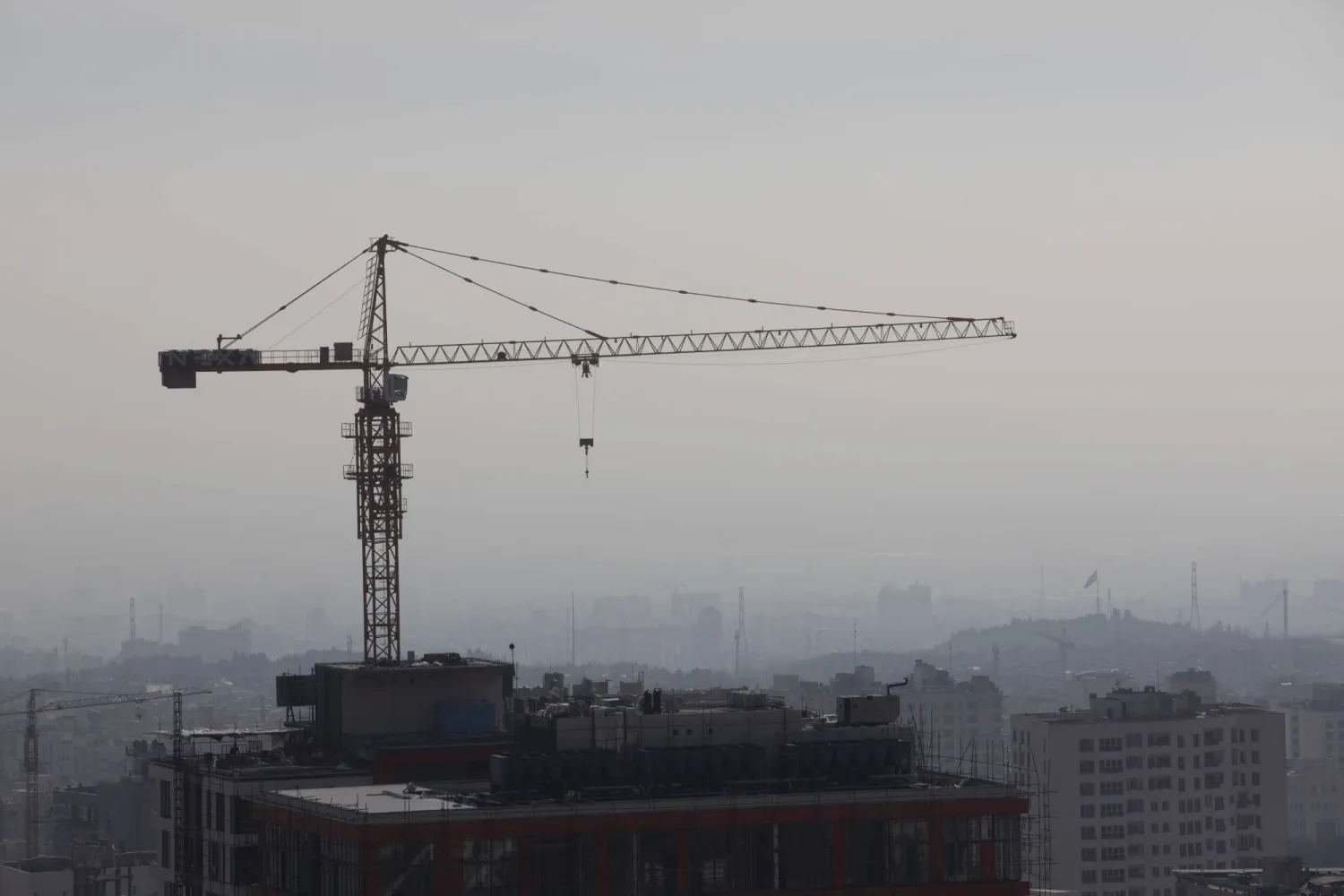
03 December 2025, Iran, Teheran: View of the smog-ridden metropolis of Tehran. Photo: Aref Taherkenareh/dpa
TT

Iran’s Revolutionary Guards Media Accuse Rouhani of ‘Serving Israel’

03 December 2025, Iran, Teheran: View of the smog-ridden metropolis of Tehran. Photo: Aref Taherkenareh/dpa

Media outlets aligned with Iran’s Revolutionary Guards have accused former president Hassan Rouhani and his associates of “doing Israel a service,” escalating a political backlash triggered by Rouhani’s recent criticism of Iran’s ability to defend its airspace if last June’s 12-day war with Israel were to resume.

Tasnim, the Guards’ main media arm, protested sharply against Rouhani’s latest speech and the recommendations he offered to prevent a repeat of the conflict.

The media attack coincided with rising political tensions inside Iran as Rouhani’s name resurfaced in the debate over who might succeed Supreme Leader Ali Khamenei, a succession file that has deepened domestic polarization.

Tasnim opened its weekly analytical supplement with the headline “Working for Israel,” placing Rouhani’s photograph on the cover. It accused him of offering “narcissistic, arrogance-filled interpretations” about his claims that he prevented a war on Iran through diplomacy during his past government roles.

The agency questioned whether Rouhani was suggesting that Iran had no deterrent other than his negotiations, and whether the United States and Israel were at full strength at the time while Iran lacked defensive capability.

It further asked why Rouhani’s diplomacy failed to prevent the US withdrawal from the nuclear agreement under Donald Trump or avert the assassinations of General Qassem Soleimani and Mohsen Fakhrizadeh, the senior nuclear official killed in late 2020 in an attack attributed to Israel.

Rouhani last week criticized the country’s tightened security climate, saying Iran needed “an atmosphere of safety, not an atmosphere of securitization.”

He warned that Iran could not remain in a state of “no war and no peace,” citing Khamenei’s own remarks, and urged efforts to rebuild deterrence across multiple fields to confront what he called “the conspiracies of enemies.”

He argued that Iran today lacks “broad regional deterrence,” noting that the airspace of neighboring countries, including Iraq, Syria, Lebanon and Jordan, had fallen under US and Israeli influence, making hostile aerial movement near Iran “safe and free of obstacles.”

Rouhani insisted continuation of the nuclear deal would have prevented the 12-day conflict, calling the nuclear file a pretext for the attacks and blaming subsequent governments for failing to revive the accord.

Tasnim said Rouhani’s positions “practically serve Israel” because they place responsibility on internal actors while removing Israel from the circle of blame. It portrayed his comments as a political act against “sacred unity,” adding that presenting such views “even within a realistic and careful framework” ultimately benefits Israel.

Tasnim also revived long-standing criticism that Rouhani’s government did not sufficiently support Iran’s intervention in Syria in 2013 and 2014, arguing that such reluctance approached “the level of treason.” It claimed one of General Soleimani’s biggest grievances was the administration’s lack of cooperation on the Syrian front.

Responding to Rouhani’s remarks on “securitization,” Tasnim said his own administration had been among the most security-dominated of the Islamic Republic era. The agency pointed to Rouhani’s intelligence background and argued that his current counsel contradicted his record in office.

Rouhani’s comments were also interpreted as an indirect response to Khamenei’s November 27 televised speech, in which the Supreme Leader warned against internal division, repeated his narrative that the US and Israel had “failed” to achieve their war aims and urged Iranians to maintain “national alignment.”

The renewed criticism comes as Rouhani has faced months of attacks from rivals, including parliamentarians, who accuse him of positioning himself to assume the role of Supreme Leader should Khamenei become unable to carry out his duties, including in the event of an Israeli assassination attempt.

Last month, parliament speaker Mohammad Bagher Ghalibaf accused Rouhani and former foreign minister Mohammad Javad Zarif of damaging Iran’s strategic ties with Russia.

Hardline lawmakers revived the chant “Death to Fereydoun,” using Rouhani’s birth family name. One conservative MP said the judiciary should address Rouhani’s “misconduct” so that anyone aspiring to senior posts would “return to his rightful place behind bars.”

After Rouhani’s latest remarks circulated, discussion of his possible leadership prospects reemerged, this time in reformist media.

Reformist theorist Sadegh Zibakalam said Rouhani believes he lacks nothing compared to other succession candidates, including Mojtaba Khamenei, arguing that Rouhani’s executive experience makes him “more qualified than others.”

At the same time, businessman Babak Zanjani, who was sentenced to death for corruption during Rouhani’s presidency but released last year, made a harsh post on X rejecting any future political role for Rouhani.

Iran, he wrote, needed a “young, educated and effective” force, “not holders of fake degrees,” warning that “we will cleanse Iran of incompetence.”



Nigeria's President to Make a Sate Visit to the UK in March

Nigeria’s President Bola Tinubu gives a joint statement with Brazil’s President Luiz Inacio Lula da Silva, at the Planalto presidential palace, in Brasilia, Brazil, Aug. 25, 2025. (AP Photo/Eraldo Peres, File)
TT

Nigeria's President to Make a Sate Visit to the UK in March

Nigeria’s President Bola Tinubu gives a joint statement with Brazil’s President Luiz Inacio Lula da Silva, at the Planalto presidential palace, in Brasilia, Brazil, Aug. 25, 2025. (AP Photo/Eraldo Peres, File)

Nigeria’s president is set to make a state visit to the UK in March, the first such trip by a Nigerian leader in almost four decades, Britain’s Buckingham Palace said Sunday.

Officials said President Bola Tinubu and first lady Oluremi Tinubu will travel to the UK on March 18 and 19, The AP news reported.

King Charles III and Queen Camilla will host them at Windsor Castle. Full details of the visit are expected at a later date.

Charles visited Nigeria, a Commonwealth country, four times from 1990 to 2018 before he became king. He previously received Tinubu at Buckingham Palace in September 2024.m

Previous state visits by a Nigerian leader took place in 1973, 1981 and 1989.

A state visit usually starts with an official reception hosted by the king and includes a carriage procession and a state banquet.

Last year Charles hosted state visits for world leaders including US President Donald Trump, French President Emmanuel Macron and German President Frank-Walter Steinmeier.


Iran Strikes Hard Line on US Talks, Saying Tehran's Power Comes From Saying 'No'

Traffic moves through a street in Tehran on February 7, 2026. (Photo by ATTA KENARE / AFP)
TT

Iran Strikes Hard Line on US Talks, Saying Tehran's Power Comes From Saying 'No'

Traffic moves through a street in Tehran on February 7, 2026. (Photo by ATTA KENARE / AFP)

Iran's top diplomat insisted Sunday that Tehran's strength came from its ability to “say no to the great powers," striking a maximalist position just after negotiations with the United States over its nuclear program and in the wake of nationwide protests.

Foreign Minister Abbas Araghchi, speaking to diplomats at a summit in Tehran, signaled that Iran would stick to its position that it must be able to enrich uranium — a major point of contention with President Donald Trump, who bombed Iranian atomic sites in June during the 12-day Iran-Israel war.

Iran will never surrender the right to enrich uranium, even if war "is imposed on us,” he noted.

"Iran has paid a very heavy price for its peaceful nuclear program and for uranium enrichment." 

Israeli Prime Minister Benjamin Netanyahu is expected to travel to Washington this week, with Iran expected to be the major subject of discussion, his office said.

While Iranian President Masoud Pezeshkian praised the talks Friday in Oman with the Americans as “a step forward,” Araghchi's remarks show the challenge ahead. Already, the US moved the aircraft carrier USS Abraham Lincoln, ships and warplanes to the Middle East to pressure Iran into an agreement and have the firepower necessary to strike the Islamic Republic should Trump choose to do so, according to The AP news.

“I believe the secret of the Islamic Republic of Iran’s power lies in its ability to stand against bullying, domination and pressures from others," Araghchi said.

"They fear our atomic bomb, while we are not pursuing an atomic bomb. Our atomic bomb is the power to say no to the great powers. The secret of the Islamic Republic’s power is in the power to say no to the powers.”

‘Atomic bomb’ as rhetorical device Araghchi's choice to explicitly use an “atomic bomb” as a rhetorical device likely wasn't accidental. While Iran has long maintained its nuclear program is peaceful, the West and the International Atomic Energy Agency say Tehran had an organized military program to seek the bomb up until 2003.

Iran had been enriching uranium up to 60% purity, a short, technical step to weapons-grade levels of 90%, the only non-weapons state to do so. Iranian officials in recent years had also been increasingly threatening that Tehran could seek the bomb, even while its diplomats have pointed to Iranian Supreme Leader Ali Khamenei’s preachings as a binding fatwa, or religious edict, that Iran wouldn’t build one.

Pezeshkian, who ordered Araghchi to pursue talks with the Americans after likely getting Khamenei's blessing, also wrote on X on Sunday about the talks.

“The Iran-US talks, held through the follow-up efforts of friendly governments in the region, were a step forward,” the president wrote. “Dialogue has always been our strategy for peaceful resolution. ... The Iranian nation has always responded to respect with respect, but it does not tolerate the language of force.”

It remains unclear when and where, or if, there will be a second round of talks. Trump, after the talks Friday, offered few details but said: “Iran looks like they want to make a deal very badly — as they should.”

Aircraft carrier in the Arabian Sea During Friday's talks, US Navy Adm. Brad Cooper, the head of the American military's Central Command, was in Oman. Cooper's presence was apparently an intentional reminder to Iran about US military power in the region. Cooper later accompanied US special envoy Steve Witkoff and Jared Kushner, Trump's son-in-law, to the Lincoln out in the Arabian Sea after the indirect negotiations.

Araghchi appeared to be taking the threat of an American military strike seriously, as many worried Iranians have in recent weeks. He noted that after multiple rounds of talks last year, the US “attacked us in the midst of negotiations."

“If you take a step back (in negotiations), it is not clear up to where it will go,” Araghchi said.


Russia: Man Suspected of Shooting Top General Detained in Dubai

An investigator works outside a residential building where the assassination attempt on Russian Lieutenant General Vladimir Alexeyev took place in Moscow, Russia February 6, 2026. REUTERS/Anastasia Barashkova
TT

Russia: Man Suspected of Shooting Top General Detained in Dubai

An investigator works outside a residential building where the assassination attempt on Russian Lieutenant General Vladimir Alexeyev took place in Moscow, Russia February 6, 2026. REUTERS/Anastasia Barashkova

Russia's Federal Security Service (FSB) said on Sunday that the man suspected of shooting top Russian military intelligence officer Vladimir Alexeyev in Moscow has been detained in Dubai and handed over to Russia.

Lieutenant General Vladimir Alexeyev, deputy head of the GRU, ⁠Russia's military intelligence arm, was shot several times in an apartment block in Moscow on Friday, investigators said. He underwent surgery after the shooting, Russian media ⁠said.

The FSB said a Russian citizen named Lyubomir Korba was detained in Dubai on suspicion of carrying out the shooting.

Russian Foreign Minister Sergei Lavrov accused Ukraine of being behind the assassination attempt, which he said was designed to sabotage peace talks. ⁠Ukraine said it had nothing to do with the shooting.

Alexeyev's boss, Admiral Igor Kostyukov, the head of the GRU, has been leading Russia's delegation in negotiations with Ukraine in Abu Dhabi on security-related aspects of a potential peace deal.