
Hamas Official Says the Group Ready to Discuss ‘Freezing or Storing’ Its Weapons

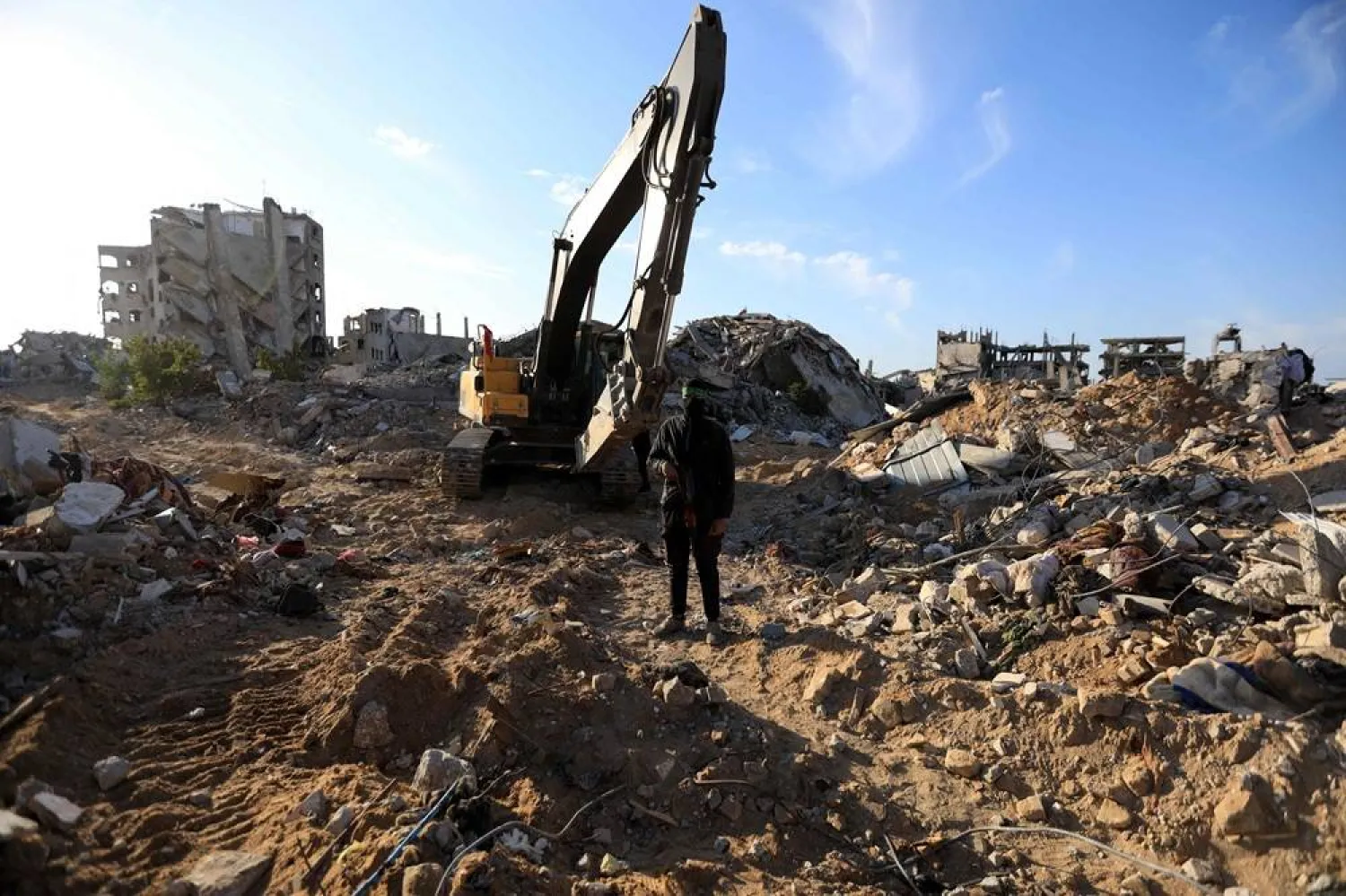
A Palestinian gunman stands guard as Hamas and Islamic Jihad fighters transport a white body bag believed to carry the remains of an Israeli hostage in the town of Beit Lahia in the northern Gaza Strip on December 3, 2025. (AFP)
TT

Hamas Official Says the Group Ready to Discuss ‘Freezing or Storing’ Its Weapons

A Palestinian gunman stands guard as Hamas and Islamic Jihad fighters transport a white body bag believed to carry the remains of an Israeli hostage in the town of Beit Lahia in the northern Gaza Strip on December 3, 2025. (AFP)

Hamas is ready to discuss “freezing or storing” its arsenal of weapons as part of its ceasefire with Israel, a senior official said Sunday, offering a possible formula to resolve one of the thorniest issues in the US-brokered agreement. 

Bassem Naim, a member of Hamas’ decision-making political bureau, spoke as the sides prepare to move into the second and more complicated phase of the agreement. 

“We are open to have a comprehensive approach in order to avoid further escalations or in order to avoid any further clashes or explosions,” Naim told The Associated Press in Qatar’s capital, Doha, where much of the group’s leadership is located. 

The deal halted a two-year Israeli offensive in Gaza, launched in response to Hamas’ Oct. 7, 2023, attack. Asked whether the attack was a mistake, Naim defended it as an “act of defense.” 

More difficult phase  

Since the truce took effect in October, Hamas and Israel have carried out a series of exchanges of Israeli hostages for Palestinian prisoners. With only the remains of one hostage still held in Gaza -- an Israeli policeman killed in the Oct. 7 attack -- the sides are preparing to enter the second phase. 

The new phase aims to lay out a future for war-battered Gaza and promises to be even more difficult –- addressing such issues as the deployment of an international security force, formation of a technocratic Palestinian committee in Gaza, the withdrawal of Israeli troops from the territory and the disarmament of Hamas. An international board, led by President Donald Trump, is to oversee implementation of the deal and reconstruction of Gaza. 

The Israeli demand for Hamas to lay down its weapons promises to be especially tricky -– with Israeli officials saying this is a key demand that could hold up progress in other areas. Hamas’ ideology is deeply rooted in what it calls armed resistance against Israel, and its leaders have rejected calls to surrender despite over two years of war that left large parts of Gaza destroyed and killed tens of thousands of Palestinians. 

Naim said Hamas retains its “right to resist,” but said the group is ready to lay down its arms as part of a process aimed at leading to the establishment of a Palestinian state. He gave few details on how this might work but suggested a long-term truce of five or 10 years for discussions to take place. 

“This time has to be used seriously and in a comprehensive way,” he said, adding that Hamas is “very open minded” about what to do with its weapons. 

“We can talk about freezing or storing or laying down, with the Palestinian guarantees, not to use it at all during this ceasefire time or truce,” he said. 

It is not clear whether the offer would meet Israel's demands for full disarmament. 

Many questions remain 

The ceasefire is based on a 20-point plan presented by Trump, with international “guarantor” nations, in October. 

The plan, adopted by the UN Security Council, offered a general way forward. But it was vague on details or timelines and will require painstaking negotiations involving the US and the guarantors, which include Qatar, Egypt and Türkiye. 

“The plan is in need of a lot of clarifications,” Naim said. 

One of the most immediate concerns is deployment of the international stabilization force. 

Several countries, including Indonesia, have expressed a willingness to contribute troops to the force, but its exact makeup, command structure and responsibilities have not been defined. US officials say they expect “boots on the ground” early next year. 

One key question is whether the force will take on the issue of disarmament. 

Naim said this would be unacceptable to Hamas, and the group expects the force to monitor the agreement. 

“We are welcoming a UN force to be near the borders, supervising the ceasefire agreement, reporting about violations, preventing any kind of escalations,” he said. “But we don’t accept that these forces have any kind of mandates authorizing them to do or to be implemented inside the Palestinian territories.” 

In one sign of progress, Naim said Hamas and the rival Palestinian Authority have made progress on the formation of the new technocratic committee set to run Gaza’s daily affairs. He said they have agreed upon a Palestinian Cabinet minister who lives in the West Bank, but is originally from Gaza, to head the committee. He did not give the name, but Hamas officials, speaking on condition of anonymity to discuss the negotiations, have identified him as Health Minister Majed Abu Ramadan. 

First phase complications  

Both Israel and Hamas have accused each other of repeated violations of the deal during the first phase. 

Israel has accused Hamas of dragging out the hostage returns, while Palestinian health officials say over 370 Palestinians have been killed in continued Israeli strikes since the ceasefire took effect. 

Israel says its strikes have been in response to Palestinian violations, including the movement of Palestinians into the Israeli-held half of Gaza. Three soldiers have been killed in clashes with about 200 Hamas fighters that Israeli and Egyptian officials say remain holed up underground in Israeli-held territory. 

Naim said Hamas was “not aware” of these gunmen when the ceasefire was signed, and that communications with them were “totally cut.” 

“Therefore, they are not aware about what’s going on now on the ground,” he said. 

He claimed that Israel has rejected Hamas offers to resolve the standoff and added numerous “conditions” to their surrender. Israel has not acknowledged the negotiations and says it has killed several dozens of them. 

Naim said Hamas is committed to “fulfilling its obligations” and claimed that Israel has fallen short of key pledges, including not flooding Gaza with humanitarian supplies and failing to reopen the Rafah border crossing with Egypt. 

Most of the supplies entering Gaza, he said, are goods for private merchants to sell to the few people in Gaza with money, leaving masses of poor people struggling without food or shelter. 

Last week, Israel said it was ready to reopen Rafah -– Gaza’s main gateway to the outside world -– but only for people to leave the strip. Egypt and the Palestinians fear this is a plot to expel Gaza’s Palestinians and say Israel is obligated to open the crossing in both directions. 

The Oct. 7 attack killed over 1,200 people and took over 250 others hostage. It is the deadliest attack in Israel’s history and remains a source of great national trauma. 

Israel’s retaliatory offensive has killed over 70,000 Palestinians, according to local health officials, displaced nearly all of Gaza’s 2 million people and caused widespread damage that will take years to rebuild. It remains unclear who will pay for the reconstruction or when it will begin. 

The Palestinian Health Ministry, part of Gaza’s Hamas government, does not distinguish between civilians and fighters, but says that roughly half of the dead were women and children. 

Naim acknowledged the Palestinians have paid a heavy price for Oct. 7 but when asked if the group regrets carrying out the attack, he insisted it came in response to years of Israeli policies going back to the war surrounding Israel’s establishment in 1948. 

“History didn’t start on Oct. 7,” he said. “Oct. 7 for us, it was an act of defense. We have done our duty to raise … the voice of our people.” 


EU Warns Israel Suspending Gaza NGOs Would Block 'Life-Saving Aid'

Palestinians walk along streets past tent camps for displaced people in Gaza City, Wednesday, Dec. 31, 2025. (AP)
TT

EU Warns Israel Suspending Gaza NGOs Would Block 'Life-Saving Aid'

Palestinians walk along streets past tent camps for displaced people in Gaza City, Wednesday, Dec. 31, 2025. (AP)

The EU warned Wednesday that Israel's threat to suspend several aid groups in Gaza under new registration rules would block "life-saving" assistance from reaching the population.

"The EU has been clear: the NGO registration law can not be implemented in its current form," EU humanitarian chief Hadja Lahbib posted on X, after Israel said several groups would be barred from January 1 for failing to comply with rules concerning the listing of their Palestinian employees.

"IHL (international humanitarian law) leaves no room for doubt: aid must reach those in need," Lahbib wrote.


Hadhramaut Governor to Asharq Al-Awsat: UAE Has Started Withdrawing its Forces, Door Still Open to STC

Hadhramaut Governor Salem Ahmed al-Khanbashi. (Asharq Al-Awsat)
TT

Hadhramaut Governor to Asharq Al-Awsat: UAE Has Started Withdrawing its Forces, Door Still Open to STC

Hadhramaut Governor Salem Ahmed al-Khanbashi. (Asharq Al-Awsat)

Hadhramaut Governor Salem Ahmed al-Khanbashi called on Wednesday inhabitants of the governorate who are involved with the Southern Transitional Council to "return home" and join their "brothers in the National Shield Forces".

In remarks to Asharq Al-Awsat, he pledged that they will be welcomed in the ranks and that their "affairs will be arranged."

He also confirmed that the United Arab Emirates has started withdrawing its forces from all positions they were stationed at, including Hadhramaut and al-Shabwah.

He said they pulled out from the al-Rayan airport and Balhaf in Shabwah.

The forces had a limited presence in the al-Rabwa and al-Dabba areas in Hadhramaut . Their role was limited to supervising the STC's security support forces, he explained.

Sources confirmed that the UAE started pulling out its forces from Shabwah on Tuesday at the request of Presidential Leadership Council (PLC) Chairman Dr. Rashad al-Alimi.

Al-Khanbashi stressed that the only way to resolve the current crisis lies in the withdrawal of the STC from Hadhramaut and Mahra.

"The door is still open and we hope our brothers in the STC will seize the opportunity to avert the eruption of any fighting in Hadhramaut and the rest of the country," he added.

"They should return to where they came from and then we can kick of political dialogue about any future formations without resorting to imposing a status quo by force," he stressed.

Moreover, he underlined the readiness of the National Shield Forces, which are overseen by al-Alimi, to deploy in Hadhramaut and Mahra, in line with the state of emergency that he declared on Tuesday.

An additional 3,000 Hadhramaut residents, who have military experience, are also prepared to support their brothers in the National Shield Forces, al-Khanbashi revealed.

He said that coordination with Saudi Arabia was at its highest levels.

The Kingdom views Hadhramaut and Mahra as part of its "strategic security depth," he went on to say. "Our shared borders stretch over 700 kms, so the security and stability of the two provinces are part of the Kingdom's strategic security."

Saudi Arabia does not want Hadhramaut and Mahra to turn into dangerous hubs that can threaten it, he continued.

Al-Khanbashi added that al-Alimi's orders on Tuesday came at the right time to prevent saboteurs from trying to undermine the situation.


Nearly 25 ISIS Fighters Killed or Captured in Syria, US Military Says

A US military patrol is seen in northeastern Syria. (Reuters file)
TT

Nearly 25 ISIS Fighters Killed or Captured in Syria, US Military Says

A US military patrol is seen in northeastern Syria. (Reuters file)

The US military said Tuesday that nearly 25 operatives of the ISIS group were killed or captured in Syria this month following an ambush that killed two US troops and an American civilian interpreter.

The US Central Command, which oversees the Middle East, said in a statement on X that 11 missions were carried out over the past 10 days and followed initial strikes against ISIS weapons sites and infrastructure on Dec. 19, which hit 70 targets across central Syria.

In the operations since, the US military and other forces from the region, including Syria, killed at least seven ISIS members, captured others and eliminated four weapons caches, US Central Command said.

“We will not relent,” Adm. Brad Cooper, who leads the command, said in the statement. “We are steadfast in commitment to working with regional partners to root out the ISIS threat posed to US and regional security.”

Targets ranged from senior ISIS members who were being closely monitored by military officials to lower-level foot soldiers, according to a US official who spoke on the condition of anonymity to discuss sensitive military operations.

The official said a growing collaboration between the United States and Syria's relatively new government meant that US forces were able to attack ISIS in areas of the country where they previously did not operate. Syrian forces were the driving force behind some of the missions against the militant group this year, the official added.

The official compared the growing cooperation to that between the US and Iraq in fighting ISIS a decade ago and said the goal, like in Iraq, is to ultimately hand over the effort fully to the Syrians.

The latest operations followed a Dec. 13 ambush that occurred near the ancient city of Palmyra while American and Syrian security officials had gathered for a meeting over lunch. Two members of the Iowa National Guard and a civilian interpreter from Michigan were killed, while three other US troops and members of Syria’s security forces were wounded.

The gunman, who was killed, had joined Syria’s internal security forces as a base security guard and recently had been reassigned because of suspicions he might be affiliated with ISIS, Syrian officials said.

The initial retaliatory strike on ISIS targets in Syria, which included fighter jets from Jordan, was a major test for the warming ties between the US and Syria since last year's ouster of autocratic leader Bashar al-Assad.

President Donald Trump said Syria's new president, Ahmed al-Sharaa, was “extremely angry and disturbed by this attack."