


Israel’s Netanyahu to Discuss Second Phase of Gaza Plan with Trump Later This Month

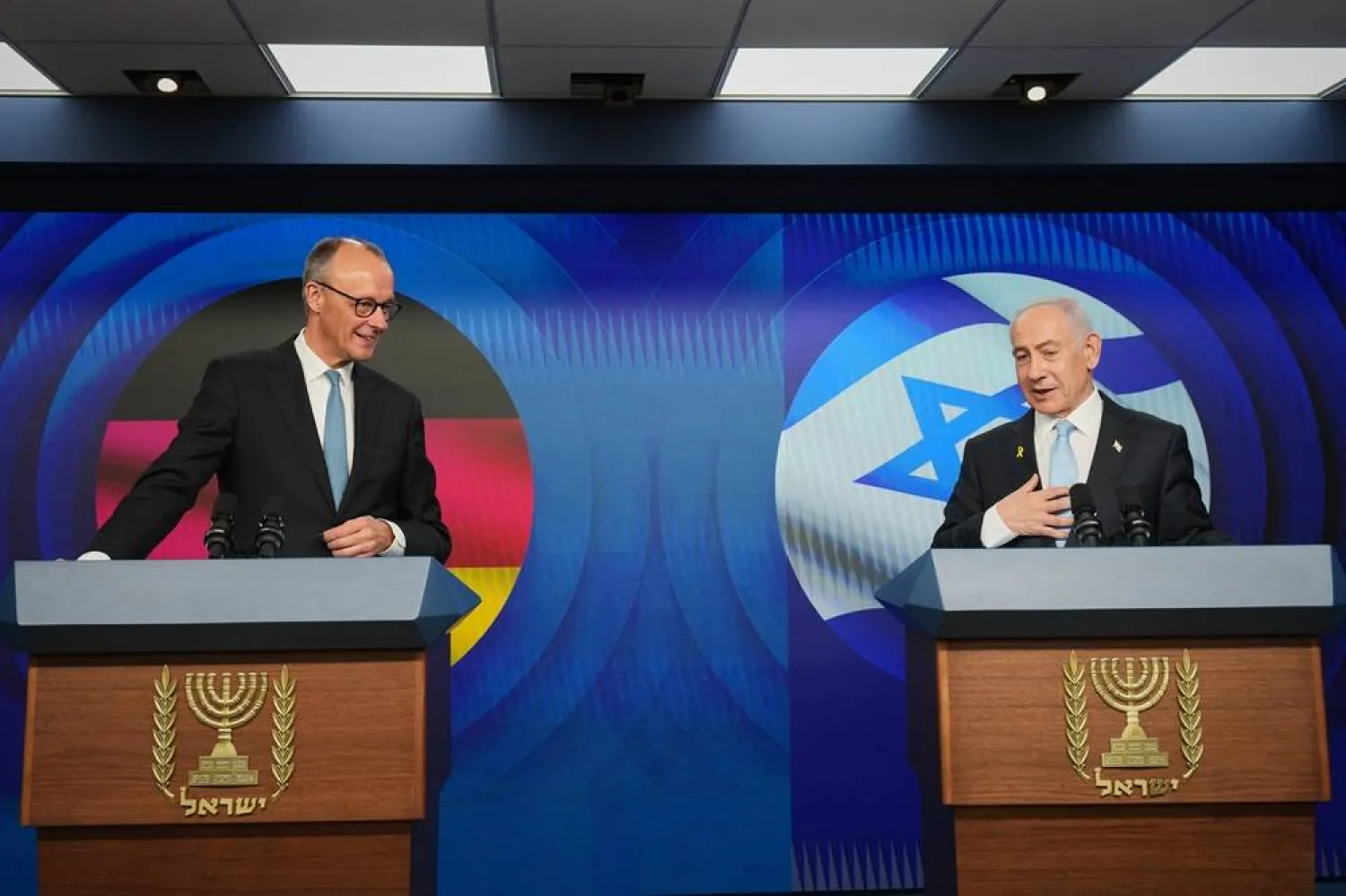
Israeli Prime Minister Benjamin Netanyahu (R) and German Chancellor Friedrich Merz address a joint press conference in Jerusalem, 07 December 2025. (EPA)
TT

Israel’s Netanyahu to Discuss Second Phase of Gaza Plan with Trump Later This Month

Israeli Prime Minister Benjamin Netanyahu (R) and German Chancellor Friedrich Merz address a joint press conference in Jerusalem, 07 December 2025. (EPA)

Israeli Prime Minister Benjamin Netanyahu said on Sunday that the second phase of a US plan to end the war in Gaza was close, but cautioned several key issues still needed to be resolved, including whether a multinational security force would be deployed. 

Netanyahu, speaking to reporters alongside German Chancellor Friedrich Merz in Jerusalem, said that he would hold important discussions with US President Donald Trump at the end of the month on how to ensure the plan's second phase was achieved. 

The prime minister's office in November said that Trump had invited Netanyahu to the White House "in the near future", although a date for the visit has not yet been made public. 

Netanyahu said that he would discuss with Trump how to bring an end to Hamas rule in Gaza. A ceasefire between Israel and Hamas is entering its second month, although both sides have repeatedly accused each other of violating the truce agreement. 

Netanyahu said that it was important to ensure Hamas not only upholds the ceasefire but also follows through on "their commitment" to the plan to disarm and for Gaza to be demilitarized. 

Israel retained control of 53% of Gaza under the first phase of Trump's plan, which involved the release of hostages held by fighters in Gaza and of Palestinians detained by Israel. The final hostage remains to be handed over are those of an Israeli police officer killed on October 7, 2023 fighting Gazan gunmen who had invaded Israel. 

"We'll get him out," Netanyahu said. 

Since the ceasefire started in October, the militant group has reestablished itself in the rest of Gaza. 

GERMAN CHANCELLOR: PHASE TWO MUST COME NOW 

According to the plan, Israel is to pull back further in the second phase as a transitional authority is established in Gaza and a multinational security force is deployed, Hamas is disarmed, and reconstruction begins. 

A multinational coordination center has been established in Israel, but there are no deadlines in the plan and officials involved say that efforts to advance it have stalled. 

"What will be the timeline? What are the forces that are coming in? Will we have international forces? If not, what are the alternatives? These are all topics that are being discussed," Netanyahu said, describing them as central issues. 

Merz said that Germany was willing to help rebuild Gaza but would wait for Netanyahu's meeting with Trump, and for clarity on what Washington was prepared to do, before Berlin decides what it would contribute but that phase two "must come now". 

Israel has repeatedly carried out air strikes since the ceasefire came into effect that it says are fending off attacks or destroying militant infrastructure. Gaza's health ministry says 373 Palestinians have been killed since the ceasefire started. Three Israeli soldiers have been killed by gunmen. 

Netanyahu said that he would also discuss with Trump "opportunities for peace", an apparent reference to US efforts for Israel to establish formal ties with Arab and Muslim states. 

"We believe there's a path to advance a broader peace with the Arab states, and a path also to establish a workable peace with our Palestinian neighbors," Netanyahu said, asserting Israel would always insist on security control of the West Bank. 

Trump has said he promised Muslim leaders that Israel would not annex the occupied West Bank, where Netanyahu's government is backing the development of Jewish settlements. 

The "question of political annexation" of the West Bank remains a subject of discussion, Netanyahu said. 


Arab League Urges Action to Force Israel to Repeal Prisoner Execution Law

Meeting at Palestine’s request, the Arab League Council, at the level of permanent representatives, convened an extraordinary session in Cairo on Thursday. (Arab League)
TT

Arab League Urges Action to Force Israel to Repeal Prisoner Execution Law

Meeting at Palestine’s request, the Arab League Council, at the level of permanent representatives, convened an extraordinary session in Cairo on Thursday. (Arab League)

The Arab League strongly condemned on Thursday the Israeli Knesset’s approval of a law allowing the execution of Palestinian prisoners.

It urged the international community, particularly the United Nations Security Council and the United Nations Human Rights Council, to act urgently to compel Israel to repeal it.

Meeting at Palestine’s request, the Arab League Council, at the level of permanent representatives, convened an extraordinary session in Cairo, chaired by Bahrain, to address what it described as a “racist and invalid” law, and to discuss Arab and international steps to confront systematic Israeli violations in Jerusalem.

A 21-point resolution adopted at the meeting said limiting the death penalty to Palestinian prisoners amounted to “entrenching an apartheid system imposed by Israel,” holding “Israel, the illegal occupying power, fully responsible for the legal and humanitarian consequences.”

The Arab League called for listing Israel’s National Security Minister Itamar Ben-Gvir and members of his party, along with Finance Minister Bezalel Smotrich and their party members, on “international, regional, and national terrorism lists,” and welcomed condemnations of the law by several countries and the European Union.

It urged states party to the Fourth Geneva Convention to annul the law, and called on the International Criminal Court to open an urgent investigation and prosecute Israeli officials responsible for its approval, describing it as a “war crime.”

The Arab League also called for activating a legal monitoring unit to document any implementation of the law for use before international courts, and urged Arab parliamentary bodies to work toward suspending the Knesset’s membership in the Inter-Parliamentary Union.

Foreign ministers from Saudi Arabia, Türkiye, Egypt, Indonesia, Jordan, Pakistan, Qatar, and the United Arab Emirates also condemned the law, warning it entrenches an apartheid system and promotes rhetoric denying the Palestinian people’s inalienable rights and presence in occupied territory.

Regarding Jerusalem, the Arab League condemned what it described as unprecedented Israeli measures to close Al-Aqsa Mosque, calling it a “flagrant violation of international law” and an unprecedented provocation to Muslims worldwide, as well as an assault on freedom of worship. It also condemned measures targeting the Christian presence in the city.

The Arab League denounced Israeli efforts to dismantle the United Nations Relief and Works Agency for Palestine Refugees in the Near East and shut its offices and schools in Jerusalem, calling it an attempt to erase the refugee issue from final status talks.

It called for coordinated Arab, Islamic, and international action, political, diplomatic, economic, and legal, to protect Jerusalem and its holy sites, urging the international community, including the UN Security Council, to take a firm stance obliging Israel to halt its violations.

The Arab League reiterated its rejection of any move to alter Jerusalem’s legal status, including relocating diplomatic missions, and warned Argentina against moving its embassy to the city, saying such a move would damage Arab-Argentine relations.

Arab League Assistant Secretary-General for Palestine Affairs Faed Mustafa told the Cairo meeting that developments in Jerusalem and measures targeting Palestinian prisoners are “two facets of one policy,” urging a shift from condemnation to concrete action and impact.

Former Egyptian assistant foreign minister Mohamed Hegazy told Asharq Al-Awsat the meeting was a necessary step toward unifying the Arab stance and moving beyond political condemnation.

He called for a serious international debate on sanctions against Israel if violations continue.


Israel Says Hezbollah Chief to Pay ‘Heavy Price’ for Jewish Holiday Attacks

First responders clear the rubble from the site of an Israeli airstrike that targeted a building in the southern Lebanese village of Hanouiyeh, east of Tyre, on March 30, 2026. (AFP)
TT

Israel Says Hezbollah Chief to Pay ‘Heavy Price’ for Jewish Holiday Attacks

First responders clear the rubble from the site of an Israeli airstrike that targeted a building in the southern Lebanese village of Hanouiyeh, east of Tyre, on March 30, 2026. (AFP)

Israeli Defense Minister Israel Katz on Thursday warned that Hezbollah chief Sheikh Naim Qassem would pay an "extraordinarily heavy price" for escalating attacks during the ongoing Jewish holidays.

"I have a clear message for Naim Qassem... you and your associates will pay an extraordinarily heavy price for the intensified rocket fire directed at Israeli citizens as they gathered to celebrate Passover Seder," Katz said in a video statement.

"You will be consigned to the depths of hell alongside Nasrallah, Khamenei, Sinwar and the other fallen figures of the axis of evil," he said, referring to the former leaders of Hezbollah, Iran, and the Palestinian Hamas movement, who have been assassinated by Israel over the past two and half years.

"The Hezbollah terrorist organization you now lead, and its supporters in Lebanon, will bear the full and severe consequences," Katz added.

His warning followed claims by Hezbollah that it had carried out a series of rocket attacks on northern Israel late Wednesday and early Thursday, as Israeli Jews began marking the Passover holidays.

Katz also reiterated that Israeli forces "will clear Hezbollah and its supporters from southern Lebanon, maintain Israeli security control throughout the Litani area, and dismantle Hezbollah's military capabilities across Lebanon."

Lebanon was drawn into the Middle East war in early March when Tehran-backed Hezbollah launched rockets towards Israel to avenge the attack that killed Iran's supreme leader Ali Khamenei.

Israel has responded with massive strikes across Lebanon and a ground offensive.


UN Experts Call for Investigation into Israel's Killing of Lebanese Journalists

A woman sits in a cemetery before the funeral of Lebanese journalists, Al Manar reporter Ali Shoeib, Al Mayadeen reporter Fatima Ftouni and cameraman Mohammed Ftouni, who were killed by a targeted Israeli strike, amid escalating hostilities between Israel and Hezbollah, as the US-Israeli conflict with Iran continues, in Choueifat, Lebanon, March 29, 2026. (Reuters)
TT

UN Experts Call for Investigation into Israel's Killing of Lebanese Journalists

A woman sits in a cemetery before the funeral of Lebanese journalists, Al Manar reporter Ali Shoeib, Al Mayadeen reporter Fatima Ftouni and cameraman Mohammed Ftouni, who were killed by a targeted Israeli strike, amid escalating hostilities between Israel and Hezbollah, as the US-Israeli conflict with Iran continues, in Choueifat, Lebanon, March 29, 2026. (Reuters)

UN experts on Thursday called for an international investigation into the death of three Lebanese journalists in an Israeli strike, saying Israel had not provided "credible evidence" of their alleged links to armed groups.

The three journalists, including Ali Shoeib, a star correspondent for Al Manar channel of Hezbollah, which is at war with Israel, were killed on March 28 in an Israeli strike in southern Lebanon.

"We denounce strongly what has now become a standard, dangerous practice of Israel to target and kill journalists and then claim, without providing any credible evidence, that they were involved with armed groups," the experts said in a statement.

The Israeli army had described Shoeib as a member of the Radwan force, an elite Hezbollah unit, operating "under the guise of a journalist".

According to the experts, Israel's only so-called "evidence" for its claims was a photoshopped image of the journalist.

Israel also confirmed it killed journalist Fatima Ftouni of Al Mayadeen, seen as close to Hezbollah, and her brother cameraman Mohammed Ftouni, describing him as "an additional terrorist in Hezbollah's military wing".

The experts argued that working as a journalist for a media outlet linked to an armed group does not constitute direct participation in hostilities under international humanitarian law.

"Israeli officials know this, yet they choose to ignore it -- emboldened by impunity for their previous killings of journalists in Lebanon, Gaza and the West Bank."

At least 231 journalists and media workers have been killed by Israel since 2023, including 210 in Gaza and 11 in Lebanon, according to the Committee to Protect Journalists (CPJ).

Although appointed by the United Nations Human Rights Council, special rapporteurs are independent experts and do not speak on behalf of the UN.
