


Huge Rotating Structure of Galaxies and Dark Matter Is Detected

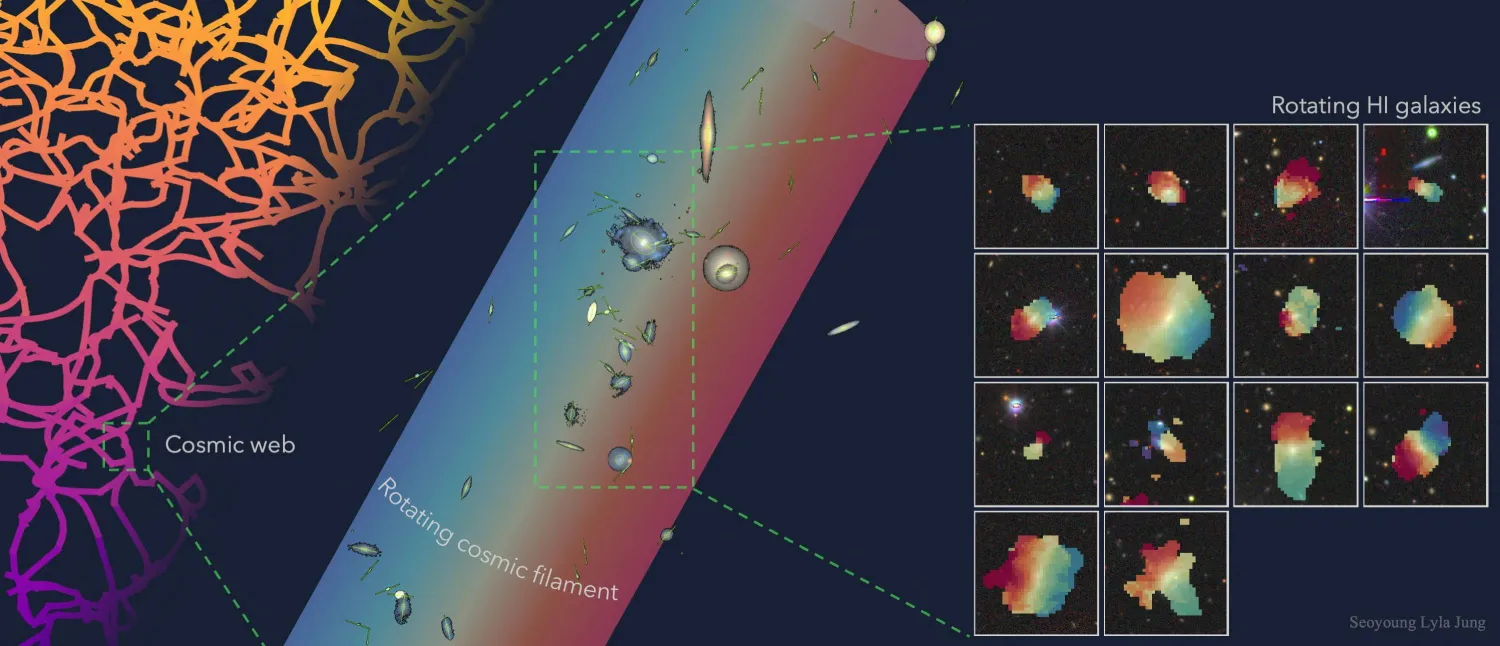
A figure depicting the rotation of neutral hydrogen in galaxies residing in an extended filament, where the galaxies exhibit a coherent bulk rotational motion tracing the large-scale cosmic web, is seen in this undated illustration obtained by Reuters on December 4, 2025. (Lyla Jung/Handout via Reuters)
TT

Huge Rotating Structure of Galaxies and Dark Matter Is Detected

A figure depicting the rotation of neutral hydrogen in galaxies residing in an extended filament, where the galaxies exhibit a coherent bulk rotational motion tracing the large-scale cosmic web, is seen in this undated illustration obtained by Reuters on December 4, 2025. (Lyla Jung/Handout via Reuters)

Scientists have observed the largest-known rotating structure in the cosmos - a gargantuan thread-like assemblage of hundreds of galaxies, gas and dark matter that makes up a filament in the macrostructure of the universe called the cosmic web.

The filament, located about 140 million light-years from Earth, was observed by scientists primarily using the MeerKAT radio telescope located in South Africa, an array of 64 interlinked satellite dishes.

The rotating filament is astonishingly large, measuring about 50 million light-years long and 117,000 light-years wide. A light-year is the distance light travels in a year, 5.9 trillion miles (9.5 trillion km). By way of comparison, our Milky Way galaxy, which itself is part of a filament in the cosmic web, measures roughly 100,000 light-years in diameter.

"We believe that the universe on very large scales is made of a network-like distribution of galaxies, gas and dark matter," said University of Cambridge astrophysicist Madalina Tudorache, co-lead author of the study published this month in the journal Monthly Notices of the Royal Astronomical Society.

"This network is called the cosmic web, and it is formed of clusters, which are very dense clumps of matter, often formed of many groups of galaxies; voids - which are empty or almost empty regions of space; and filaments, which are strand-like structures which connect the very dense regions and border the voids," Tudorache said.

The rotating filament described in the new study is populated by nearly 300 galaxies of various sizes as well as gas and dark matter, the mysterious invisible stuff estimated to make up 27% of the cosmos.

Everything visible in the universe is made of ordinary matter - stars, planets, moons and all the stuff on Earth. It can be seen in wavelengths from infrared to visible light and gamma rays, but comprises only about 5% of the universe. Dark matter, on the other hand, does not absorb or reflect or emit light, but its presence is known through its gravitational effects on large scales.

The researchers determined that the filament is spinning by observing that the galaxies on either side of its central axis are moving through space in opposite directions, with the whole thing having a rotational velocity of about 246,000 miles (396,000 km) per hour.

"This is the largest individual spinning structure so far detected. Statistically, we believe there are other spinning structures, some of which could be larger. However, we have not been able to detect them directly with our current data and telescopes," said University of Oxford astrophysicist and study co-lead author Lyla Jung.

The researchers likened what they see in this filament to the amusement park attraction called a teacup ride.

"The teacup ride analogy explains the two levels of spinning motion that make this object unique," Jung said.

"First, each galaxy in the filament spins on its own. The gas and stars in each galaxy orbit around the galaxy center, like each teacup on the ride spins individually. Second, the entire cosmic filament also rotates. The filament is made of many galaxies, and this study demonstrates that the entire structure is rotating, like the teacup platform spins as a whole," Jung added.

In studying the cosmos, astrophysicists examine it at the smallest and largest scales. They look at tiny fundamental particles such as neutrinos. They look at objects such as comets, asteroids, moons, planets and stars that make up solar systems. They look at galaxies comprised of billions of stars and at clusters of galaxies. And then on the largest scales they look at filaments and other components of the cosmic web.

This study looks at the large end of things.

"This is a very exciting time to work in this field, as our capacity of discovering such structures is increasing with the advent of better radio and optical surveys. It will deepen our understanding of the universe," Tudorache said.



'Large-scale' Avalanche Kills Two Skiers in French Alps

Members of the CRS Alpes Grenoble mountain rescue team prepare to board a Securite Civile helicopter (emergency management) after after an avalanche emergency response rescue mission in an off-piste area of the Ecrins massif, French Alps on January 29, 2026. (Photo by JEFF PACHOUD / AFP)
TT

'Large-scale' Avalanche Kills Two Skiers in French Alps

Members of the CRS Alpes Grenoble mountain rescue team prepare to board a Securite Civile helicopter (emergency management) after after an avalanche emergency response rescue mission in an off-piste area of the Ecrins massif, French Alps on January 29, 2026. (Photo by JEFF PACHOUD / AFP)

An avalanche has killed two off-piste ski tourers in the French Alps, a local prosecutor said on Sunday.

According to local rescue services, the two men died when an avalanche was triggered on Saturday afternoon near the village of Saint-Veran, known as the highest village in the French Alps.

The two victims-- one born in 1997 and the other in 1991 -- were part of a group of four unguided skiers when a "large-scale" avalanche swept down the north side of the Tete de Longet mountain peak, Gap prosecutor Marion Lozac'hmeur told AFP.

The other two skiers were unharmed, Lozac'hmeur added.

An autopsy has been ordered as part of an investigation into the cause of death, according to the prosecutor.

Avalanches have already claimed the lives of more than 20 skiers across the French, Swiss and Austrian Alps so far this season.


Olympic Tourists in Cortina Can Explore the Dolomites with the New ‘Uber Snowmobile’ Service

 The peaks of the Dolomites are seen from the Cortina Sliding Centre during the Milano Cortina 2026 Winter Olympic Games in Cortina d'Ampezzo on February 5, 2026. (AFP)
The peaks of the Dolomites are seen from the Cortina Sliding Centre during the Milano Cortina 2026 Winter Olympic Games in Cortina d'Ampezzo on February 5, 2026. (AFP)
TT

Olympic Tourists in Cortina Can Explore the Dolomites with the New ‘Uber Snowmobile’ Service

 The peaks of the Dolomites are seen from the Cortina Sliding Centre during the Milano Cortina 2026 Winter Olympic Games in Cortina d'Ampezzo on February 5, 2026. (AFP)
The peaks of the Dolomites are seen from the Cortina Sliding Centre during the Milano Cortina 2026 Winter Olympic Games in Cortina d'Ampezzo on February 5, 2026. (AFP)

The peaks of the Dolomites are seen from the Cortina Sliding Centre during the Milano Cortina 2026 Winter Olympic Games in Cortina d'Ampezzo on February 5, 2026. (AFP)

For one month starting on Saturday, Olympic spectators keen for a side trip to a UNESCO World Heritage Site can use Uber to reserve a ride on a snowmobile along the snow-covered road to the base of the Three Peaks of Lavaredo.

The dramatic, jagged limestone pinnacles stand just 23 kilometers (14.3 miles) from the Cortina venues where athletes are competing in the 2026 Winter Olympics and Paralympics.

One of the Olympic torchbearers, Giulia Baffetti, runs snowmobiling tours through Cortina-based winter activities outfit Snowdreamers. The company partnered with Uber, the official ride-hailing sponsor for the Games, to offer free tours on the weekends in February to people in town.

"Uber Snowmobile" tours, which can only be booked through Uber, include a ride in an Uber transfer bus for up to eight people from Cortina to the spot where riders mount their snowmobiles for departure. Tourgoers then follow the instructor, who leads the line of snowmobiles.

The first slots offered went fast, but Uber spokesperson Caspar Nixon said Friday that it planned to add more.

The three peaks are a magical place, Baffetti said, and this is a way for more people to experience it. Hikers and climbers flock there in the warmer months. In the winter, it’s a prime spot for cross-country skiing, snowshoeing and sledding. Snowmobiling is allowed in a limited area in order to protect the environment.

"We want to give an experience to the tourists, so they can feel the mountains in a different way," she said.

The Associated Press took the one-hour tour on Thursday, ahead of the Saturday launch, along with one other person. Helmets are essential, while heated handgrips are a most welcome feature. And that red button? Passengers can push it to stop the snowmobile if it veers off course or they feel unsafe.

The adrenaline-filled ride reaches speeds up to 40 kph (25 mph) when zooming past snow-covered trees, and drivers are instructed to slow when coming upon cross-country skiers and sledders. Deer and wolves are sometimes seen along the 7-kilometer (4.3-mile) route up to the base of the peaks.

Also visible on Thursday was the southernmost of the three Lavaredo peaks, rising sharply out of the fog. While the Dolomites are breathtaking from Cortina — and on Friday, the sun shone and the view was clear from town — they are even more impressive up close.

The route back includes a short loop around Lake Antorno. Before traversing all the ups and downs, the snowmobile instructor leading the tour offers a reminder about that red button.

Saher Deeb, an Israeli tourist, was along for the ride Thursday, one day after his 29th birthday. It was his first time on a snowmobile, and he was all smiles as he climbed off at the end.

"It was perfect," he said.


French Duo Finish Walking from France to Shanghai After 1.5 Years

 Performers throw molten iron to create sparks during a performance on the Bund promenade along the Huangpu river, ahead of the upcoming Lunar New Year of the Horse in Shanghai on February 2, 2026. (AFP)
Performers throw molten iron to create sparks during a performance on the Bund promenade along the Huangpu river, ahead of the upcoming Lunar New Year of the Horse in Shanghai on February 2, 2026. (AFP)
TT

French Duo Finish Walking from France to Shanghai After 1.5 Years

 Performers throw molten iron to create sparks during a performance on the Bund promenade along the Huangpu river, ahead of the upcoming Lunar New Year of the Horse in Shanghai on February 2, 2026. (AFP)
Performers throw molten iron to create sparks during a performance on the Bund promenade along the Huangpu river, ahead of the upcoming Lunar New Year of the Horse in Shanghai on February 2, 2026. (AFP)

Two French adventurers reached the end of an epic walk from France to Shanghai on Saturday, after nearly a year and a half crossing 16 countries almost entirely on foot.

Loic Voisot and Benjamin Humblot embraced as they stood by the river on the Bund promenade, the financial hub's distinctive skyline glittering in the background.

Voisot and Humblot set off from Annecy in September 2024.

"We were thinking about this moment almost every day for more than a year now, so it's a really strong feeling," Humblot said of reaching their destination.

Hanging out after work one day, the two friends realized they both yearned for a "great adventure".

They wanted to visit China -- but without flying, which they believe is too harmful to the environment.

A plan to set out on foot was hatched, and except for a stretch in Russia which was done by bus for safety reasons, 518 days and around 12,850 kilometers (7,980 miles) later they took the last steps to completing it.

Around 50 people gathered at the start point for the last 10km stretch of their odyssey, many local people who have been following them on social media.

Along the way their numbers swelled, as media, French residents of Shanghai and others joined.

"If your dreams are crazy, just take it step by step and sometimes you will not succeed, but sometimes you will," said Voisot.

Asked what he would do first now the walk was over, he joked: "Sleep a lot!"