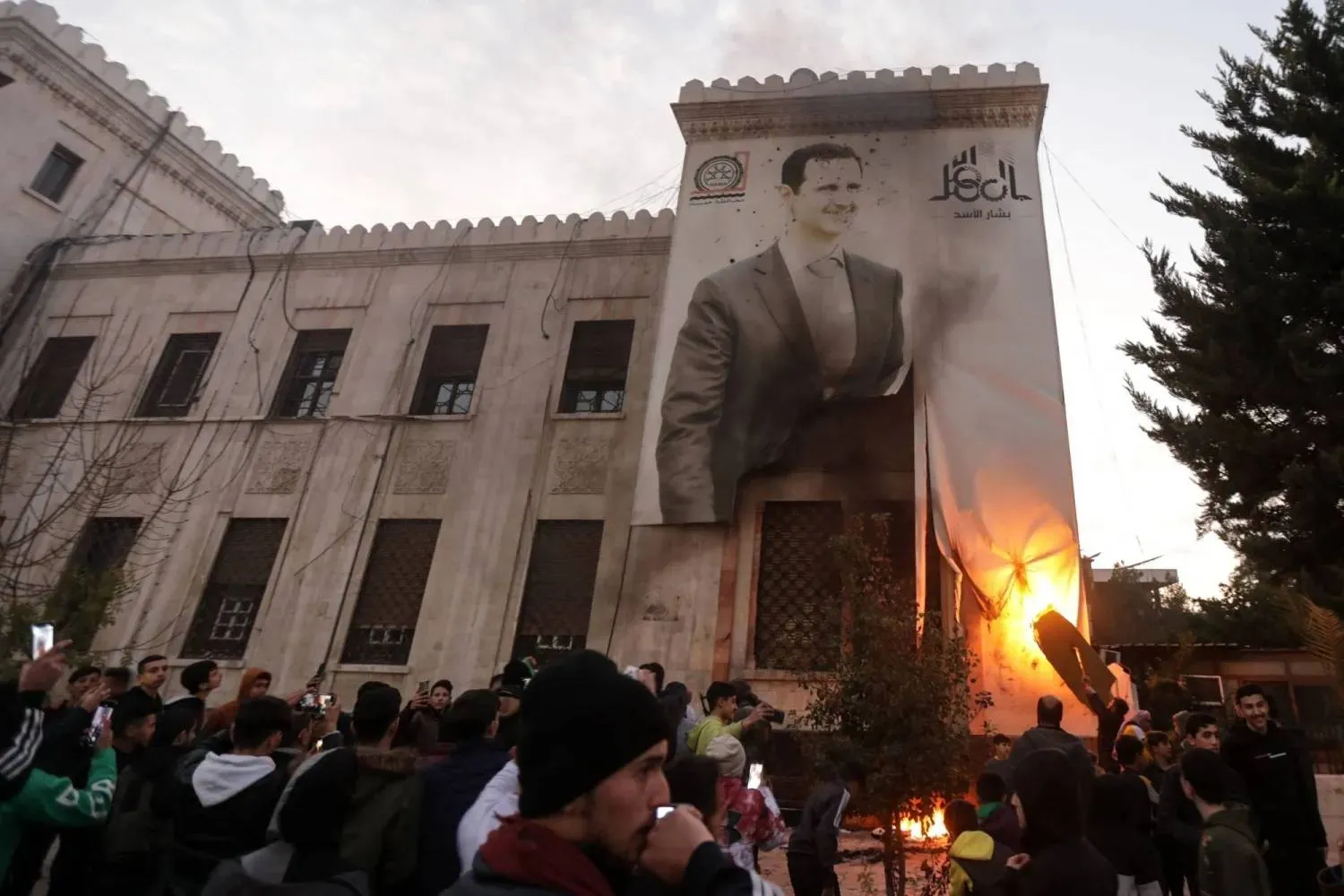

Syria’s map of control has been shaken to its core since late 2024, when the Deterrence of Aggression offensive erupted and the Assad government fell, unleashing a series of security and military shifts that continued to redraw the country’s landscape through 2025.
But this fluid map is unlikely to hold, according to a study by the Syrian research group Jusoor Center for Studies. With regional and international actors working to head off the chaos and potential partition that threaten wider stability, any near term changes in who controls what are expected to come through political and security pressure rather than a return to large scale battles.
Mahmoud Eibo, one of three researchers who worked on a report on territorial influence in Syria in 2025, told Asharq Al-Awsat that the balance of control shifted sharply after the launch of the Deterrence of Aggression battles on November 27, 2024.
In less than two weeks, the Assad government lost the areas it had held since 2020, which covered more than half of the country.
Iranian withdrawal from Syrian territory
With the government’s fall, Iran’s presence also unraveled after more than a decade of entrenchment. Iran backed militias withdrew from rural Damascus, Homs, Aleppo, the southern provinces and from Al-Bukamal and Al-Mayadin.
Eibo said the militias “withdrew completely” after supply lines linking them to Lebanon and Iraq were severed, which effectively ended Iran’s influence and that of its militias across Syria.
The military role of Hezbollah also came to an end. The group had been one of Tehran’s key proxies in Syria since 2013, when its intervention began with the capture of Al-Qusayr.
But the turning point ended in the same town, after factions in the Deterrence of Aggression campaign seized Al-Qusayr in late 2024 and Hezbollah forces pulled out entirely.
The moment marked a definitive end to Hezbollah’s long military presence in Syria, after the group lost one of its most critical geographic links to Iran through Syrian territory.
Many areas that had been under the indirect influence of Hezbollah and Iran backed factions also slipped out of their orbit and reverted to the authority of the new Syrian state and its security and military institutions in the north.
The largest shift in influence last year came at the expense of the Syrian Democratic Forces, known as the SDF, Eibo said. The Dawn of Freedom operation ended the group’s presence in strategically important areas west of the Euphrates, beginning with the fall of Tel Rifaat and surrounding villages and extending toward Manbij, which cost the SDF one of its key cities in the region.
As a result, the SDF’s influence contracted in northern and eastern Aleppo countryside and the group withdrew eastward toward Raqqa, Hasakeh and parts of Deir Ezzor.
Sweida and the south
In the south, a limited but consequential development emerged in Sweida province. Local groups linked to Sheikh Hikmat Al-Hajri seized parts of the province after government forces withdrew, taking advantage of the security vacuum.
Although the area under their control is geographically small, it created a pocket of influence outside the new government’s authority and added another layer of instability to the southern provinces.
In parallel, Israel capitalized on the collapse of the southern front. It pushed beyond the buffer zone and established a presence in select points and strategic hilltops near the disengagement line.
Although the area is small, the symbolic and intelligence value of the chosen positions gives Israel leverage through monitoring and pressure, keeping the south open to volatility.
What the new map shows
Syria’s territorial map at the end of 2025 reflects a new political landscape dominated by four actors: the Syrian government, the SDF, the National Guard forces in Sweida and Israel, each wielding varying degrees of influence.
The Syrian government remains the primary authority. Beyond its broad political and social control, it holds 69.3% of the country’s territory, covering major cities, most administrative structures and key transport routes. It does not, however, control four provincial capitals: Quneitra, Sweida, Hasakeh and Raqqa.
The SDF controls 27.8% of Syria’s territory, concentrated in the north and east. The expanse is significant but uneven in terms of internal stability. The group faces serious political pressure tied to the implementation of the March 10, 2025 agreement, which is expected to reshape its relationship with the Syrian government.
The National Guard forces in Sweida, loyal to Sheikh Hikmat Al-Hajri, control 2.8% of the country. Their influence is small in size but distinct in nature. The significance lies in their location and in the direct support they receive from Israel, which positions them within a broader framework aimed at prolonging instability in the south.
Their presence overlaps with Israel’s incursion into Syrian territory, which covers 0.1% of the country. Despite the small footprint, the choice of elevated positions and small villages with high surveillance value reflects strategic intent.
Israel is not seeking territorial control, but rather an early warning line and a tighter grip over the border zone, while supporting an environment that prevents full stability in the south. This aligns with its indirect role in reinforcing the position of the Sweida National Guard forces.
Change driven by political pressure
According to Eibo, Syria’s map of control has undergone a fundamental rupture since late 2024, ending a geopolitical phase that had been largely settled since 2020.
The country has entered a more fluid and complex period marked by the retreat of traditional actors and the emergence of new, still unsettled zones of influence.
Although limited security and military shifts continued through 2025, it is unlikely that the current map will hold. Regional and international efforts are focused on avoiding chaos and partition.
Any upcoming change in territorial control will most likely be driven by political and security pressure and by reengineering spheres of influence rather than a return to large scale military confrontations.