
From Israeli-Held Zones in Gaza, Foes of Hamas Seek Lasting Role 

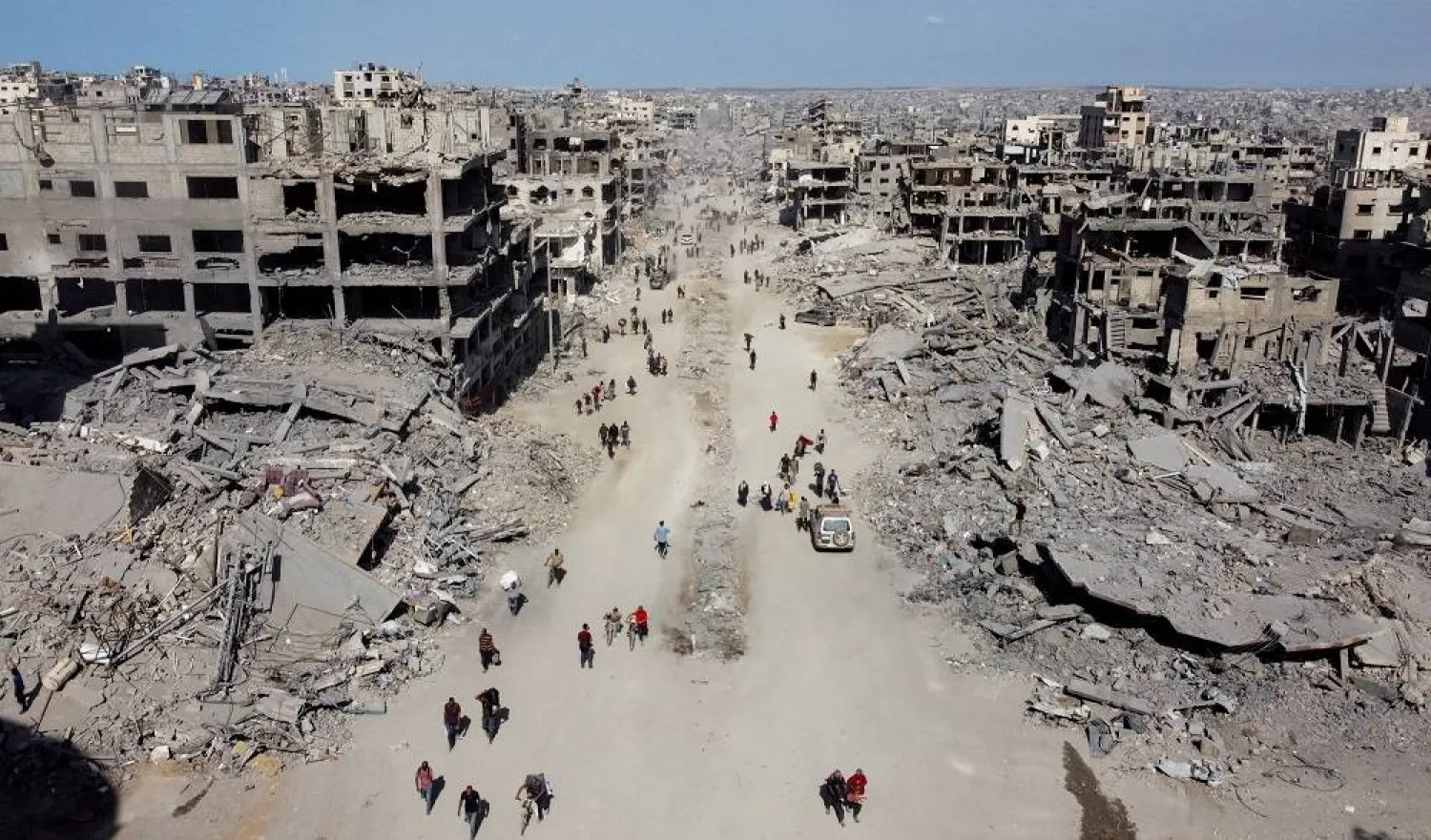
A drone view shows Palestinians walking past the rubble, following Israeli forces' withdrawal from the area, amid a ceasefire between Israel and Hamas in Gaza, in Gaza City, October 11, 2025. (Reuters)
TT

From Israeli-Held Zones in Gaza, Foes of Hamas Seek Lasting Role 

A drone view shows Palestinians walking past the rubble, following Israeli forces' withdrawal from the area, amid a ceasefire between Israel and Hamas in Gaza, in Gaza City, October 11, 2025. (Reuters)

Groups operating from Israeli-held areas of Gaza say they will continue to fight Hamas despite the killing of their most prominent commander, reporting more recruits since an October ceasefire as they eye a role in the enclave's future.

The emergence of the groups, though they remain small and localized, has added to pressures on Hamas and could complicate efforts to stabilize and unify a divided Gaza shattered by two years of war.

Prime Minister Benjamin Netanyahu acknowledged Israeli backing for anti-Hamas groups in June, saying Israel had "activated" clans, though Israel has given little detail since then.

Last week, the man seen at the heart of efforts to establish anti-Hamas forces - Yasser Abu Shabab - was killed in southern Gaza's Rafah area. His group, the Popular Forces, said he died mediating a family feud, without saying who killed him. His deputy, Ghassan al-Dahini, has taken over and vowed to continue on the same path.

Hamas, which has controlled Gaza since 2007 and has so far refused to disarm under the ceasefire plan, has branded such groups collaborators - a view that Palestinian analysts say is broadly shared by the public. It moved swiftly against Palestinians who defied its control after the US-backed ceasefire took hold, killing dozens, including some it accused of working with Israel.

Nearly all Gaza's 2 million people live in Hamas-held areas, where the group has been reestablishing its grip and where four Hamas sources said it continues to command thousands of men despite suffering heavy blows during the war.

But Israel still holds over half of Gaza - areas where Hamas' foes operate beyond its reach. With President Donald Trump's plan for Gaza moving slowly, there is no immediate prospect of further Israeli withdrawals.

Three Egyptian security and military sources said Israel-backed groups had increased their activities since the ceasefire, and estimated they now had 1,000 fighters, adding 400 since the truce.

Egypt, which borders Gaza, has been closely involved in negotiations over the conflict. The sources expected the groups to further step up their activities in the absence of a comprehensive deal on Gaza's future.

FOOTAGE SHOWS FIGHTERS ASSEMBLED

A diplomat who spoke to Reuters on condition of anonymity said the anti-Hamas groups lacked any popular constituency, but added that their emergence raised concerns for the enclave's stability, heightening risks of conflict among Palestinians.

Since Abu Shabab's death, his group and two others have posted videos showing dozens of fighters assembled, as commanders are heard praising him as a martyr and vowing to continue.

One video released on December 5 shows Dahini telling fighters Abu Shabab's death was a "grave loss" and adding that they would "continue on this path and move with the same strength and even more strength".

Reuters verified the location as Rafah Governorate - an area of Gaza where Israeli forces are still deployed - by analyzing the buildings, walls and trees in the footage which matched file and satellite imagery of the area.

On December 7, Dahini announced the execution in late November of two men he identified as Hamas fighters, saying they had killed a member of his group. A security official in a Hamas-led coalition of militant groups in Gaza said such actions did not "alter the realities on the ground".

Hussam Al-Astal, who heads another anti-Hamas faction based in the Khan Younis area, said he and Dahini had "agreed the war on terror will continue" during a visit to Abu Shabab's grave in the Rafah area. "Our project, new Gaza ... will move ahead," Al-Astal told Reuters by phone.

Al-Astal, speaking to Reuters in a separate call in late November, said his group has received arms, money and other support from international "friends" whom he declined to identify. He denied receiving Israeli military backing but acknowledged contacts with Israel over "the coordination of the entry of food and all the resources we need to survive".

He said he was speaking from inside Gaza, in the Israeli-controlled sector near the "yellow line" behind which Israel has withdrawn. Al-Astal said his group had added recruits since the truce and now had several hundred members including fighters and civilians. The Popular Forces has also grown, a source close to it said, without giving a figure.

Hamas police officers stand guard, amid a ceasefire between Israel and Hamas, in Gaza City, October 11, 2025. (Reuters)

HAMAS: ABU SHABAB MET 'INEVITABLE FATE'

Israel says it aims to ensure that Hamas, which ignited the war with its October 7, 2023 attack on Israel, is disarmed and has no future role governing Gaza.

In response to a request for comment, an Israeli government official said: "There is no shortage of Palestinians wishing and actively fighting to free themselves of the Hamas repression and tyranny."

The Popular Forces didn't respond to requests for comment sent via their Facebook page. It has previously denied receiving Israeli support.

Hamas said Abu Shabab's death was the "inevitable fate of all those who betrayed their people and homeland", while claiming no role in his killing.

The security official in the Hamas-led coalition said threats by its foes were "psychological warfare" orchestrated by Israel to "undermine internal stability".

Hamas spokesperson Hazem Qassem said security forces would pursue collaborators "until this phenomenon is eradicated".

But they "are protected by the occupation army in the areas where these forces are present, which makes it difficult for the security apparatuses", he said, in comments to Reuters before Abu Shabab's death.

HOUSING COMPOUNDS PLANNED

As well as disarming Hamas, Trump's plan foresees the establishment of a transitional authority, the deployment of a multinational force, and reconstruction.

But with no clarity on next steps, there is a risk of de facto partition between an inland sector controlled by Israel where few people now remain, and a sector along the coast now crowded with displaced people, much of it wasteland.

Touring Gaza on Sunday, Israeli military chief Lieutenant General Eyal Zamir said Israel had "control over extensive parts of the Gaza Strip and we will remain on those defense lines".

"The Yellow Line is a new border line — serving as a forward defensive line for our communities and a line of operational activity," he said.

Goals cited by anti-Hamas groups include establishing secure areas for displaced Gazans.
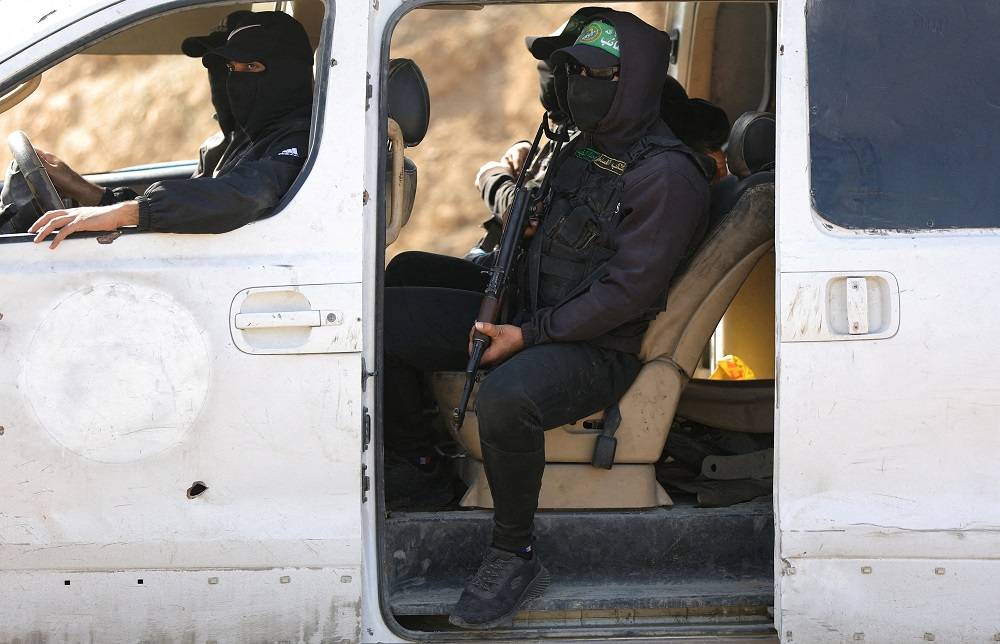
Hamas militants sit inside a vehicle as they escort members of the Red Cross towards an area within the so-called "yellow line" to which Israeli troops withdrew under the ceasefire, in Gaza City November 20, 2025. (Reuters)

In October, US Vice President JD Vance and Trump's son-in-law Jared Kushner said reconstruction funds could flow to the Israel-controlled area without waiting for the next stage of the plan to begin, with the idea of creating model zones for Gazans to live in.

Rafah is one of the first sites US officials have identified for such housing compounds, described as "Alternative Safe Communities," though no timeline has been set, according to two Israeli officials and three Western diplomats involved in post-war Gaza planning.

A US State Department spokesperson said the US was working with partners "to provide housing and other services to Gazans as quickly as possible".

The United States has not had any official contact with the anti-Hamas groups, "nor are we providing any funding or support", a US official said. "We are not going to be picking winners or losers in Gaza," the official said, adding: "Beyond Hamas having no future role, who will govern Gaza will be up to Gazans."

DESTABILIZING HAMAS CONTROL

Some Palestinians celebrated news of Abu Shabab's death in the nearby city of Khan Younis by distributing sweets, witnesses said.

Ghassan al-Khatib, a lecturer in international studies at Birzeit University in the occupied West Bank, said that while Hamas' popularity had declined because of the costs of the Gaza war, the anti-Hamas groups had no future because they are viewed by Palestinians as collaborators.

"Israel is using them only for tactical reasons, particularly to try to destabilize Hamas control," he said.

A spokesperson for President Mahmoud Abbas' Fatah Movement, which was driven from Gaza by Hamas and runs the Palestinian Authority in the West Bank, said it rejected any armed groups backed by Israel, saying they had "nothing to do with our people and their cause".


Khartoum Markets Back to Life but 'Nothing Like Before'

Men walk along a street past destroyed high-rise building, as efforts to restore the city's infrastructure resumes after nearly three years of devastation caused by war, in the Sudanese capital Khartoum on January 17, 2025. (AFP)
TT

Khartoum Markets Back to Life but 'Nothing Like Before'

Men walk along a street past destroyed high-rise building, as efforts to restore the city's infrastructure resumes after nearly three years of devastation caused by war, in the Sudanese capital Khartoum on January 17, 2025. (AFP)

The hustle and bustle of buyers and sellers has returned to Khartoum's central market, but "it's nothing like before," fruit vendor Hashim Mohamed told AFP, streets away from where war first broke out nearly three years ago.

On April 15, 2023, central Khartoum awoke to battles between the Sudanese army and the paramilitary Rapid Support Forces, who had been allies since 2021, when they ousted civilians from a short-lived transitional government.

Their war has since killed tens of thousands and displaced millions. In greater Khartoum alone, nearly 4 million people -- around half the population -- fled the city when the RSF took over.

Hashim Mohamed did not.

"I had to work discreetly, because there were regular attacks" on businesses, said the fruit seller, who has worked in the sprawling market for 50 years.

Like him, those who stayed in the city report living in constant fear of assaults and robberies from fighters roaming the streets.

Last March, army forces led an offensive through the capital, pushing paramilitary fighters out and revealing the vast looting and destruction left behind.

"The market's not what it used to be, but it's much better than when the RSF was here," said market vendor Adam Haddad, resting in the shade of an awning.

In the market's narrow, dusty alleyways, fruits and vegetables are piled high, on makeshift stalls or tarps spread on the ground.

- Two jobs to survive -

Khartoum, where entire neighborhoods were once under siege, is no longer threatened by the mass starvation that stalks battlefield cities and displacement camps elsewhere in Sudan.

But with the economy a shambles, a good living is still hard to provide.

"People complain about prices, they say it's too expensive. You can find everything, but the costs keep going up: supplies, labor, transportation," said Mohamed.

Sudan has known only triple-digit annual inflation for years. Figures for 2024 stood at 151 percent -- down from a 2021 peak of 358.

The currency has also collapsed, going from trading at 570 Sudanese pounds to the US dollar before the war to 3,500 in 2026, according to the black market rate.

One Sudanese teacher, who only a few years ago could provide comfortably for his two children, told AFP he could no longer pay his rent with a monthly salary of 250,000 Sudanese pounds ($71).

To feed his family, pay for school, and cover healthcare, he "works in the market or anywhere" on his days off.

"You have to have another job to pay for the bare minimum of basic needs," he said, asking for anonymity to protect his privacy.

For Adam Haddad, the road to recovery will be a long one.

"We don't have enough resources or workers or liquidity going through the market," he said, adding that reliable electricity was still a problem.

"The government is striving to restore everything, and God willing, in the near future, the power will return and Khartoum will become what it once was."


Trump Heads into Davos Storm, with an Eye on Home

FILE - President Donald Trump is illuminated by a camera flash as he gestures while walking across the South Lawn of the White House, Nov. 2, 2025, in Washington, after returning from a trip to Florida. (AP Photo/Mark Schiefelbein, File)
TT

Trump Heads into Davos Storm, with an Eye on Home

FILE - President Donald Trump is illuminated by a camera flash as he gestures while walking across the South Lawn of the White House, Nov. 2, 2025, in Washington, after returning from a trip to Florida. (AP Photo/Mark Schiefelbein, File)

Donald Trump returns to the Davos ski resort next week after unleashing yet another avalanche on the global order. But for the US president, his main audience is back home.

Trump's first appearance in six years at the gathering of the world's political and global elite comes amid a spiraling crisis over his quest to acquire Greenland.

Fellow leaders at the mountain retreat will also be eager to talk about other shocks from his first year back in power, from tariffs to Venezuela, Ukraine, Gaza and Iran.

Yet for the Republican president, his keynote speech among the Swiss peaks will largely be aimed at the United States.

US voters are angered by the cost of living despite Trump's promises of a "golden age," and his party could be facing a kicking in crucial midterm elections in November.

That means Trump will spend at least part of his time in luxurious Davos talking about US housing.

A White House official told AFP that Trump would "unveil initiatives to drive down housing costs" and "tout his economic agenda that has propelled the United States to lead the world in economic growth."

The 79-year-old is expected to announce plans allowing prospective homebuyers to dip into their retirement accounts for down payments.

Billionaire Trump is keenly aware that affordability has become his Achilles' heel in his second term. A CNN poll last week found that 58 percent of Americans believe his first year back in the White House has been a failure, particularly on the economy.

Trump's supporters are also increasingly uneasy about the "America First" president's seemingly relentless focus on foreign policy since his return to the Oval Office.

But as he flies into the snowy retreat, Trump will find it impossible to avoid the global storm of events that he has stirred since January 20, 2025.

Trump will be alongside many of the leaders of the same European NATO allies that he has just threatened with tariffs if they don't back his extraordinary quest to take control of Greenland from Denmark.

Those threats have once again called into question the transatlantic alliance that has in many ways underpinned the western economic order celebrated at Davos.

- 'Economic stagnation' -

So have the broader tariffs Trump announced early in his second term, and he is set to add to the pressure on Europe in his speech.

Trump will "emphasize that the United States and Europe must leave behind economic stagnation and the policies that caused it," the White House official said.

The Ukraine war will also be on the cards.

Ukrainian President Volodymyr Zelensky is hoping for a meeting with Trump to sign new security guarantees for a hoped-for ceasefire deal with Russia, as are G7 leaders.

But while the largest-ever US Davos delegation includes Secretary of State Marco Rubio, special envoy Steve Witkoff and son-in-law Jared Kushner, who have all played key roles on Ukraine, no meeting is assured.

"No bilateral meetings have been scheduled for Davos at this time," the White House told AFP.

Trump is meanwhile reportedly considering a first meeting of the so-called "Board of Peace" for war-torn Gaza at Davos, after announcing its first members in recent days.

Questions are also swirling about the future of oil-rich Venezuela following the US military operation to topple its leader Nicolas Maduro, part of Trump's assertive new approach to his country's "backyard."

But Trump may also pause to enjoy his time in the scenic spot he called "beautiful Davos" in his video speech to the meeting a year ago.

The forum has always been an odd fit for the former New York property tycoon and reality TV star, whose brand of populism has long scorned globalist elites.

But at the same time, Trump relishes the company of the rich and successful.

His first Davos appearance in 2018 met occasional boos but he made a forceful return in 2020 when he dismissed the "prophets of doom" on climate and the economy.

A year later he was out of power. Now, Trump returns as a more powerful president than ever, at home and abroad.


Russia, China Unlikely to Back Iran Against US Military Threats

A man stands by the wreckage of a burnt bus bearing a banner (unseen) that reads "This was one of Tehran’s new buses that was paid for with the money of the people’s taxes,” in Tehran's Sadeghieh Square on January 15, 2026. (AFP)
TT

Russia, China Unlikely to Back Iran Against US Military Threats

A man stands by the wreckage of a burnt bus bearing a banner (unseen) that reads "This was one of Tehran’s new buses that was paid for with the money of the people’s taxes,” in Tehran's Sadeghieh Square on January 15, 2026. (AFP)

While Russia and China are ready to back protest-rocked Iran under threat by US President Donald Trump, that support would diminish in the face of US military action, experts told AFP.

Iran is a significant ally to the two nuclear powers, providing drones to Russia and oil to China. But analysts told AFP the two superpowers would only offer diplomatic and economic aid to Tehran, to avoid a showdown with Washington.

"China and Russia don't want to go head-to-head with the US over Iran," said Ellie Geranmayeh, a senior policy expert for the European Council on Foreign Relations think tank.

Tehran, despite its best efforts over decades, has failed to establish a formal alliance with Moscow and Beijing, she noted.

If the United States carried out strikes on Iran, "both the Chinese and the Russians will prioritize their bilateral relationship with Washington", Geranmayeh said.

China has to maintain a "delicate" rapprochement with the Trump administration, she argued, while Russia wants to keep the United States involved in talks on ending the war in Ukraine.

"They both have much higher priorities than Iran."

- Ukraine before Iran -

Despite their close ties, "Russia-Iranian treaties don't include military support" -- only political, diplomatic and economic aid, Russian analyst Sergei Markov told AFP.

Alexander Gabuev, director of Carnegie Russia Eurasia Center, said Moscow would do whatever it could "to keep the regime afloat".

But "Russia's options are very limited," he added.

Faced with its own economic crisis, "Russia cannot become a giant market for Iranian products" nor can it provide "a lavish loan", Gabuev said.

Nikita Smagin, a specialist in Russia-Iran relations, said that in the event of US strikes, Russia could do "almost nothing".

"They don't want to risk military confrontation with other great powers like the US -- but at the same time, they're ready to send weaponry to Iran," he said.

"Using Iran as a bargaining asset is a normal thing for Russia," Smagin said of the longer-term strategy, at a time when Moscow is also negotiating with Washington on Ukraine.

Markov agreed. "The Ukrainian crisis is much more important for Russia than the Iranian crisis," he argued.

- Chinese restraint -

China is also ready to help Tehran "economically, technologically, militarily and politically" as it confronts non-military US actions such as trade pressure and cyberattacks, Hua Po, a Beijing-based independent political observer, told AFP.

If the United States launched strikes, China "would strengthen its economic ties with Iran and help it militarize in order to contribute to bogging the United States down in a war in the Middle East," he added.

Until now, China has been cautious and expressed itself "with restraint", weighing the stakes of oil and regional stability, said Iran-China relations researcher Theo Nencini of Sciences Po Grenoble.

"China is benefiting from a weakened Iran, which allows it to secure low-cost oil... and to acquire a sizeable geopolitical partner," he said.

However, he added: "I find it hard to see them engaging in a showdown with the Americans over Iran."

Beijing would likely issue condemnations, but not retaliate, he said.

Hua said the Iran crisis was unlikely to have an impact on China-US relations overall.

"The Iranian question isn't at the heart of relations between the two countries," he argued.

"Neither will sever ties with the other over Iran."