
A Son of Iran’s Late Supreme Leader Is a Possible Candidate to Replace His Father as War Rages

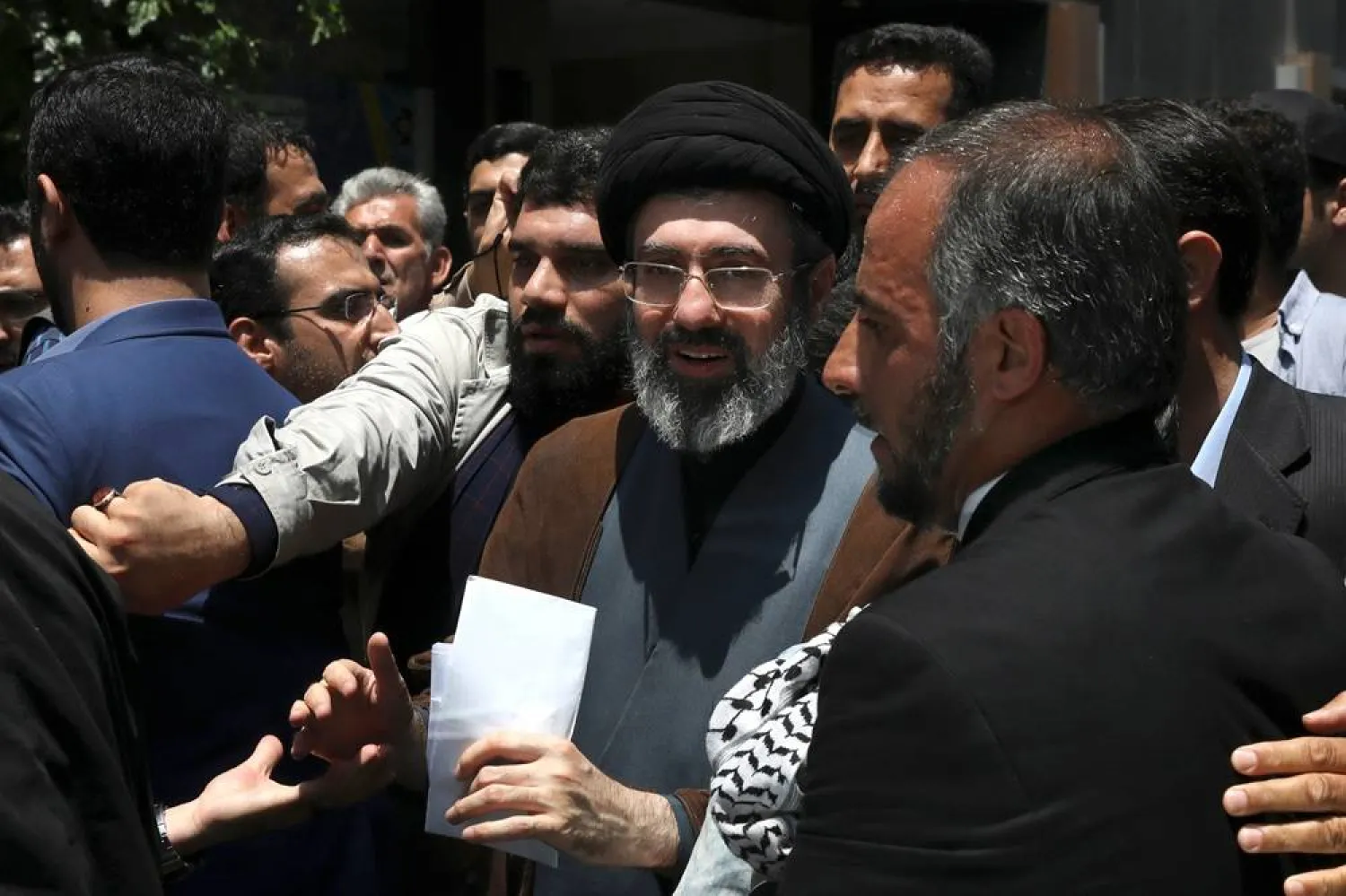
Mojtaba Khamenei, the son of Iranian Supreme Leader Ali Khamenei, center, attends the annual Quds, or Jerusalem Day rally in Tehran, Iran, on May 31, 2019. (AP)
TT

A Son of Iran’s Late Supreme Leader Is a Possible Candidate to Replace His Father as War Rages

Mojtaba Khamenei, the son of Iranian Supreme Leader Ali Khamenei, center, attends the annual Quds, or Jerusalem Day rally in Tehran, Iran, on May 31, 2019. (AP)

Mojtaba Khamenei, a son of Iran's late Supreme Leader Ali Khamenei has long been considered a contender to the post of the country's next paramount ruler — even before an Israeli strike killed his father at the start of the war last week and despite the fact he's has never been elected or appointed to a government position.

A secretive figure within the Islamic Republic, Mojtaba Khamenei has not been seen publicly since Saturday, when the Israeli airstrike targeting the supreme leader's offices killed his 86-year-old father. Also killed were the younger Khamenei's wife, Zahra Haddad Adel, who came from a family long associated with the country's theocracy.

Khamenei is believed to still be alive and has likely has gone into hiding as American and Israeli airstrikes continue to pound Iran, though state-run Iranian media have not reported on his whereabouts.

Profile of Khamenei's son rises after airstrike

Mojtaba Khamenei's name continues to circulate as a possible candidate to replace his father, something that had been criticized in the past as potentially creating a theocratic version of Iran's former hereditary monarchy.

But now with his father and wife considered by hard-liners as martyrs in the war against America and Israel, Khamenei's stock likely has risen with the aging clerics of the 88-seat Assembly of Experts who will select the country's next supreme leader.

Whoever becomes the leader will gain control of an Iranian military now at war and a stockpile of highly enriched uranium that could be used to build a nuclear weapon — should he choose to decree it.

Khamenei had occupied a similar role to that of Ahmad Khomeini, a son of Iran's first Supreme Leader Khomeini — "a combination of aide-de-camp, confidant, gatekeeper and power broker,” according to United Against Nuclear Iran, a US-based pressure group.

Born into dissent

Born in 1969 in the city of Mashhad, some 10 years before the 1979 revolution that would sweep Iran, Khamenei grew up as his father agitated against Shah Mohammad Reza Pahlavi of Iran.

An official biography on Ali Khamenei's life recounts one moment when the shah's secret police, the SAVAK, broke into their home and beat the cleric. Woken up after, Mojtaba and the rest of Khamenei's children were told their father was going on vacation.

“But I told them, ‘There is no need to lie.’ I told them the truth,” the elder Khamenei was quoted as saying.

After the fall of the shah, Khamenei's family moved to Tehran, Iran's capital. Khamenei would go on to fight in the Iran-Iraq war with the Habib ibn Mazahir Battalion, a division of Iran's paramilitary Revolutionary Guard that would see several of its members ascend to powerful intelligence positions within the force, likely with the backing of the Khamenei family.

His father became supreme leader in 1989 and soon Mojtaba Khamenei and his family had access to the billions of dollars and business assets spread across Iran's many bonyads, or foundations funded from state industries and other wealth once held by the shah.

Power rises with his father's

His own power rose alongside his father's, working within his offices in downtown Tehran. US diplomatic cables published by WikiLeaks in the late 2000s began referring to the younger Khamenei as “the power behind the robes.” One recounted an allegation that Khamenei actually tapped his own father's phone, served as his “principal gatekeeper” and had been forming his own power base within the country.

Khamenei “is widely viewed within the regime as a capable and forceful leader and manager who may someday succeed to at least a share of national leadership; his father may also see him in that light,” a 2008 cable read, also noting his lack of theological qualifications and age.

“Mojtaba is, however, due to his skills, wealth, and unmatched alliances, reportedly seen by a number of regime insiders as a plausible candidate for shared leadership of Iran upon his father’s demise, whether that demise is soon or years in the future,” it said.

Khamenei has worked closely with Iran's paramilitary Revolutionary Guard, both with commanders of its expeditionary Quds Force and its all-volunteer Basij that violently suppressed nationwide protests in January, the US Treasury has said.

The United States sanctioned him in 2019 during the first term of USPresident Donald Trump over working to “advance his father’s destabilizing regional ambitions and oppressive domestic objectives.”

That includes allegations that Khamenei from behind the scenes supported the election of hard-line President Mahmoud Ahmadinejad in 2005 and his disputed re-election in 2009 that sparked the Green Movement protests.

Mahdi Karroubi, who was a presidential candidate in 2005 and 2009, denounced Khamenei as “a master's son” and alleged he interfered in both votes. His father reportedly at the time said Khamenei was “a master himself, not a master’s son."

Powers of supreme leader at stake

There has been only one other transfer of power in the office of supreme leader of Iran, the paramount decision-maker since the country’s 1979 revolution. Khomeini died at age 86 after being the figurehead of the revolution and leading Iran through its eight-year war with Iraq.

Now the new leader will come on board after the 12-day war with Israel and as a US-Israeli war with Iran is seeking to eliminate Iran's nuclear threat and military power, hoping also the Iranian people will rise up against the Iranian theocracy.

The supreme leader is at the heart of Iran’s complex power-sharing theocracy and has final say over all matters of state. He also serves as the commander-in-chief of the country’s military and the Guard, a paramilitary force that the United States designated a terrorist organization in 2019, and which his father empowered during his rule.

The Guard, which has led the self-described “Axis of Resistance,” a series of militant groups and allies across the Middle East meant to counter the US and Israel, also has extensive wealth and holdings in Iran. It also controls the country's ballistic missile arsenal.
How Have US Presidents Tapped Strategic Petroleum Reserves During War?

GILLETT, TEXAS - MARCH 11: Pump jacks operate in a field on March 11, 2026 in Gillett, Texas. Brandon Bell/Getty Images/AFP
TT

How Have US Presidents Tapped Strategic Petroleum Reserves During War?

GILLETT, TEXAS - MARCH 11: Pump jacks operate in a field on March 11, 2026 in Gillett, Texas. Brandon Bell/Getty Images/AFP

The US plans to release 172 million barrels of oil from its Strategic Petroleum Reserve, more than 40% of a wider release coordinated with allies, to help dampen prices spiked by supply disruptions from the US-Israeli war on Iran.

The US sale, announced late on Wednesday, is part of a 400-million-barrel release by members of the International Energy Agency. The US Department of Energy said the US drawdown would begin next week and take about four months.

The SPR currently holds about 415 million barrels, most of which is high sulfur, or sour ‌crude, that US ‌refineries are geared to process. The crude is ‌held ⁠underground in hollowed-out salt ⁠caverns on the coasts of Texas and Louisiana that can store 714 million barrels.

Here is how US presidents have tapped the SPR in times of war:

RUSSIA INVADES UKRAINE

In March 2022, the month after Russia invaded Ukraine, former President Joe Biden ordered the release of 180 million barrels over six months - the largest sale ever from the emergency stash. Biden, ⁠and later President Donald Trump, slowly bought some oil ‌to replenish the reserves, but little ‌has been added back as Congress needs to provide more money to ‌do so.

LIBYA CIVIL WAR

In ⁠June 2011, former ⁠President Barack Obama ordered the release of 30 million barrels of oil from the reserve to offset disruptions to global markets from civil war in oil producer Libya. That sale was coordinated with the Paris-based IEA, resulting in an additional 30-million-barrel release from other member countries.

OPERATION DESERT STORM

In 1990-1991, after the Iraqi invasion of Kuwait, former President George H. W. Bush sold about 21 million barrels in two phases. In October 1990, the US ordered a 3.9-million-barrel test sale. In January 1991, after US and allied warplanes began attacks against Baghdad and other military targets in OPEC-member Iraq as part of Operation Desert Storm, Bush ordered the sale of 34 million barrels, of which half was sold.


How Trump and his Advisers Miscalculated Iran’s Response to War

Karoline Leavitt, the White House press secretary, said the administration “had a strong game plan” before the war broke out. Doug Mills/The New York Times
TT

How Trump and his Advisers Miscalculated Iran’s Response to War

Karoline Leavitt, the White House press secretary, said the administration “had a strong game plan” before the war broke out. Doug Mills/The New York Times

By Mark Mazzetti, Tyler Pager, Edward Wong

On Feb. 18, as President Trump weighed whether to launch military attacks on Iran, Chris Wright, the energy secretary, told an interviewer he was not concerned that the looming war might disrupt oil supplies in the Middle East and wreak havoc in energy markets.

Even during the Israeli and US strikes against Iran last June, Wright said, there had been little disruption in the markets. “Oil prices blipped up and then went back down,” he said.

Some of Trump’s other advisers shared similar views in private, dismissing warnings that — the second time around — Iran might wage economic warfare by closing shipping lanes carrying roughly 20% of the world’s oil supply.

The extent of that miscalculation was laid bare in recent days, as Iran threatened to fire at commercial oil tankers transiting the Strait of Hormuz, the strategic choke point through which all ships must pass on their way out of the Arabian Gulf.

In response to the Iranian threats, commercial shipping has come to a standstill in the Gulf, oil prices have spiked, and the Trump administration has scrambled to find ways to tamp down an economic crisis that has triggered higher gasoline prices for Americans.

The episode is emblematic of how much Trump and his advisers misjudged how Iran would respond to a conflict that the government in Tehran sees as an existential threat.

Iran has responded far more aggressively than it did during last June’s 12-day war, firing barrages of missiles and drones at US military bases, cities in Arab nations across the Middle East, and on Israeli population centers.

US officials have had to adjust plans on the fly, from hastily ordering the evacuation of embassies to developing policy proposals to reduce gas prices.

After Trump administration officials gave a closed-door briefing to lawmakers on Tuesday, Senator Christopher S. Murphy, Democrat of Connecticut, said on social media that the administration had no plan for the Strait of Hormuz and did “not know how to get it safely back open.”

Inside the administration, some officials are growing pessimistic about the lack of a clear strategy to finish the war. But they have been careful not to express that directly to the president, who has repeatedly declared that the military operation is a complete success.

Trump has laid out maximalist goals like insisting that Iran name a leader who will submit to him, while Secretary of State Marco Rubio and Defense Secretary Pete Hegseth have described narrower and more tactical objectives that could provide an off-ramp in the near term.

Karoline Leavitt, the White House press secretary, said the administration “had a strong game plan” before the war broke out, and vowed that oil prices would drop after it ended.

“The purposeful disruption in the oil market by the Iranian regime is short term, and necessary for the long-term gain of wiping out these terrorists and the threat they pose to America and the world,” she said in a statement.

This article is based on interviews with a dozen US officials, who asked for anonymity to discuss private conversations.

‘Show Some Guts’

Hegseth acknowledged on Tuesday that Iran’s ferocious response against its neighbors caught the Pentagon somewhat off guard. But he insisted that Iran’s actions were backfiring.

“I can’t say that we anticipated necessarily that’s exactly how they would react, but we knew it was a possibility,” Hegseth said at a Pentagon news conference. “I think it was a demonstration of the desperation of the regime.”

Trump has displayed growing frustration over how the war is disrupting the oil supply, telling Fox News that oil tanker crews should “show some guts” and sail through the Strait of Hormuz.

Some military advisers did warn before the war that Iran could launch an aggressive campaign in response, and would view the US-Israeli attack as a threat to its existence. But other advisers remained confident that killing Iran’s senior leadership would lead to more pragmatic leaders taking over who might bring an end to the war.

When Trump was briefed about risks that oil prices could rise in the event of war, he acknowledged the possibility but downplayed it as a short-term concern that should not overshadow the mission to decapitate the Iranian regime. He directed Wright and Treasury Secretary Scott Bessent to work on developing options for a potential spike in prices.

But the president did not speak publicly about these options — including political risk insurance backed by the US government, and the potential of US Navy escorts — until more than 48 hours after the conflict started. The escorts have not yet taken place.

As the conflict has roiled global markets, Republicans in Washington have grown concerned about rising oil prices damaging their efforts to sell an economic agenda to voters ahead of the midterm elections.

Trump, both publicly and privately, has been arguing that Venezuelan oil could help solve any shocks coming from the Iran war. The administration announced on Tuesday a new refinery in Texas that officials said could help increase oil supply, ensuring that Iran does not cause any long-term damage to oil markets.

A Potential Off-Ramp

Trump has said both that the war could go on for more than a month and that it was “very complete, pretty much.” He also said the United States would “go forward more determined than ever.”

Rubio and Hegseth, however, appear to have coordinated their messaging for now on three discrete goals that they began laying out in public remarks on Monday and Tuesday.

“The goals of this mission are clear,” Rubio said at a State Department event on Monday before Trump held his own news conference. “It is to destroy the ability of this regime to launch missiles, both by destroying their missiles and their launchers; destroy the factories that make these missiles; and destroy their navy.”

The State Department even laid out the three goals in bullet-point fashion, and highlighted a video clip of Rubio stating them on an official social media account.

The presentation by Rubio, who is also the White House national security adviser, appeared to be setting the stage for the president to bring an end to the war sooner rather than later. In his news conference, Trump boasted of how the US military had already destroyed Iran’s ballistic missile capability and its navy. But he also warned of even more aggressive action if Iranian leaders tried to cut off the world’s energy supply.

Matthew Pottinger, who was a deputy national security adviser in the first Trump administration, said in an interview that Mr. Trump had indicated he could decide to pursue ambitions war goals that would take weeks at least.

“In his press conference, I could hear him circling back to a rationale for fighting a bit longer given that the regime is still signaling it won’t be deterred and is still trying to control the Strait of Hormuz,” said Pottinger, now the chair of the China program at the Foundation for Defense of Democracies, a group that advocates a close US partnership with Israel and confrontation with Iran.

“He doesn’t want to have to fight a ‘sequel’ war,” Pottinger added.

The search for pathways out of the war has gained urgency since the weekend, as global oil prices surge and as the United States burns through costly munitions.

Pentagon officials said in recent closed-door briefings on Capitol Hill that the military used up $5.6 billion of munitions in the first two days of the war alone, according to three congressional officials. That is a far larger amount and munitions burn rate than had been publicly disclosed. The Washington Post reported on the figure on Monday.

Iranian officials have remained defiant, saying they will use their leverage over the world’s oil supply to force the United States and Israel to blink.

“Strait of Hormuz will either be a Strait of peace and prosperity for all,” Ali Larijani, Iran’s top national security official, said in a social media post on Tuesday. “Or it will be a Strait of defeat and suffering for warmongers.”

The New York Times


Saudi Flag Narrative Centers on Justice, Security

Saudi flag’s profound symbolism reflects unity, justice, strength and prosperity (SPA)
TT

Saudi Flag Narrative Centers on Justice, Security

Saudi flag’s profound symbolism reflects unity, justice, strength and prosperity (SPA)

Ensuring a certain level of security is not difficult for any state, regardless of its system of governance. Security, understood here as the preservation of order, can exist under many political systems. History shows that numerous authoritarian governments have succeeded in imposing strict security on their societies.

The real question, however, lies not in the existence of security but in its nature and its source. The issue is whether the desired security is that of authority imposed by force, or that of justice arising from a system of values and a fair legal order.

Security under authoritarian systems is often superficial, enforced through mechanisms of control, surveillance and punishment. It is inherently fragile because it relies on fear rather than consent, and deterrence rather than justice. Such security remains vulnerable to disruption at the first shift in the balance of power or legitimacy, as many historical examples demonstrate.

By contrast, another form of security is more stable and enduring, the security that stems from justice. This emerges when society believes that the rule governing it is fair and that the authority enforcing it is subject to a higher reference rather than an unchecked will.

National flags often reflect a country’s identity, principles and values, as well as the orientation of its political or intellectual systems. They may also contain symbols carrying religious, historical or cultural significance.

The flag of the Kingdom of Saudi Arabia stands apart not only for its color and symbols but also for its meanings and implications. It reflects the state’s deep-rooted history, embodies its identity and represents the values and principles on which it was founded.

Saudi Flag Day, observed annually on March 11, highlights the close bond between Saudis and their national banner and reflects their pride in their identity.

Custodian of the Two Holy Mosques King Salman bin Abdulaziz has said that celebrating Flag Day affirms pride in national identity and in the flag’s historical symbolism and deep meanings that embody the country’s constants and represent a source of pride in its history.

He has also said that the Saudi state was founded by its forefathers on the principles of monotheism, justice and unity under one banner, a foundation that brought security and prosperity.

Saudi researcher and historian Dr. Abdullah Al-Munif said the Saudi flag is not merely a sovereign symbol of the state but also an expression that carries deep significance for the state’s philosophy and vision for life and society.

“The green color, which symbolizes Islam and prosperity, reflects support for a state founded on an Islamic approach with a commitment to justice and to spreading security in its comprehensive sense,” he said.

“The phrase ‘There is no god but God, Muhammad is the Messenger of God’, inscribed in Arabic, highlights the enduring foundation upon which the state stands and affirms its commitment to an approach that does not deviate from this reference as a basic guide for governance and politics.”

He added that the sword, which symbolizes strength and the pursuit of justice, reflects the state’s effort to protect the path it believes is right, with the aim of spreading justice and establishing security across the country.

“These three elements are not merely formal components but form a precise equation linking justice and security in a cause-and-effect relationship,” he said.

“The Islamic approach represents the spiritual and social foundations of the state that seeks to achieve justice and stability, ensure security and provide an environment suitable for promoting what is right.”

In this sense, the Saudi flag becomes a symbol of the dynamic interaction among the components of the state. The state seeks to achieve security as a necessity for establishing and spreading what is right, while also pursuing justice and stability as the basis for comprehensive security and sustainable prosperity.

The Saudi flag can therefore be read historically as more than a sovereign symbol. It symbolizes the state’s vision. The three elements that compose it, the green color, the inscription and the sword, reflect a precise equation between justice and security in a cause-and-effect relationship.

Legal expert Dr. Fahd Al-Tarisi said the phrase at the center of the flag represents the system’s supreme reference.

“It is a clear declaration that the justice on which governance is based is not the product of a temporary political will but rests on a fixed religious reference,” he said.

“The presence of this phrase at the center of the flag therefore means that law and justice derive their source from a higher system of values rather than from political authority alone.”

He added that the sword placed beneath the phrase does not symbolize violence or domination but rather the authority to enforce justice.

“Every legal system needs power to protect it and ensure respect for it, otherwise it remains merely text,” he said. “The sword therefore symbolizes the power that protects the principle, not the power that replaces it.”

He said the placement of the sword beneath the phrase reflects a symbolic order in which power serves justice rather than replacing it.

The green color that fills the flag, historically associated in Islamic culture with calm, stability and reassurance, can symbolize the social security that emerges when justice prevails in political and legal systems.

In this reading, the symbolism of the Saudi flag presents a clear equation: the reference establishes justice, power protects that justice, and from this arises the security and stability of society.

This distinction highlights two types of security: the security of authority, imposed by force and often present in authoritarian systems, and the security of justice, which arises naturally when the rules governing society are fair and enjoy moral and legal legitimacy.

Within this framework, the symbolic structure of the Saudi flag presents a clear vision of the state. Security is not the starting point but the result. The cause that leads to it is justice protected by legitimate power within a stable reference.

In that sense, the flag becomes more than a national emblem. It becomes a visual expression of a philosophy of governance that sees true stability not as something built on fear but as the outcome of justice that produces security.

For Saudis, the flag reflects the needs and aspirations of the Saudi citizen, summarized in the values of justice, stability, security and prosperity.

In celebrating Flag Day, Saudis celebrate a nation that sees its strength in unity, a leadership that places service to its people among its top priorities, and a banner under which people and leadership have stood together for centuries.