


Anti-Hamas Groups Vow to Fight On as Movement Warns

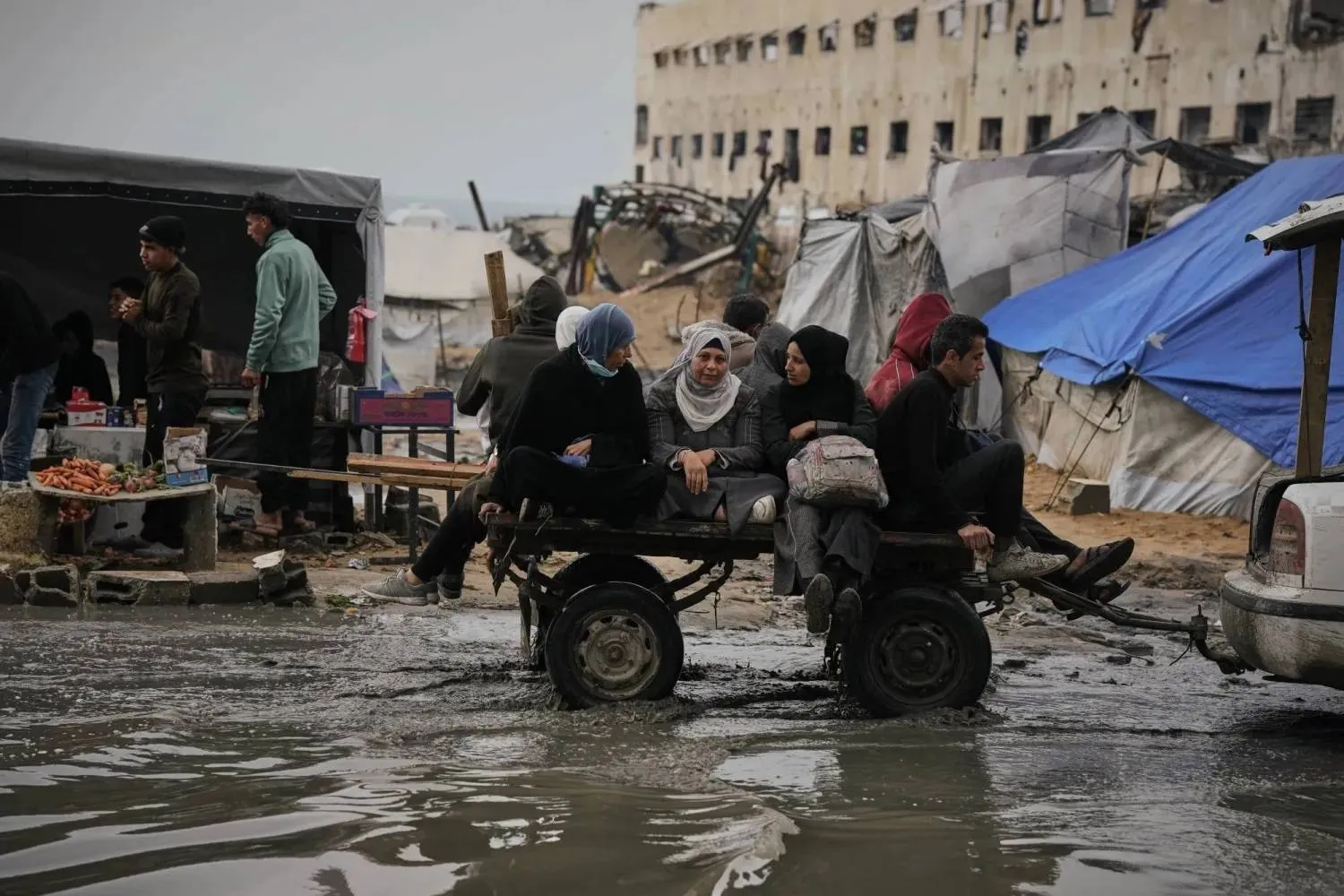
Palestinians ride in a car-drawn cart through a flooded street after a storm in Gaza City on Wednesday (AP)
TT

Anti-Hamas Groups Vow to Fight On as Movement Warns

Palestinians ride in a car-drawn cart through a flooded street after a storm in Gaza City on Wednesday (AP)

Groups operating in Israeli controlled pockets of the Gaza Strip say they will press ahead with their fight against Hamas despite the killing of their most senior commanders, insisting that they have expanded their ranks with new recruits since the October ceasefire as they seek a foothold in Gaza’s political future.

Their emergence, still modest in size and influence, has added a new layer of pressure on Hamas and threatens to complicate efforts to stabilise and reunify a territory battered and divided by two years of war.

Israeli Prime Minister Benjamin Netanyahu acknowledged in June that Israel had supported anti Hamas groups, saying Israel had “activated” some tribal linked factions, although Israeli authorities have given few details since then.

Hamas sources told Asharq Al-Awsat that the campaign against what they called “armed gangs collaborating with Israel” would continue through various means. One source said Israel’s attempt to promote and empower such groups “failed from the outset” because they had not posed any meaningful challenge capable of threatening the movement.

Last week, Yasser Abu Shabab, widely seen as the central figure in efforts to form anti-Hamas forces in the southern city of Rafah, was killed. The Popular Forces group he led said he died while trying to mediate a family dispute, without disclosing who shot him. His deputy, Ghassan al-Dahini, has taken charge and vowed to continue the same path.

Hamas, which has run Gaza since 2007, has so far refused to disarm under the ceasefire plan and has described its opponents as Israeli “agents”, a view that Palestinian analysts say enjoys broad public support.

The movement acted quickly against Palestinians who challenged its authority after the United States backed ceasefire took effect in October, killing dozens of people including some it accused of collaborating with Israel.

Hamas consolidates control

Almost all of Gaza’s roughly two million residents live in areas under full Hamas control, where the group is reasserting its hold. Four Hamas sources said it still commands thousands of fighters despite heavy losses during the war.

Hamas figures told Asharq Al-Awsat that Israel has failed to eliminate the movement during two years of war and that Hamas retains its manpower and much of its military infrastructure to varying degrees.

Residents in areas west of the yellow line that separates Hamas held zones from Israeli controlled territory say the group deploys security forces including police and other agencies, and at night members of the Qassam Brigades, to maintain order and prevent infiltration by Israeli special units.

One source stressed that preserving the group’s strength “does not mean we insist on keeping control of the Strip or prolonging the war. We are committed to completing the agreement stages through a Palestinian national consensus”.

Israel still controls more than half the enclave, areas where Hamas’s rivals are active outside the group’s reach. With implementation of President Donald Trump’s Gaza plan moving slowly, there are no signs of further Israeli withdrawals for now.

Anti-Hamas forces expand

Three Egyptian security and military sources said Israeli backed groups have stepped up activity since the ceasefire. They estimated their numbers at around one thousand fighters, up by four hundred since the truce began.

Egypt plays a central role in negotiations to end the conflict. The sources said these groups are likely to escalate operations in the absence of a comprehensive agreement on Gaza’s future.

A diplomat who requested anonymity said the factions lack any popular base but added that their emergence raises concerns about Gaza’s stability and heightens the risk of Palestinian infighting.

Since Abu Shabab’s death, his faction and two others have released videos showing gatherings of dozens of fighters.

On December 7, al-Dahini said two men were executed in late November. He described them as Hamas fighters and said they had killed a Popular Forces member.

A senior security official in the armed factions alliance led by Hamas in Gaza said the killing of a “collaborator”, along with the group’s public display of images, was an empty victory. “It will not change the facts on the ground,” he said.

Tactical motives

Witnesses said some Palestinians in nearby Khan Younis celebrated Abu Shabab’s death by handing out sweets.

Ghassan al-Khatib, a lecturer in international studies at Birzeit University in the occupied West Bank, said that although Hamas’s popularity has declined due to the impact of the war, the anti Hamas factions have no future because Palestinians view them as collaborators.

“Israel uses them only for tactical reasons, especially to undermine Hamas’s control,” he said.

A spokesman for Fatah, the movement led by Palestinian President Mahmoud Abbas and which Hamas ousted from Gaza, said it rejects any armed groups backed by Israel.

He said such factions have no connection “to our people or to our national institutions, neither directly nor indirectly”.

Coordination with Israel

Hussam al-Astal, who heads another anti-Hamas faction based in Khan Younis, said he and al-Dahini agreed to continue what he called the “war on terrorism” during a visit to Abu Shabab’s grave in Rafah. He added, “Our project, New Gaza, will continue”.

In a separate phone call with Reuters in late November, al-Astal said his group had received weapons, money and other support from international friends whose identities he declined to reveal.

He denied receiving military assistance from Israel but confirmed contacts with Israeli authorities for coordinating the entry of food and all the resources we need to survive.

He said he was speaking from inside Gaza in the Israeli controlled zone near the yellow line where Israeli forces have pulled back. Al-Astal said the group has recruited new members since the truce and now has several hundred personnel including fighters and civilians.

A source close to the Popular Forces also said the group had seen significant growth in its ranks but gave no figures.

The Popular Forces did not respond to messages seeking comment via its Facebook page. The group previously denied receiving Israeli support.

Housing complexes

Beyond the disarmament of Hamas, the Trump plan calls for the creation of a transitional authority, deployment of a multinational force and reconstruction of the enclave.

But with no clarity on next steps, concerns are growing over a de facto partition between an interior area under Israeli control with few inhabitants and a coastal zone packed with displaced Palestinians and largely reduced to rubble.

During a tour of Gaza on Sunday, Israeli army chief of staff Eyal Zamir said Israel “controls wide parts of the Gaza Strip and we will remain on those defensive lines”.

Anti-Hamas factions have said their objectives include creating safe zones for displaced Gazans.

In October, United States Vice President JD Vance and Trump’s son in law Jared Kushner said reconstruction funds could flow into Israeli controlled areas without waiting for the next phase of the plan, aiming to create model zones for Gazan residents.

According to two Israeli officials and three Western diplomats involved in planning for Gaza’s post war phase, Rafah is among the first sites identified by United States officials for such housing compounds, described as “alternative safe clusters”, although no timeline has been set.

A United States State Department spokesperson said Washington is working with partners “to provide housing and other services to the people of Gaza as quickly as possible”.

A United States official said Washington has had no formal contact with anti-Hamas groups and “provides no funding or support”.

They added that the US is not choosing winners or losers in Gaza. Aside from the exclusion of any future role for Hamas, it will be up to the people of Gaza to determine who governs Gaza.



Syria Welcomes Repeal of the ‘Caesar Act,’ Sees Step Toward Economic Recovery and Reconstruction

People gather during a march marking the first anniversary of the overthrow of Bashar al-Assad’s regime in Idlib (EPA)
TT

Syria Welcomes Repeal of the ‘Caesar Act,’ Sees Step Toward Economic Recovery and Reconstruction

People gather during a march marking the first anniversary of the overthrow of Bashar al-Assad’s regime in Idlib (EPA)

Syria’s Foreign Ministry on Thursday welcomed a vote by the US House of Representatives a day earlier in favor of repealing the Caesar Act, under which the United States imposed sanctions on former Syrian president Bashar al-Assad’s regime, describing the move as a “pivotal milestone” that opens a new path for cooperation.

In a statement, the ministry said the House vote, along with an anticipated vote in the US Senate next week, lays the groundwork for “a phase of tangible improvement in import activity, the availability of basic goods and medical supplies, and the creation of suitable conditions for reconstruction projects and the revitalization of the national economy.”

“This development represents a pivotal milestone in rebuilding trust and opening a new path for cooperation, paving the way for broader economic recovery and the return of opportunities that the Syrian people were denied for years as a result of sanctions,” the statement added.

The ministry expressed hope that the forthcoming Senate vote would lead to “the completion of the full repeal of the restrictive framework and the opening of new horizons for cooperation” between Syria and the United States.

The US House of Representatives has approved the repeal of sanctions imposed on Syria under the Caesar Act, a step that effectively clears the way to close the sanctions file and enables international and financial institutions to resume dealings with Damascus.

The move came after the House approved the US National Defense Authorization Act (NDAA), which includes provisions repealing the Caesar Act sanctions. The NDAA is expected to be passed by the end of the year and signed into law by President Donald Trump.

The Caesar Act, enacted in 2019, imposed sweeping sanctions on Syria targeting individuals, companies and institutions linked to Assad, who ruled the country from 2000 until his ouster in 2024 by armed opposition factions led by Ahmed al-Sharaa, the country’s current president.


Al-Alimi Calls for Containing Escalation in Eastern Yemen, Praises Saudi Role

 
Caption: Soldiers loyal to Yemen’s Southern Transitional Council inspect a truck outside the presidential palace complex in Aden (Reuters)
  Caption: Soldiers loyal to Yemen’s Southern Transitional Council inspect a truck outside the presidential palace complex in Aden (Reuters)
TT

Al-Alimi Calls for Containing Escalation in Eastern Yemen, Praises Saudi Role

 
Caption: Soldiers loyal to Yemen’s Southern Transitional Council inspect a truck outside the presidential palace complex in Aden (Reuters)
  Caption: Soldiers loyal to Yemen’s Southern Transitional Council inspect a truck outside the presidential palace complex in Aden (Reuters)

Yemen’s Presidential Leadership Council Chairman Rashad al-Alimi on Thursday urged political, tribal and social forces in the eastern provinces of Hadramawt and Al-Mahra to close ranks behind state efforts and local authorities to contain the fallout from the recent security and military escalation.

While praising Saudi Arabia’s role in easing tensions, al-Alimi warned of the repercussions of continued unrest on Yemen’s economic and living conditions, noting early warning signs, including the International Monetary Fund’s announcement that it has suspended key activities in the country due to the deteriorating security environment.

A source in the presidential office said al-Alimi, during two phone calls with Hadramawt Governor Salem al-Khanbashi and Al-Mahra Governor Mohammed Ali Yasser, stressed the need for all forces brought in from outside the two provinces to withdraw, and for local authorities to be fully empowered to carry out their security and service responsibilities in line with the constitution and the law.

He also reiterated earlier directives to conduct a comprehensive investigation into all human rights violations linked to what he described as the Southern Transitional Council’s “unilateral measures,” including arbitrary arrests, enforced disappearances, and attacks on public and private property, emphasizing accountability and an end to impunity.

Al-Alimi cautioned against any further escalation that could lead to more bloodshed and deepen the economic and humanitarian crisis, stressing that the national priority must remain confronting the Iran-backed Houthi militia, which he described as the greatest threat to security and stability.

He commended Saudi efforts to de-escalate tensions and support stability in Hadramawt and Al-Mahra, affirming the state’s full backing for these initiatives and its commitment to strengthening the role of local authorities in safeguarding social peace and citizens’ interests.

According to the presidential source, al-Alimi underscored the need to restore conditions in the two provinces to their pre-escalation state, respect the frameworks governing the transitional period, and enable the government and local authorities to fulfill their constitutional duties.

He warned that the severe living conditions facing Yemenis “cannot withstand the opening of additional internal fronts,” calling on all parties to prioritize the public interest and preserve national gains, ensuring focus remains on the main battle against the Houthis and allied terrorist groups.

The appeal comes amid broader rejection of unilateral actions in the east. Parliament issued a statement condemning any military moves outside national consensus, describing recent developments as a “clear violation of constitutional legitimacy” and the powers of the Presidential Leadership Council.

Lt. Gen. Mohammed al-Qahtani, who headed a Saudi delegation that visited Hadramawt, stressed that Riyadh rejects “any attempts to impose a fait accompli by force” in the two provinces and supports restoring conditions to what they were prior to the escalation.

Al-Qahtani said Saudi Arabia, as leader of the Coalition to Support Legitimacy in Yemen, is working to resolve the crisis through a series of measures agreed upon with all parties, including the Southern Transitional Council.


Iran’s Araqchi to Visit Beirut After Lebanese FM Declines Trip to Tehran

Iranian Foreign Minister Abbas Araqhchi looks on during a press conference in Istanbul, Türkiye, June 22, 2025. REUTERS/Umit Bektas/File Photo
TT

Iran’s Araqchi to Visit Beirut After Lebanese FM Declines Trip to Tehran

Iranian Foreign Minister Abbas Araqhchi looks on during a press conference in Istanbul, Türkiye, June 22, 2025. REUTERS/Umit Bektas/File Photo

Iran's foreign minister, Abbas Araqchi, said on Thursday he would travel to Beirut for talks after receiving a formal invitation from his Lebanese counterpart, who a day earlier had declined to visit Tehran for direct talks.

On Wednesday, Lebanese Foreign Minister Youssef Raji said "current conditions" prevented him from travelling to Tehran, but stressed that the move did not mean rejection of dialogue with Iran.

Raji told Reuters late on Wednesday that he had invited Araqchi "in a formal diplomatic letter to come to Beirut to hold talks."

Araqchi said on X that he would "gladly accept the invitation to come to Beirut," although he said he found Raji's position "bemusing." He said foreign ministers of countries with "full diplomatic relations" did not need a neutral venue to meet.

"Subjected to Israeli occupation and blatant 'ceasefire' violations, I fully understand why my esteemed Lebanese counterpart is not prepared to visit Tehran," Araqchi added.

Raji said on Wednesday that Lebanon was ready to open a new phase of relations with Iran based on mutual respect, sovereignty and non-interference.

He added that no strong state could be built unless the government held the exclusive right to bear arms, in an apparent reference to calls to disarm Hezbollah, the Iran-aligned Lebanese armed group.