



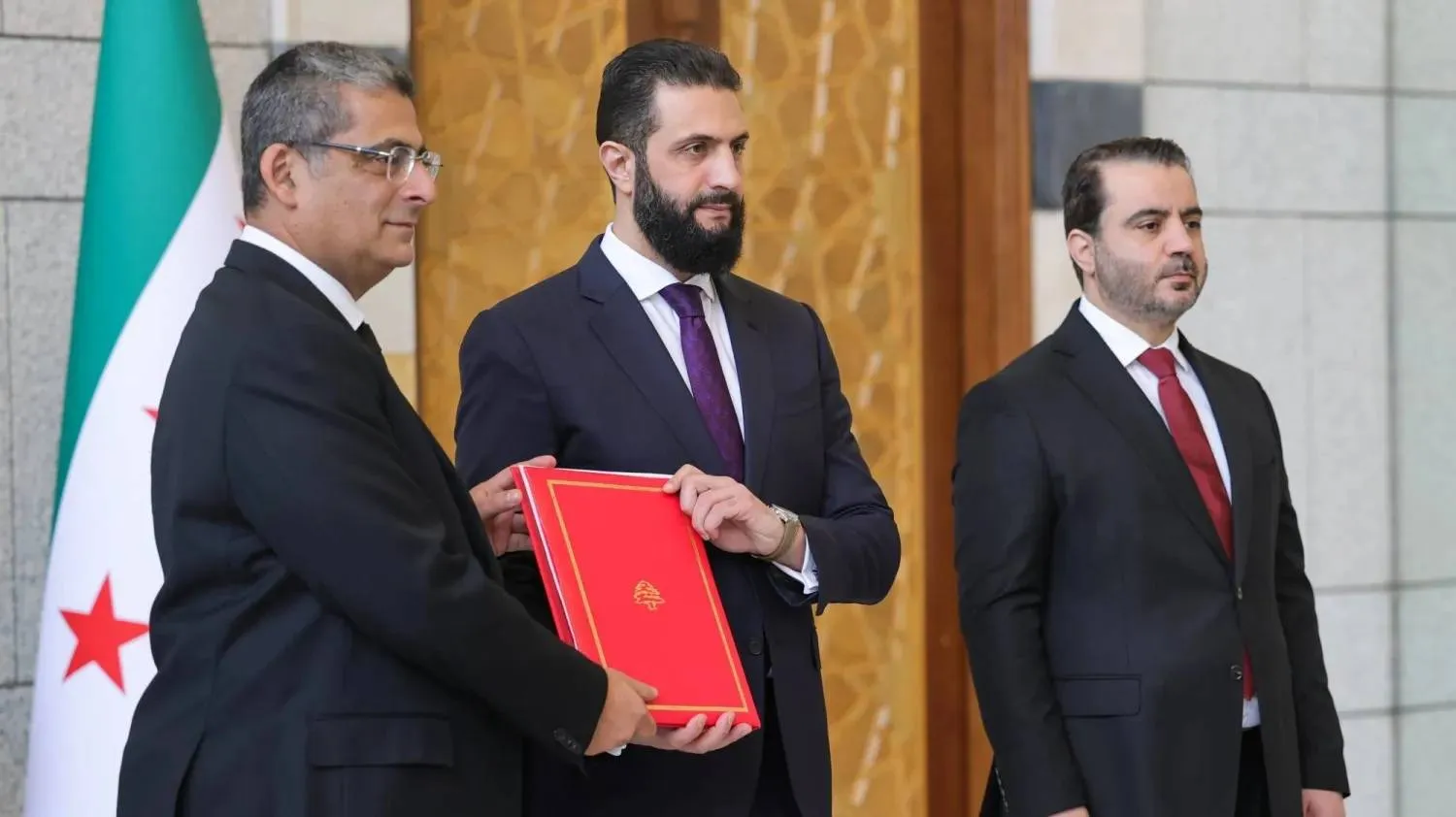

The appointment of Lebanese ambassador Henry Kastoun in Damascus, formalized Wednesday when he presented his credentials to Syrian President Ahmed al-Sharaa, signals a significant reset in relations between Lebanon and Syria.
It ends a four year diplomatic vacuum and opens a new chapter in which both governments are expected to confront long standing issues, including the fate of Syrian detainees in Lebanon, the refugee crisis, and cross border smuggling, in a bid to place the relationship on firmer and more transparent footing.
Representation after vacancy
The Syrian presidency said on Wednesday that al-Sharaa received the credentials of Ambassador Kastoun, Lebanon’s envoy to the Syrian Arab Republic, at the People’s Palace in Damascus, in the presence of Foreign Minister and Expatriates Asaad al Shibani.
Kastoun fills a four year vacancy, arriving seventeen years after the establishment of full diplomatic representation between the two countries. Diplomatic ties were formalized in 2008 when Michel el-Khoury was appointed Lebanon’s first ambassador to Syria since independence, a historic step that ended decades of uneven representation.
El-Khoury remained in the post until late 2013, after which the position remained vacant until 2017, when Saad Zakhia took over as the second ambassador and served until the end of 2021.
His term was followed by a second diplomatic void that lasted until Kastoun’s appointment in 2025, restoring the Lebanese diplomatic presence in Damascus.
Amending the relationship
While the appointment ushers in a new path for official engagement, Deputy Prime Minister Tarek Mitri had earlier said that diplomatic exchange would resume soon, noting that the past five decades witnessed an unequal relationship between Lebanon and Syria.
The current phase allows for opening a new diplomatic page based on reciprocity and mutual respect.
It follows the suspension of the Higher Council in October 2024, coinciding with a visit by Syrian Foreign Minister Asaad al-Shaibani to Beirut, during which he spoke of a historic opportunity to shift the relationship from a troubled security driven trajectory to a political and economic partnership.
At the time, authorities announced the suspension of the Lebanese-Syrian Higher Council, which for decades served as the central mechanism for managing joint issues during the period of Syrian influence in Lebanon, a sign of an evolving approach rather than a continuation of previous institutional frameworks.
Detainees
In parallel with the diplomatic step, a senior Lebanese judicial delegation visited Damascus on Wednesday to discuss a draft agreement that would allow the transfer of detainees and convicts to their home countries in a manner that does not conflict with Lebanese law, according to local media reports.
The delegation was headed by Government Commissioner to the Military Court Judge Claude Ghanem and included Judges Mona Hanqir and Jad Maalouf. They met Syrian Justice Minister Mazhar al-Weis and senior judicial officials.
Lebanon’s Al-Jadeed television said the two sides reached an initial draft that requires amendments before final approval. The talks did not cover the cases of convicts involved in fighting against the Lebanese army.


