


Chocolate Prices High Before Christmas Despite Cocoa Fall

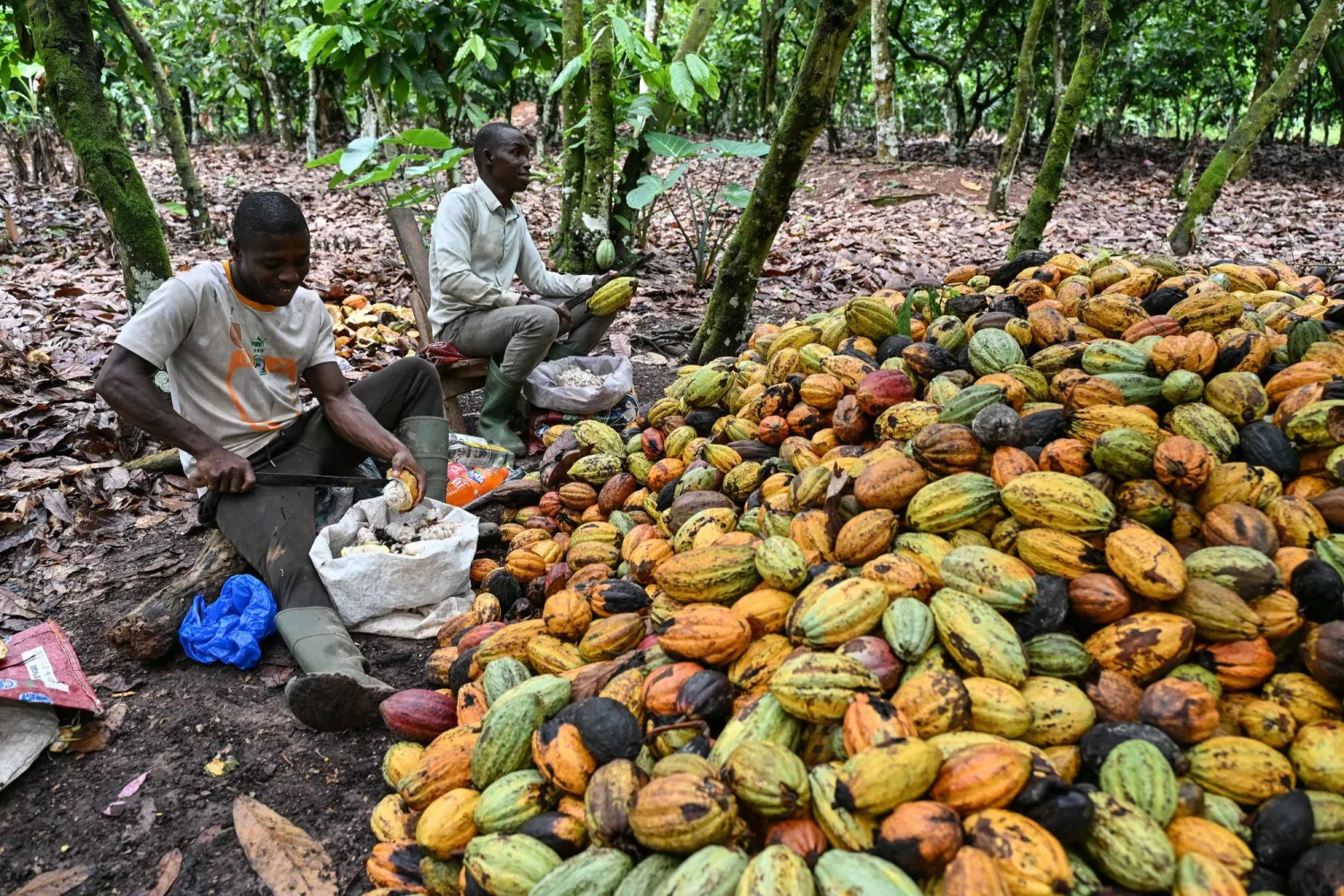
Producers harvest cocoa on a plantation in Agboville, in the Agneby-Tiassa region of Ivory Coast, on December 4, 2025. (Photo by Sia KAMBOU / AFP)
TT

Chocolate Prices High Before Christmas Despite Cocoa Fall

Producers harvest cocoa on a plantation in Agboville, in the Agneby-Tiassa region of Ivory Coast, on December 4, 2025. (Photo by Sia KAMBOU / AFP)

After soaring for nearly two years, cocoa prices dropped sharply in 2025. However, chocolate, in demand ahead of the festive holiday season, has seen prices rise.

AFP examines the reasons for the divergence and the current state of the cocoa market.
Ivory Coast and Ghana are the world's biggest suppliers of pods -- the fruit of the cocoa tree -- from which cocoa beans are extracted to make chocolate.

The two west African countries account for more than half of global production, with most of the remainder coming from Brazil, Cameroon, Ecuador, Indonesia and Nigeria.

The geographic concentration of plantations makes the cocoa market highly vulnerable to West Africa's weather patterns and tree diseases.

Cultivation is meanwhile carried out by a very large number of independent smallholders.

Cocoa harvests between 2021 and 2024 failed to meet demand, which sent prices soaring.

"That was the result of ... supply side issues like ageing trees, the spread of swollen shoot virus (and) the spread of black pot disease" in Ghana and Ivory Coast, Rabobank analyst Oran van Dort told AFP.

Low usage of fertilizer and pesticides, owing to farmers' low incomes, also contributed, he added.

In December 2024, cocoa prices reached $12,000 per ton in New York trading, having stood at between $1,000 and $4,000 since the 1980s.

In Ghana and Ivory Coast, cocoa prices -- which rose significantly this year after having remained unchanged for a long time -- are set by the countries' respective governments.

"For the first time in years, I feel like we are farming with the government behind us, not on our own," Ghanaian producer Kwame Adu, 52, told AFP.

Higher income has allowed producers to buy fertilizer and machinery, improving their harvests -- and to plant new trees.

"Last year went well because as the cocoa was to bear fruit the rains came," Jean Kouassi, a 50-year-old Ivorian farmer, told AFP.

He owns plantations measuring four hectares, the size of nearly six football pitches.

"Record-high raw material costs (have) forced chocolate manufacturers into a series of unpopular choices: shrinkflation, price increases and the quiet dilution of cocoa content," noted Saxo Bank analyst Ole Hansen.

UK snack brand McVitie's recently disclosed that Penguin and Club bars are no longer classed as chocolate having reduced their cocoa content because of elevated prices.
They are instead each described as "chocolate flavor".

It is a major reversal especially for Club, whose advertising campaigns carried the slogan: "If you like a lot of chocolate on your biscuit, join our club."

Chocolate giants Ferrero, Mars, Mondelez and Nestle have meanwhile seen demand weaken, having raised the prices of their treats.

However, cocoa prices have retreated strongly compared to one year ago, with New York prices at around $6,000 per ton.

"The current slump arrives far too late to affect Christmas assortments already produced and priced months ago," said Hansen.

Nestle told AFP that "it is still too early to comment on specific changes regarding prices" in the wake of cocoa's drop.

"Recent shifts in cocoa prices are encouraging, but the market remains volatile," it added.

There is hope, however, for Easter eggs and chocolate bunnies set to hit shop shelves soon after Christmas, said Hansen -- but only if the market stabilizes around current levels, he added.


Punch the Baby Monkey Isn’t Being Bullied, Says Japan Zoo

 Punch, right a Japanese macaque born on July 26, 2025, sits with others in the monkeys' playground at the Ichikawa city zoo in Tokyo's eastward neighboring city, Tuesday, March 3, 2026. (AP)
Punch, right a Japanese macaque born on July 26, 2025, sits with others in the monkeys' playground at the Ichikawa city zoo in Tokyo's eastward neighboring city, Tuesday, March 3, 2026. (AP)
TT

Punch the Baby Monkey Isn’t Being Bullied, Says Japan Zoo

 Punch, right a Japanese macaque born on July 26, 2025, sits with others in the monkeys' playground at the Ichikawa city zoo in Tokyo's eastward neighboring city, Tuesday, March 3, 2026. (AP)
Punch, right a Japanese macaque born on July 26, 2025, sits with others in the monkeys' playground at the Ichikawa city zoo in Tokyo's eastward neighboring city, Tuesday, March 3, 2026. (AP)

A Japanese zoo caring for a baby monkey who has become an internet sensation was forced to issue a statement denying he was being bullied, following an outpouring of concern online.

Punch, a seven-month-old baby macaque, was abandoned by his mother and shot to stardom after he began clinging to a plush orangutan toy from IKEA for comfort at Ichikawa City Zoo outside Tokyo.

But after the zoo posted on X last month that Punch "had been scolded many times by other monkeys", videos showing him being chased by members of the troop were spread online, alongside claims that he was being bullied.

"As a result, we have received many voices of concern from people both in Japan and overseas," the zoo said in a statement Tuesday.

The zoo added that Punch was becoming less reliant on the stuffed orangutan toy because increasing numbers of monkeys were looking after or playing with him.

"While dominant individuals may show disciplining actions toward their subordinates, as macaques do naturally, these actions in the macaque society 'differ from human abuses'," it said.

"Punch spends most of the day peacefully," the zoo added.

The zoo also warned that "Punch has become accustomed to living in this troop, so separating him now would create the risk that he would never be able to return to the group and would have to continue living that way for the rest of his life".

Spurned by its mother, Punch was raised in an artificial environment after being born in July, and began training to rejoin his troop earlier this year.

Punch's predicament sparked huge interest online, spawning a devoted fanbase under the hashtag #HangInTherePunch, as large crowds thronged the zoo, and sales of his IKEA orangutan toy boomed.

However, animal rights group People for the Ethical Treatment of Animals (PETA) said Punch's plight has highlighted the cruelty of zoos and called for his relocation to a "reputable sanctuary, where he could live in a more natural environment".


Thousands of Authors Publish ‘Empty’ Book to Protest AI Using their Work

Thousands of authors published an “empty” book to protest AI (Shutterstock)
TT

Thousands of Authors Publish ‘Empty’ Book to Protest AI Using their Work

Thousands of authors published an “empty” book to protest AI (Shutterstock)

Thousands of authors including Kazuo Ishiguro, Philippa Gregory and Richard Osman have published an “empty” book to protest against AI firms using their work without permission.

About 10,000 writers have contributed to Don’t Steal This Book, in which the only content is a list of their names.

Copies of the work were distributed to attenders at the London book fair on Tuesday, a week before the UK government is due to issue an assessment on the economic cost of proposed changes in copyright law.

By March 18, ministers must deliver an economic impact assessment as well as a progress update on a consultation about the legal overhaul, against a backdrop of anger among creative professionals about how their work is being used by AI firms.

The organizer of the book, Ed Newton-Rex, a composer and campaigner for protecting artists’ copyright, said the AI industry was “built on stolen work ... taken without permission or payment.”

He added: “This is not a victimless crime – generative AI competes with the people whose work it is trained on, robbing them of their livelihoods. The government must protect the UK’s creatives, and refuse to legalize the theft of creative work by AI companies.”

Other authors who have contributed their names to the book include the Slow Horses author, Mick Herron; the author Marian Keyes; the historian David Olusoga; and Malorie Blackman, the writer of Noughts and Crosses.

“It is not in any way unreasonable to expect AI companies to pay for the use of authors’ books,” said Blackman.


Wildlife to Replace Humans on Next Series of UK Banknotes

Banknotes and coins that feature an image of Britain's King Charles III are pictured on display during a photocall for "The Future of Money" exhibition, at the Bank of England Museum, City of London, UK, Feb. 27, 2024. (AFP)
TT

Wildlife to Replace Humans on Next Series of UK Banknotes

Banknotes and coins that feature an image of Britain's King Charles III are pictured on display during a photocall for "The Future of Money" exhibition, at the Bank of England Museum, City of London, UK, Feb. 27, 2024. (AFP)

Images of ‌animals will feature on the next series of banknotes from the Bank of England, as the central bank shifts away from historical figures such as William Shakespeare, Winston Churchill and Jane Austen over the coming years.

"Nature is a great choice from a banknote authentication perspective and means we can showcase the UK's rich and varied wildlife on the next series of ‌banknotes," Victoria ‌Cleland, the BoE's chief cashier, said.

Bank ‌of ⁠England banknotes have ⁠featured monarchs since Queen Elizabeth first appeared on one in 1960, while Shakespeare was the first historic figure to appear in 1970.

King Charles' portrait will continue to appear on the next series of notes as well, the ⁠BoE said.

The BoE held a ‌consultation on a change ‌to the design of banknotes in July 2025, ‌inviting views from the public.

The theme of ‌nature was supported by 60% of the 44,000 responses, narrowly beating the category of "architecture and landmarks" on 56% and "notable historical figures" on 38%. Other categories included "arts, ‌culture and sport", "innovation" and "noteworthy milestones".

The new notes will feature wildlife native ⁠to ⁠the United Kingdom and will not include household pets, the BoE said. It plans to run a second consultation in the coming months asking for the public's views on specific animals to feature on the notes taken from a list created by British wildlife experts.

The BoE is not the only producer of banknotes in the United Kingdom. Notes are also produced by seven commercial banks in Scotland and Northern Ireland.
