

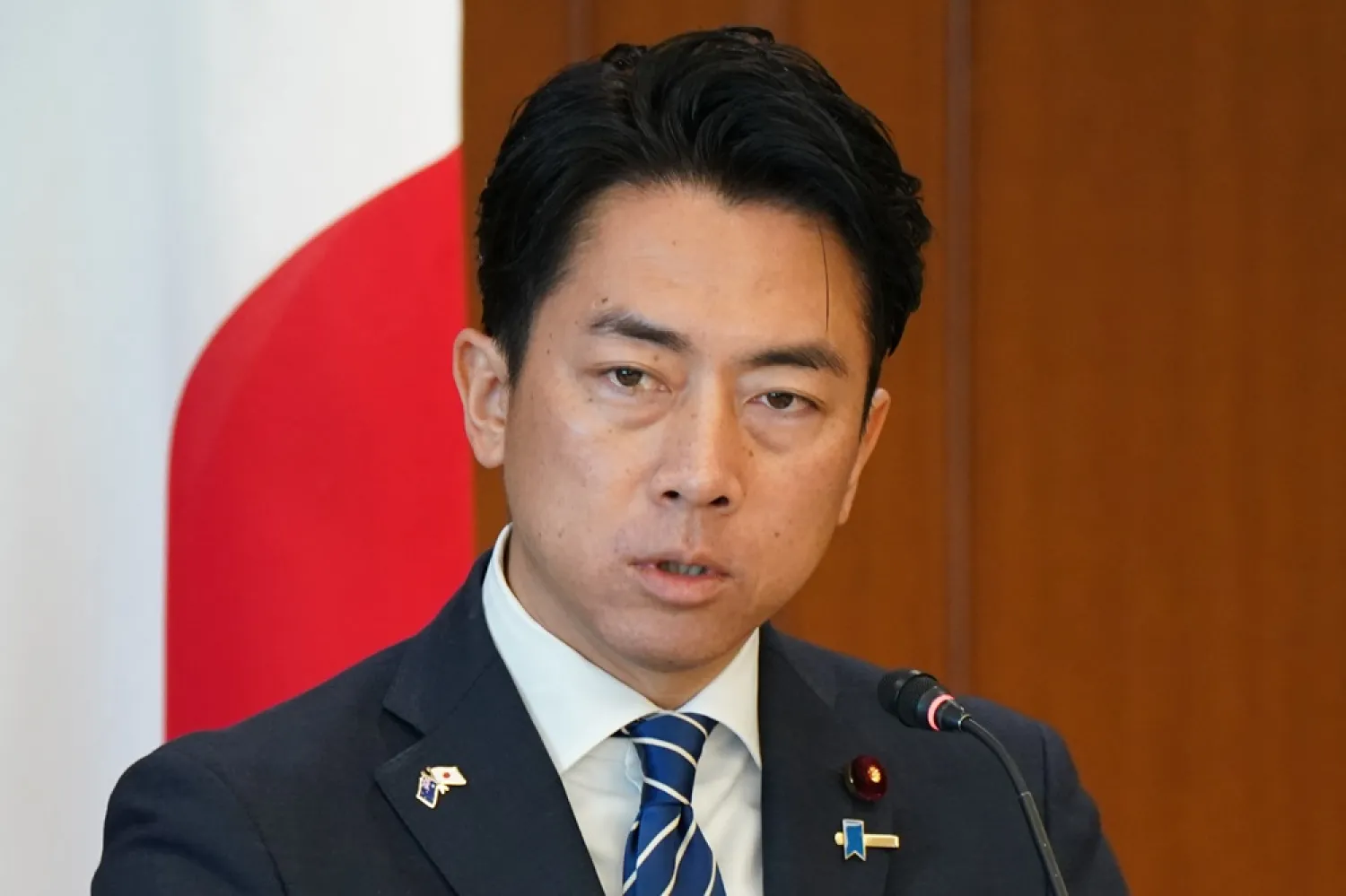

US, Japan Defense Chiefs Say China Harming Regional Peace

Japan's Defense Minister Shinjiro Koizumi speaks during a press conference with Australia's Defense Minister Richard Marles at the Defense Ministry in Tokyo Sunday, Dec. 7, 2025. (Kazuhiro Nogi/Pool Photo via AP)
TT

US, Japan Defense Chiefs Say China Harming Regional Peace

Japan's Defense Minister Shinjiro Koizumi speaks during a press conference with Australia's Defense Minister Richard Marles at the Defense Ministry in Tokyo Sunday, Dec. 7, 2025. (Kazuhiro Nogi/Pool Photo via AP)

Beijing's actions are "not conducive to regional peace", Japan's defense minister and US counterpart Pete Hegseth agreed during a call after Chinese aircraft locked radar on Japanese jets near Taiwan, Tokyo said Friday.

The December 6 radar incident came after comments by Prime Minister Sanae Takaichi on Taiwan that infuriated China, AFP reported.

It was followed this week by Chinese-Russian air patrols around Japan.

Hegseth and Shinjiro Koizumi "exchanged candid views on the increasingly severe security situation in the Indo-Pacific region, including the radar incident", the Japanese defense ministry said after the call.

They "expressed serious concern over any actions to increase regional tensions, as China's actions are not conducive to regional peace and stability", the statement added.

Koizumi said on X he told Hegseth that China was "disseminating information that is completely contrary to the facts" about the radar incident.

"However, Japan has made clear that it does not seek escalation and that we are responding calmly while making necessary rebuttals, and we are keeping the door open for dialogue," Koizumi added.

Hegseth's office said they had "discussed... China's military activities" among other issues including "Japan's efforts to increase its defense spending and strengthen its capabilities".

'Tactical exercises'

Takaichi had indicated on November 7 that Japan would intervene with military force in any Chinese attack on Taiwan, which Beijing claims as its own and has not ruled out seizing by force.

Media reports on Friday reinforced suggestions that her comments in a parliamentary debate were unplanned and that she deviated from prepared remarks.

Last week, J-15 jets from China's Liaoning aircraft carrier twice locked radar on Japanese aircraft that had scrambled in international waters near Okinawa, according to Japan.

Fighter jets use their radar for fire control to identify targets as well as for search and rescue operations.

But China's foreign ministry on Wednesday accused Japan of sending the jets "to intrude into the Chinese training area without authorization, conduct close-range reconnaissance and harassment, create tense situations, and... maliciously hype up the situation".

On Tuesday two Russian Tu-95 nuclear-capable bombers flew from the Sea of Japan to rendezvous with two Chinese H-6 bombers in the East China Sea, then conducted a joint flight around the country, Japan said.

Japan said that it scrambled fighter jets in response.

A day later, Japan and the United States air forces conducted their own joint air drills, Tokyo said.

The "tactical exercises" over the Sea of Japan involved two US B52 bombers, three Japanese F-35 fighter jets and three Japanese F-15s, Tokyo said.

South Korea said Tuesday that Russian and Chinese warplanes also entered its air defense zone, with Seoul also deploying fighter jets that same day.

Beijing confirmed on Tuesday that it had organized drills with Russia's military according to "annual cooperation plans".

Moscow also described it as a routine exercise, saying it lasted eight hours and that some foreign fighter jets followed the Russian and Chinese aircraft.



Trump Board of Peace Excludes Canada as Carney Pushes Back on America First

US President Donald Trump gestures after a signing ceremony for the Board of Peace in Davos, Switzerland (AP)
TT

Trump Board of Peace Excludes Canada as Carney Pushes Back on America First

US President Donald Trump gestures after a signing ceremony for the Board of Peace in Davos, Switzerland (AP)

US President Donald Trump withdrew an invitation to Canadian Prime Minister Mark Carney to join a newly established Board of Peace, originally set up to oversee the implementation of a ceasefire between Israel and Hamas in Gaza, as the White House moves to broaden the body into what it envisions as a rival to the United Nations.

Carney had delivered a sharp speech at the World Economic Forum in Davos, arguing that a more rigid posture adopted by the United States and other major powers had effectively collapsed the rules-based international order.

He urged medium-sized and smaller countries to coordinate their efforts to counter Trump’s America First doctrine and what he described as attempts to dismantle the international system established after World War II.

Hours before Trump announced the Board of Peace, Carney escalated his criticism, condemning what he called policies of authoritarianism and exclusion, in remarks that appeared aimed at the US president.

Although Trump offered no formal explanation for withdrawing the invitation, the move appeared to be a response to Carney’s remarks.

Trump, who has a record of harshly criticizing leaders who publicly challenge him, has taken similar steps in the past.

Months earlier, he sought to penalize Canada with additional tariffs in response to a Canadian television advertisement that cited comments by former US President Ronald Reagan opposing tariffs.

In a post on his Truth Social platform addressed to Carney, Trump said the Board of Peace was rescinding its invitation for Canada to join what he described as a body that would become the most distinguished gathering of leaders ever assembled.

The White House has sent invitations to at least 50 countries to join the Board of Peace, which the Trump administration portrays as a broad organization designed to resolve global conflicts, with ambitions comparable to those of the United Nations.

Carney received the invitation last week, and aides said he had planned to accept it. He later reconsidered after learning that Trump intended to require members to pay $1 billion for a permanent seat on the board and that other Western leaders, including French President Emmanuel Macron and German Chancellor Friedrich Merz, had declined to participate.

Trump’s decision added further strain to relations between the United States and Canada, which have traditionally been close despite significant tensions during Trump’s first presidential term.

Since returning to the White House last year, Trump has adopted a more confrontational stance toward Washington’s northern neighbor, drawing criticism from the Canadian government and anger among the public.

Trump has at times waged a trade war against Canada and threatened to annex it as the 51st US state. He has issued sharp rebukes of Carney and other Canadian officials during negotiations over tariffs and other disputes.

Economic ties have also suffered, with Canadians, long one of the most significant sources of international tourism to the United States, increasingly boycotting US destinations and products.

The diplomatic downturn has cast doubt on prospects for renegotiating the United States–Mexico–Canada Agreement, which underpins trade and supply chains across North America. The future of the pact, signed during Trump’s first administration, remains uncertain.

The withdrawal of Carney’s invitation has reinforced doubts that the Board of Peace will operate as a conventional international organization that tolerates dissent and open debate. Under its charter, Trump holds sweeping powers, including veto authority over decisions, control over the agenda, the ability to invite or dismiss members, the power to dissolve the board entirely, and the authority to appoint a successor body.

The board’s creation coincides with a broader shift in Trump’s foreign policy, which emphasizes US power to overthrow governments, seize foreign territory and resources, and dominate neighboring states regardless of their consent.

The administration has largely avoided traditional alliance-building and consensus-driven diplomacy associated with institutions such as the United Nations and NATO.

Relations between Trump and Carney had previously been cordial, but Carney’s Davos speech appeared to mark a turning point. Without naming Trump or the United States directly, Carney described what he called a rupture in the US-led global order.

He warned that middle powers such as Canada, lacking the strength to compete individually with the United States or China, risked subordination unless they acted collectively, cautioning that countries not seated at the negotiating table risked becoming targets of stronger powers.

The following day, Trump briefly addressed Carney’s remarks in Davos, saying the Canadian leader appeared insufficiently appreciative and asserting that Canada owed its existence to the United States, while warning Carney to keep that in mind in future statements.

Carney responded in a televised address to the nation, saying Canada and the United States had built a unique partnership based on economic cooperation, security, and cultural exchange, but stressing that Canada did not exist because of the United States.

He added that Canada prospered because it was Canadian.


Italy’s Meloni Hopes to Nominate Trump for Peace Prize

Italian Prime Minister Giorgia Meloni attends a press conference with German Chancellor Friedrich Merz (not pictured) on the sidelines of an intergovernmental summit between Italy and Germany at Villa Doria Pamphilj in Rome, Italy, 23 January 2026. (EPA)
TT

Italy’s Meloni Hopes to Nominate Trump for Peace Prize

Italian Prime Minister Giorgia Meloni attends a press conference with German Chancellor Friedrich Merz (not pictured) on the sidelines of an intergovernmental summit between Italy and Germany at Villa Doria Pamphilj in Rome, Italy, 23 January 2026. (EPA)

Italian leader Giorgia Meloni said Friday she hoped US President Donald Trump would end the conflict in Ukraine so she could nominate him for the Nobel Peace Prize.

Meloni revels in her cordial ties with Trump, who has expressed frustration at failing to win the prize.

"I hope that one day we can award a Nobel Peace Prize to Donald Trump," Italian Prime Minister Meloni told a press conference after meeting German Chancellor Friedrich Merz.

"I trust that if he makes a difference... in achieving a just and lasting peace for Ukraine, for Ukraine too... finally, we too could nominate Donald Trump for the Nobel Peace Prize."

In a message to Norwegian Prime Minister Jonas Gahr Store made public on Monday, Trump said failing to get the prize meant he no longer felt obliged "to think purely of peace".

On Thursday, Trump unveiled his "Board of Peace", initially designed to oversee the Gaza truce and the territory's revival, but which has morphed into a mechanism aiming to resolve all sorts of international conflicts.

Italy has been invited to join the "Board", but Meloni said she had told Trump that Italy faced "constitutional problems".

Italy's constitutional rules do not allow the country to join an organization led by a single foreign leader, according to media reports.

Trump is the chairman of the "Board", as well as serving as the US representative and the chair of its executive board.

Meloni said she had asked Trump to reopen the framework "to meet the needs not only of Italy, but also of other European countries".

"We must try to do this work," she said. "The presence of countries like ours can make a difference."


Turkish Court Rejects Bid by Erdogan Rival to Overcome Block to His Presidential Run

Turkish gendarmes block the way as supporters of jailed and suspended Istanbul Mayor Ekrem Imamoglu rally outside the courthouse of the Marmara Prison Complex, formerly Silivri Prison, on the outskirts of Istanbul, Türkiye, 15 January 2026. (EPA)
TT

Turkish Court Rejects Bid by Erdogan Rival to Overcome Block to His Presidential Run

Turkish gendarmes block the way as supporters of jailed and suspended Istanbul Mayor Ekrem Imamoglu rally outside the courthouse of the Marmara Prison Complex, formerly Silivri Prison, on the outskirts of Istanbul, Türkiye, 15 January 2026. (EPA)

A Turkish court rejected on Friday a lawsuit from jailed Istanbul Mayor Ekrem Imamoglu challenging the cancellation of his university degree, his legal team said, in a further blow to his plans to run for the presidency in the next election.

Imamoglu, who is President Recep Tayyip Erdogan's main political rival, has been in jail since last March, pending trial ‌on corruption charges. He ‌received a separate ‌prison ⁠sentence in July ‌for insulting and threatening the city’s chief prosecutor.

Without a university degree, Imamoglu cannot stand as a candidate for president. His legal team told Reuters that he would appeal against Friday's court ruling.

His jailing has been criticized ⁠by Imamoglu's opposition Republican People's Party (CHP), other opposition parties, ‌some Western leaders and rights ‍groups as an ‍anti-democratic move aimed at eliminating an electoral ‍threat to Erdogan.

Imamoglu himself has denied all the accusations against him, saying they are politically motivated. Erdogan's government denies political pressure on the courts and says the judiciary is independent.

Istanbul University said last March it had annulled Imamoglu’s ⁠degree, days before the opposition picked him as its presidential candidate in the next election, which is scheduled to take place in 2028.

Imamoglu has said the university's decision was illegal and outside its jurisdiction.

In a post on X, CHP Vice Chair Burhanettin Bulut said the court's dismissal of the diploma case amounted to a political decision that ‌showed the judiciary was being used against rivals.