

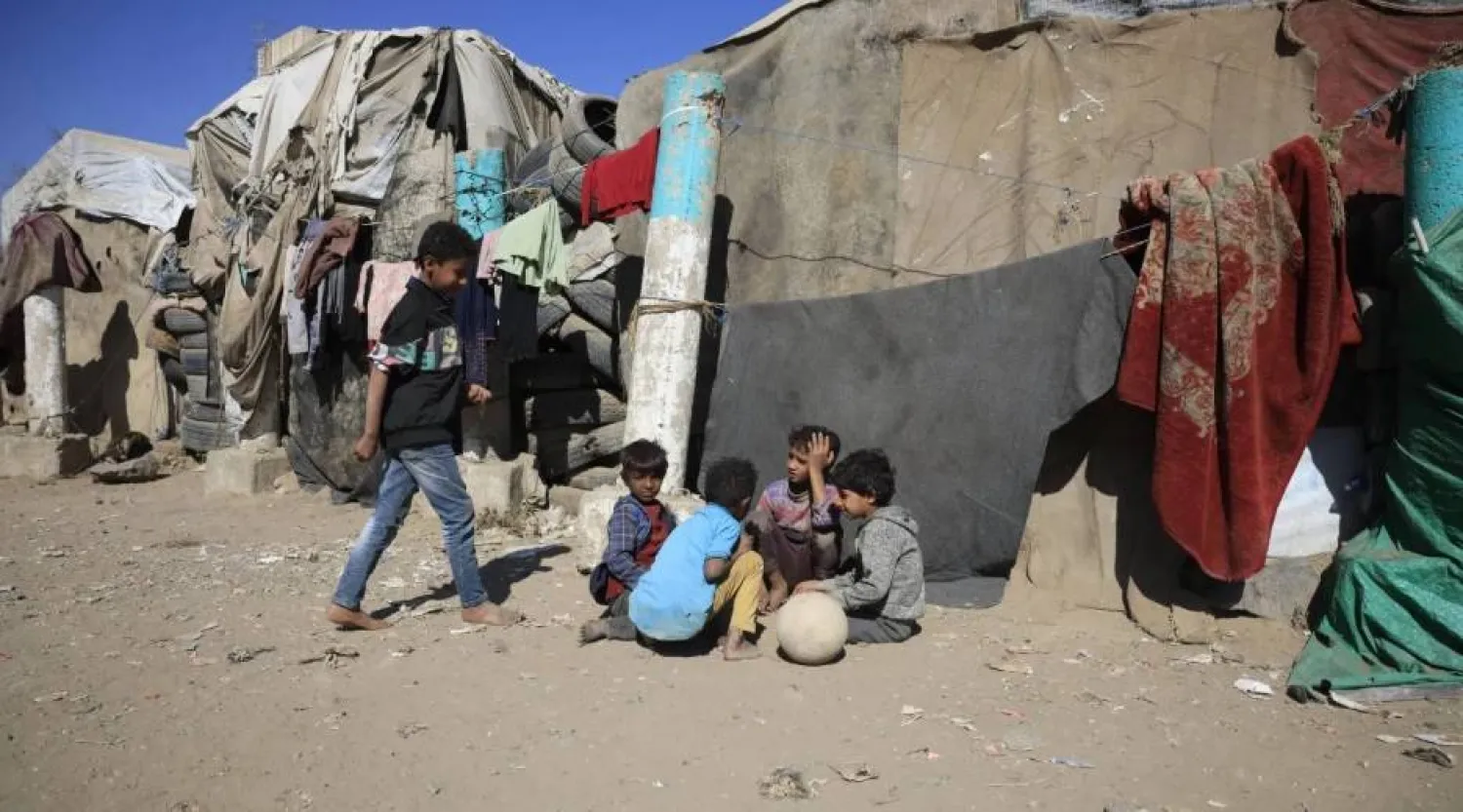

UN Appeals for $2.5 Billion to Confront Humanitarian Crisis in Yemen

Displaced children gather in a camp in Sanaa. EPA
TT

UN Appeals for $2.5 Billion to Confront Humanitarian Crisis in Yemen

Displaced children gather in a camp in Sanaa. EPA

The United Nations has warned of an unprecedented rise in humanitarian needs in Yemen during the coming year, saying the country is heading towards one of the worst humanitarian crises in the world unless urgent funding for a response plan is provided.

Latest data showed that in 2026, 23.1 million people, nearly 65.4 percent of the population, will need lifesaving humanitarian assistance and protection services to meet their basic needs and safeguard their well-being.

So, the UN launched an urgent appeal to fund the 2026 Yemen Humanitarian Response Plan, requesting the international community to raise $2.5 billion to confront the humanitarian crisis that is escalating in complexity and severity.

The plan aims to provide support to more than 10.5 million people in desperate need, with a special focus on life-saving interventions and combating hunger and malnutrition in the most deprived areas.

Yet the plan did not clarify how programs will be implemented in areas under Houthi control, which are witnessing increasing restrictions after the group closed offices belonging to the United Nations and international organizations since last September, and arrested dozens of their staff, including 59 UN employees.

The UN said that a convergence of conflict, economic decline, and climate shocks, compounded by shrinking operational space in parts of the country and funding shortfalls, continues to exacerbate humanitarian needs.

Already, 18.1 million people face acute food insecurity, while 2.5 million children under five risk acute malnutrition, and 1.3 million pregnant and breastfeeding women are suffering from severe acute malnutrition.

Amid the massive collapse of basic systems, 8.41 million people lack access to healthcare, while 15 million suffer from water insecurity. With 17.4 million lacking adequate sanitation and hygiene, preventable waterborne diseases will surge, the UN warned.

Protection risks are escalating as resilience collapses, it said. Over 16 million people require protection assistance, of which 4.7 million are internally displaced.

Meanwhile, 6.2 million people need GBV services as women and girls, especially among displaced and marginalized communities, face escalating risks of gender-based violence.

About 2.6 million children remain out of class, while teachers continue to work without pay, while floods, weather events and droughts affected 1.5 million people in 2025.

The UN on Tuesday condemned a referral by the Houthis of some of the dozens of UN staff they have detained to a special criminal court.

UN Secretary-General Antonio Guterres said the Houthis have arbitrarily detained 59 Yemeni UN personnel, who have been held “incommunicado - some for years - without any due process, in violation of international law,” according to his spokesperson Stephane Dujarric.

“We call on the de facto authorities to rescind the referral and work in good faith toward the immediate release of all detained personnel,” Dujarric said.

“The United Nations remains committed to supporting the people of Yemen and delivering principled humanitarian assistance,” he added.



Former Iraq President Named UN Refugee Chief, Document Shows

Former Iraqi President Barham Salih. (Reuters)
TT

Former Iraq President Named UN Refugee Chief, Document Shows

Former Iraqi President Barham Salih. (Reuters)

Iraq's former president Barham Salih has been chosen as the next High Commissioner for Refugees for the United Nations, a letter showed on Friday, breaking with a tradition of appointing leaders from major donor countries.

The letter, signed by UN Chief Antonio Guterres and dated December 11, says Salih has been appointed for a five-year term beginning January 1.

He replaces Italy's Filippo Grandi, a veteran UN official, who has held the position since 2016. The appointment is provisional and needs to be approved by UNHCR's Executive Committee, the document showed.

Salih, a British-educated engineer from Iraq's Kurdish region, faces major challenges with global displacement at record highs and about double the levels it was when Grandi first began.

In parallel, funding has fallen this year as key donors like the United States have cut back and other Western donors have shifted funds to defense.

About a dozen candidates were competing for the role, including several politicians as well as an IKEA executive, an ER doctor and a TV personality. More than half of them were from Europe, in keeping with a tradition of the Geneva-based agency's chief coming from top donor states.


Trump: ‘We Actually Do Have a Real Peace in the Middle East’

US President Donald Trump delivers remarks during the Congressional Ball in the Grand Foyer of the White House in Washington, DC, on December 11, 2025. (Photo by Alex WROBLEWSKI / AFP)
TT

Trump: ‘We Actually Do Have a Real Peace in the Middle East’

US President Donald Trump delivers remarks during the Congressional Ball in the Grand Foyer of the White House in Washington, DC, on December 11, 2025. (Photo by Alex WROBLEWSKI / AFP)

US President Donald Trump has said that there are prospects for “a real peace in the Middle East.”

When asked by a reporter at the White House about reports that he was planning to appoint an American two-star general to command the International Stabilization Force (ISF) in Gaza, Trump said Thursday: “We actually do have a real peace in the Middle East ... it’s never happened before and I think it’s very strong actually.”

The ceasefire, in effect since October 10, halted the war but it remains fragile as Israel and Hamas accuse each other almost daily of violations.

The agreement is composed of three phases. Israeli Prime Minister Benjamin Netanyahu recently indicated that he expected the second phase to begin soon.

That phase involves the Israeli army pulling farther back, the ISF deploying to Gaza, and a new governing structure coming into force, including the Trump-led Board of Peace.

Trump told reporters Wednesday that he's planning to announce the Gaza Board of Peace in early 2026.

Gaza’s population of around 2 million is almost entirely displaced, and most people live in vast tent camps stretching along the coast, or set up among the shells of damaged buildings.


Series of Israeli Strikes Hit Lebanon

A convoy of Lebanese army vehicles drives near the border with Israel in the village of Alma al-Shaab during a Lebanese army media tour in south Lebanon, Friday, Nov. 28, 2025. (AP Photo/Bilal Hussein)
TT

Series of Israeli Strikes Hit Lebanon

A convoy of Lebanese army vehicles drives near the border with Israel in the village of Alma al-Shaab during a Lebanese army media tour in south Lebanon, Friday, Nov. 28, 2025. (AP Photo/Bilal Hussein)

A series of Israeli strikes hit south and east Lebanon on Friday, state media reported, as Israel's army said it was targeting Hezbollah sites, the latest such raids despite a year-old ceasefire.

Lebanon's state-run National News Agency (NNA) reported strikes in around a dozen locations, including up to around 30 kilometers (20 miles) from the Israeli border, citing at times "heavy raids".

Israel has kept up strikes on Lebanon despite a November 2024 ceasefire that was supposed to end more than a year of hostilities with the Iran-backed militant group Hezbollah, and has also kept troops in five areas it deems strategic, reported AFP.

The Israeli military said in a statement that its forces "struck a training and qualification compound" used by Hezbollah's elite Radwan Force where operatives "underwent shooting exercises and additional training on the use of various types of weapons".

The army also "struck additional Hezbollah military infrastructure in several areas in southern Lebanon", it said.

According to the ceasefire, Hezbollah was required to pull its forces north of the Litani River, some 30 kilometers from the border with Israel, and have its military infrastructure there dismantled.

Under a government-approved plan, Lebanon's army is to dismantle Hezbollah's military infrastructure south of the Litani by the end of the year, before tackling the rest of the country.

The sites struck on Friday were generally north of the river.

Earlier this week, Israel launched a series of strikes on southern Lebanon, also saying it hit a Hezbollah training center and other targets.