
Algeria’s Kabylie Unites against MAK Separatist Project

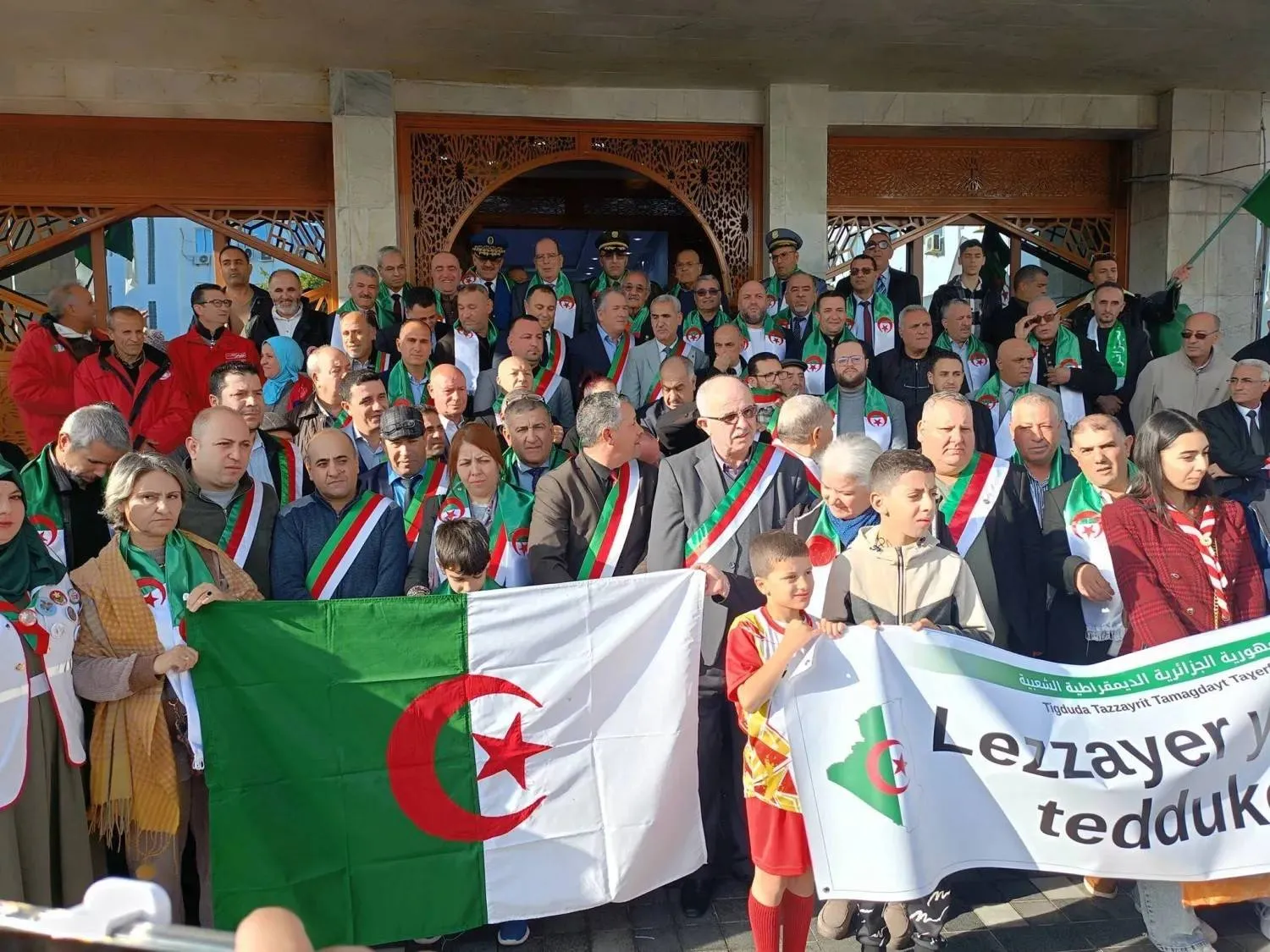
Activists rally in Bejaia against separatist project, private accounts
TT

Algeria’s Kabylie Unites against MAK Separatist Project

Activists rally in Bejaia against separatist project, private accounts

Algeria’s Kabylie region is witnessing unusual momentum and activity, marked by initiatives opposing a separatist group’s plan to proclaim an “Independent State of Kabylie” on Sunday in France.

The move is one chapter in ongoing tensions with Algeria, which accuses Paris of “harboring enemies of its territorial unity.”

In Bejaia province, about 250 km east of Algiers and the largest city in Kabylie, residents and local groups have launched a series of initiatives in recent days to express their rejection of any proposal that undermines national unity.

The national flag has been widely hung from the facades of homes and shops, while taxis and public and private transport vehicles have also been decorated with the flag, creating a scene dominated by national colors across the city’s streets and neighborhoods.

Rejecting any threat to national unity

Coinciding with the anniversary of demonstrations held in 1960 during Algeria’s war of independence from France from 1954 to 1962, the Bejaia Directorate of Youth and Sports organized a convoy of cars adorned with national flags on Thursday.

The convoy set off from the city center and passed through several streets and villages under the slogan “Algeria is one and united,” under the supervision of local authorities.

In the same context, a real estate developer raised the national flag on the main facade of one of the city’s largest residential complexes, a 28-story building, in a move that drew positive reactions from residents and was seen as another expression of attachment to national symbols.

Bejaia’s neighborhoods have also witnessed a form of symbolic competition through the display of flags of varying sizes.

A large flag was raised in November 1, 1954 Square, with announcements of further initiatives to unfurl a massive flag atop Mount Gouraya, the city’s most prominent tourist landmark, with the participation of several local associations.

Bejaia University students issued a statement rejecting the separatist project carried by the Movement for the Self Determination of Kabylie, known by its French acronym MAK.

They reaffirmed their commitment to “the unity and sovereignty of Algeria” and called for confronting what they described as “narratives that undermine national cohesion,” referring to the planned declaration of an “Independent State of Kabylie,” which MAK says it will announce on Sunday in Paris under the leadership of its head, Ferhat Mehenni, who is wanted in Algeria on terrorism charges.

In the same vein, a number of intellectuals and activists in Bejaia expressed similar positions through statements and comments, while a popular gathering is expected to be held near the House of Culture on Sunday to voice opposition to the move.

The local journalists’ organization in Bejaia also announced its rejection of “any plan targeting the country’s unity,” stressing in a statement that “preserving a unified Algeria is a collective responsibility that is not open to compromise.”

Calls to confront MAK

Abdelkader Bengrina, head of the pro-government National Construction Movement party, said on Saturday during a meeting with party officials that “what this terrorist movement is attempting today is a desperate effort to turn back the clock and revive colonial ambitions that were buried decades ago.”

He added that “their determination to declare the independence of Kabylie from Algeria is nothing more than a new chapter in a farcical play aimed at testing the pulse of the Algerian nation and dragging the country into chaos.”

“We are fully confident that our security forces will strike with an iron fist against the plans of this movement and its operational cells wherever they exist, within the framework of the law,” he said.

Bengrina implicitly accused France of hosting separatists and their project, saying that “some European capitals are crying foul these days when one of their agents is exposed while posing as a tourist, even though his mission was to promote separatist discourse and encourage chaos.”

He was referring to French journalist Christophe Gleizes, who was sentenced by a court in Tizi Ouzou to seven years in prison on charges of “maintaining links with a leader of the Movement for the Self Determination of Kabylie.”

By contrast, Mehenni said in comments to the media in France, where he lives as a political refugee, that “there is no turning back,” arguing that “the policies pursued by Algeria in Kabylie since 1963 make independence the only solution.”

The movement was founded in 2001 following deadly clashes between security forces and segments of the Kabylie population that left 160 people dead.

Initially advocating autonomy, it later shifted toward full secession.

In May 2021, Algerian authorities designated the group a “terrorist organization,” accusing its members of planning violent acts and receiving foreign funding.

The movement relies heavily on emigrants originating from Kabylie, particularly in France and North America, but has little presence inside Algeria.

Authorities have arrested many of its members in the three Kabylie provinces of Tizi Ouzou, Bejaia and Bouira, all east of the capital, including MAK’s representative in the region, Bouaziz Ait Chebib.

Deep rooted political forces in the region have strongly rejected the separatist step, led by the Socialist Forces Front, which condemned what it described as “a separatist project that undermines Algeria’s national unity.”


7 Killed in Drone Strike on Hospital in Sudan's Kordofan

A Sudanese man rides his decorated bicycle as others (unseen) rally in support of the Sudanese armed forces. (Photo by Ebrahim Hamid / AFP)
TT

7 Killed in Drone Strike on Hospital in Sudan's Kordofan

A Sudanese man rides his decorated bicycle as others (unseen) rally in support of the Sudanese armed forces. (Photo by Ebrahim Hamid / AFP)

A drone strike Sunday on an army hospital in the besieged southern Sudan city of Dilling left "seven civilians dead and 12 injured", a health worker at the facility told AFP.

The victims included patients and their companions, the medic said on condition of anonymity, explaining that the army hospital "serves the residents of the city and its surroundings, in addition to military personnel".

Dilling, in the flashpoint state of South Kordofan, is controlled by the Sudanese army but is besieged by the Rapid Support Forces (RSF).

The greater Kordofan region is currently facing the fiercest fighting in Sudan's war between the army and the RSF, as both seek to wrest control of the massive southern region.

The UN has repeatedly warned the region is in danger of witnessing a repeat of the atrocities that unfolded in North Darfur state capital El-Fasher, including mass killing, abductions and sexual violence.


Iraq's Election Result Ratified by Supreme Federal Court as Premiership Remains up for Grabs

Election workers gather parliamentary election ballots after the polls closed in Baghdad, Iraq, Nov. 11, 2025. (AP Photo/Hadi Mizban, File)
TT

Iraq's Election Result Ratified by Supreme Federal Court as Premiership Remains up for Grabs

Election workers gather parliamentary election ballots after the polls closed in Baghdad, Iraq, Nov. 11, 2025. (AP Photo/Hadi Mizban, File)

The result of last month’s parliamentary elections in Iraq was ratified by the Supreme Federal Court on Sunday, confirming that the party of caretaker prime minister Mohammed Shia al-Sudani won the largest number of seats — but not enough to assure him a second term.

The court confirmed that the voting process met all constitutional and legal requirements and had no irregularities affecting its validity.

The Independent High Electoral Commission submitted the final results of the legislative elections to the Supreme Federal Court on Monday for official certification after resolving 853 complaints submitted regarding the election results, according to The AP news.

Al-Sudani's Reconstruction and Development Coalition won 46 seats in the 329-seat parliament. However, in past elections in Iraq, the bloc taking the largest number of seats has often been unable to impose its preferred candidate.

The coalition led by former Prime Minister Nouri al-Maliki won 29 seats, the Sadiqoun Bloc, which is led by the leader of the Asaib Ahl al-Haq militia, Qais al-Khazali, won 28 seats, and the Kurdistan Democratic Party, led by Masoud Barzani, one of the two main Kurdish parties in the country, won 27 seats.

The Taqaddum (Progress) party of ousted former Parliament Speaker Mohammed al-Halbousi also won 27 seats, setting the stage for a contest over the speaker's role.


Hamas Confirms the Death of a Top Commander in Gaza after Israeli Strike

Destroyed buildings, amid a ceasefire between Israel and Hamas, in Khan Younis in the southern Gaza Strip November 18, 2025. (Reuters)
TT

Hamas Confirms the Death of a Top Commander in Gaza after Israeli Strike

Destroyed buildings, amid a ceasefire between Israel and Hamas, in Khan Younis in the southern Gaza Strip November 18, 2025. (Reuters)

Hamas on Sunday confirmed the death of a top commander in Gaza, a day after Israel said it had killed Raed Saad in a strike outside Gaza City.

The Hamas statement described Saad as the commander of its military manufacturing unit. Israel had described him as an architect of the Oct. 7, 2023, attack that sparked the war in Gaza, and asserted that he had been “engaged in rebuilding the terrorist organization” in a violation of the ceasefire that took effect two months ago, The AP news reported.

Israel said it killed Saad after an explosive device detonated and wounded two soldiers in the territory’s south.

Hamas also said it had named a new commander but did not give details.

Saturday's strike west of Gaza City killed four people, according to an Associated Press journalist who saw their bodies arrive at Shifa Hospital. Another three were wounded, according to Al-Awda hospital. Hamas in its initial statement described the vehicle struck as a civilian one.

Israel and Hamas have repeatedly accused each other of truce violations.

Israeli airstrikes and shootings in Gaza have killed at least 391 Palestinians since the ceasefire took hold, according to Palestinian health officials. Israel has said recent strikes are in retaliation for militant attacks against its soldiers, and that troops have fired on Palestinians who approached the “Yellow Line” between the Israeli-controlled majority of Gaza and the rest of the territory.

Israel has demanded that Palestinian militants return the remains of the final hostage, Ran Gvili, from Gaza and called it a condition of moving to the second and more complicated phase of the ceasefire. That lays out a vision for ending Hamas’ rule and seeing the rebuilding of a demilitarized Gaza under international supervision.

Israel’s two-year campaign in Gaza has killed more than 70,660 Palestinians, roughly half of them women and children, according to the territory’s Health Ministry, which does not distinguish between militants and civilians in its count. The ministry, which operates under the Hamas-run government, is staffed by medical professionals and maintains detailed records viewed as generally reliable by the international community.