Hamas Confirms the Death of a Top Commander in Gaza after Israeli Strike

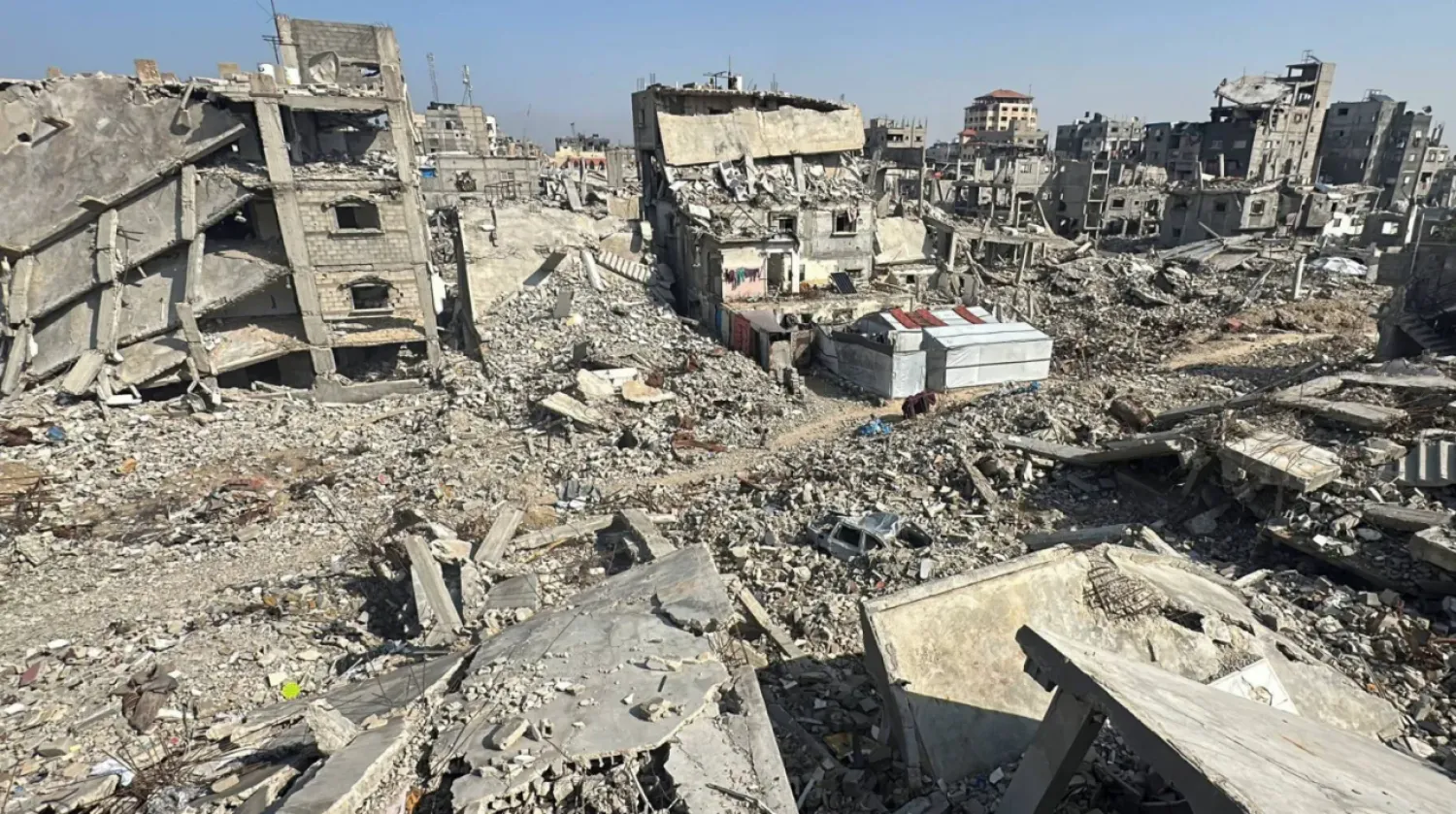
Destroyed buildings, amid a ceasefire between Israel and Hamas, in Khan Younis in the southern Gaza Strip November 18, 2025. (Reuters)
TT

Hamas Confirms the Death of a Top Commander in Gaza after Israeli Strike

Destroyed buildings, amid a ceasefire between Israel and Hamas, in Khan Younis in the southern Gaza Strip November 18, 2025. (Reuters)

Hamas on Sunday confirmed the death of a top commander in Gaza, a day after Israel said it had killed Raed Saad in a strike outside Gaza City.

The Hamas statement described Saad as the commander of its military manufacturing unit. Israel had described him as an architect of the Oct. 7, 2023, attack that sparked the war in Gaza, and asserted that he had been “engaged in rebuilding the terrorist organization” in a violation of the ceasefire that took effect two months ago, The AP news reported.

Israel said it killed Saad after an explosive device detonated and wounded two soldiers in the territory’s south.

Hamas also said it had named a new commander but did not give details.

Saturday's strike west of Gaza City killed four people, according to an Associated Press journalist who saw their bodies arrive at Shifa Hospital. Another three were wounded, according to Al-Awda hospital. Hamas in its initial statement described the vehicle struck as a civilian one.

Israel and Hamas have repeatedly accused each other of truce violations.

Israeli airstrikes and shootings in Gaza have killed at least 391 Palestinians since the ceasefire took hold, according to Palestinian health officials. Israel has said recent strikes are in retaliation for militant attacks against its soldiers, and that troops have fired on Palestinians who approached the “Yellow Line” between the Israeli-controlled majority of Gaza and the rest of the territory.

Israel has demanded that Palestinian militants return the remains of the final hostage, Ran Gvili, from Gaza and called it a condition of moving to the second and more complicated phase of the ceasefire. That lays out a vision for ending Hamas’ rule and seeing the rebuilding of a demilitarized Gaza under international supervision.

Israel’s two-year campaign in Gaza has killed more than 70,660 Palestinians, roughly half of them women and children, according to the territory’s Health Ministry, which does not distinguish between militants and civilians in its count. The ministry, which operates under the Hamas-run government, is staffed by medical professionals and maintains detailed records viewed as generally reliable by the international community.


Can ISIS Breach Syrian Security at Will?

Syrian security personnel inspect a burned-out car near the Four Seasons Hotel in Damascus, where French President Emmanuel Macron stayed. (AP)
TT

Can ISIS Breach Syrian Security at Will?

Syrian security personnel inspect a burned-out car near the Four Seasons Hotel in Damascus, where French President Emmanuel Macron stayed. (AP)

Two days after two bombs exploded in Damascus during French President Emmanuel Macron’s visit, Syrian security forces said on Thursday they had arrested the cell behind the attacks. Initial investigations found that it was affiliated with ISIS.

The blasts were especially sensitive because they struck near the luxury Four Seasons Hotel in central Damascus, where Macron was staying.

His visit was the first by the leader of a major Western power since President Ahmed al-Sharaa took office in late 2024.

The attacks have fueled unease among Damascus residents and raised a pressing question: Does the cell’s link to ISIS mean the group can breach security at will?

Ismat al-Absi, a strategic security and military expert close to the Defense Ministry, rejected that conclusion.

“The two explosions cannot in any way be seen as a sign of weakness or incapacity,” he said. “Rather, they confirm the nature of the asymmetric war Syrian security and military authorities are fighting against ISIS, which relies on suicide attacks and indiscriminate violence to spread fear.”

Speaking to Asharq Al-Awsat, Absi said the incident was “not a security breach in the technical sense, but a failed terrorist attempt that was uncovered and dealt with in record time.”

The bombs exploded several hundred meters from the hotel, minutes after Macron’s convoy left for the presidential palace.

He was heading to an expanded meeting with Sharaa, attended by delegations from both countries.

The twin blasts were caused by two improvised explosive devices. They killed one person and wounded 36 others, according to the Health Ministry.

The French presidency said Macron was safe and would continue his visit.

Macron later wrote on X that the trip “will continue.”

Absi said the visit had been protected by tight and complex security measures.

“The fact that the devices were detonated away from the official guest’s route, followed by the immediate arrest of those responsible, proves that the red line of national security was not breached,” he said.

“It also shows that the state can separate the enemy’s noise from the performance of its sovereign duties.”

The attacks came days after an explosion inside a cafe near the Palace of Justice in Damascus killed 10 people last Friday.

Absi drew a distinction between infiltration and the establishment of a foothold.

“The organization has no popular base and no real civilian presence,” he said. “It depends on scattered sleeper cells trying to exploit the temporary security vacuum left by years of war.”

The appearance of such cells around Damascus reflects desperate attempts by ISIS to restore its presence before the state eliminates it completely, he said.

It does not, he added, point to broad infiltration.

Absi said security agencies were now working through pre-emption and close surveillance.

That approach, he said, had allowed them to turn each case of infiltration into an arrest-and-prosecution operation, rather than letting it grow into a lasting threat.

Asked whether ISIS had a large number of cells in and around Damascus, Absi said numbers alone did not define the danger.

“One well-organized cell can be more harmful than dozens of scattered operatives,” he said.

“We are dealing with the remnants of an organization that was defeated militarily but has not yet been fully eliminated through judicial and security measures.”

Some remaining members, he said, were still looking for opportunities to take revenge or destabilize the new political order.

But their capabilities were now far more limited than before.

“Our task is to cut off the sources of this activity through community cooperation and intelligent monitoring,” he said. “We are seeing the results of this approach every day, as this operation showed.”

The bombings came as the Interior Ministry stepped up counterterrorism operations with the General Intelligence Service and the Counterterrorism Directorate.

On June 9, the ministry said it had dismantled seven ISIS cells and arrested 235 members of the group over the previous three months.

Absi said the latest attack would accelerate structural security reforms already underway.

“We will see stronger cooperation between the Internal Security Forces and the General Intelligence Service to build a unified and rapidly responsive information network,” he said.

Preventive operations would also be intensified in rural areas and towns surrounding the capital to stop cells from re-forming.

“The goal is not only a rapid response,” Absi said. “It is to build an integrated security system that makes the environment unsuitable for any terrorist activity.”

That, he added, would send a clear message to international partners that Syria was safe and stable for investment and political engagement.

On Thursday, the Interior Ministry also said that, working with the General Intelligence Service, it had dismantled several ISIS cells in southern Syria.

It announced the arrest of senior ISIS figure Firas al-Dagher and several prominent figures responsible for assassinations and financing.

Political researcher Diaa Qaddour, who specializes in security affairs, said ISIS was now waging a low-intensity escalation campaign against the Syrian state.

The group, he said, remained a persistent threat, continuing to exploit security gaps and vulnerable areas.

“The two recent explosions were painful and shocking,” Qaddour told Asharq Al-Awsat. “But the large security operations carried out by the security forces have also revealed their growing ability to fight the organization.”

He said the simultaneous arrest of so many cells showed the Interior Ministry had built a precise intelligence database and developed strong logistical capabilities to track its targets.

Qaddour said the main aim of the bombings was not necessarily to cause casualties.

Rather, he said, they were intended to disrupt Macron’s visit, portray the Syrian state as weak and undermine the current political phase.

He said the cell was linked to ISIS, but added that major intelligence agencies that did not want Syria to become calm and stable could also be behind it.

Despite talk of the group’s growing capabilities, Qaddour said the attacks did not mark a full return by ISIS.

The group was not trying to seize territory or rebuild the “ISIS,” he said.

Instead, it was trying to obstruct those rebuilding the state.

“This is ISIS’s strategy today: attrition and raising the cost,” he said.

As the security forces improve their technological capabilities and sanctions are lifted, it will become harder for the group to strike city centers, Qaddour said.

That could push it towards the suburbs and open areas.

“The security threat remains,” he said. “The state and its security agencies need a comprehensive and integrated response to the continuing ISIS threat.”

Statistics for 2026, he said, showed that ISIS operations had declined compared with the previous two years.

But the group could still exploit security gaps and carry out painful, shocking attacks.

The Syrian state, he said, needed to address the threat through a broader security formula.

That response should not rely only on stronger military, technological and security tools.

It should also tackle economic conditions and social and economic grievances.

“Security is an integrated equation,” Qaddour said.

“We are facing a long-term phase, and the battle is difficult. We may face setbacks and obstacles.”

“But with stronger expertise and capabilities, and greater intelligence cooperation with countries in the region, I believe we will reach an important result.”


US-Iran Escalation Revives Lebanese Fears of War

First responders inspect the wreckage of a car reportedly targeted by an Israeli strike in Nabatieh on July 6, 2026. (AFP)
TT

US-Iran Escalation Revives Lebanese Fears of War

First responders inspect the wreckage of a car reportedly targeted by an Israeli strike in Nabatieh on July 6, 2026. (AFP)

Renewed escalation between the United States and Iran has raised fears in Lebanon that conflict could spread to its southern border, as implementation of a framework agreement between Lebanon and Israel remains stalled and Israeli military operations continue.

Washington has resumed strikes on Iran, while Tehran has responded by targeting US bases in the region.

The developments have shifted attention to the possible impact of US-Iranian tensions on Lebanon, where the violence has been contained in recent months despite continued Israeli airstrikes, assassinations and demolitions. Israel has insisted on remaining in what it calls a “security zone” in southern Lebanon.

Retired Brigadier General Hassan Jouni said the escalation did not necessarily signal the collapse of the US-Iranian agreement or a permanent halt to negotiations.

He said it could represent a period of mutual pressure before the two sides return to the agreement after addressing disputed points.

“The United States used military force more than once and on a wide scale over about 40 days, and this is the result that force produced,” Jouni told Asharq Al-Awsat.

He said the outcome could encourage both sides to continue maneuvering within the agreement’s limits rather than abandon it entirely.

Jouni said the Lebanese front was directly tied to the conflict involving Iran, the United States and Israel.

“If war resumes between Iran and the United States, I do not think Hezbollah will remain on the sidelines,” he said.

He added that the current situation in southern Lebanon did not serve Hezbollah’s interests and that the group could view a renewed confrontation as an opportunity to alter the existing balance.

“If the agreement between Washington and Tehran is disrupted and war returns, Hezbollah is likely to return to confrontation as well, in an attempt to restore its gains or improve its position in any later settlement,” he said.

Retired Brigadier General Naji Malaeb also said the latest US-Iranian developments did not necessarily mean the collapse of the path toward an understanding.

He said the escalation remained contained, while Washington appeared increasingly focused on implementing the agreement concerning Lebanon.

“Talk of the agreement with Iran being over does not necessarily mean that it has fallen apart permanently, because Tehran itself has an interest in preserving room for an understanding if conditions allow,” Malaeb told Asharq Al-Awsat.

He said the responses had so far remained measured.

A woman smokes a cigarette as she stands on the balcony of a building damaged in an Israeli airstrike, while Hassan Hejazieh carries bricks as he walks amid the rubble, attempting to rebuild his home after returning home following displacement during the war, following the Israel-Lebanon deal, in Tyre, southern Lebanon, July 5, 2026. (Reuters)

Concerning Lebanon, Malaeb said growing official frustration with the outcome of negotiations reflected a belief that the results had fallen short of Lebanese expectations and that US guarantees had been insufficient.

He said Lebanon’s initial refusal to attend the next round of negotiations in Rome was linked to the meeting’s format.

“It was not acceptable for it to appear as a direct Lebanese-Israeli meeting with low-level US representation,” he remarked.

Lebanon changed its position after Washington said the meetings would be held at the US Embassy in Rome and managed by US officials, Malaeb said.

He added that Lebanon tied its participation to the implementation of the first part of the agreement, particularly the pilot arrangement in two areas, before meetings scheduled for July 15 and 16

Malaeb note the recent US activity showed direct interest in the Lebanese file, citing the US ambassador’s meetings with Lebanese officials, a lengthy meeting with Parliament Speaker Nabih Berri – a key Hezbollah ally - and a visit by US Central Command chief General Brad Cooper.

He said the appointment of US General Joseph Clearfield to oversee the agreement’s implementation, along with reports that he would move to Lebanon and work from the US Embassy, was a further sign of US seriousness.

Malaeb said Iran knew it would not receive permanent guarantees and would therefore continue to preserve its regional allies for as long as possible.

He stressed Hezbollah’s tougher position reflected Iran’s stance.

“I do not expect a major development unless Iran instructs Hezbollah to move outside the ceasefire framework and continue resisting the Israeli presence,” he added.


Israel Hunts Hamas Figures as Gaza Killings Continue

Palestinians carry the body of Mohammed Odeh, a commander in Hamas’ military wing, during his funeral in Gaza City on May 27, 2026. (AFP)
TT

Israel Hunts Hamas Figures as Gaza Killings Continue

Palestinians carry the body of Mohammed Odeh, a commander in Hamas’ military wing, during his funeral in Gaza City on May 27, 2026. (AFP)

Israel tried on Thursday to kill Hamas spokesman Hazem Qassem, the only senior figure from the group to have appeared publicly in Gaza in recent weeks, as it presses a campaign of assassinations against Hamas leaders and prominent operatives, particularly in its armed wing.

Qassem survives

Several Israeli media outlets cited local reports saying Qassem had been seriously wounded after a Hamas-affiliated media activist posted about the attack on X.

But informed Hamas sources told Asharq Al-Awsat that Qassem had survived and was in good health.

They said he had left the vehicle targeted by an Israeli drone near Haidar Roundabout, west of Gaza City, only minutes before the strike. His escort was killed.

Israel had not commented on the attack by the time of publication.

The attempt came days after Qassem appeared at a news conference announcing the dissolution of the Government Work Follow-up Committee, Hamas’ governing body in Gaza.

Israeli Foreign Minister Gideon Saar called the move misleading, saying Hamas still refused to disarm.

Qassem, 46, is one of Hamas’ younger and most prominent figures in Gaza. He has appeared regularly in interviews and news conferences and has repeatedly spoken positively about negotiations in Cairo.

His position has at times differed from that of Hamas leaders abroad, who have offered a different assessment of conditions in Gaza, drawing criticism of him from inside and outside the movement.

Israel widens its targets

A Hamas political source told Asharq Al-Awsat that the attack showed Israel was expanding its target list and seeking to eliminate anyone who emerged as a public symbol of the movement.

The source said Israel was targeting Hamas figures across political, military, economic, religious and social spheres.

Qassem was wounded at least once during the war and suffered a serious injury that nearly led to the amputation of his foot. He later recovered.

He remained in northern Gaza and did not move south during the early siege of the area, when Israel controlled the Netzarim Corridor separating northern Gaza from the central and southern parts of the enclave.

Israel has repeatedly targeted Hamas spokesmen during the war.

Among them was Abdel Latif al-Qanou, who had served alongside Qassem since 2016. He was killed in March 2025 in a strike on a tent where he was living in Jabalia, northern Gaza.

The Hamas source said Qassem had become one of the movement’s main political figures in Gaza after the killing of many senior leaders and had recently emerged as its most visible media representative.

He also takes part in decisions made through consultations within Hamas institutions, the source said.

Qassem recently represented Hamas at Fatah’s eighth conference after receiving an invitation from its leadership.

His attendance drew criticism from parts of Fatah’s grassroots base because of his repeated public attacks on the movement’s leadership and the Palestinian Authority.

Some Fatah leaders defended his participation, saying it was important given the state of internal Palestinian affairs.

Assassinations continue

The attempt on Qassem was the most prominent since the killing of senior commanders from the general staff of the Izz al-Din al-Qassam Brigades, Hamas’ armed wing, including Ezz al-Din al-Haddad, Mohammed Odeh and Imad Islim.

It came as Israel continued to target senior operatives from Hamas and other Palestinian factions.

In recent days, Israeli forces have focused on members of the Al-Quds Brigades, Islamic Jihad’s armed wing, who took part in the Oct. 7, 2023 attack and were involved in holding Israeli hostages.

Asharq Al-Awsat documented the killing of at least five of them in less than two weeks.

Among the latest was Rashid al-Qadi, killed on Wednesday. Israel said he worked in Islamic Jihad’s military manufacturing unit.

Israel said on Friday that it had killed Yahya Hamdan in Khan Younis a day earlier. It said he belonged to Hamas’ elite Nukhba force and had taken part in the attack on the Re’im military base on Oct. 7.

Israel also killed Waheed Abu Salem, a Khan Younis resident, on Tuesday. It accused him of taking part in the attack and of capturing and holding Israeli hostages.

Asharq Al-Awsat learned that Abu Salem had worked with Ahmed Sarhan, a commander in the Al-Nasser Salah al-Din Brigades.

An Israeli special forces unit had previously entered Khan Younis and killed Sarhan during an attempt to capture him.

Sources told Asharq Al-Awsat at the time that Sarhan had been responsible for capturing and holding Israeli civilian Arbel Yehoud.

Israel had insisted on her release under hostage exchange agreements before allowing displaced Palestinians to return from southern Gaza to the north.

One of the most prominent figures killed in recent days was Fadi Daghmash, a senior Qassam Brigades commander whose rank was equivalent to brigade commander.

He had previously held a rank equivalent to battalion commander before moving from the training department to military logistics.

Israel also killed Hamouda Abu Daqqa and Mohammed Abu Taima, both from Khan Younis, in separate strikes.

The two were commanders in Hamas’ elite forces and military intelligence and had been involved in major attacks and in holding Israeli hostages.

Israel also killed Huthaifa al-Hawajri, a Jabalia resident who had seized an Israeli drone after it crashed in Gaza City’s Rimal neighborhood during the war.