


Sudan Named Most Neglected Crisis of 2025 in Aid Agency Poll 

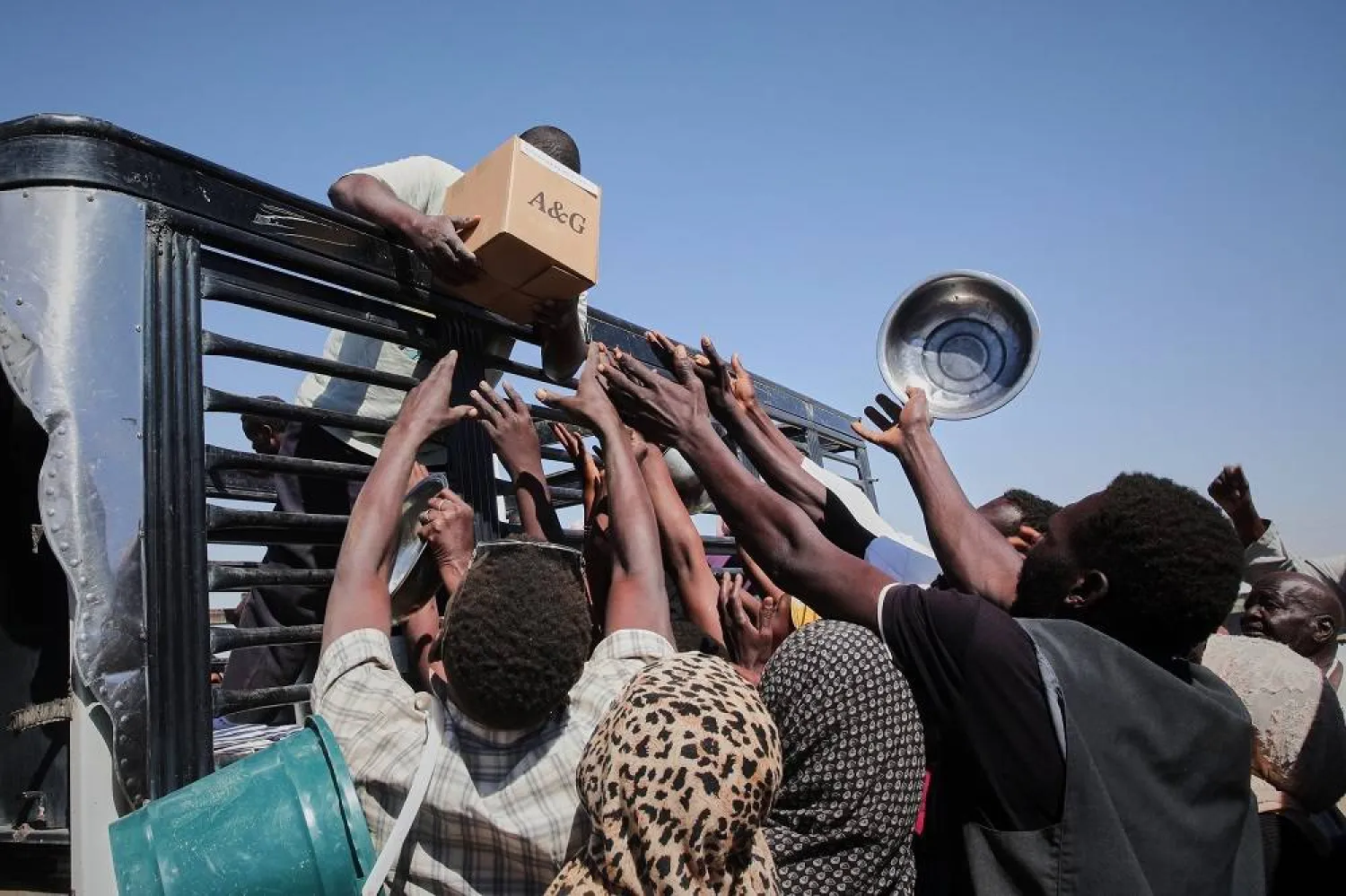
Sudanese families displaced from el-Fasher reach out as aid workers distribute food supplies at the newly established El-Afadh camp in Al Dabbah, in Sudan's Northern State, Sunday, Nov. 16, 2025. (AP)
TT

Sudan Named Most Neglected Crisis of 2025 in Aid Agency Poll 

Sudanese families displaced from el-Fasher reach out as aid workers distribute food supplies at the newly established El-Afadh camp in Al Dabbah, in Sudan's Northern State, Sunday, Nov. 16, 2025. (AP)

The humanitarian catastrophe engulfing Sudan, unleashing horrific violence on children and uprooting nearly a quarter of the population, is the world's most neglected crisis of 2025, according to a poll of aid agencies.

Some 30 million Sudanese people - roughly equivalent to Australia's population - need assistance, but experts warn that warehouses are nearly empty, aid operations face collapse and two cities have tipped into famine.

"The Sudan crisis should be front page news every single day," said Save the Children humanitarian director Abdurahman Sharif.

"Children are living a nightmare in plain sight, yet the world continues to shamefully look away."

Sudan was named by a third of respondents in a Thomson Reuters Foundation crisis poll of 22 leading aid organizations.

Democratic Republic of Congo (DRC), widely considered the deadliest conflict since World War Two, ranked second.

Although Sudan has received some media attention, Sharif said the true scale of the catastrophe remained "largely out of sight and out of mind."

The United Nations has called Sudan the world's biggest humanitarian crisis, but a $4.16 billion appeal is barely a third funded.

The poll's respondents highlighted a number of overlooked emergencies, including Myanmar, Afghanistan, Somalia, Africa's Sahel region and Mozambique.

Many agencies said they were reluctant to single out just one crisis in a year when the United States and other Western donors slashed aid despite soaring humanitarian needs.

"It feels as though the world is turning its back on humanity," said Oxfam's humanitarian director Marta Valdes Garcia.

'INDICTMENT OF HUMANITY'

The conflict between the Sudanese army and the paramilitary Rapid Support Forces, which erupted out of a power struggle in April 2023, has created the world's largest displacement crisis with 12 million people fleeing their homes.

Aid groups cited appalling human rights violations, including child cruelty, rape and conscription.

"What is being done to Sudan's children is unconscionable, occurring on a massive scale and with apparent impunity," said World Vision's humanitarian operations director Moussa Sangara.

Hospitals and schools have been destroyed or occupied, and 21 million people face acute hunger.

The UN World Food Program (WFP) has warned that without additional funds it will have to cut rations for communities in famine or at risk.

Aid organizations say violence, blockades and bureaucratic obstacles are making it hard to reach civilians in conflict zones.

"What we are witnessing in Sudan is nothing short of an indictment of humanity," said the UN refugee agency's regional director Mamadou Dian Balde.

"If the world does not urgently step up - diplomatically, financially, and morally - an already catastrophic situation will deteriorate further with millions of Sudanese and their neighbors paying the price."

'BREAKING POINT'

South Sudan and Chad, both hosting large numbers of Sudanese refugees, were also flagged in the survey.

Charlotte Slente, head of the Danish Refugee Council, said Chad - a country already dealing with deep poverty and hunger exacerbated by the climate crisis - was being pushed "to breaking point."

"Chad's solidarity with the refugees is a lesson for the world's wealthiest nations. That generosity is being met by global moral failure," Slente said.

In South Sudan, Oxfam said donors were pulling out, forcing aid agencies to cut crucial support for millions of people.

'HELLSCAPE FOR WOMEN'

Several organizations sounded the alarm over escalating conflict in DRC.

Around 7 million people are displaced and 27 million face hunger in the vast resource-rich country, where rape has been used as a weapon of war through decades of conflict.

"This is the biggest humanitarian emergency that the world isn't talking about," said Christian Aid's chief executive Patrick Watt.

On a recent visit, he said villagers told him how armed groups had stolen livestock, torched homes, recruited boys to fight and subjected women and girls to terrifying sexual violence.

Rwandan-backed M23 rebels seized a swathe of eastern Congo this year in their bid to topple the government in Kinshasa. Fighting has continued despite a US-led peace deal signed this month by DRC and Rwanda.

DRC's conflict has intensified amid soaring global demand for minerals needed for clean energy technologies, smartphones and more.

Watt said people now face economic disaster due to Kinshasa's blockade on M23-controlled areas and aid cuts that have hollowed out the humanitarian response.

ActionAid said the violence had "created a hellscape" for women, while the Norwegian Refugee Council (NRC) called Congo "a case study of global neglect."

"This neglect is not an accident: it is a choice," said NRC Secretary General Jan Egeland.

UN aid chief Tom Fletcher named Myanmar as the most neglected crisis, describing it as "a billion-dollar emergency running on fumes."

A $1.1 billion appeal for the southeast Asian country is only 17% funded despite mass displacement, rising hunger and rampant violence.

Although donors raced to help after Myanmar's massive earthquake in March, Fletcher said the world had turned away from the "grinding crisis" underneath.

"Myanmar is becoming invisible," he said.


Lebanon Judge to Question Shipowner Linked to Port Blast

Igor Grechushkin, a Russian businessman based in Cyprus, is escorted by police before the start of his trial on the possible extradition to Lebanon, in Sofia, Bulgaria, December 10, 2025. (Reuters)
TT

Lebanon Judge to Question Shipowner Linked to Port Blast

Igor Grechushkin, a Russian businessman based in Cyprus, is escorted by police before the start of his trial on the possible extradition to Lebanon, in Sofia, Bulgaria, December 10, 2025. (Reuters)

Lebanese judge Tarek Bitar headed to Bulgaria on Wednesday to question a shipowner wanted in connection with a catastrophic 2020 Beirut port blast, a judicial official told AFP.

The long-awaited questioning comes after a court this month refused Lebanon's request to extradite Igor Grechushkin, a 48-year-old Russian-Cypriot who was arrested in September at Sofia airport.

Authorities in Lebanon say the August 4, 2020, explosion was triggered by a fire in a warehouse where tons of ammonium nitrate fertilizer had been stored haphazardly for years, despite repeated warnings to senior officials.

Beirut authorities have identified Grechushkin as the owner of the Rhosus, the ship that brought the ammonium nitrate into the port.

The blast was one of the world's largest non-nuclear explosions, destroying swathes of the Lebanese capital, killing more than 220 people and injuring more than 6,500.

The Lebanese judicial official told AFP on condition of anonymity that "Bitar headed to Sofia on Wednesday" and is expected to question Grechushkin the following day.

The Lebanese embassy in Sofia is arranging for a translator and a clerk to record the minutes of the questioning, which Bulgarian judicial officials are to attend, the official said.

According to Bulgarian prosecutors, Grechushkin is accused by Lebanese judicial authorities of "introducing explosives into Lebanon -- a terrorist act that resulted in the death of a large number of people".

The Lebanese judicial official told AFP that authorities are relying on Grechushkin's testimony and the information he has about the ammonium nitrate shipment "and the party that ordered and financed it", and to determine if Beirut was the ship's destination.

Bitar resumed his investigation this year as Lebanon's balance of power shifted following a war between Israel and Hezbollah that weakened the group, which had spearheaded a campaign against him.

A travel ban imposed on Bitar as part of a judicial battle related to the case was recently lifted.

President Joseph Aoun and Prime Minister Nawaf Salam, who both took office this year, have vowed to uphold the independence of the judiciary in a country plagued by official impunity.

Officials named in the port explosion investigation had filed a flurry of lawsuits seeking to hamper its progress.


Palestinians Retrieve Belongings from West Bank Camp Before Home Demolitions

A Palestinian resident of the Nur Shams refugee camp walks with a child past Israeli soldiers while carrying belongings retrieved from her home ahead of the Israeli military's demolition of residential buildings in the camp near Tulkarem in the Israeli-occupied West Bank on December 17, 2025. (AFP)
TT

Palestinians Retrieve Belongings from West Bank Camp Before Home Demolitions

A Palestinian resident of the Nur Shams refugee camp walks with a child past Israeli soldiers while carrying belongings retrieved from her home ahead of the Israeli military's demolition of residential buildings in the camp near Tulkarem in the Israeli-occupied West Bank on December 17, 2025. (AFP)

Dozens of residents from the West Bank's emptied Nur Shams refugee camp returned on Wednesday to retrieve belongings ahead of the Israeli military's demolition of 25 residential buildings there.

Early this year, the military launched an ongoing operation it said was aimed at rooting out Palestinian armed groups from camps in the northern occupied West Bank -- including Nur Shams, Tulkarem and Jenin.

Loading furniture, children's toys and even a window frame onto small trucks, Palestinian residents hurried Wednesday to gather as much as they could under the watchful eye of Israeli soldiers, according to an AFP journalist at the scene.

Troops performed ID checks and physical searches, allowing through only those whose houses were set to be demolished.

Some who were able to enter salvaged large empty water tanks, while others came out with family photos, mattresses and heaters.

More than 32,000 people remain displaced from the now-empty camps, where Israeli troops are stationed, according to the UN's agency for Palestinian refugees, UNRWA.

Mahmud Abdallah, who was displaced from Nur Shams and was able to enter a part of the camp on Wednesday, said he witnessed for the first time the destruction that had taken place after he was forced to leave.

"I was surprised to find that there were no habitable houses; maybe two or three, but they were not suitable for living," he said.

"The camp is destroyed".

The demolitions, affecting 25 buildings housing up to 100 families, were announced earlier this week and are scheduled for Thursday.

They are officially part of a broader Israeli strategy of home demolitions to ease its military vehicles' access in the dense refugee camps of the northern West Bank.

Israel has occupied the Palestinian territory since 1967.

Ahmed al-Masri, a camp resident whose house was to be demolished, told AFP that his request for access was denied.

"When I asked why, I was told: 'Your name is not in the liaison office records'," he said.

UNRWA's director for the West Bank and east Jerusalem, Roland Friedrich, said an estimated 1,600 houses were fully or partially destroyed during the military operation, making it "the most severe displacement crisis that the West Bank has seen since 1967".

Nur Shams, along with other refugee camps in the West Bank, was established after the creation of Israel in 1948, when hundreds of thousands of Palestinians were displaced from their homes in what is now Israel.

"We ask God to compensate us with palaces in paradise", said Ibtisam al-Ajouz, a displaced camp resident whose house was also set to be destroyed.

"We are determined to return, and God willing, we will rebuild. Even if the houses are demolished, we will not be afraid -- our morale is high."


Arab Parliament Welcomes UN Resolution on Palestinian Self-Determination

Arab Parliament Welcomes UN Resolution on Palestinian Self-Determination
TT

Arab Parliament Welcomes UN Resolution on Palestinian Self-Determination

Arab Parliament Welcomes UN Resolution on Palestinian Self-Determination

Speaker of the Arab Parliament Mohamed Al-Yamahi has welcomed the United Nations General Assembly's overwhelming vote in favor of a resolution affirming the Palestinian people's inalienable right to self-determination.

The resolution passed with a significant majority of 164 countries voting in favor, SPA reported.

Al-Yamahi described the vote as a pivotal victory for Palestinian rights and a reflection of a clear international will that highlights the political and moral isolation of the Israeli occupation.

He emphasized that the resolution serves as an explicit rejection of all forms of illegal settlement activity in the West Bank, which violates international law, the Fourth Geneva Convention, and numerous Security Council resolutions.

The speaker also strongly condemned the ongoing violations in the West Bank and recent attempts to alter the legal and historical status of occupied territories, citing the occupation government's recent approval to establish and legalize 19 new settlements.
