
Worn Banknotes, Tobacco Taxes: How Hamas Pays Its Members

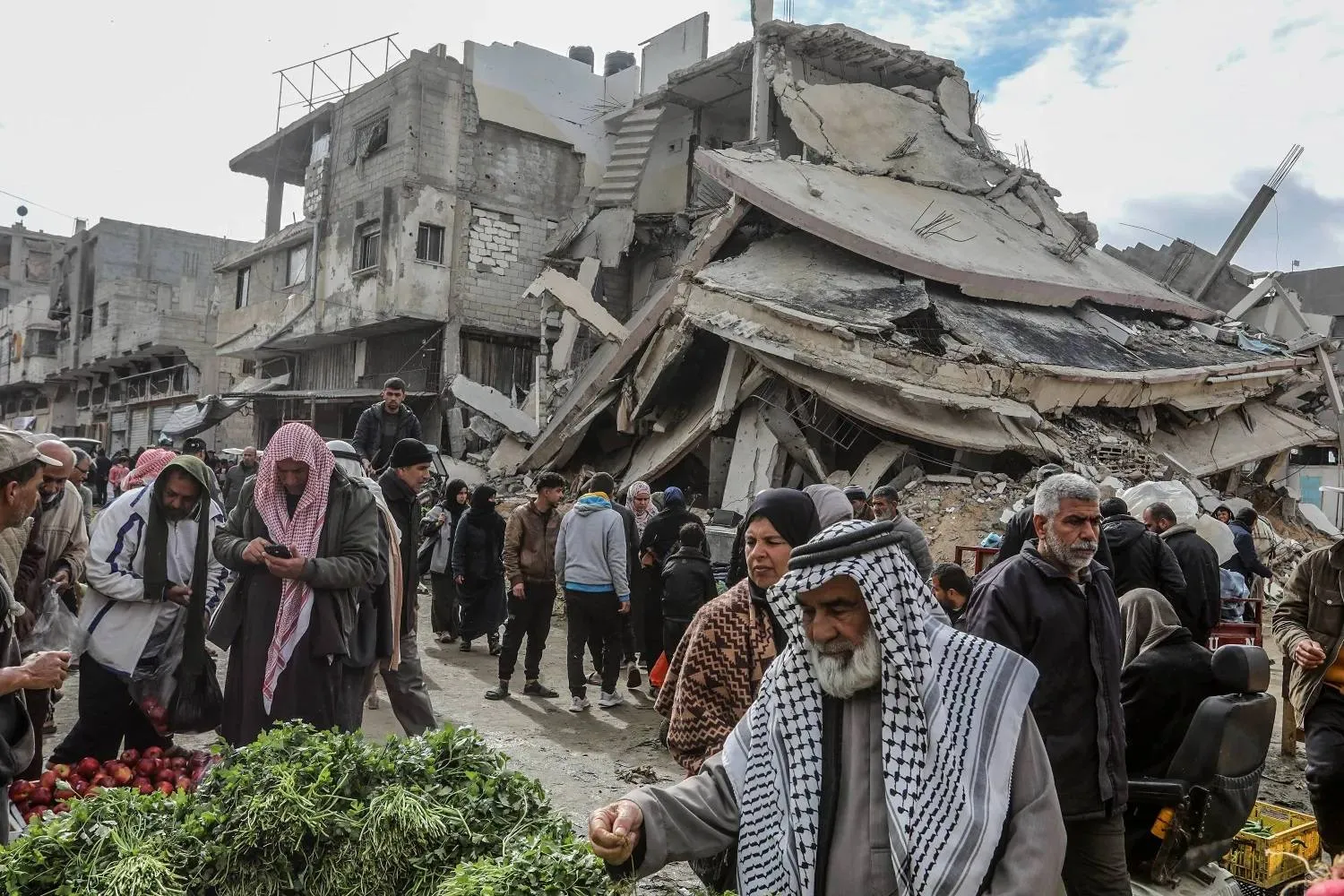
Palestinians shop amid the rubble in Khan Younis in southern Gaza, February last year (DPA)
TT

Worn Banknotes, Tobacco Taxes: How Hamas Pays Its Members

Palestinians shop amid the rubble in Khan Younis in southern Gaza, February last year (DPA)

More than two months after a fragile ceasefire between Israel and Hamas took effect in Gaza, the group has steadily reasserted some security control in areas under its authority. Yet for Gaza’s residents, daily economic hardship and deteriorating living conditions show little sign of easing.

Hamas’s popular base, made up of its members, their families, and supporters, remains a key pillar of its strength. Nearly two years of war with Israel have partially disrupted the group’s ability to consistently pay salaries.

During the war, Israel sought to dry up Hamas’s financial network by killing figures responsible for transferring money inside Gaza, as well as raiding currency exchange companies in the occupied West Bank that Israeli authorities said were linked to Palestinian factions.

According to field sources and Hamas officials who spoke to Asharq Al-Awsat, the group faced difficulties and delays in paying salaries regularly at leadership, field and other levels due to security conditions.

It has since resumed partial payments to all its members, including leaders and fighters from the Izz al-Din al-Qassam Brigades, Hamas’s armed wing, while paying lower rates to its preaching and social apparatus, described as civilian elements.

Where does Hamas get its money?

Sources agree that Hamas has managed to preserve some of its financial resources, including commercial activities inside and outside Gaza. One Hamas source said these business revenues generate income for the group alongside funds received from supporting parties such as Iran and others.

They added that such external support fluctuates, sometimes declining, increasing or arriving with delays for reasons related to the donors.

The source said Hamas faces growing difficulties in transferring funds into Gaza, forcing those overseeing salary payments to rely on whatever cash remains accessible in their reserves or to collect revenues from their own commercial sources.

How are salaries paid?

Sources who receive some of these payments told Asharq Al-Awsat, on condition of anonymity, that salaries and stipends were sometimes paid regularly each month but were also delayed by periods ranging from six weeks to two months.

A Hamas source said salary rates varied and did not exceed 80 percent at best, particularly for leaders and operatives in the Qassam Brigades and at the political level.

Lower percentages were paid to the preaching and social apparatus and other bodies, alongside allocations for activities aimed at supporting the population and what the group calls its popular base.

The source said the lowest rates were paid to government employees at both civilian and military levels, reaching 60 percent at most before declining in recent months to around 35 percent.

Several sources said Hamas continues to pay stipends to the families of its members and leaders killed over decades of its activities, as well as to prisoners and wounded fighters.

They added that the group also supports families whose salaries were cut by the Palestinian Authority, continues to provide social assistance and allocates funds to projects aimed at supporting its popular base, including food aid, water provision and communal kitchens, in coordination with foreign institutions.

Asked how salaries are delivered, Hamas sources said payments are made through tight networks and by hand to avoid Israeli monitoring of electronic wallets and banks.

Worn banknotes and tobacco taxes

As Hamas relies on manual delivery, questions remain over how it secures cash under Israel’s blockade. A Hamas source said the process was complex and could not be disclosed for security reasons.

Local sources outside Hamas said the group depends heavily on traders to obtain cash, alongside its existing cash reserves and revenues from businesses it operates.

One source said Hamas often pays worn banknotes to government employees in particular, and to a lesser extent to Qassam fighters and political figures. This forces recipients to manage on their own as most traders refuse to accept damaged or worn currency.

Hamas has encouraged some small traders, especially fruit and vegetable sellers, to accept such notes in exchange for continued support and access to goods at lower prices.

Another source said Hamas has imposed taxes on certain goods, such as tobacco products, to raise funds, noting that most cigarette traders deal in cash rather than electronic wallets, which many Gaza residents now rely on.

Israeli accusations against Iran

On Dec. 7, Israel accused Iran of supporting what it described as a banking network transferring hundreds of thousands of dollars to Hamas. Israel said the network consisted of Gaza-based money changers residing in Türkiye who exploit the country’s financial infrastructure for what it called terrorist purposes.

According to Israel, the network operated in full cooperation with the Iranian regime, transferring funds to Hamas and its leaders and managing wide ranging economic activity involving receiving money from Iran, storing it and transferring it to Hamas via Türkiye.

Israel published the identities of three individuals, including an official in Hamas’s financial apparatus and two money changers from Gaza, claiming they worked under the direction of Khalil al-Hayya.

Sources familiar with the two men told Asharq Al-Awsat they have lived outside Gaza for many years.

One was known to work with various Palestinian factions and had previously smuggled funds for them, including through tunnels along the Egyptian border, while also operating as a businessman in multiple fields beyond currency exchange.

Hamas sources dismissed the accusations as baseless, saying the group has its own methods for transferring funds.

They said Hamas often faces difficulties moving money from abroad into Gaza, a problem that also affects the West Bank due to Israeli pursuit and Palestinian Authority security pressure, though conditions there are better than in Gaza for transferring funds.

Sources from other Palestinian factions said they are also suffering financial crises and difficulties paying salaries and stipends to their members and leaders.

They said they sometimes distribute food aid and other assistance to help their members and families cope with harsh economic conditions, with most of the support coming through institutions backed by Iran or other parties.


Trump Heads into Davos Storm, with an Eye on Home

FILE - President Donald Trump is illuminated by a camera flash as he gestures while walking across the South Lawn of the White House, Nov. 2, 2025, in Washington, after returning from a trip to Florida. (AP Photo/Mark Schiefelbein, File)
TT

Trump Heads into Davos Storm, with an Eye on Home

FILE - President Donald Trump is illuminated by a camera flash as he gestures while walking across the South Lawn of the White House, Nov. 2, 2025, in Washington, after returning from a trip to Florida. (AP Photo/Mark Schiefelbein, File)

Donald Trump returns to the Davos ski resort next week after unleashing yet another avalanche on the global order. But for the US president, his main audience is back home.

Trump's first appearance in six years at the gathering of the world's political and global elite comes amid a spiraling crisis over his quest to acquire Greenland.

Fellow leaders at the mountain retreat will also be eager to talk about other shocks from his first year back in power, from tariffs to Venezuela, Ukraine, Gaza and Iran.

Yet for the Republican president, his keynote speech among the Swiss peaks will largely be aimed at the United States.

US voters are angered by the cost of living despite Trump's promises of a "golden age," and his party could be facing a kicking in crucial midterm elections in November.

That means Trump will spend at least part of his time in luxurious Davos talking about US housing.

A White House official told AFP that Trump would "unveil initiatives to drive down housing costs" and "tout his economic agenda that has propelled the United States to lead the world in economic growth."

The 79-year-old is expected to announce plans allowing prospective homebuyers to dip into their retirement accounts for down payments.

Billionaire Trump is keenly aware that affordability has become his Achilles' heel in his second term. A CNN poll last week found that 58 percent of Americans believe his first year back in the White House has been a failure, particularly on the economy.

Trump's supporters are also increasingly uneasy about the "America First" president's seemingly relentless focus on foreign policy since his return to the Oval Office.

But as he flies into the snowy retreat, Trump will find it impossible to avoid the global storm of events that he has stirred since January 20, 2025.

Trump will be alongside many of the leaders of the same European NATO allies that he has just threatened with tariffs if they don't back his extraordinary quest to take control of Greenland from Denmark.

Those threats have once again called into question the transatlantic alliance that has in many ways underpinned the western economic order celebrated at Davos.

- 'Economic stagnation' -

So have the broader tariffs Trump announced early in his second term, and he is set to add to the pressure on Europe in his speech.

Trump will "emphasize that the United States and Europe must leave behind economic stagnation and the policies that caused it," the White House official said.

The Ukraine war will also be on the cards.

Ukrainian President Volodymyr Zelensky is hoping for a meeting with Trump to sign new security guarantees for a hoped-for ceasefire deal with Russia, as are G7 leaders.

But while the largest-ever US Davos delegation includes Secretary of State Marco Rubio, special envoy Steve Witkoff and son-in-law Jared Kushner, who have all played key roles on Ukraine, no meeting is assured.

"No bilateral meetings have been scheduled for Davos at this time," the White House told AFP.

Trump is meanwhile reportedly considering a first meeting of the so-called "Board of Peace" for war-torn Gaza at Davos, after announcing its first members in recent days.

Questions are also swirling about the future of oil-rich Venezuela following the US military operation to topple its leader Nicolas Maduro, part of Trump's assertive new approach to his country's "backyard."

But Trump may also pause to enjoy his time in the scenic spot he called "beautiful Davos" in his video speech to the meeting a year ago.

The forum has always been an odd fit for the former New York property tycoon and reality TV star, whose brand of populism has long scorned globalist elites.

But at the same time, Trump relishes the company of the rich and successful.

His first Davos appearance in 2018 met occasional boos but he made a forceful return in 2020 when he dismissed the "prophets of doom" on climate and the economy.

A year later he was out of power. Now, Trump returns as a more powerful president than ever, at home and abroad.


Russia, China Unlikely to Back Iran Against US Military Threats

A man stands by the wreckage of a burnt bus bearing a banner (unseen) that reads "This was one of Tehran’s new buses that was paid for with the money of the people’s taxes,” in Tehran's Sadeghieh Square on January 15, 2026. (AFP)
TT

Russia, China Unlikely to Back Iran Against US Military Threats

A man stands by the wreckage of a burnt bus bearing a banner (unseen) that reads "This was one of Tehran’s new buses that was paid for with the money of the people’s taxes,” in Tehran's Sadeghieh Square on January 15, 2026. (AFP)

While Russia and China are ready to back protest-rocked Iran under threat by US President Donald Trump, that support would diminish in the face of US military action, experts told AFP.

Iran is a significant ally to the two nuclear powers, providing drones to Russia and oil to China. But analysts told AFP the two superpowers would only offer diplomatic and economic aid to Tehran, to avoid a showdown with Washington.

"China and Russia don't want to go head-to-head with the US over Iran," said Ellie Geranmayeh, a senior policy expert for the European Council on Foreign Relations think tank.

Tehran, despite its best efforts over decades, has failed to establish a formal alliance with Moscow and Beijing, she noted.

If the United States carried out strikes on Iran, "both the Chinese and the Russians will prioritize their bilateral relationship with Washington", Geranmayeh said.

China has to maintain a "delicate" rapprochement with the Trump administration, she argued, while Russia wants to keep the United States involved in talks on ending the war in Ukraine.

"They both have much higher priorities than Iran."

- Ukraine before Iran -

Despite their close ties, "Russia-Iranian treaties don't include military support" -- only political, diplomatic and economic aid, Russian analyst Sergei Markov told AFP.

Alexander Gabuev, director of Carnegie Russia Eurasia Center, said Moscow would do whatever it could "to keep the regime afloat".

But "Russia's options are very limited," he added.

Faced with its own economic crisis, "Russia cannot become a giant market for Iranian products" nor can it provide "a lavish loan", Gabuev said.

Nikita Smagin, a specialist in Russia-Iran relations, said that in the event of US strikes, Russia could do "almost nothing".

"They don't want to risk military confrontation with other great powers like the US -- but at the same time, they're ready to send weaponry to Iran," he said.

"Using Iran as a bargaining asset is a normal thing for Russia," Smagin said of the longer-term strategy, at a time when Moscow is also negotiating with Washington on Ukraine.

Markov agreed. "The Ukrainian crisis is much more important for Russia than the Iranian crisis," he argued.

- Chinese restraint -

China is also ready to help Tehran "economically, technologically, militarily and politically" as it confronts non-military US actions such as trade pressure and cyberattacks, Hua Po, a Beijing-based independent political observer, told AFP.

If the United States launched strikes, China "would strengthen its economic ties with Iran and help it militarize in order to contribute to bogging the United States down in a war in the Middle East," he added.

Until now, China has been cautious and expressed itself "with restraint", weighing the stakes of oil and regional stability, said Iran-China relations researcher Theo Nencini of Sciences Po Grenoble.

"China is benefiting from a weakened Iran, which allows it to secure low-cost oil... and to acquire a sizeable geopolitical partner," he said.

However, he added: "I find it hard to see them engaging in a showdown with the Americans over Iran."

Beijing would likely issue condemnations, but not retaliate, he said.

Hua said the Iran crisis was unlikely to have an impact on China-US relations overall.

"The Iranian question isn't at the heart of relations between the two countries," he argued.

"Neither will sever ties with the other over Iran."


Beirut’s Commodore Hotel, a Haven for Journalists During Lebanon’s Civil War, Shuts Down

People stand outside the closed Commodore hotel, in Beirut, Lebanon, Sunday, Jan. 11, 2026. (AP)
TT

Beirut’s Commodore Hotel, a Haven for Journalists During Lebanon’s Civil War, Shuts Down

People stand outside the closed Commodore hotel, in Beirut, Lebanon, Sunday, Jan. 11, 2026. (AP)

During Lebanon’s civil war, the Commodore Hotel in western Beirut's Hamra district became iconic among the foreign press corps.

For many, it served as an unofficial newsroom where they could file dispatches even when communications systems were down elsewhere. Armed guards at the door provided some sense of protection as sniper fights and shelling were turning the cosmopolitan city to rubble.

The hotel even had its own much-loved mascot: a cheeky parrot.

The Commodore endured for decades after the 15-year civil war ended in 1990 — until this week, when it closed for good.

The main gate of the nine-story hotel with more than 200 rooms was shuttered Monday. Officials at the Commodore refused to speak to the media about the decision to close.

Although the country’s economy is beginning to recover from a protracted financial crisis that began in 2019, tensions in the region and the aftermath of the Israel-Hezbollah war that was halted by a tenuous ceasefire in November 2024 are keeping many tourists away. Lengthy daily electricity cuts force businesses to rely on expensive private generators.

The Commodore is not the first of the crisis-battered country’s once-bustling hotels to shut down in recent years.

But for journalists who lived, worked and filed their dispatches there, its demise hits particularly hard.

“The Commodore was a hub of information — various guerrilla leaders, diplomats, spies and of course scores of journalists circled the cafes and lounges,” said Tim Llewellyn, a former BBC Middle East correspondent who covered the civil war. “On one occasion (late Palestinian leader) Yasser Arafat himself dropped in to sip coffee with” with the hotel manager's father, he recalled.

A line to the outside world

At the height of the civil war, when telecommunications were dysfunctional and much of Beirut was cut off from the outside world, it was at the Commodore where journalists found land lines and Telex machines that always worked to send reports to their media organizations around the globe.

Across the front office desk in the wide lobby of the Commodore, there were two teleprinters that carried reports of The Associated Press and Reuters news agencies.

“The Commodore had a certain seedy charm. The rooms were basic, the mattresses lumpy and the meal fare wasn’t spectacular,” said Robert H. Reid, the AP’s former Middle East regional editor, who was among the AP journalists who covered the war. The hotel was across the street from the international agency’s Middle East head office at the time.

“The friendly staff and the camaraderie among the journalist-guests made the Commodore seem more like a social club where you could unwind after a day in one of the world’s most dangerous cities,” Reid said.

Llewellyn remembers that the hotel manager at the time, Yusuf Nazzal, told him in the late 1970s “that it was I who had given him the idea” to open such a hotel in a war zone.

Llewellyn said that during a long chat with Nazzal on a near-empty Middle East Airlines Jumbo flight from London to Beirut in the fall of 1975, he told him that there should be a hotel that would make sure journalists had good communications, “a street-wise and well-connected staff running the desks, the phones, the teletypes.”

During Israel's 1982 invasion of Lebanon and a nearly three-month siege of West Beirut by Israeli troops, journalists used the roof of the hotel to film fighter jets striking the city.

The parrot

One of the best-known characters at the Commodore was Coco the parrot, who was always in a cage near the bar. Patrons were often startled by what they thought was the whiz of an incoming shell, only to discover that it was Coco who made the sound.

AP’s chief Middle East correspondent Terry Anderson was a regular at the hotel before he was kidnapped in Beirut in 1985 and held for seven years, becoming one of the longest-held American hostages in history.

Videos of Anderson released by his kidnappers later showed him wearing a white T-shirt with the words “Hotel Commodore Lebanon.”

With the kidnapping of Anderson and other Western journalists, many foreign media workers left the predominantly-Muslim western part of Beirut, and after that the hotel lost its status as a safe haven for foreign journalists.

Ahmad Shbaro, who worked at different departments of the hotel until 1988, said the main reason behind the Commodore’s success was the presence of armed guards that made journalists feel secure in the middle of Beirut’s chaos as well as functioning telecommunications.

He added that the hotel also offered financial facilities for journalists who ran out of money. They would borrow money from Nazzal and their companies could pay him back by depositing money in his bank account in London.

Shbaro remembers a terrifying day in the late 1970s when the area of the hotel was heavily shelled and two rooms at the Commodore were hit.

“The hotel was full and all of us, staffers and journalists, spent the night at Le Casbah,” a famous nightclub in the basement of the building, he said.

In quieter times, journalists used to spend the night partying by the pool.

“It was a lifeline for the international media in West Beirut, where journalists filed, ate, slept, and hid from air raids, shelling, and other violence,” said former AP correspondent Scheherezade Faramarzi.

“It gained both fame and notoriety,” she said, speaking from the Mediterranean island of Cyprus.

The hotel was built in 1943 and kept functioning until 1987 when it was heavily damaged in fighting between Shiite and Druze militiamen at the time. The old Commodore building was later demolished and a new structure was build with an annex and officially opened again for the public in 1996.

But Coco the parrot was no longer at the bar. The bird went missing during the 1987 fighting. Shbaro said it is believed he was taken by one of the gunmen who stormed the hotel.