


Canada, US to Launch Formal Talks to Review Free Trade Agreement in Mid-January

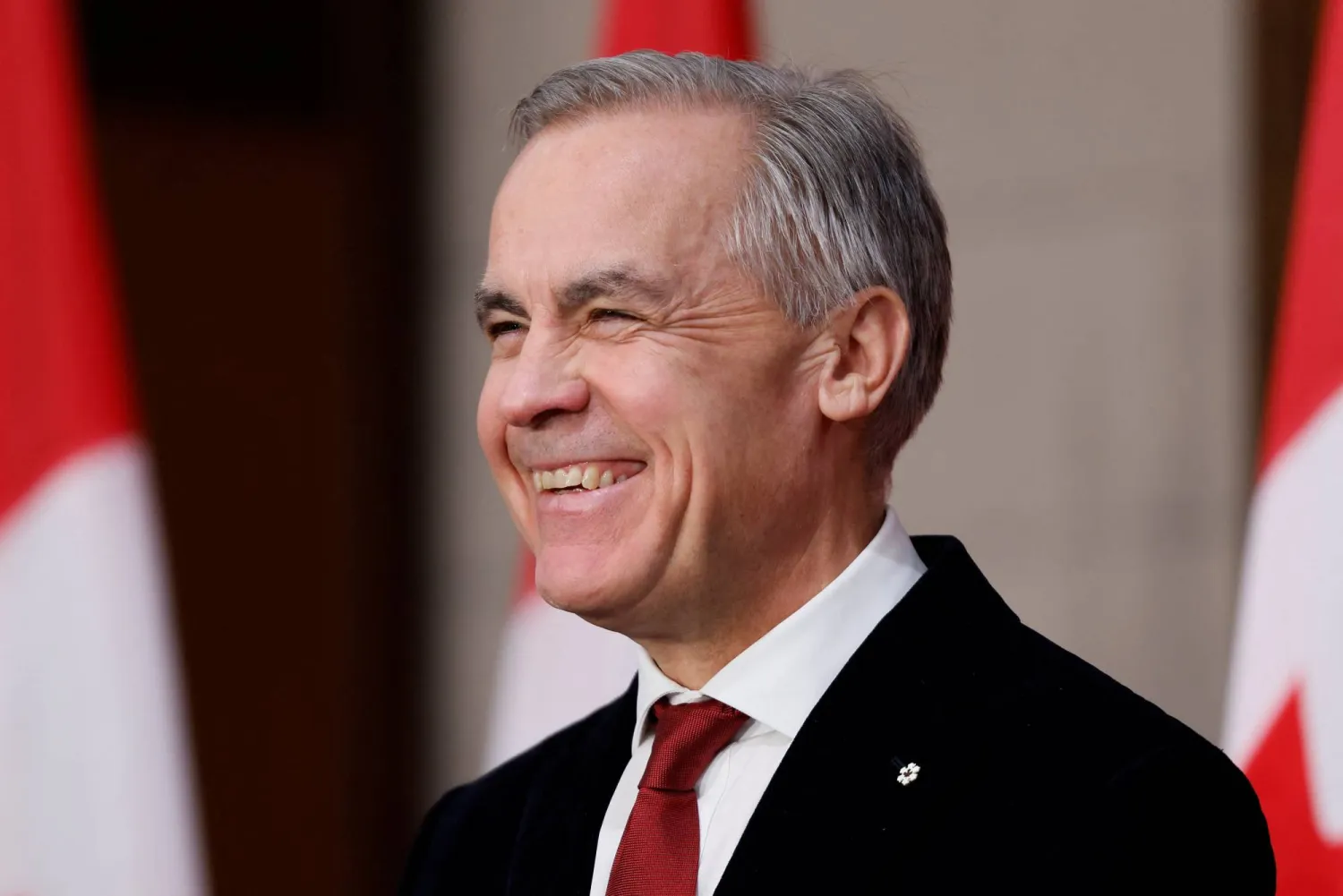
Canada's Prime Minister Mark Carney takes part in a press conference on Parliament Hill in Ottawa, Ontario, Canada December 18, 2025. REUTERS/Blair Gable
TT

Canada, US to Launch Formal Talks to Review Free Trade Agreement in Mid-January

Canada's Prime Minister Mark Carney takes part in a press conference on Parliament Hill in Ottawa, Ontario, Canada December 18, 2025. REUTERS/Blair Gable

Canada and the US will launch formal discussions to review their free trade agreement in mid-January, the office of Canadian Prime Minister Mark Carney said.

The prime minister confirmed to provincial leaders that Dominic LeBlanc, the country’s point person for US-Canada trade relations, “will meet with US counterparts in mid-January to launch formal discussions," Carney’s office said in a statement late Thursday.

The United States-Mexico-Canada trade pact, or USMCA, is up for review in 2026. US President Donald Trump negotiated the deal in his first term and included a clause to possibly renegotiate the deal in 2026.

Carney met with the leaders of Canada’s provinces on Thursday to give them an update on trade talks with the US.

Canada is one of the most trade-dependent countries in the world, and more than 75% of Canada’s exports go to the country's southern neighbor. But most exports to the US are currently exempted by USMCA.

Trump cut off trade talks to reduce tariffs on certain sectors with Carney in October after the Ontario provincial government ran an anti-tariff advertisement in the US. That followed a spring of acrimony, since abated, over Trump’s insistence that Canada should become the 51st US state.

Carney said earlier Thursday that Canada and the US were close to an agreement at the time on sectoral tariff relief in multiple areas, including steel and aluminum. Tariffs are taking a toll on certain sectors of Canada's economy, particularly aluminum, steel, auto and lumber.

Carney also said trade irritants flagged this week by US Trade Representative Jamieson Greer are elements of a “much bigger discussion” about continental trade. Greer said a coming review of the Canada-US-Mexico trade deal will hinge on resolving US concerns about Canadian policies on dairy products, alcohol and digital services.

Carney and the provincial premiers agreed to meet in person in Ottawa early in the new year.

Canada is the top export destination for 36 US states. Nearly $3.6 billion Canadian (US$2.7 billion) worth of goods and services cross the border each day.

About 60% of US crude oil imports are from Canada, as are 85% of US electricity imports.

Canada is also the largest foreign supplier of steel, aluminum and uranium to the US and has 34 critical minerals and metals that the Pentagon is eager for and investing in for national security.

Carney said US access to Canada’s critical ministers is not a certainty.

“It’s a potential opportunity for the United States, but it’s not an assured opportunity for the United States. It’s part of a bigger discussion in terms of our trading relationship, because we have other partners around the world, in Europe for example, who are very interested in participating,” Carney said earlier Thursday.



Saudi Arabia Sets New Benchmarks in Privatization, Healthcare Innovation, and Venture Capital

A drone view shows cityscape in Riyadh, Saudi Arabia, June 1, 2025. (Reuters)
TT

Saudi Arabia Sets New Benchmarks in Privatization, Healthcare Innovation, and Venture Capital

A drone view shows cityscape in Riyadh, Saudi Arabia, June 1, 2025. (Reuters)

The second half of January was defined by the cementing of Saudi Arabia’s economic transformation and its emergence as a global hub for innovation and humanitarian leadership, reported the Saudi Press Agency on Tuesday.

Economic structural transformation

The Kingdom moved from planning to execution in its fiscal reforms with the official launch of the National Privatization Strategy. This concludes the foundational phase, with the National Center for Privatization & PPP having already developed over 200 projects worth $213 billion.

This structural shift is supported by robust market confidence, evidenced by Fitch affirming Saudi Arabia’s A+ rating and the Saudi Electricity Company successfully issuing $2.4 billion in international sukuk with orders exceeding $10 billion.

Simultaneously, the innovation economy reached a new peak, with Saudi Arabia leading the region in venture capital for the third consecutive year, attracting a record $1.72 billion in 2025 - a 145% annual increase driven by fintech and gaming.

Pioneering science and medicine

Saudi Arabia’s investment in advanced capabilities yielded global headlines. The King Faisal Specialist Hospital and Research Centre achieved a world-first medical milestone by performing a fully robotic living-donor liver transplant, executing both the donor and recipient surgeries robotically.

In the environmental sciences, the National Center for Wildlife published a groundbreaking study in Nature regarding the discovery of naturally mummified cheetahs in Saudi caves dating back 4,800 years, providing a genetic roadmap for reintroduction programs.

Global connectivity

The Kingdom continued to expand its global footprint. The aviation sector recorded a historic 140.9 million passengers in 2025, a 9.6% growth that outpaced regional rates, while Saudia strengthened ties with India through a new codeshare agreement with Air India.

In numbers:

60%: The new Saudization rate mandated for marketing and sales professions in the private sector.

SAR4.7 trillion: The size of the Saudi economy in 2024, nearly doubling from SAR2.6 trillion in 2016.

14.8 million: The number of Umrah performances recorded during the month of Rajab.

$39 million: The grant pledged by Saudi Arabia to the Global Fund to fight AIDS, Tuberculosis, and Malaria.

18%: The annual growth rate in the number of SFDA-licensed factories and warehouses in 2025.

2.1 million: The number of trees planted by the National Water Company in Madinah to date.

97%: The case completion rate achieved by the Board of Grievances in 2025.

41 million: The number of electronic transactions processed by the Absher platform in December 2025 alone.

25 million: The number of worshippers received at the Prophet’s Mosque during the month of Rajab.

60,000: The number of sacrificial animals (Adahi) delivered to Egypt and Palestine as part of the Kingdom's support.

2.7 billion liters: The volume of raw milk produced by specialized dairy farms in the Kingdom in 2024, with 95% certified under Saudi GAP.

317,200 square meters: The total area of two new parks announced for development in Riyadh.

24%: The increase in the number of seafarers in the Kingdom during 2025, reaching 2,948.

These figures reflect a nation that is successfully leveraging its financial strength to fuel future growth while delivering tangible results in healthcare, logistics, and digital governance today.


Saudi Aramco Announces Completion of $4 Billion Bond Issuance

The Aramco tower in Riyadh, which is located within the King Abdullah Financial District (KAFD). AFP
TT

Saudi Aramco Announces Completion of $4 Billion Bond Issuance

The Aramco tower in Riyadh, which is located within the King Abdullah Financial District (KAFD). AFP

Saudi Aramco announced on Tuesday that it has successfully completed a $4 billion issuance of bonds across four tranches under its Global Medium Term Note Program.

The tranches include:
• $500 million senior notes maturing in 2029 with a coupon rate of 4.0%;
• $1.5 billion senior notes maturing in 2031 with a coupon rate of 4.375%;
• $1.25 billion senior notes maturing in 2036 with a coupon rate of 5.0%; and
• $750 million senior notes maturing in 2056 with a coupon rate of 6.0%.

The transaction was priced on January 26, 2026, and the notes were listed on the London Stock Exchange.

“This issuance is part of Aramco’s focused strategy to further optimize its capital structure and enhance shareholder value creation,” said Aramco’s Executive Vice President & Chief Financial Officer Ziad Al-Murshed.

“The attractive pricing achieved on the transaction reflects global investors’ continued confidence in Aramco’s financial strength and resilient balance sheet,” he said.

Al-Murshed added that Aramco remains firmly committed to maintaining disciplined capital management and delivering long-term value to its shareholders.


Türkiye Monthly Inflation Jumps to 4.84% in January, Exceeds Forecast

People walk past the counter of a traditional Turkish bagel "simit" street vendor, Eminönü, Istanbul, Türkiye, Dec. 27, 2025. (AFP)
TT

Türkiye Monthly Inflation Jumps to 4.84% in January, Exceeds Forecast

People walk past the counter of a traditional Turkish bagel "simit" street vendor, Eminönü, Istanbul, Türkiye, Dec. 27, 2025. (AFP)

Turkish consumer price inflation leapt to a higher-than-expected 4.84% month-on-month in January, Turkish Statistical ​Institute data showed on Tuesday, driven in part by a 6.59% jump in food and non-alcoholic drinks prices.

Annual inflation dipped to 30.65% in January, with price rises driven by the annual hike in the minimum wage and ‌various new year price ‌adjustments.

In a Reuters ‌poll, ⁠monthly ​inflation ‌was forecast to be 4.32% with the annual rate seen at 30.00%.

In December, monthly consumer price inflation edged up to 0.89% while the annual rate slipped to 30.89%.

According to the poll's median estimate, annual ⁠inflation is expected to slow to 23% by ‌year-end, remaining above the central bank's ‍forecast of 16%.

In ‍January, the central bank lowered its ‍key interest rate by a less-than-expected 100 basis points to 37%, citing firming inflation, and pricing behavior and expectations that threaten the disinflation ​process.

After a brief policy reversal early last year due to political turmoil, ⁠the central bank's rate-cutting cycle resumed in July with a 300-basis-point move, followed by cuts of 250 points and then 100 in October amid rising food prices, before the last two cuts of 150 in December then 100 points in January.

The data also showed the domestic producer price index rose 2.67% month-on-month in January ‌for an annual increase of 27.17%.