


‘No Male Visitors’: Gaza Rents Soar Under Tight Restrictions

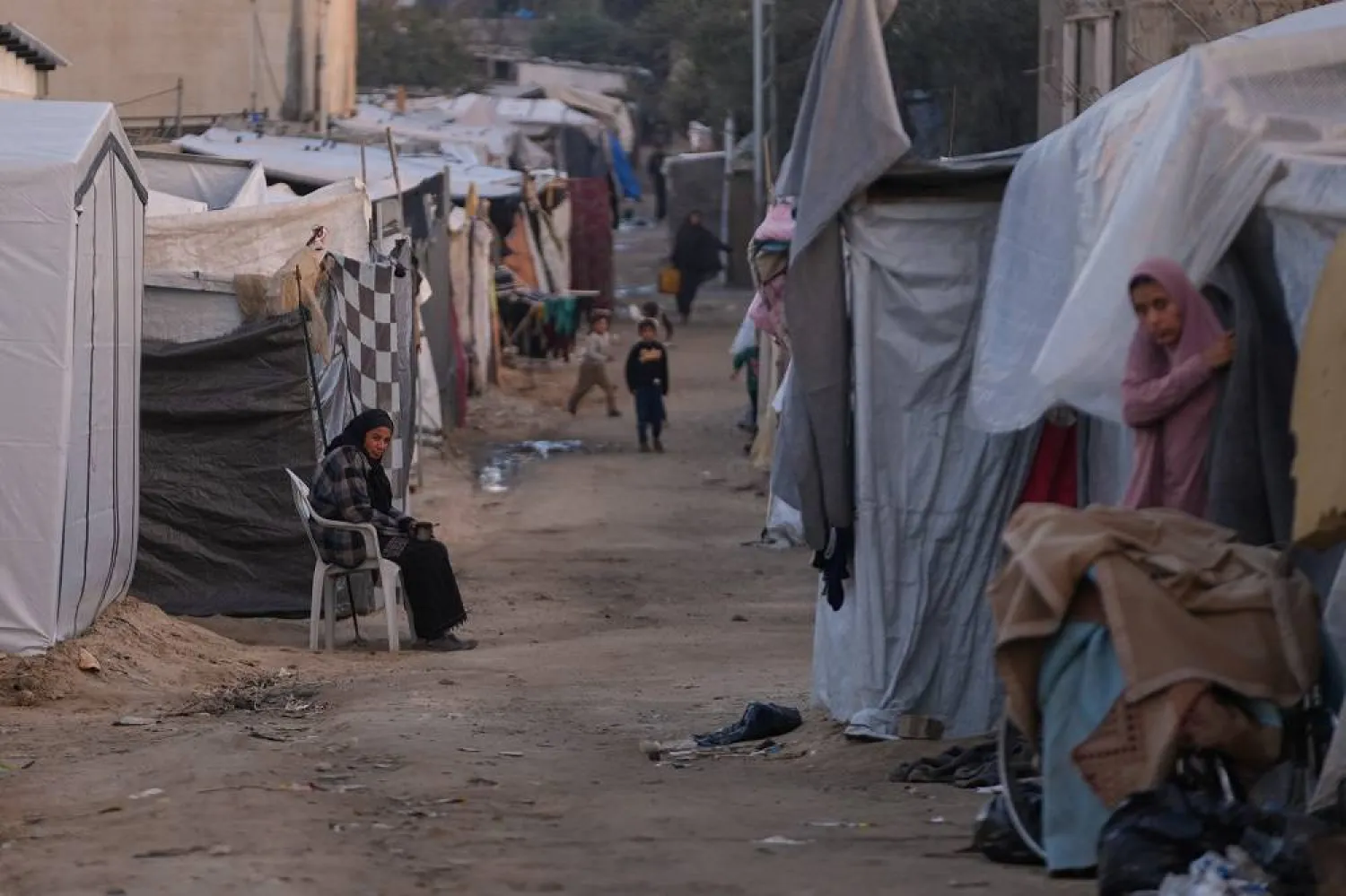
A woman sits next to her tent on an alley of a makeshift tent camp for displaced Palestinians in Deir al-Balah, central Gaza Strip, Tuesday, Dec. 23, 2025. (AP)
TT

‘No Male Visitors’: Gaza Rents Soar Under Tight Restrictions

A woman sits next to her tent on an alley of a makeshift tent camp for displaced Palestinians in Deir al-Balah, central Gaza Strip, Tuesday, Dec. 23, 2025. (AP)

For weeks, Nafez al-Ghorani has moved from one lead to another, spending long, punishing days searching for an apartment to rent, clinging to the hope of finding a roof for his family until they can return to their own home in Gaza.

A resident of Sheikh Radwan in the city’s north, al-Ghorani is now displaced in Khan Younis in the south, where his search has collided with a stark reality, as widespread destruction has left most homes and residential buildings uninhabitable.

Finding an apartment was not the only challenge facing al-Ghorani and hundreds of others each day. More difficult still are the complex conditions imposed by landlords when someone is fortunate enough to find a vacant unit.

Al-Ghorani, who currently lives in a tent in Khan Younis, told Asharq Al-Awsat that whenever he finds an apartment suitable for rent, the owner asks for a copy of his identity card to conduct background checks, either in his original neighborhood before his home was destroyed or through other parties, before approving the lease.

He said his requests were rejected several times for reasons he could not understand.

In one instance, after agreeing on rent with a landlord, al-Ghorani was surprised by a condition barring him from receiving any male visitors in the apartment, even his brothers, over fears that one of them might belong to a Palestinian faction, which could expose the building to an Israeli strike.

Al-Ghorani said he rejected the condition, and the landlord, in turn, refused to rent the apartment.

Al-Ghorani said that finding an apartment for rent, even at exorbitant prices, has become nearly impossible amid the complications imposed by homeowners who fear for their properties and their own safety.

While he considers such concerns a legitimate right, he pointed to what he described as excessive and sometimes unjustified conditions, including those that prevented him from renting despite the fact that neither he nor any of his five children belongs to any faction.

Forced choices

With only a small number of homes and apartments left standing in Gaza after widespread destruction across large parts of the enclave, residents fear being targeted by Israeli strikes as ceasefire violations continue following the truce that took effect on Oct. 10.

In a report published early this year, the United Nations Office for the Coordination of Humanitarian Affairs said 92 percent of housing units in Gaza have been destroyed or damaged.

The office said 436,000 housing units were affected by the war, with 160,000 completely destroyed and 276,000 partially damaged, some severely.

The report stated that more than 1.8 million people are in urgent need of emergency shelter and basic household essentials.

Fadl al-Shanti, who owns a six-story residential building in western Gaza City, said he cannot rent to anyone without first inquiring about them, calling it a fundamental right to protect his building and the lives of his family members who live in one of its apartments.

Speaking to Asharq Al-Awsat, he said Israel does not wait for permission when it decides to strike a suspected militant and has committed dozens of massacres against entire families and buildings to kill a single person.

“The lives of my family and those living in the building are a trust I carry as part of my responsibilities,” he said.

He added that as a building owner, he is not against his own people, whether they belong to a Palestinian faction or not, but said there are compelling circumstances and harsh conditions that cannot be ignored.

“I cannot sacrifice the lives of several families for one person who can find an alternative place,” he said.

Al-Shanti acknowledged that some landlords have sharply raised rents, yet demand among those forced to seek housing remains high. He said he personally raised the rent from prewar levels to about $800 from $500 previously, while most landlords now demand between $1,000 and $1,500 for apartments ranging from 130 to 170 square meters.

Before the war, rents ranged from $200 to $500, while furnished apartments rented for up to $700 per month.

A citizen without a homeland

Conditions imposed by landlords do not stop there. Some landlords refuse to rent to families with more than six members or impose conditions related to water, such as requiring tenants to share the landlord’s limited water allocation due to severe shortages.

It has also been noted that most apartment owners refuse to rent to people working in certain professions, such as journalists, medical staff and university professors, due to their repeated targeting by Israel during the war.

Haitham Omar, who was also searching for an apartment, said he was shocked by the excessive price hikes and the onerous conditions, in addition to payments demanded by brokers and intermediaries who market the apartments.

Speaking to Asharq Al-Awsat, he stated that a landlord demanded $1,300 per month for a two-room apartment with a kitchen and living room.

“I am a simple citizen working in a private sector company, and all I earn monthly is $550,” he said.

Even damaged units have not escaped high rents. Omar said the owner of a damaged apartment demanded about $600 a month, even though parts of it were covered with tarpaulins, describing the situation as unjust.

With bitterness in his voice, he added, “They were right to say that a home is a homeland, and today we are without a homeland.”

Even women are barred from visiting

Iman al-Attar, a young woman who works as an online intermediary between landlords and tenants, noted that some conditions are viewed by many as normal, adding that apartment owners fear that tenants may host displaced relatives in the same unit, which can affect building services.

She recounted an incident in which a landlord imposed a condition banning the tenant from receiving any guests, men or women, claiming that Israel had struck women because their husbands were faction members. She said the tenant rejected the condition outright.

As for banning male visitors, al-Attar said it has become a frequent practice and is now often included as a clause in rental contracts.

She did not deny that most apartment owners are exploiting the current situation, with no clear vision for reconstruction or a definitive end to the war, to impose their conditions and raise rents to excessive levels.



Baby Born in Tent on a Beirut Roadside Struggles to Survive, Her Family Displaced by War

Haifa Kenjo, who fled Israeli airstrikes on the southern suburbs of Beirut, holds her 15-day-old daughter Shiman inside the tent she uses as a shelter and where she gave birth to her in Beirut, Sunday, April 12, 2026. (AP Photo/Emilio Morenatti)
TT

Baby Born in Tent on a Beirut Roadside Struggles to Survive, Her Family Displaced by War

Haifa Kenjo, who fled Israeli airstrikes on the southern suburbs of Beirut, holds her 15-day-old daughter Shiman inside the tent she uses as a shelter and where she gave birth to her in Beirut, Sunday, April 12, 2026. (AP Photo/Emilio Morenatti)

All that newborn Shiman knows of the world is a flimsy tent along Beirut’s waterfront — the stench of mildewed blankets, stings of swarming insects and screams of Israeli warplanes striking the Lebanese capital.

As of Monday, she was 16 days old after being born here in the mud, said her mother, Haifa Kenjo.

Kenjo, 34, was nine months pregnant when Israeli attacks on Beirut’s southern suburbs of Dahiyeh sent her, her husband and their 2-year-old son, Khalid, running for their lives in sandals and pajamas. They had no time to bring anything as explosions shook the house, they said — not clothes, not cash.

They took refuge in a donated tent near downtown Beirut and secured the tarp with rocks as the wind threatened to rip it from the ground.

Of the more than 1 million people uprooted in Lebanon by this latest war between Israel and the Iran-backed Hezbollah, 13,500 are pregnant and more than 1,500 are expected to deliver in the next month, the United Nations’ sexual and reproductive health agency said this week, warning that many struggle to access adequate maternal care.

When life had been normal, Kenjo pictured giving birth at Beirut's main public hospital, where she delivered Khalid. She is originally from Syria, and although she has spent almost half her life in the Lebanese capital and married a Lebanese man, she must pay to access the country’s public hospitals, where Lebanese mothers can give birth for free.

When her water broke and she went into labor on March 28, she called an ambulance and her husband scraped together the $40 admission fee. But the $500 they needed to deliver Shiman at the hospital was buried in the ruins of their home, razed the week before in an Israeli airstrike.

They returned to the tent, called a midwife and prayed.

Umm Ali, the midwife, said she did her best, but the tent was filthy. The rain seeped inside. They washed tiny Shiman with bottled water.

Kenjo had no milk in her breasts to give her child. Infant formula costs more than her husband makes in a day installing water tanks.

She knows her baby is hungry. Volunteers passing out food in the displacement camp gave her just enough formula for the next few days.

Shiman doesn’t cry like a normal infant. She coughs. Her skin is cold and clammy, pockmarked with insect bites.

“She is so precious,” Kenjo said, stroking her baby girl. “But for her we have nothing. We have less than zero.”


Iran, Lebanon Bore Brunt of Missiles and Drones Launched During War

 People stand next to a Synagogue, which was damaged in a strike, amid the US-Israeli conflict with Iran, in Tehran, Iran, April 7, 2026. Majid Asgaripour/WANA (West Asia News Agency) via Reuters
People stand next to a Synagogue, which was damaged in a strike, amid the US-Israeli conflict with Iran, in Tehran, Iran, April 7, 2026. Majid Asgaripour/WANA (West Asia News Agency) via Reuters
TT

Iran, Lebanon Bore Brunt of Missiles and Drones Launched During War

 People stand next to a Synagogue, which was damaged in a strike, amid the US-Israeli conflict with Iran, in Tehran, Iran, April 7, 2026. Majid Asgaripour/WANA (West Asia News Agency) via Reuters
People stand next to a Synagogue, which was damaged in a strike, amid the US-Israeli conflict with Iran, in Tehran, Iran, April 7, 2026. Majid Asgaripour/WANA (West Asia News Agency) via Reuters

Some three-quarters of the airstrikes during the Middle East war targeted sites in Iran or Lebanon, according to an AFP analysis of data from ACLED, a non-profit that tracks political violence worldwide.

At least 7,700 strikes or series of strikes by missiles, drones, rockets or bombs, were recorded by the US-based conflict research group between the start of the war on February 28 up to April 8, when a fragile ceasefire concluded between Tehran and Washington came into effect.

ACLED collected and vetted its data from sources that it considers reliable, such as news reports, social networks, institutions, and other NGOs.

This count, which includes attacks that were intercepted, cannot be considered an exhaustive list from the conflict.

- Iran -

Approximately four out of 10 recorded attacks targeted Iran, mostly attributed to the Israeli military, According to AFP's analysis, in only a third of the cases could the target be identified as military or linked to the Iranian Revolutionary Guard Corps (IRGC), the regime's ideological army.

A third of the attacks had no identified target. April 6 and 7 -- the two days preceding the ceasefire -- saw the highest number of strikes.

- Lebanon -

Lebanon, where Israel has been conducting a campaign triggered by the Iran-backed movement Hezbollah on March 2 launching an offensive, accounted for a third of the attacks, according to ACLED data as of April 3.

The vast majority were carried out by Israeli forces, while nearly 10 percent were Hezbollah attacks against Israeli positions in the south of Lebanon.

Israel asserts the two-week ceasefire agreed between the United States and Iran does not apply to Lebanon and it has continued to bombard the country.

- Israel -

One in seven attacks targeted Israel, most of which were intercepted. The attacks were in almost equal proportions from Iran and Hezbollah.

- Other countries -

The main countries targeted by Iran were Gulf states, primarily the United Arab Emirates, Kuwait, Saudi Arabia, and Bahrain. In Iraq, 40 percent of the attacks were against Kurdish groups and 20 percent against US interests.

Qatar and Oman were targeted to a lesser extent.

In Syria, ACLED recorded approximately one hundred incidents, but these were mainly the result of Iranian missiles and drones being intercepted by Israel. Several dozen similar incidents were recorded in the West Bank and Jordan.

In Türkiye, four missile launches were intercepted by NATO to protect its Incirlik airbase, where US troops are stationed.

- Most common targets -

Israel targeted 15 bridges or their approaches in Lebanon and around 20 in Iran.

Attacks against energy infrastructure in Iran were most intense during the second and third weeks of the conflict, as well as during the week of the ceasefire announcement.

Iran's key petrochemical complex at Assalouyeh, already targeted in mid-March, was struck again on April 6 by Israel. Numerous Iranian fuel depots were also hit.

ACLED reported four strikes near Iran's only nuclear power plant, in Bushehr.

Military bases housing US personnel were targeted around 50 times in total, primarily during the first two weeks of the conflict.


US-Iran: More Than Four Decades of Enmity

A person holds a placard representing a US flag, with an image of Iran's new Supreme Leader Mojtaba Khamenei on a billboard in the background, on the day of a ceremony marking 40 days since Ali Khamenei was killed in Israeli and US strikes, in Tehran, Iran, April 9, 2026. Majid Asgaripour/WANA (West Asia News Agency) via Reuters
TT

US-Iran: More Than Four Decades of Enmity

A person holds a placard representing a US flag, with an image of Iran's new Supreme Leader Mojtaba Khamenei on a billboard in the background, on the day of a ceremony marking 40 days since Ali Khamenei was killed in Israeli and US strikes, in Tehran, Iran, April 9, 2026. Majid Asgaripour/WANA (West Asia News Agency) via Reuters

The United States and Iran have been sworn enemies since the 1979 revolution and the hostage crisis at the US embassy in Tehran.

On Saturday, the arch-foes are set to hold talks in Islamabad to end more than a month of war in the Middle East, as a fragile ceasefire holds despite deep mutual mistrust.

- 1979: Hostage crisis -

On November 4, 1979, student activists demanding the extradition of Iran's deposed monarch -- Mohammad Reza Pahlavi, who was undergoing medical treatment in the US -- take staff hostage at the US embassy in Tehran.

The move comes seven months after the establishment of the Islamic Republic of Iran.

Some 52 hostages are held for 444 days.

In April 1980, Washington breaks off diplomatic relations with Iran and imposes restrictions on commerce and travel. Nine months later, the last hostages are released.

- 2002: 'Axis of evil' -

On April 30, 1995, US president Bill Clinton announces a complete ban on trade and investment with Iran, accusing it of supporting terrorism.

The US cites Iran's backing of regional armed groups including Hezbollah, Hamas and Palestinian Islamic Jihad.

Foreign companies that invest in Iran's oil and gas sector are targeted.

On January 29, 2002, US president George W. Bush says Iran, Iraq and North Korea belong to a terror-supporting "axis of evil".

In April 2019, the US designates Iran's Revolutionary Guard Corps, the ideological arm of its military, a "terrorist organization".

- 2018: US walks out of nuclear deal -

In the early 2000s, revelations of undeclared nuclear sites in Iran spark fears Tehran is trying to make nuclear weapons, claims it denies.

A 2011 report by the UN nuclear watchdog IAEA, collating "broadly credible" intelligence, says that Iran "carried out activities relevant to the development of a nuclear explosive device" until at least 2003.

In 2005, Iranian president Mahmoud Ahmadinejad ends a freeze on uranium enrichment. Tehran insists its nuclear program is solely for civilian purposes.

A decade later, an accord with six world powers -- China, France, Germany, Russia, the United Kingdom and the United States -- on Iran's nuclear program is reached in Vienna.

It gives Tehran relief from crippling economic sanctions in exchange for guarantees that it will not make an atomic bomb. The deal is endorsed by the United Nations.

US President Donald Trump pulls out of the pact in 2018, reinstating sanctions on Iran and companies with ties to it.

A year later Iran starts to backtrack on some of its commitments under the deal.

Diplomatic efforts fail to bear fruit. UN sanctions are reimposed on September 28, 2025. The accord lapses in October.

- 2020: Top general killed -

On January 3, 2020, the US kills top Iranian general Qasem Soleimani in Baghdad.

Trump says Soleimani had been planning an "imminent" attack on US diplomats and forces in Iraq.

Iran retaliates with missile strikes on bases in Iraq hosting American forces.

- 2025: Nuclear sites bombed -

During the 12-day war between Israel and Iran, the US strikes three major Iranian nuclear sites on June 21, 2025.

Trump says the sites have been "obliterated", but the true extent of the damage is not known.

- February 2026: Khamenei killed -

Trump threatens to strike Iran in response to its deadly crackdown on a massive protest movement that began in late December 2025, though the focus of his threats soon shifts to Tehran's nuclear program.

He sends a US "armada" to the region. The two countries resume indirect talks under Omani mediation in early February 2026.

On February 28, the US and Israel launch coordinated strikes killing supreme leader Ali Khamenei and hitting Iran's military and nuclear infrastructure.

Tehran vows to avenge Khamenei's death, launching waves of missiles at its Gulf neighbors hosting US forces and effectively closing the vital Strait of Hormuz, through which one-fifth of the world's crude flows.

- April 2026: high-level talks amid shaky truce -

The US and Iran reach a fragile two-week ceasefire at the start of April, with thousands killed and displaced, and the global economy severely disrupted after over a month of war.

Top delegations from the two countries are to meet on Saturday in Islamabad, Pakistan, which brokered the truce.

The teams led by US Vice President JD Vance and Iranian parliamentary speaker Mohammad Bagher Ghalibaf express mutual distrust, and remain at odds on key demands.

The ceasefire is set to expire April 22 unless the talks reach an agreement.