

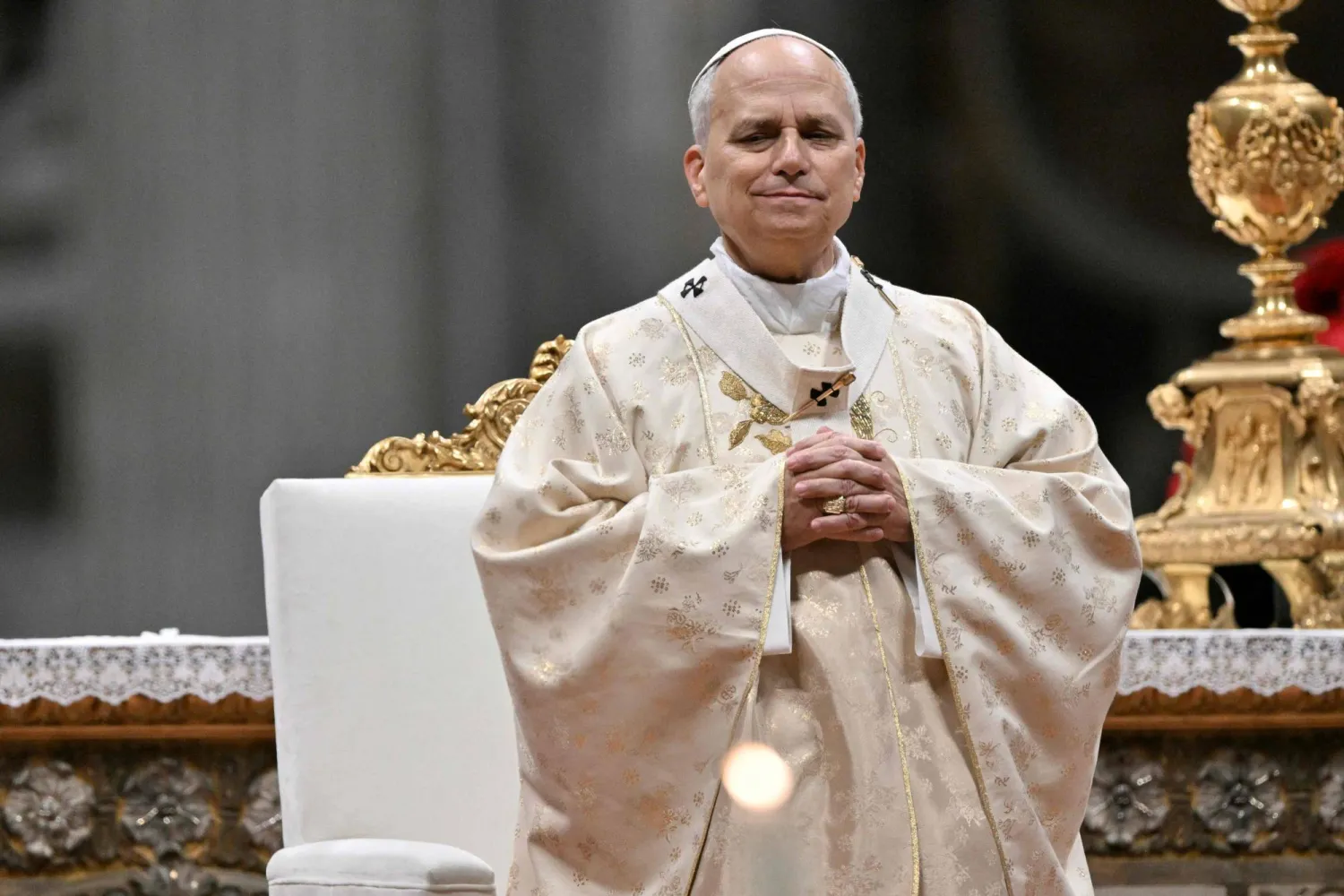

In First Christmas Sermon, Pope Leo Decries Conditions for Palestinians in Gaza

 Pope Leo XIV arrives looks on as he performs the Christmas mass at St Peter's Basilica in the Vatican on December 25, 2025. (AFP)
Pope Leo XIV arrives looks on as he performs the Christmas mass at St Peter's Basilica in the Vatican on December 25, 2025. (AFP)
TT

In First Christmas Sermon, Pope Leo Decries Conditions for Palestinians in Gaza

 Pope Leo XIV arrives looks on as he performs the Christmas mass at St Peter's Basilica in the Vatican on December 25, 2025. (AFP)
Pope Leo XIV arrives looks on as he performs the Christmas mass at St Peter's Basilica in the Vatican on December 25, 2025. (AFP)

Pope Leo decried conditions for Palestinians in Gaza in his Christmas sermon on Thursday, in an unusually direct appeal during what is normally a solemn, spiritual service on the day Christians across the globe celebrate the birth of Jesus. 

Leo, the first US pope, said the story of Jesus being born in a stable showed that God had "pitched his fragile tent" among the people of the world. 

"How, then, can we not think of the tents in Gaza, exposed for weeks to rain, wind and cold?" he asked. 

Leo, celebrating his first Christmas after being elected in May by the world's cardinals to succeed the late ‌Pope Francis, has a ‌quieter, more diplomatic style than his predecessor and usually refrains from ‌making ⁠political references in ‌his sermons. 

In a later Christmas blessing, the pope, who has made care for immigrants a key theme of his early papacy, also lamented the situation for migrants and refugees who "traverse the American continent". 

Leo, who has in the past criticized US President Donald Trump's immigration crackdown, did not mention Trump. In a Christmas Eve sermon on Wednesday, the pope said refusing to help the poor and strangers was tantamount to rejecting God himself. 

LEO DECRIES 'RUBBLE AND OPEN WOUNDS' OF WAR 

The new pope has lamented the conditions for Palestinians in Gaza several times recently and told ⁠journalists last month that the only solution in the decades-long Palestinian-Israeli conflict must include a Palestinian state. 

Israel and ‌Hamas agreed to a ceasefire in October after two years of ‍intense Israeli bombardment and military operations that followed ‍a deadly attack by Hamas-led fighters on Israeli communities in October 2023. Humanitarian agencies say there ‍is still too little aid getting into Gaza, where nearly the entire population is homeless. 

In Thursday's service with thousands in St Peter's Basilica, Leo also lamented conditions for the homeless across the globe and the destruction caused by war more generally. 

"Fragile is the flesh of defenseless populations, tried by so many wars, ongoing or concluded, leaving behind rubble and open wounds," said the pope. 

"Fragile are the minds and lives of young people forced to take up arms, who on the front lines feel the senselessness ⁠of what is asked of them and the falsehoods that fill the pompous speeches of those who send them to their deaths," he said. 

POPE LAMENTS CONFLICTS IN UKRAINE, THAILAND AND CAMBODIA 

In an appeal on Thursday during the "Urbi et Orbi" (to the city and the world) message and blessing given by the pope at Christmas and Easter, Leo called for an end to all global wars. 

Speaking from the central balcony of St Peter's Basilica to thousands of people in the square below, he lamented conflicts, political, social or military, in Ukraine, Sudan, Mali, Myanmar, and Thailand and Cambodia, among others. 

Leo said people in Ukraine, where Russian troops are threatening cities critical to the country's eastern defenses, have been "tormented" by violence. 

"May the clamor of weapons cease, and may the parties involved, with the support and commitment of the international community, find the courage to engage in sincere, ‌direct and respectful dialogue," said the pope. 

For Thailand and Cambodia, where border fighting is in its third week with at least 80 killed, Leo asked that the nations' "ancient friendship" be restored, "to work towards reconciliation and peace". 


Israeli Attorney General Opposes Appointment of Next Mossad Chief

Israeli left-wing activists demonstrate in Tel Aviv's HaBima Square against the ongoing war with Iran and against the Israeli government on May 9, 2026. (AFP)
TT

Israeli Attorney General Opposes Appointment of Next Mossad Chief

Israeli left-wing activists demonstrate in Tel Aviv's HaBima Square against the ongoing war with Iran and against the Israeli government on May 9, 2026. (AFP)

Israel's attorney general on Sunday opposed the appointment of the next head of the Mossad spy agency, due to take office in June, in a letter to the Supreme Court shared with the Israeli media.

The court is due to hear multiple petitions against the appointment of Major General Roman Gofman in the coming days.

Attorney General Gali Baharav-Miara's opposition centers on a case dating back to 2022, in which she says Gofman did nothing to exonerate a teenager arrested for espionage who had in fact been secretly recruited by the military at Gofman's request.

Gofman was a military commander on Israel's northern border at the time.

According to the attorney general's letter, army officers acting "at Gofman's request" recruited 17-year-old Uri Elmakiyes outside any legal framework to conduct "information gathering and influence" operations online with citizens of enemy countries, mainly Syria.

Unaware that the teenager was acting on behalf of the military, the Shin Bet internal security agency arrested and detained him in isolation for nearly two months before moving him to house arrest for over a year.

Prosecutors eventually dropped all charges against Elmakiyes, following an investigation. He is among those petitioning the Supreme Court against the appointment.

Baharav-Miara accused Gofman of doing nothing to exonerate the young man after his arrest. Gofman initially denied any knowledge of the affair.

Prime Minister Benjamin Netanyahu selected Gofman, who currently serves as his military secretary, for the post of Mossad director in December 2025.

An advisory committee for senior appointments was tasked with issuing an opinion on the appointment.

The committee's chairman, a former Supreme Court judge, opposed the nomination, saying Gofman had lied about the affair during his hearing, raising concerns about his "moral integrity".

But he was outvoted by the committee's three other members, who are all known to be supporters of the prime minister.

Netanyahu wrote to the court requesting that the petitions be dismissed, arguing that "responsibility for the security of the state and its citizens rests with the prime minister, and with him alone".

Netanyahu has refused to assume responsibility for the October 7, 2023 attack by Hamas on Israel that sparked the two-year war in Gaza, placing the blame on the security establishment.


Iran War ‘Not Over,’ Uranium Must Be Removed, Says Netanyahu

 Israeli Prime Minister Benjamin Netanyahu speaks during a press conference, amid the US-Israel conflict with Iran, in Jerusalem, March 19, 2026. (Reuters)
Israeli Prime Minister Benjamin Netanyahu speaks during a press conference, amid the US-Israel conflict with Iran, in Jerusalem, March 19, 2026. (Reuters)
TT

Iran War ‘Not Over,’ Uranium Must Be Removed, Says Netanyahu

 Israeli Prime Minister Benjamin Netanyahu speaks during a press conference, amid the US-Israel conflict with Iran, in Jerusalem, March 19, 2026. (Reuters)
Israeli Prime Minister Benjamin Netanyahu speaks during a press conference, amid the US-Israel conflict with Iran, in Jerusalem, March 19, 2026. (Reuters)

Iran's stockpile of enriched uranium must be "taken out" before the US-Israeli war against Iran can be considered over, Israeli Prime Minister Benjamin Netanyahu said in an interview Sunday.

"It's not over, because there's still nuclear material -- enriched uranium -- that has to be taken out of Iran. There's still enrichment sites that have to be dismantled," Netanyahu said in an excerpt of an interview due to air later Sunday on CBS's "60 Minutes" program.

"You go in and you take it out," the Israeli leader said when asked how the uranium could be removed.

Netanyahu said that US President Donald Trump had a similar position.

"I'm not going to talk about military means, but the president, what President Trump has said to me -- 'I want to go in there.'"

However, Netanyahu's statement was in contrast to Trump's public position.

The 79-year-old Republican is under increasing domestic pressure to end the Iran war and he insists that Tehran's nuclear program has been contained.

In an interview aired Sunday but apparently recorded earlier, Trump said Iran was "militarily defeated" and he insisted that the uranium could be removed "whenever we want."

"We'll get that at some point, whenever we want. We'll have it surveilled," he told independent television journalist Sharyl Attkisson.

"We have that very well surveilled. If anybody got near the place we will know about it and we'll blow them up."

Asked by CBS how the uranium stockpiles could be taken out from Iran, Netanyahu said he would prefer an agreement.

"I think it can be done physically. That's not the problem. If you have an agreement and you go in and you take it out, why not? That's the best way."

Pressed on whether there are military options to seize the hidden uranium, Netanyahu said, "I'm not going to talk about our military possibilities, plans, or anything of the kind."

"I'm not going to give a timetable to it, but I am going to say that's a terrifically important mission."

In addition to the unresolved uranium stockpile issue, Netanyahu said there were several other war aims that had yet to be accomplished.

"There's still proxies that Iran supports, their ballistic missiles that they still want to produce. Now, we've degraded a lot of it, but all that is still there and there's work to be done."

Netanyahu's interview with "60 Minutes" was due to air at 7:00 pm (2300 GMT).


Trump Says US Would Need Two Weeks to Hit All Iran Targets

 08 May 2026, US, Washington: US President Donald Trump speaks to reporters ahead of departing on Marine One from the South Lawn of the White House. (Jen Golbeck/SOPA Images via ZUMA Press Wire/dpa)
08 May 2026, US, Washington: US President Donald Trump speaks to reporters ahead of departing on Marine One from the South Lawn of the White House. (Jen Golbeck/SOPA Images via ZUMA Press Wire/dpa)
TT

Trump Says US Would Need Two Weeks to Hit All Iran Targets

 08 May 2026, US, Washington: US President Donald Trump speaks to reporters ahead of departing on Marine One from the South Lawn of the White House. (Jen Golbeck/SOPA Images via ZUMA Press Wire/dpa)
08 May 2026, US, Washington: US President Donald Trump speaks to reporters ahead of departing on Marine One from the South Lawn of the White House. (Jen Golbeck/SOPA Images via ZUMA Press Wire/dpa)

US President Donald Trump has said in an interview aired Sunday that it would only take two weeks to hit "every single target" in Iran, adding that the country was "militarily defeated."

In the interview with independent journalist Sharyl Attkisson, which was recorded last week, he also called NATO a "paper tiger" and accused Washington's allies of failing to assist in the campaign against Tehran.

The comments come as Iran is reported to have responded to the latest US proposal on ending a conflict that began on February 28 with US and Israeli strikes on Iran.

"They're militarily defeated. In their own minds, maybe they don't know that. But I think they do," Trump said in the interview, before adding: "That doesn't mean they're done."

He suggested the US military could "go in for two more weeks and do every single target. We have certain targets that we wanted, and we've done probably 70 percent of them, but we have other targets that we could conceivably hit."

"But even if we didn't do that, you know, that would just be final touches," Trump said.

On NATO, he said the alliance "has proven to be a paper tiger. They weren't there to help."
