


Japan Proposes Record Budget Spending While Curbing Fresh Debt

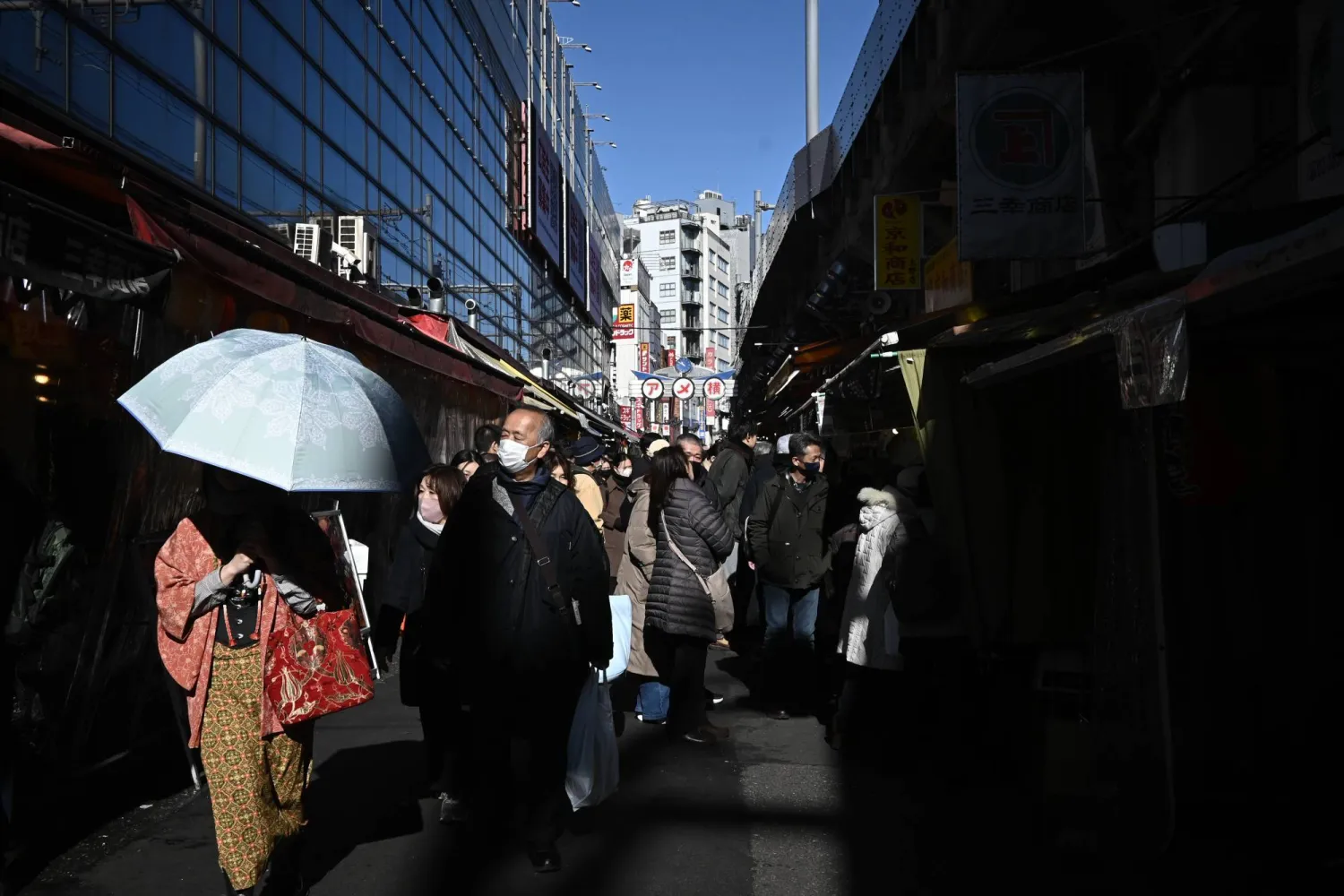
Year-end shoppers walk along at the Ameyoko shopping street ahead of the New Year in Tokyo, Japan, 26 December 2025. (EPA)
TT

Japan Proposes Record Budget Spending While Curbing Fresh Debt

Year-end shoppers walk along at the Ameyoko shopping street ahead of the New Year in Tokyo, Japan, 26 December 2025. (EPA)

Japan's government on Friday proposed record spending for next fiscal year while curbing debt issuance, underscoring Prime Minister Sanae Takaichi's challenge in boosting the ​economy while inflation remains above the central bank's target.

Her cabinet approved a draft budget of $783 billion that addresses market jitters by capping bond issuance and reducing the proportion of the budget financed by fresh debt to the lowest in almost three decades.

Also complicating Takaichi's policy challenge, core inflation in Tokyo stayed above the Bank of Japan's 2% target this month while the yen remains weak, bolstering the central bank's case to keep raising interest rates.

The record 122.3-trillion-yen budget for the year starting in April, a core part of Takaichi's "proactive" fiscal policy, will likely underpin consumption but could also accelerate inflation and further strain Japan's tattered finances.

DELICATE BALANCE OF BUDGET SUPPORT, DEBT RESTRAINT

Investor unease about fiscal expansion in an economy with the heaviest debt burden in the industrialized world has driven super-long government bond yields to record highs and weighed on the ‌yen.

"We believe we have ‌been able to draft a budget that not only increases allocations for key policy ‌measures ⁠but also takes ​fiscal discipline ‌into account, achieving both a strong economy and fiscal sustainability," said Finance Minister Satsuki Katayama.

She told a press conference the draft budget keeps new bond issuance below 30 trillion yen ($190 billion) for a second consecutive year, with the debt dependence ratio falling to 24.2%, the lowest since 1998.

The Takaichi government's efforts to reassure Japanese government bond investors were showing some success.

The 30-year JGB yield fell on Thursday from a record high 3.45% after Reuters reported the government will likely reduce new issuance of super-long JGBs next fiscal year to the lowest in 17 years. Yields slipped further on Friday on the administration's efforts at fiscal restraint.

The budget was not as large as initially feared, said Saisuke Sakai, senior economist at Mizuho Research & Technologies. "But political fragmentation raises ⁠the risk that Takaichi may resort to a large supplementary budget next year to secure opposition support, keeping alive market concerns that fiscal expansion could push the yen down and accelerate inflation," he ‌said.

"It's too optimistic to assume that the current environment will persist."

The proposed spending is ‍inflated by a jump in debt-servicing costs for interest payments and ‍debt redemption.

It also reflects a 3.8% rise in military spending to 9 trillion yen ($60 billion) as part of the assertive defense ‍policy of Takaichi, a conservative nationalist, and in line with a U.S. push for its allies to pay more for their own defense.

TOKYO INFLATION SLOWS BUT STILL POINTS TO RATE HIKES

The Tokyo core consumer price index, which excludes volatile costs of fresh food, rose 2.3% in December from a year earlier, less than market forecasts for a 2.5% gain and slowing from a 2.8% increase in November.

The data backs up the central bank's view that core inflation will ​slide below its 2% target in coming months on easing cost pressure, before resuming a more demand-led increase that justifies additional rate increases.

But some analysts warn of the risk renewed yen declines may prod firms to keep raising ⁠prices, leading to sticky, cost-led inflation that could quicken the pace of BOJ rate hikes.

"Today's data suggests food inflation may be peaking. But the weak yen may give firms an excuse to resume price hikes for food, which may keep inflation elevated," said Yoshiki Shinke, senior executive economist at Dai-ichi Life Research Institute.

An inflation index for the capital that strips away both fresh food and fuel costs - closely watched by the BOJ as a measure of demand-driven prices - rose 2.6% in December after a 2.8% increase in November.

Data on Friday also showed Japan's factory output fell 2.6% in November from the previous month, deeper than market forecasts for a 2.0% drop, due to cuts in automobile and lithium-ion battery production.

The BOJ raised its policy rate last week to a 30-year high of 0.75%, taking another landmark step in ending decades of huge monetary support, in a sign of its conviction Japan is progressing toward durably hitting its 2% inflation target.

With core inflation exceeding the BOJ's target for nearly four years, Governor Kazuo Ueda has signaled the BOJ's readiness to keep raising rates if the economy continues to improve, backed by solid wage gains.

Yen bears, however, have dumped ‌the Japanese currency in the belief that Ueda's rate hikes are too gradual, prompting Katayama last week to threaten yen-buying intervention, saying the government was "alarmed as we are clearly seeing one-sided, sharp moves" in the yen.


Saudi Arabia, Syria Sign Joint Airline and Telecoms Deals

Officials pose after signing a framework agreement for developmental cooperation and the launch of 45 development initiatives between the Syrian Development Fund and Saudi Arabia's Development Committee at the People's Palace in Damascus, Syria, Saturday, Feb. 7, 2026. (AP)
TT

Saudi Arabia, Syria Sign Joint Airline and Telecoms Deals

Officials pose after signing a framework agreement for developmental cooperation and the launch of 45 development initiatives between the Syrian Development Fund and Saudi Arabia's Development Committee at the People's Palace in Damascus, Syria, Saturday, Feb. 7, 2026. (AP)

Syria and Saudi Arabia signed deals Saturday that include a joint airline and a $1-billion project to develop telecommunications, officials said, as Syria seeks to rebuild after years of war.

The new authorities in Damascus have worked to attract investment and have signed major agreements with several companies and governments.

Syrian Investment Authority chief Talal al-Hilali announced a series of deals including "a low-cost Syrian-Saudi airline aimed at strengthening regional and international air links".

The agreement also includes the development of a new international airport in the northern city of Aleppo, and redeveloping the existing facility.

Hilali also announced an agreement for a project called SilkLink to develop Syria's "telecommunications infrastructure and digital connectivity".

Syrian Telecommunications Minister Abdulsalam Haykal told the signing ceremony that the project would be implemented "with an investment of around $1 billion".

For decades, Syria was unable to secure significant investments because of Assad-era sanctions.

But the United States fully removed its remaining sanctions on Damascus late last year, paving the way for the full return of investments.

Syria and Saudi Arabia also inked an agreement on water desalination and development cooperation on Saturday.

At the ceremony, Saudi Investment Minister Khalid Al-Falih announced the launch of an investment fund for "major projects in Syria with the participation of the (Saudi) private sector".

The deals are part of "building a strategic partnership" between the two countries, he said.

Syria's Hilali said the agreements targeted "vital sectors that impact people's lives and form essential pillars for rebuilding the Syrian economy".

Syria has begun the mammoth task of trying to rebuild its shattered infrastructure and economy.

In July last year, Riyadh signed investment and partnership deals with Damascus valued at $6.4 billion to help rebuild the country's infrastructure, telecommunications and other major sectors.

A month later, Syria signed agreements worth more than $14 billion, including investments in Damascus airport and other transport and real estate projects.

This week, Syria signed a preliminary deal with US energy giant Chevron and Qatari firm Power International to explore for oil and gas offshore.


India’s Modi Lauds Interim Trade Pact After US Tariff Rollback

Indian Prime Minister Narendra Modi addresses the media before the budget session of Parliament at Parliament House in New Delhi, India, 29 January 2026. (EPA)
TT

India’s Modi Lauds Interim Trade Pact After US Tariff Rollback

Indian Prime Minister Narendra Modi addresses the media before the budget session of Parliament at Parliament House in New Delhi, India, 29 January 2026. (EPA)

Indian Prime Minister Narendra Modi on Saturday hailed an interim trade agreement with the United States, saying it would bolster global growth and deepen economic ties between the two countries.

The pact cuts US "reciprocal" duties on Indian products to 18 percent from 25 percent, and commits India to large purchases of US energy and industrial goods.

US President Donald Trump, while announcing the deal Tuesday, had said Modi promised to stop buying Russian oil over the war in Ukraine.

The deal eases months of tensions over India's oil purchases -- which Washington says fund a conflict it is trying to end -- and restores the close ties between Trump and the man he describes as "one of my greatest friends."

"Great news for India and USA!" Modi said on X on Saturday, praising US President Donald Trump's "personal commitment" to strengthening bilateral ties.

The agreement, he said, reflected "the growing depth, trust and dynamism" of their partnership.

Modi's remarks came hours after Trump issued an executive order scrapping an additional 25 percent levy imposed over New Delhi's purchases of Russian oil, in a step to implement the trade deal announced this week.

Modi, who has faced criticism at home about opening access of Indian agricultural markets to the United States and terms on oil imports, did not mention Russian oil in his statement.

"This framework will also strengthen resilient and trusted supply chains and contribute to global growth," he said.

It would also create fresh opportunities for Indian farmers, entrepreneurs and fishermen under the "Make in India" initiative.

In a separate statement, Commerce Minister Piyush Goyal said the pact would "open a $30 trillion market for Indian exporters".

Goyal also said the deal protects India's sensitive agricultural and dairy products, including maize, wheat, rice, soya, poultry and milk.

Other terms of the agreement include the removal of tariffs on certain aircraft and parts, according to a separate joint statement released Friday by the White House.

The statement added that India intends to purchase $500 billion of US energy products, aircraft and parts, precious metals, tech products and coking coal over the next five years.

The shift marks a significant reduction in US tariffs on Indian products, down from a rate of 50 percent late last year.

Washington and New Delhi are expected to sign a formal trade deal in March.


Gold Bounces Back on Softer Dollar, US-Iran Concerns; Silver Rebounds

Gold and silver bars are stacked in the safe deposit boxes room of the Pro Aurum gold house in Munich, Germany, January 10, 2025. REUTERS/Angelika Warmuth
TT

Gold Bounces Back on Softer Dollar, US-Iran Concerns; Silver Rebounds

Gold and silver bars are stacked in the safe deposit boxes room of the Pro Aurum gold house in Munich, Germany, January 10, 2025. REUTERS/Angelika Warmuth

Gold rebounded on Friday and was set for a weekly gain, helped by bargain hunting, a slightly weaker dollar and lingering concerns over US-Iran talks in Oman, while silver recovered from a 1-1/2-month low.

Spot gold rose 3.1% to $4,916.98 per ounce by 09:31 a.m. ET (1431 GMT), recouping losses posted during a volatile Asia session that followed a fall of 3.9% on Thursday. Bullion was headed for a weekly gain of about 1.3%.

US gold futures for April delivery gained 1% to $4,939.70 per ounce.

The US dollar index fell 0.3%, making greenback-priced bullion cheaper for the overseas buyers.

"The gold market is seeing perceived bargain hunting from bullish traders," said Jim Wyckoff, senior analyst at Kitco Metals.

Iran and the US started high-stakes negotiations via Omani mediation on Friday to try to overcome sharp differences over Tehran's nuclear program.

Wyckoff said gold's rebound lacks momentum and the metal is unlikely to break records without a major geopolitical trigger.

Gold, a traditional safe haven, does well in times of geopolitical and economic uncertainty.

Spot silver rose 5.3% to $74.98 an ounce after dipping below $65 earlier, but was still headed for its biggest weekly drop since 2011, down over 10.6%, following steep losses last week as well.

"What we're seeing in silver is huge speculation on the long side," said Wyckoff, adding that after years in a boom cycle, gold and silver now appear to be entering a typical commodity bust phase.

CME Group raised margin requirements for gold and silver futures for a third time in two weeks on Thursday to curb risks from heightened market volatility.

Spot platinum added 3.2% to $2,052 per ounce, while palladium gained 4.9% to $1,695.18. Both were down for the week.