


Russia’s Gerasimov Says Putin Ordered Ukraine Buffer Zone Expansion in 2026

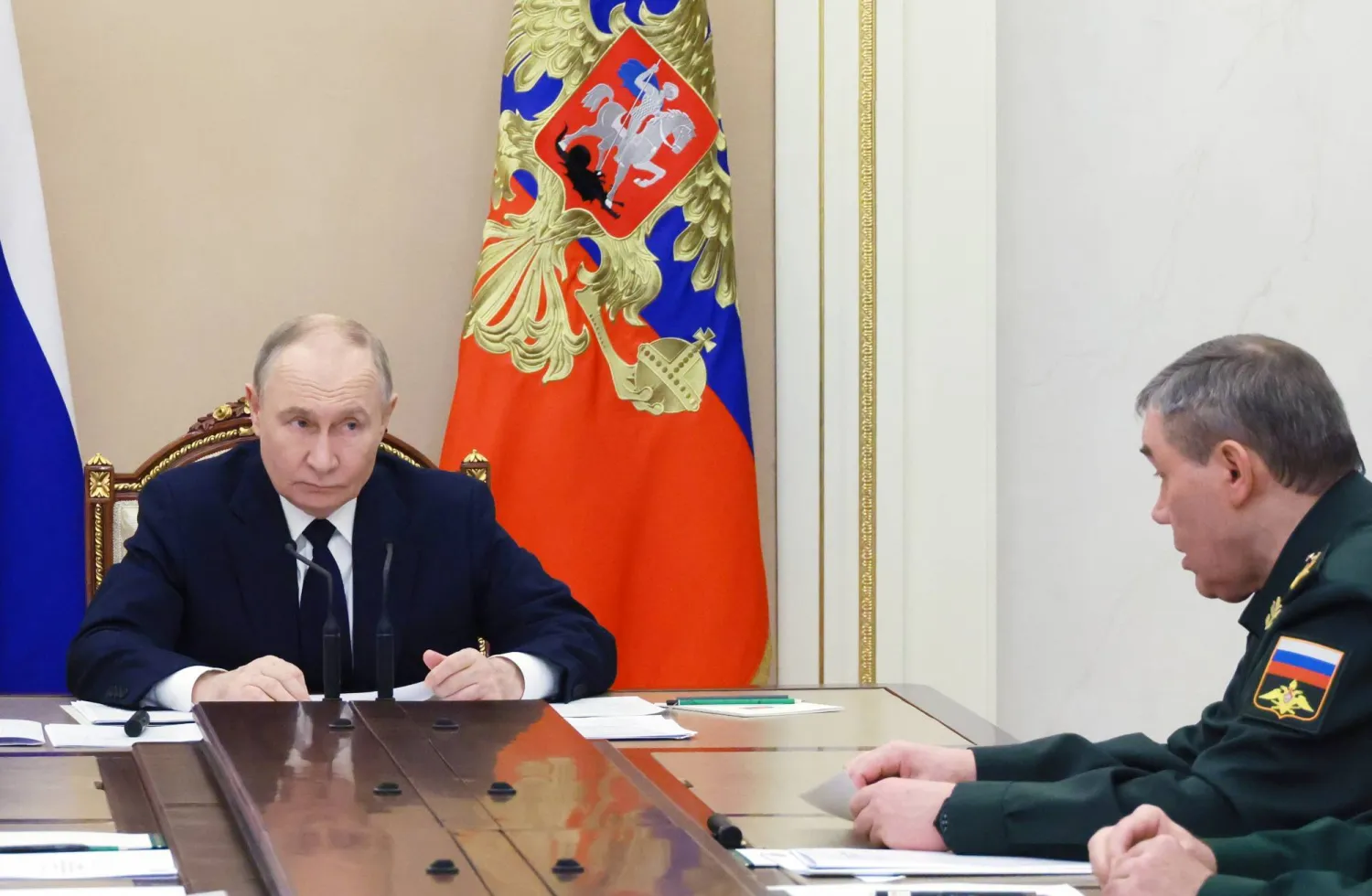
Russian President Vladimir Putin (L) chairs a meeting to discuss Russia's "special military operation" in Ukraine, as Chief of the General Staff of the Russian Armed Forces, First Deputy Defense Minister Valery Gerasimov (R) sits nearby, at the Kremlin in Moscow, Russia, 29 December 2025. (EPA/Mikhail Metzel/Sputnik/Kremlin Pool)
TT

Russia’s Gerasimov Says Putin Ordered Ukraine Buffer Zone Expansion in 2026

Russian President Vladimir Putin (L) chairs a meeting to discuss Russia's "special military operation" in Ukraine, as Chief of the General Staff of the Russian Armed Forces, First Deputy Defense Minister Valery Gerasimov (R) sits nearby, at the Kremlin in Moscow, Russia, 29 December 2025. (EPA/Mikhail Metzel/Sputnik/Kremlin Pool)

Russia’s top general said its forces were pressing forward in northeastern Ukraine and President Vladimir ​Putin had ordered expansion of territory Moscow calls a buffer zone there in 2026, Russian news agencies said on Wednesday.

Chief of the General Staff Valery Gerasimov said Putin ordered expansion in 2026 of the buffer zone in Ukraine’s regions ‌of Sumy and ‌Kharkiv near the ‌Russian ⁠border, ​RIA ‌said, adding that he inspected the “North” troop grouping.

The grouping, formed in early 2024, has operated in northeastern Ukraine, seeking to create a buffer along the border and trying to push back Ukrainian forces there for further ⁠advances.

Gerasimov's remarks follow Russia's vow to retaliate for what ‌it claimed, without evidence, was ‍an attempt to ‍attack Putin's residence, an allegation Kyiv denied, ‍saying it was aimed at derailing peace talks as the war nears its fourth year.

There was no immediate reaction from Ukraine ​to the Gerasimov report.

Putin has repeatedly portrayed the buffer zone as a way ⁠to push Ukrainian forces and weapons farther from Russia’s border, citing cross-border shelling and drone attacks on regions such as Belgorod and Kursk.

Kyiv has rejected Moscow’s buffer zone calling it an idea Russia is using to justify deeper incursions into Ukrainian territory.

President Volodymyr Zelenskiy has said Moscow’s plans for Sumy and Kharkiv are “mad” and will be ‌resisted as Ukraine defends the regions.


Ukraine, Russia to Hold Second Day of Direct Talks on US Plan

The talks began as thousands of people in Kyiv were without heating in sub-zero temperatures due to Russian strikes. Roman PILIPEY / AFP
TT

Ukraine, Russia to Hold Second Day of Direct Talks on US Plan

The talks began as thousands of people in Kyiv were without heating in sub-zero temperatures due to Russian strikes. Roman PILIPEY / AFP

Negotiators from Russia, Ukraine and the United States will meet in Abu Dhabi on Saturday for the second day of negotiations on a plan being pushed by US President Donald Trump to end the almost four-year-long war.

The first known direct contact between Ukrainian and Russian officials on the proposal began Friday. Ukraine's chief negotiator Rustem Umerov said the discussions focused "on the parameters for ending Russia's war and the further logic of the negotiation process".

An initial US draft drew heavy criticism in Kyiv and western Europe for hewing too closely to Moscow's line, while later iterations prompted pushback from Russia for floating the idea of European peacekeepers, said AFP.

Both sides say the fate of territory in the eastern Donbas region is one of the main outstanding issues in the search for a settlement to a war that has killed tens of thousands, displaced millions and decimated parts of Ukraine.

Trump met Ukrainian President Volodymyr Zelensky at the World Economic Forum in Davos on Thursday and US envoy Steve Witkoff later held talks with Vladimir Putin in the Kremlin.

Donbas dispute

The Emirates meeting began as thousands of people in Kyiv were without heating in sub-zero temperatures due to Russian strikes.

The European Union, which has sent hundreds of generators, accused Moscow of "deliberately depriving civilians of heat".

Further Russian strikes killed one person and injured 22 others in Ukraine's capital and the northeastern city of Kharkiv overnight, authorities said early Saturday.

"Kyiv is under a massive enemy attack," Mayor Vitali Klitschko posted on Telegram, adding that several non-residential buildings had been hit and telling residents to remain in shelters.

While diplomacy to end Europe's worst conflict since World War II has gained pace, Moscow and Kyiv appear deadlocked over the issue of territory.

Hours after Putin met Witkoff -- and Trump's son-in-law Jared Kushner -- in Moscow, the Kremlin said its maximalist demand that Kyiv withdraw from the eastern Donbas region still stood.

"Russia's position is well known on the fact that Ukraine, Ukrainian armed forces, have to leave the territory of the Donbas," Kremlin spokesman Dmitry Peskov said.

"This is a very important condition," he added.

Kyiv, which still controls around 20 percent of the eastern region, has rejected such terms.

'God willing'

Ahead of the talks Zelensky told reporters territory remained a "key issue" -- with Moscow having said it is not dropping its demand that Kyiv pull out of its eastern Donbas region.

In a post online, he later added: "It is necessary that not only Ukraine has the desire to end the war and achieve full security, but that a similar desire somehow emerges in Russia as well."

Russian and Ukrainian negotiators are last known to have met face-to-face in Istanbul last summer, in talks that ended only in deals to exchange captured soldiers.

The Abu Dhabi meeting is the first time they have faced each other to talk about the Trump administration's plan.

Putin has repeatedly said Moscow intends to get full control of eastern Ukraine by force if talks fail.

After the Russia-US talks in the Kremlin, Putin aide Yuri Ushakov insisted Moscow was "genuinely interested in resolving" the war diplomatically.

Trump has in the past pressured Ukraine to agree to terms that Kyiv sees as capitulation.

Trump repeated on Wednesday his belief that Putin and Zelensky were close to a deal.

"I believe they're at a point now where they can come together and get a deal done. And if they don't, they're stupid -- that goes for both of them," he said.


Pentagon Foresees 'More Limited' Role in Deterring North Korea

This picture taken on January 19, 2026 and released by North Korea's official Korean Central News Agency (KCNA) on January 20, 2026 shows North Korean leader Kim Jong Un delivering a speech at the completion of the first phase of renovation and modernization of the Ryongsong Machine Complex in South Hamgyong Province, North Korea. (Photo by KCNA VIA KNS / AFP)
TT

Pentagon Foresees 'More Limited' Role in Deterring North Korea

This picture taken on January 19, 2026 and released by North Korea's official Korean Central News Agency (KCNA) on January 20, 2026 shows North Korean leader Kim Jong Un delivering a speech at the completion of the first phase of renovation and modernization of the Ryongsong Machine Complex in South Hamgyong Province, North Korea. (Photo by KCNA VIA KNS / AFP)

The Pentagon foresees a "more limited" role in deterring North Korea, with South Korea taking primary responsibility for the task, according to a policy document released on Friday, a move that could lead to a reduction of US forces on the Korean Peninsula.

South Korea hosts about 28,500 US troops in combined defense against North Korea's military threat and Seoul has raised its defense budget by 7.5% for this year, said Reuters.

"South Korea is capable of taking primary responsibility for deterring North Korea with critical but more limited US support," the Pentagon said in the 25-page National Defense Strategy document that guides its policies.

"This shift in the balance of responsibility is consistent with America's interest in updating US force posture on the Korean Peninsula."

In recent years, US officials have signaled a desire to make US forces in South Korea more flexible, to potentially operate outside the Korean Peninsula in response to a broader range of threats, such as in defending Taiwan and checking China's growing military reach.

South Korea has resisted the idea of shifting ‌the role of US ‌troops, but has worked to grow its defense capabilities in the past 20 years, with ‌the ⁠goal of being ‌able to take on the wartime command of combined US and South Korean forces. South Korea has 450,000 troops.

The Pentagon's top policy official, Elbridge Colby, is due to travel to Asia next week and is expected to visit South Korea, a US official said.

The wide-ranging document, which each new administration publishes, said the Pentagon's priority was defending the homeland. In the Indo-Pacific region, the document said, the Pentagon was focused on ensuring that China could not dominate the United States or US allies.

"This does not require regime change or some other existential struggle. Rather, a decent peace, on terms favorable to Americans but that China can also accept and live under, is possible," the document said, without mentioning Taiwan by name.

China claims ⁠democratically governed Taiwan as its own territory and has not ruled out the use of force to take control of the island. Taiwan rejects Beijing's sovereignty claims and says only ‌the people of Taiwan can decide their future.

The Pentagon document is based on ‍US President Donald Trump's National Security Strategy, published last year, which said ‍the United States will reassert its dominance in the Western Hemisphere, build military strength in the Indo-Pacific, and possibly reassess its ‍relationship with Europe.


Iran Will Treat any Attack as 'All-out War against Us,' Says Senior Iran Official

FILE PHOTO: People attend the funeral of the security forces who were killed in the protests that erupted over the collapse of the currency's value in Tehran, Iran, January 14, 2026. Majid Asgaripour/WANA (West Asia News Agency) via REUTERS
TT

Iran Will Treat any Attack as 'All-out War against Us,' Says Senior Iran Official

FILE PHOTO: People attend the funeral of the security forces who were killed in the protests that erupted over the collapse of the currency's value in Tehran, Iran, January 14, 2026. Majid Asgaripour/WANA (West Asia News Agency) via REUTERS

Iran will treat any attack "as an all-out war against us," a senior Iranian official said on Friday, ahead of the arrival of a US military aircraft carrier strike group and other assets in the Middle East in the coming days, Reuters said.

"This military buildup - we hope it is not intended for real confrontation - but our military is ready for the worst-case scenario. This is ‌why everything is ‌on high alert in ‌Iran," ⁠said the senior ‌Iranian official, speaking on condition of anonymity.

"This time we will treat any attack - limited, unlimited, surgical, kinetic, whatever they call it - as an all-out war against us, and we will respond in the hardest way possible to settle this," the official said.

US ⁠President Donald Trump said on Thursday that the United States had ‌an "armada" heading toward Iran but ‍hoped he would not ‍have to use it, as he renewed ‍warnings to Tehran against killing protesters or restarting its nuclear program.

"If the Americans violate Iran's sovereignty and territorial integrity, we will respond," said the Iranian official. He declined to specify what an Iranian response might look like.

"A country under constant military threat ⁠from the United States has no option but to ensure that everything at its disposal can be used to push back and, if possible, restore balance against anyone who dares to attack Iran," the official said.

The US military has in the past periodically sent increased forces to the Middle East at times of heightened tensions, moves that were often defensive. However, the US military staged a major ‌buildup last year ahead of its June strikes against Iran's nuclear program.
