

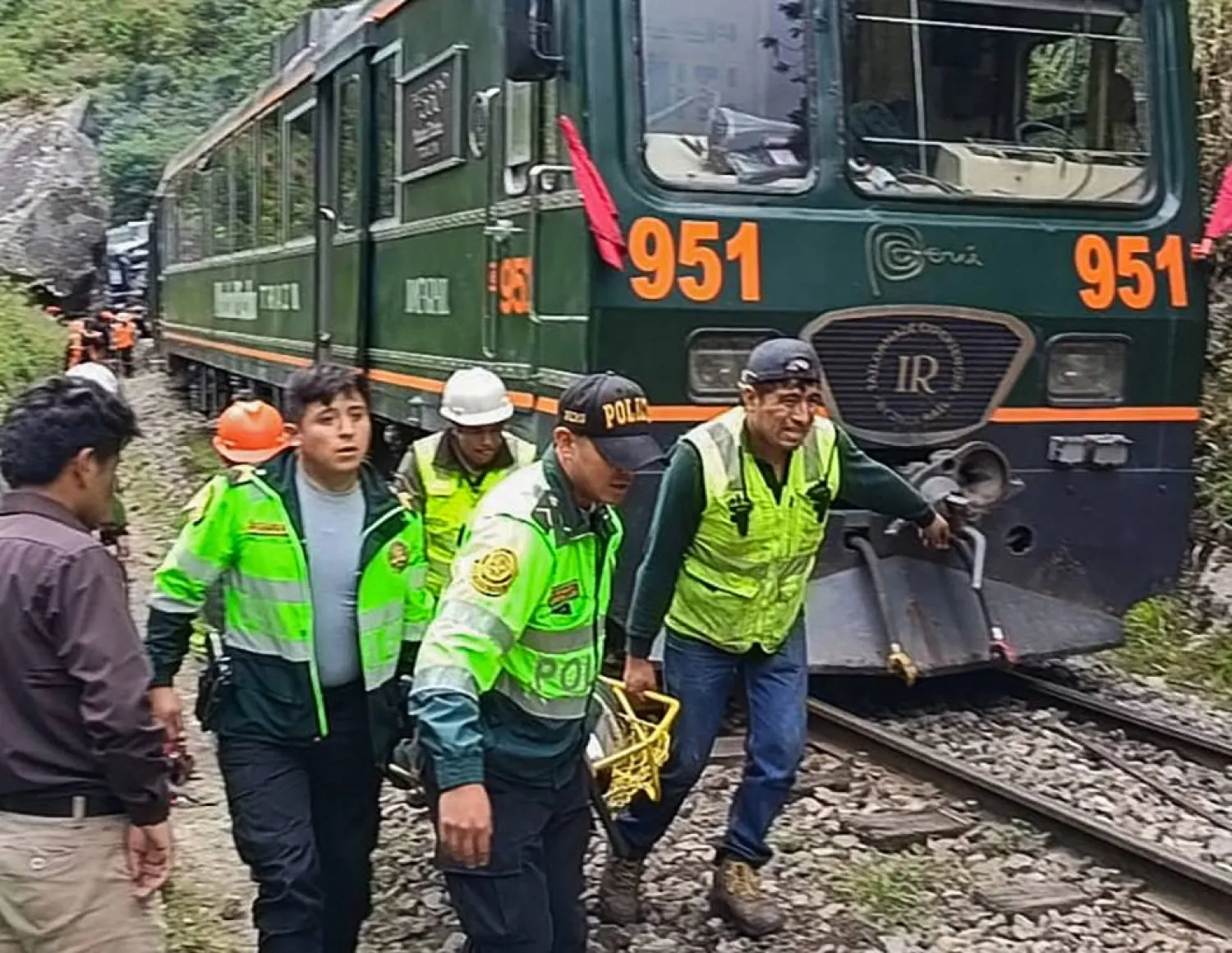

Train Crash Near Peru’s Machu Picchu Kills One, Injures 40

Police officers carry an injured passenger from one of the two trains affected after a head-on collision connecting Machu Picchu with Ollantaytambo in Pampacahua, Cusco Department, Peru, on December 30, 2025. (AFP)
TT

Train Crash Near Peru’s Machu Picchu Kills One, Injures 40

Police officers carry an injured passenger from one of the two trains affected after a head-on collision connecting Machu Picchu with Ollantaytambo in Pampacahua, Cusco Department, Peru, on December 30, 2025. (AFP)

A head-on collision between two trains on the line that services Peru's Machu Picchu killed one person and injured at least 40 others, authorities said, updating an earlier toll.

The deceased was the conductor of one of the two trains, according to the prosecutor's office in Cusco, the city closest to the famous Inca citadel.

Officials said they were working to identify the injured train passengers, many of them foreign visitors and most of them seriously hurt.

Videos sent by passengers to the RPP television channel showed injured victims lying next to the tracks with two damaged locomotives standing idle nearby.

A dozen ambulances and medical personnel were rushed to the site in a remote Andean area without direct road access.

Police wearing hardhats and neon-colored jackets carried injured passengers on stretchers from the trains to receive treatment.

A UNESCO World Heritage Site since 1983, the ancient fortified complex of Machu Picchu receives some 4,500 visitors on average each day, many of them foreigners, according to the tourism ministry.

Most tourists take a train and a bus to reach the historic site high in the Andes mountains.

Rail agency Ferrocarril Transandino said a train operated by PeruRail collided with another belonging to Inca Rail around lunchtime on the single track that links the town of Ollantaytambo with Machu Picchu.

The cause of the accident was not yet known.

In September, about 1,400 tourists were evacuated from the Aguas Calientes train station that serves Machu Picchu and 900 others were left stranded after protesters blocked the railway tracks with logs and rocks.

Locals were demanding a new bus company be chosen in a fair bidding process to ferry visitors to the foot of Machu Picchu, and have repeatedly protested to press their demands.

The Inca empire's ancient capital Machu Picchu was built in the 15th century at an altitude of 2,500 meters (about 8,200 feet) on orders from the Inca ruler Pachacutec. It is considered a marvel of architecture and engineering.



Ukraine Says Russia Fired Hundreds of Drones, Missiles in ‘Massive’ Daytime Attack

 People relax at the Gryshko National Botanical Garden in Kyiv on April 1, 2026, amid the Russian invasion of Ukraine. (AFP)
People relax at the Gryshko National Botanical Garden in Kyiv on April 1, 2026, amid the Russian invasion of Ukraine. (AFP)
TT

Ukraine Says Russia Fired Hundreds of Drones, Missiles in ‘Massive’ Daytime Attack

 People relax at the Gryshko National Botanical Garden in Kyiv on April 1, 2026, amid the Russian invasion of Ukraine. (AFP)
People relax at the Gryshko National Botanical Garden in Kyiv on April 1, 2026, amid the Russian invasion of Ukraine. (AFP)

Kyiv and its surrounding region on Friday faced pummeling by Russian missiles and drones, officials said, the latest in an increasing number of daytime attacks on Ukraine.

"The Kyiv region is once again under a massive enemy missile and drone attack," said regional governor Mykola Kalashnyk.

One person died in the attacks, he added.

The barrage prompted emergency power outages in several regions, energy operator Ukrenergo announced.

Russia launched almost 500 drones and missiles over Ukraine, Foreign Minister Andriy Sybiga said.

"Terrorist Russia strikes in broad daylight deliberately -- to maximize civilian casualties and damage," Sybiga said.

"This is how Moscow responds to Ukraine's Easter ceasefire proposals -- with brutal attacks," he added.

Ukrainian President Volodymyr Zelensky said Kyiv was ready for a truce over the Easter holidays, but the Kremlin said it had not received any proposals.

Ukraine accuses Russia of deliberately prolonging the war to capture more Ukrainian territory and says Moscow is not genuinely interested in peace.

Talks between the two warring parties, mediated by the United States, have been stalled by the war in the Middle East.

Zelensky said he had invited an American delegation to Kyiv to relaunch negotiations with Moscow.

"The American group can come to us and, after us, go to Moscow. If it does not work out with three parties, let's do it this way," Zelensky said, in remarks made public Friday.


Human Remains Found on Thai Ship Attacked in Hormuz Strait

A cargo ship in the Gulf, near the Strait of Hormuz, as seen from northern Ras al-Khaimah, near the border with Oman’s Musandam governance, amid the US-Israeli conflict with Iran, in United Arab Emirates, March 11, 2026. (Reuters)
TT

Human Remains Found on Thai Ship Attacked in Hormuz Strait

A cargo ship in the Gulf, near the Strait of Hormuz, as seen from northern Ras al-Khaimah, near the border with Oman’s Musandam governance, amid the US-Israeli conflict with Iran, in United Arab Emirates, March 11, 2026. (Reuters)

Human remains have been found aboard a cargo ship struck by Iran while transiting the Strait of Hormuz last month, the vessel's owner said Friday, after three crew members were reported missing following the attack.

US-Israeli strikes on Iran late February prompted Tehran to respond by effectively closing the Strait of Hormuz, a crucial artery for global oil supplies.

The Thai-flagged Mayuree Naree was struck in March while travelling through the strait after departing Khalifa port in the United Arab Emirates.

"Certain human remains were found within the affected area of the vessel," a statement from transport company Precious Shipping said Friday, adding it could not yet confirm the identities or the number of individuals.

Twenty Thai crew members returned home in mid-March, while three of their colleagues were missing and presumed trapped in the damaged engine compartment.

A search was carried out under "challenging conditions" as the vessel's engine room had been flooded and damaged by fire, the company said.

Thailand's foreign ministry said it was "saddened" by the development and that families of the missing crew had been informed.

Iran's Revolutionary Guards said in March they had struck the Mayuree Naree, as well as a Liberia-flagged vessel, in the strait because the ships had ignored "warnings".


Iran’s Former Top Diplomat Urges Deal with US to End War

 A newly constructed bridge struck by US airstrikes Thursday is seen in Karaj, west of Tehran, Iran, Friday, April 3, 2026. (AP)
A newly constructed bridge struck by US airstrikes Thursday is seen in Karaj, west of Tehran, Iran, Friday, April 3, 2026. (AP)
TT

Iran’s Former Top Diplomat Urges Deal with US to End War

 A newly constructed bridge struck by US airstrikes Thursday is seen in Karaj, west of Tehran, Iran, Friday, April 3, 2026. (AP)
A newly constructed bridge struck by US airstrikes Thursday is seen in Karaj, west of Tehran, Iran, Friday, April 3, 2026. (AP)

Iran should make a deal with the United States to end the war by offering to curb its nuclear program and reopen the Strait of Hormuz in exchange for sanctions relief, a former Iranian foreign minister said.

Mohammad Javad Zarif, who served as foreign minister from 2013-2021, claimed in an op-ed for American journal Foreign Affairs that Tehran had the "upper hand" in the conflict against the US and Israel, but argued Iran needed to stop the war to prevent the loss of more civilian lives and damage to infrastructure.

"Iran should use its upper hand not to keep fighting but to declare victory and make a deal that both ends this conflict and prevents the next one," Zarif said in the piece published late Thursday.

"It should offer to place limits on its nuclear program and to reopen the Strait of Hormuz in exchange for an end to all sanctions -- a deal Washington wouldn't take before but might accept now," he added.

Iran should also be prepared to accept a mutual "nonaggression pact" with the United States, as well as economic relations, he said. Tehran and Washington have had no diplomatic ties since shortly after the 1979 revolution.

Zarif, one of the architects of the now moribund 2015 deal over the Iranian nuclear program, is seen as a relative moderate within the regime’s elite, but has no official post in the current government.

However, this is one of the first times during this conflict that a high-profile figure in Iran has called for a deal and an end to the war, with top military and political officials urging daily for fighting to continue until the US is defeated.

US President Donald Trump has evoked ongoing talks with Tehran without giving details but also threatened to send the country "back to the stone ages" if it fails to agree terms.

"As an Iranian, outraged by Donald Trump's reckless aggression and crude insults, yet proud of our armed forces and resilient people, I am torn about publishing this peace-plan in Foreign Affairs," Zarif wrote in English on X Friday.

"Yet I'm convinced that war must end on terms consistent with Iran's national interests," he added.

Zarif in the Foreign Affairs piece warned that "although continuing to fight the United States and Israel might be psychologically satisfying, it will lead only to the further destruction of civilian lives and infrastructure".