


Hadhramaut Official Says National Shield Advances, STC Withdrawal Leaves Security Gap

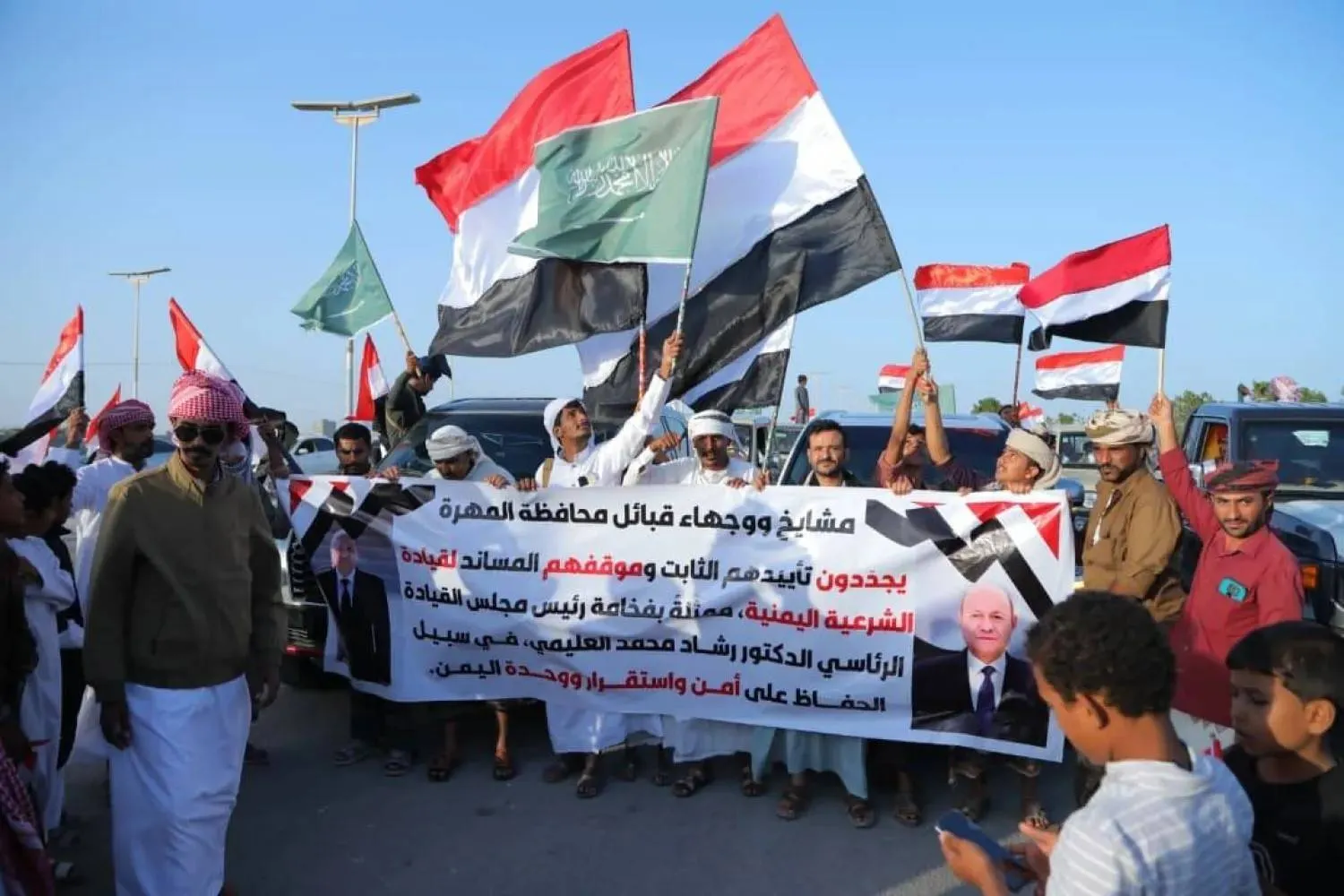
Residents of Al Mahrah governorate voiced support for Yemen’s presidential decisions (Saba News Agency)
TT

Hadhramaut Official Says National Shield Advances, STC Withdrawal Leaves Security Gap

Residents of Al Mahrah governorate voiced support for Yemen’s presidential decisions (Saba News Agency)

A Yemeni local authority official confirmed that the National Shield forces had taken full control of the 37th Brigade camp in al-Khasha and pushed on to the city of al-Qatn, moving toward the strategic city of Seiyun in Hadhramaut.

Abdulhadi al-Tamimi, assistant undersecretary of Hadhramaut governorate for valley and desert affairs, told Asharq Al-Awsat that withdrawing forces loyal to the Southern Transitional Council had left a security vacuum at several military sites, saying local authorities, in coordination with residents, were working to address and fill the gap.

Al-Tamimi, who is in Hadhramaut, stated that forces from the Hadhramaut Tribes Alliance and the Hadhramaut Protection Forces are preparing to move toward the coastal area, specifically Mukalla, to support the Hadhrami Elite Forces in maintaining security and preventing clashes with withdrawing STC forces.

The Hadhramaut official thanked Saudi Arabia for its support of Yemen, and Hadhramaut in particular, which he said had endured difficult times.

“We welcome our brothers in the National Shield forces and salute the support of our elder sister, the Kingdom of Saudi Arabia, under the leadership of the Custodian of the Two Holy Mosques and the Crown Prince and Minister of Defense, for supporting Yemen and backing Hadhramaut, which lived through difficult days due to the invasion of hordes of STC militias into the Hadhramaut Valley and Desert,” he said.

“Those areas had been far from the conflicts Yemen went through and were spared thanks to the wisdom of their people, but this time they came treacherously, seized control of the First Military Region and wreaked havoc there.”

Al-Tamimi stated that the National Shield forces moved at dawn on Friday, following the failure of all de-escalation efforts and attempts to persuade STC leaders to withdraw.

“Unfortunately, many of the STC forces present did not comply with the request to withdraw, leave their weapons and return from where they came, so clashes occurred with support from Saudi air power, and control was taken of the major base, the 37th Armored Brigade camp,” he said.

He added that the forces then advanced to al-Qatn and were heading toward Seiyun, noting that several areas where STC forces had been present were hit by airstrikes, forcing them to flee, most notably the First Military Region.

Al-Tamimi said the rapid withdrawal of STC forces left a security vacuum at camps such as al-Suwayri.

He added that there was also a separate movement on the Hadhramaut, Plateau by the Hadhramaut, Tribes Alliance, led by Sheikh Amr bin Habrish, and the Hadhramaut, Protection Forces, which were joined by many Hadhrami officers and commanders after they took control of the Ghayl bin Yamin camp.

“We are preparing to head to the Hadhramaut, coast to reinforce the Hadhrami Elite Forces there so they are not attacked by the withdrawing force,” he said.

Al-Tamimi stated that the local authority had instructed all districts to form emergency committees to address the situation and secure vital areas until the National Shield forces arrive.

Meanwhile, hospitals in Seiyun received eight wounded people and one fatality as a result of the military developments in Hadhramaut, on Friday, according to local sources.

The Second Military Region issued a statement saying that camps and military sites under its command would remain fully under its responsibility, describing itself as part of the military institution.

The commander of the Second Military Region had previously declared loyalty to the STC, while the statement suggested a shift in position.

The Second Military Region said the Hadhrami Elite Forces “have carried out their national and security duties since their establishment, pledging full commitment to protecting the Hadhramaut coast and its people, maintaining security and social peace, and safeguarding public and private property.



EU Chief von der Leyen to Visit Syria, Lebanon This Week

European Commission President Ursula von der Leyen, addresses journalists during a visit to Sarajevo, Bosnia and Herzegovina, January 23, 2024. (Reuters)
TT

EU Chief von der Leyen to Visit Syria, Lebanon This Week

European Commission President Ursula von der Leyen, addresses journalists during a visit to Sarajevo, Bosnia and Herzegovina, January 23, 2024. (Reuters)

EU chief Ursula von der Leyen will visit Syria later this week on a first trip to the country since the fall of Bashar al-Assad, a spokeswoman said Monday.

Von der Leyen will head to Syria as part of a tour of the Middle East that will also see her visit Jordan and Lebanon, spokeswoman Paula Pinho said.


Israel Says Ban on Gaza Media Access Should Stay

A Palestinian woman holds her child beside piles of rubble while heading toward Gaza City on Friday. (AFP)
TT

Israel Says Ban on Gaza Media Access Should Stay

A Palestinian woman holds her child beside piles of rubble while heading toward Gaza City on Friday. (AFP)

Israeli authorities have told the Supreme Court that a ban on international media access to Gaza should remain in place, arguing it is necessary for security reasons, according to a government submission filed by the public prosecutor. 

Since the outbreak of the Gaza war in October 2023, triggered by an attack on Israel by the Palestinian group Hamas, Israeli authorities have barred foreign journalists from independently entering the devastated territory, said AFP. 

Instead, Israel has allowed only a limited number of reporters to enter Gaza on a case-by-case basis, embedded with its military forces inside the blockaded territory. 

The Foreign Press Association (FPA), which represents hundreds of foreign journalists working in Israel and the Palestinian territories, filed a petition with the Supreme Court in 2024 seeking immediate and unrestricted access for international media to the Gaza Strip. 

Since then the court has given several extensions to the Israeli authorities to come up with a plan, but at a hearing last month it set January 4 as a final deadline. 

Late on Sunday, the Israeli authorities filed their response with the court, a copy of which was obtained by AFP. 

In the submission, the government said the ban on media access to Gaza should continue, citing security risks in the territory. 

"Even at this time, entry of journalists into the Gaza Strip without escort, as requested in the petition, should not be permitted," said the government submission. 

"This is for security reasons, based on the position of the defense establishment, which maintains that a security risk associated with such entry still exists." 

The Israeli authorities said the ceasefire in Gaza, which came into effect on October 10, continues to face regular threats. 

At least 420 Palestinians have been killed in Gaza by Israeli forces since the ceasefire took effect, according to Gaza's health ministry. 

The Israeli military said three of its soldiers have also been killed by militants during the same period. 

The Israeli authorities said in their submission that the search for the remains of the last hostage held in Gaza is ongoing, suggesting that allowing journalists into the territory at this stage could hinder the operation. 

The remains of Ran Gvili, whose body was taken to Gaza after he was killed during the Hamas attack on October 7, 2023, have still not been recovered despite the ceasefire. 

All other 250 hostages seized on that day - both the living and the deceased - have been returned to Israel. 

The Supreme Court is expected to issue a ruling on the matter, though it is unclear when a decision will be handed down. 


Calls in Lebanon for Immediate Action Against ‘Remnants’ of Assad Regime

The Masnaa border crossing between Lebanon and Syria. (AFP)
TT

Calls in Lebanon for Immediate Action Against ‘Remnants’ of Assad Regime

The Masnaa border crossing between Lebanon and Syria. (AFP)

Reports about the presence of “remnants of the former Syrian regime” in Lebanon have raised concerns that they could destabilize internal security or turn Lebanese territory into a platform for targeting Syria’s security and stability.

Authorities and security agencies have launched a broad campaign to verify these reports as voices across Lebanon warned of the presence of former Syrian officers in certain regions, particularly in the North and Bekaa Valley in the east.

The Lebanese Army Command regularly announces raids and security operations against suspects. The latest such operation was announced on Sunday, when dozens were detained, mostly Syrians, in northern Lebanon and the Bekaa.

In a statement, the Army Command said it carried out operations against wanted suspects, arresting nine Lebanese citizens and 35 Syrians in the regions of Akkar, Tripoli, Batroun, Baalbek and Hermel on charges including opening fire, possession of weapons, drug use, and human smuggling.

The army added that weapons, ammunition, drugs and military equipment were seized, and that investigations had begun under the supervision of the relevant judiciary.

Previously, a number of municipalities in northern Lebanon had issued statements urging security agencies to tighten measures in their areas, saying several former regime members have sought safety in their towns. They also spoke of the daily movement of suspicious vehicles.

Similar warnings have since emerged from the Bekaa. Dar al-Fatwa in Rashaya issued a statement on Sunday calling on the state to take “immediate, swift and decisive action to arrest the remnants of the Syrian regime in Lebanon and return them to Syria for trial.”

MP Wael Abou Faour, a member of the Democratic Gathering bloc, called on “the Lebanese security agencies to fulfill their duties with regard to the large number of officers from the remnants of the regime of former Syrian president Bashar al-Assad who are present in Lebanon.”

He stressed that despite the fall of the regime, “Lebanese-Syrian relations are governed by the Taif Agreement, which clearly stipulates that Lebanon must not be a base or a transit point for any attack on Syria’s security, and vice versa.”

“The Lebanese state must therefore act to uncover the truth and arrest officers from the remnants of the regime who are hiding in Lebanon.”