

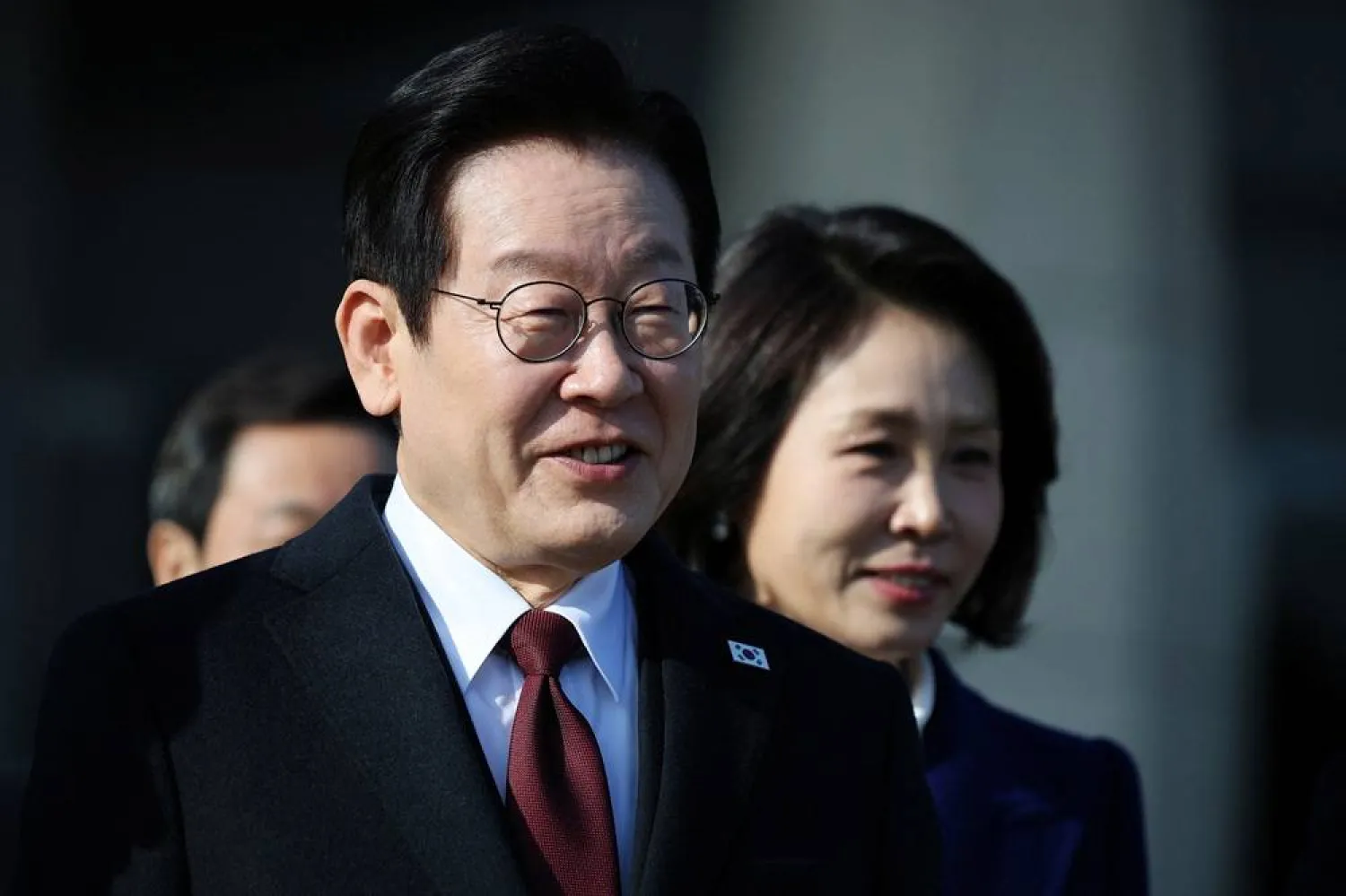

South Korea’s Lee Begins China State Visit After North Fires Missiles

 South Korean President Lee Jae Myung and his wife Kim Hye-kyung arrive at Seoul Air base as they leave for Beijing, in Seongnam, South Korea, January 4, 2026. (Reuters)
South Korean President Lee Jae Myung and his wife Kim Hye-kyung arrive at Seoul Air base as they leave for Beijing, in Seongnam, South Korea, January 4, 2026. (Reuters)
TT

South Korea’s Lee Begins China State Visit After North Fires Missiles

 South Korean President Lee Jae Myung and his wife Kim Hye-kyung arrive at Seoul Air base as they leave for Beijing, in Seongnam, South Korea, January 4, 2026. (Reuters)
South Korean President Lee Jae Myung and his wife Kim Hye-kyung arrive at Seoul Air base as they leave for Beijing, in Seongnam, South Korea, January 4, 2026. (Reuters)

South Korean President Lee Jae Myung began a state visit to China on Sunday, hoping to promote peace on the Korean Peninsula hours after rival North Korea launched ballistic missiles.

The visit, Lee's first to China since taking office in June, comes amid heightened global tensions after Pyongyang's aggressive display, on the heels of the ‌US attack on Venezuela.

Lee ‌is expected to ‌meet ⁠Chinese President Xi ‌Jinping during the trip for their second meeting in just two months, an unusually short interval that, analysts say, signals China's keen interest in boosting economic collaboration and tourism as its relations with neighboring Japan have sunk to the ⁠lowest point in years.

Beijing was incensed when Japanese Prime Minister ‌Sanae Takaichi suggested in November that ‍Tokyo could take ‍military action if Beijing attacked Taiwan. China claims ‍the democratically governed island as its own - an assertion rejected by Taiwan's government.

Sunday's missile launches by North Korea represent "a message to China to deter closer ties with South Korea and to counter China's stance on denuclearization", said Lim Eul-chul, a ⁠professor at the Institute for Far Eastern Studies in Seoul.

Lee arrived in Beijing with a delegation that includes more than 200 South Korean business leaders to start a four-day state visit to China, Chinese state news broadcaster CCTV reported.

China and South Korea are expected to discuss matters such as supply chain investment, the digital economy and cultural exchanges during Lee's ‌visit, CCTV said.


Police: Explosions, Fire at Bulgarian Munitions Site

Fire and smoke rise near an ammunition warehouse, near the village of Tsareva Livada, Bulgaria, September 12, 2026. Stringer/via REUTERS
TT

Police: Explosions, Fire at Bulgarian Munitions Site

Fire and smoke rise near an ammunition warehouse, near the village of Tsareva Livada, Bulgaria, September 12, 2026. Stringer/via REUTERS

An explosion and fires have hit an ammunition storage site in central Bulgaria, police said Saturday, weeks after a blaze at another munitions facility in the country.

The latest incident happened late Friday at the warehouse operated by Bulgarian arms maker EMCO, whose munitions are used in Ukraine, near the central village of Gorni Varpishta.

No casualties were reported, and the extent of damage was not immediately clear.

"At present there is no danger to the population," local police said in a statement, adding that employees had been evacuated and the area cordoned off.

The nearest village is more than one kilometer (0.6 miles) from the site, AFP reported.

The incident came about a month after a fire at an ammunition depot at another nearby EMCO plant in Bulgaria, a NATO member and supporter of Ukraine.

EMCO ruled out human error in that case, and prosecutors are investigating.

EMCO is owned by Bulgarian defense executive Emilian Gebrev, who survived a poisoning attempt in 2015 together with his son and another company executive.

Bulgarian prosecutors have charged three Russian nationals over the poisoning.

Separately, six Russians have also been charged with terrorism over four explosions at arms facilities in the country between 2011 and 2020.

Prosecutors said the four blasts were remotely triggered and suspected the incidents were linked to efforts to disrupt arms supplies to Georgia and Ukraine.

Bulgaria has supported Ukraine since Russia's full-scale invasion in 2022.

There have been a string of incidents at defense companies in European countries that support Ukraine in recent weeks.

Firebombs were thrown near defense company offices in the German city of Munich earlier this month and an ammunition factory near Rome operated by arms maker KNDS was hit by a blast in August.

No injuries were reported in either case.


US Links Chinese Satellite Imagery to Iranian Strike that Killed 3 Troops

Jordanian air defenses intercept missiles launched from Iran, September 9, 2026 (EPA)
TT

US Links Chinese Satellite Imagery to Iranian Strike that Killed 3 Troops

Jordanian air defenses intercept missiles launched from Iran, September 9, 2026 (EPA)

Before Iran carried out its attack that killed three US troops in July, Tehran acquired high-resolution satellite images of the base in Jordan from Chinese entities, the Wall Street Journal reported on Friday citing US officials familiar with details of the incident.

It is the clearest evidence so far that Chinese support for Iran during the war has had lethal consequences for US forces, according to the officials, who say the US has connected the imagery to the attack on Muwaffaq Salti Air Base in northeastern Jordan.

The officials did not identify the Chinese entities that supplied the imagery and stopped short of accusing the Chinese government of directly assisting the attack.

Last July, Iranian ballistic missiles struck a housing area where US troops were sleeping, killing three soldiers and wounding four others. The attack was one of three missile strikes against the base within 24 hours and marked the first US deaths since an April ceasefire.

US officials also told the Journal that Iran targeted manned and unmanned aircraft stationed at the base.

Senior US officials raised the satellite imagery linked to the July 17 attack directly with Chinese counterparts, according to the Journal, but Beijing rejected the allegations and demanded evidence.

Chinese officials have repeatedly dismissed Washington's concerns and refused to acknowledge that Chinese companies were engaged in such activity, the report said.

The findings could add friction to US-China relations ahead of a planned Sept. 24 summit between President Donald Trump and Chinese President Xi Jinping.

According to the Journal report, Iranian access to high-resolution imagery was particularly significant because US strikes earlier in the war had damaged Iranian radar, satellites and other surveillance equipment, limiting Tehran’s ability to monitor US military positions.

Caption: Jordanian air defenses intercept missiles launched from Iran, September 9, 2026 (EPA)


North Korea Fires Ballistic Missiles Toward Sea

North Korean leader Kim Jong Un, accompanied by his daughter Kim Ju Ae, oversees the test-launch of 600 mm-calibre multiple rocket launchers, North Korea, March 14, 2026, in this picture released by North Korea's official Korean Central News Agency.  KCNA via REUTERS
North Korean leader Kim Jong Un, accompanied by his daughter Kim Ju Ae, oversees the test-launch of 600 mm-calibre multiple rocket launchers, North Korea, March 14, 2026, in this picture released by North Korea's official Korean Central News Agency. KCNA via REUTERS
TT

North Korea Fires Ballistic Missiles Toward Sea

North Korean leader Kim Jong Un, accompanied by his daughter Kim Ju Ae, oversees the test-launch of 600 mm-calibre multiple rocket launchers, North Korea, March 14, 2026, in this picture released by North Korea's official Korean Central News Agency.  KCNA via REUTERS
North Korean leader Kim Jong Un, accompanied by his daughter Kim Ju Ae, oversees the test-launch of 600 mm-calibre multiple rocket launchers, North Korea, March 14, 2026, in this picture released by North Korea's official Korean Central News Agency. KCNA via REUTERS

North Korea launched multiple short-range ballistic missiles toward the sea on Saturday, its neighbors said, a day after the US, South Korea and Japan ended their trilateral military drill that North Korea views as a provocation.

North Korea's ballistic missile launches, the first in about three weeks, came as the country was continuing its weapons display after rebuffing US President Donald Trump’s decision to scale back a major bilateral military drill with South Korea in a goodwill gesture, The Associated Press reported.

South Korea’s Joint Chiefs of Staff said it detected the launches of several missiles from North Korea’s eastern coastal Wonsan area. It said the missiles flew about 250 kilometers (155 miles) each in a direction toward North Korea’s eastern waters. The Joint Chiefs of Staff said it had boosted its surveillance posture and was closely exchanging information on the launches with the US and Japan.

South Korea’s presidential national security council issued a statement urging North Korea to halt ballistic missile firings that violate UN Security Council resolutions.

The US Pacific Command said the North’s launch event didn’t pose an immediate threat to US territory or to its allies. It said the US remains committed to the defense of the US homeland and its allies in the region.

On Friday, the US, South Korea and Japan ended their five-day Freedom Edge exercise as scheduled. The US Pacific Command said the militaries of the three countries “trained side by side across air, sea and cyber domains, sharpening the interoperability that keeps the region secure.” It cited maritime maneuvers, air refueling, cyber coordination and medical drills.

South Korea’s military earlier said the exercise is defensive in nature and meant to enhance a joint response capability against North Korean nuclear threats.

Hours after the trilateral exercise began Monday, North Korean Defense Minister Kim Song Gi slammed the drill as “provocative” and threatened to take “strong and reflective countermeasures from the standpoint of power.”

On Sunday, North Korean leader Kim Jong Un called for building a more reliable nuclear deterrent in a ceremony marking the commissioning of the country’s second naval destroyer.

North Korea has said its two destroyers can carry nuclear-capable missiles. The second destroyer was damaged during a botched launch last year, but it was relaunched after repairs.

Kim has been focusing on expanding his nuclear arsenal after his high-stakes diplomacy with Trump collapsed in 2019. Trump last month ordered the Pentagon to “substantially reduce” the annual Ulchi Freedom Shield exercise with South Korea. He cited what he called a good relationship with Kim, who has called the drill an invasion rehearsal.

But Kim’s sister and senior official, Kim Yo Jong, rebuffed Trump’s move, saying just shortening the drill won’t change its “provocative, aggressive nature.”

North Korea's military later launched about 10 short-range ballistic missiles toward the sea, apparently following through with its previous threat to respond to the US-South Korean drill.

Now apparently emboldened by his advancing nuclear program and deepened ties with Russia and China, experts say Kim will likely aim to win greater US concessions in potential diplomacy with the US.

Kim Jong Un said earlier this year that he could return to talks if the US drops its “hostile policy” against his country and respects what he calls the North’s status as a nuclear state.
