


Chinese, South Korean Companies Sign 9 Cooperation Agreements

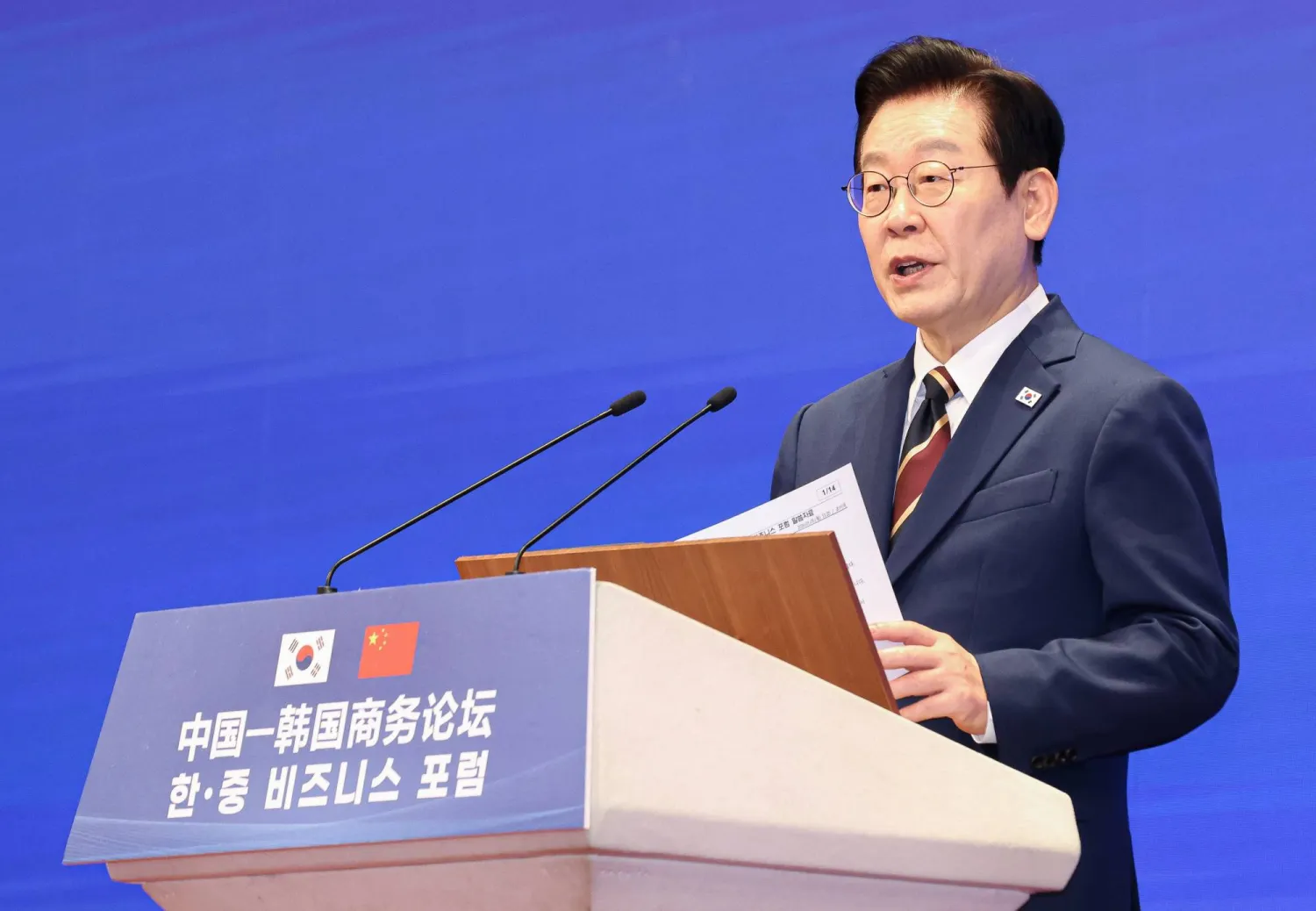
South Korean President Lee Jae Myung speaks during a forum between businesspeople of South Korea and China at the Diaoyutai State Guesthouse in Beijing, China, 05 January 2026. EPA/YONHAP
TT

Chinese, South Korean Companies Sign 9 Cooperation Agreements

South Korean President Lee Jae Myung speaks during a forum between businesspeople of South Korea and China at the Diaoyutai State Guesthouse in Beijing, China, 05 January 2026. EPA/YONHAP

Chinese and South Korean companies signed nine cooperation agreements, authorities said on Monday, during a state visit by South Korean President Lee Jae Myung with Chinese President Xi Jinping in Beijing, their second meeting in just two months.

Lee's visit to China's capital is the first since he took office in June and comes amid ratcheting global tensions after North Korea launched ballistic missiles and the US attack on Venezuela.

The unusually short interval between Xi and ‌Lee's meetings signals China's ‌keen interest in boosting economic collaboration and tourism ‌with ⁠its neighbor ‌as its relations with Japan have sunk to the lowest point in years, analysts say.

South Korea's Trade Ministry announced the nine agreements on Monday and said Alibaba International, Lenovo and South Korean retailer Shinsegae were among the companies that signed deals.

Lee arrived for his four-day state visit on Sunday, along with a delegation of more than 200 South Korean business leaders including Samsung Electronics ⁠Chairman Jay Y. Lee, SK Group Chairman Chey Tae-won, and Hyundai Motor Group Executive Chair Euisun ‌Chung.

Lee is aiming to promote peace on ‍the Korean Peninsula, though his visit to ‍Beijing comes as North Korea test fired hypersonic missiles on Sunday, ‍with leader Kim Jong Un citing the need for Pyongyang to maintain a powerful nuclear deterrent in its first ballistic missile test of the year.

South Korea and China need to expand economic cooperation in artificial intelligence, Lee said, and could also collaborate in consumer goods such as household goods, beauty, food products and cultural content such as movies, music, games and ⁠sports.

However, South Korean Presidential Chief of Staff Kang Hoon-sik said in a radio interview on Monday that Beijing was unlikely to lift its unofficial ban on Korean culture anytime soon.

China and South Korea are expected to discuss matters such as supply chain investment, the digital economy and cultural exchanges during Lee's visit, China's state broadcaster CCTV said.

South Korea and Beijing's ties have warmed as China and Japan navigate a diplomatic spat.

Beijing was incensed when Japanese Prime Minister Sanae Takaichi suggested in November that Tokyo could take military action if Beijing attacked Taiwan. China claims the democratically governed island as its own, ‌an assertion rejected by Taiwan's government.


Saudi Arabia Continues to Excel, Achieves Second-Highest Growth Rate in Tonnage in G20

A night view of Riyadh, Saudi Arabia. (Reuters file)
TT

Saudi Arabia Continues to Excel, Achieves Second-Highest Growth Rate in Tonnage in G20

A night view of Riyadh, Saudi Arabia. (Reuters file)

Saudi Arabia marked a significant milestone in the maritime transport sector in 2025, with its national fleet recording a 32% growth rate compared to 2024.

The achievement secures Saudi Arabia the second-highest growth rate globally among G20 nations.

The rapid growth reflects the continuous development of the Kingdom’s maritime sector, driven by strategic regulatory initiatives, increased investment, modernized legislative frameworks, and the enhanced efficiency of national fleets.

The performance marks a substantial leap from the 6.4% growth rate recorded at the beginning of 2024, highlighting the sector's accelerating year-on-year progress.

The Transport General Authority (TGA) stated that the achievement aligns with the National Transport and Logistics Strategy, which aims to position the Kingdom as a global logistics hub, and focuses on strengthening the maritime sector’s role in supporting supply chains, boosting the national economy, and boosting the efficiency of international trade flows through Saudi ports.

The progress underscores the Kingdom’s commitment to developing a maritime ecosystem consistent with global best practices, ensuring sustainability, and consolidating its strategic position among leading nations in the field, it added.


Iraq to Nationalize West Qurna 2 Oil Field Operations, Government Says

An oil field in Iraq. (AFP)
TT

Iraq to Nationalize West Qurna 2 Oil Field Operations, Government Says

An oil field in Iraq. (AFP)

The Iraqi cabinet has approved nationalizing the petroleum operations in the West Qurna 2 oil field, in accordance with the provisions of a service contract signed with Russia's Lukoil, the government said in a ‌statement.

The cabinet ‌also agreed ‌to ⁠seek approvals ‌to finance operations through the Majnoon oilfield account, to be boosted by proceeds from crude shipments sold by state oil marketer SOMO.

Lukoil declared force majeure in ⁠November at West Qurna 2 ‌as it was hit ‍with sanctions ‍alongside Rosneft as part ‍of US President Donald Trump's push to end the war in Ukraine.

Lukoil's 75% operational stake in Iraq's West Qurna 2 oilfield - one of the world's ⁠largest with output of around 470,000 barrels per day - was its biggest foreign asset.

The field accounts for about 0.5% of world oil supply and 9% of total output in Iraq, OPEC's second-largest producer after Saudi Arabia.


Saudi Tadawul to Open Fully to Direct Foreign Investment from Feb. 1

A view of the Saudi capital Riyadh. (Reuters)
TT

Saudi Tadawul to Open Fully to Direct Foreign Investment from Feb. 1

A view of the Saudi capital Riyadh. (Reuters)

Saudi Arabia’s Capital Market Authority (CMA) announced a landmark reform allowing all categories of foreign investors to invest directly in the Kingdom’s main stock market, Tadawul, starting February 1.

The move signals a strategic repositioning of the Saudi market as a highly competitive global investment destination.

The CMA has scrapped the “qualified foreign investor” requirement and abolished swap agreements, granting international investors full rights to direct share ownership.

The decision is underpinned by strong foreign investment momentum exceeding $157 billion and rising global confidence in the sustainability of Saudi economic growth.

The reform is also expected to increase Saudi Arabia’s weighting in major global indices, including MSCI and FTSE.

Under the new regulatory framework approved by the CMA’s board, the market shifts from “conditional openness” to “full openness.” Non-resident foreign investors will no longer be required to meet prior qualification criteria to access the main market.

The abolition of swap agreements - previously limiting investors to economic benefits without ownership - will allow foreign investors to hold shares directly and exercise full shareholder rights. This is expected to significantly boost liquidity and attract new institutional and individual investors.

According to the CMA, the amendments aim to expand and diversify the investor base, support capital inflows, and strengthen market liquidity.

By the end of the third quarter of 2025, international investors’ ownership in the Saudi market had surpassed SAR 590 billion ($157.3 billion), while foreign investment in the main market reached around SAR 519 billion, up from SAR 498 billion at the end of 2024. The Authority expects the new framework to draw additional international capital.

The steady rise in foreign investment, even before the reforms take effect, points to a potential surge in inflows in 2026 once the decision is implemented.

The announcement builds on earlier steps taken in July 2025, when the CMA eased procedures for opening and operating investment accounts for certain investor categories, including foreign individuals residing in Gulf Cooperation Council (GCC) states or with prior residency in Saudi Arabia or other GCC countries.

The latest changes align with the CMA’s phased approach to market liberalization and follow the publication, in October 2025, of a draft regulatory framework for public consultation.

The Authority said further steps will follow to deepen market openness and strengthen Tadawul’s position as a global financial hub.
