


Iran’s Leaders Struggle to End Protests, US Action in Venezuela Stokes Fears

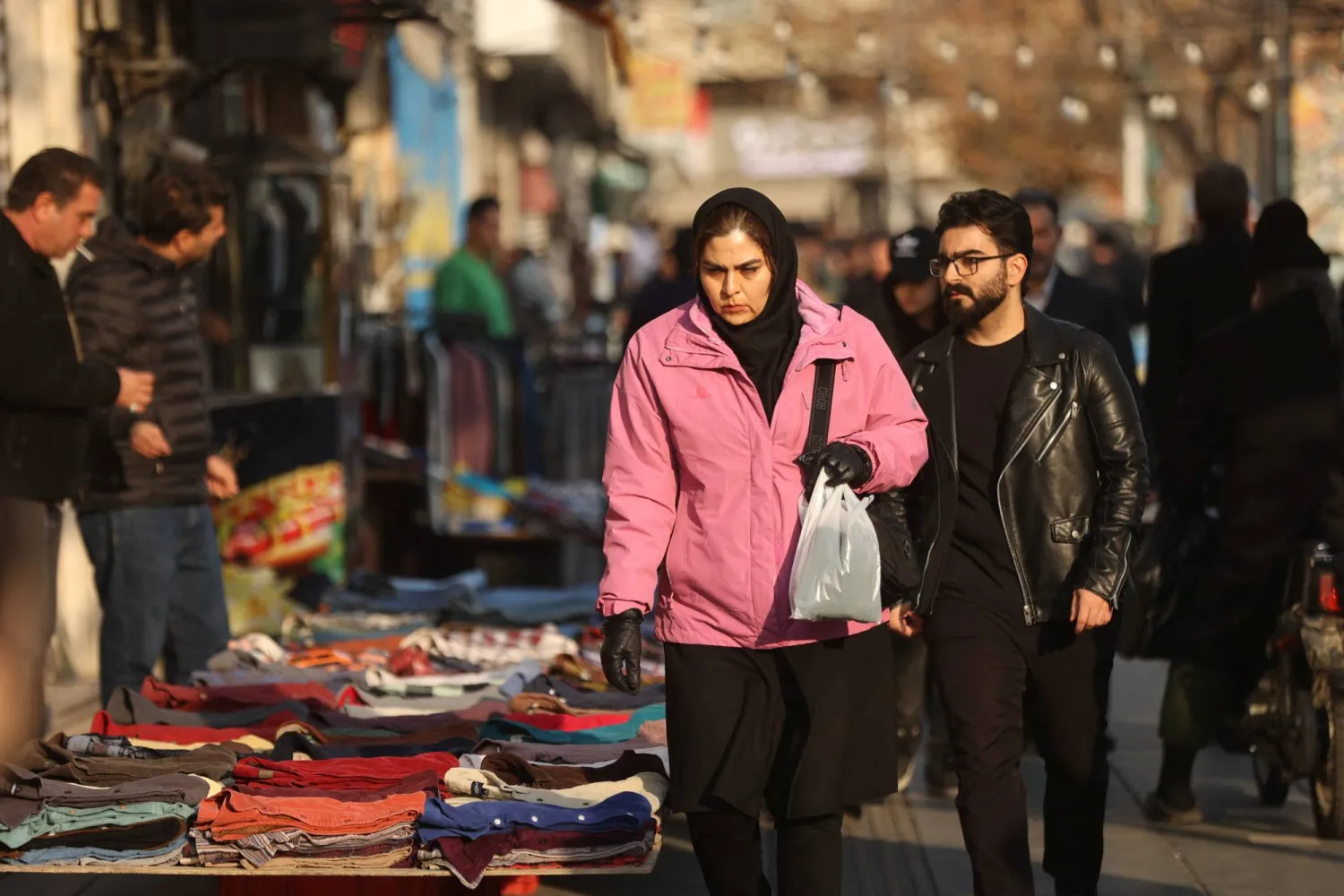
 People walk on a street, as protests erupt over the collapse of the currency's value, in Tehran, Iran, January 5, 2026. Majid Asgaripour/WANA (West Asia News Agency) via Reuters
People walk on a street, as protests erupt over the collapse of the currency's value, in Tehran, Iran, January 5, 2026. Majid Asgaripour/WANA (West Asia News Agency) via Reuters
TT

Iran’s Leaders Struggle to End Protests, US Action in Venezuela Stokes Fears

 People walk on a street, as protests erupt over the collapse of the currency's value, in Tehran, Iran, January 5, 2026. Majid Asgaripour/WANA (West Asia News Agency) via Reuters
People walk on a street, as protests erupt over the collapse of the currency's value, in Tehran, Iran, January 5, 2026. Majid Asgaripour/WANA (West Asia News Agency) via Reuters

Iran's efforts to quell a wave of anti-government protests have been complicated by Donald Trump's threat to intervene on their side, a warning firmly underlined by the subsequent US capture of Venezuela's Nicolas Maduro, officials and insiders said on Monday.

A day before US special forces seized Maduro and his wife on January 3 and whisked them off to New York, the US president warned in a social media post that if Iran's leadership killed protesters who have taken to the streets since December 28 the US "will come to their rescue". At least 17 people have died so far.

Tehran's options have been limited by Trump's threats and a long-running economic crisis that deepened after Israel, joined by the US, launched strikes on the country in June in a 12-day war that pummeled several of Iran's nuclear sites.

SOME FEAR IRAN MAY BE 'NEXT VICTIM', OFFICIAL SAYS

"These twin pressures have narrowed Tehran's room for maneuver, leaving leaders caught between public anger on the streets and hardening demands and threats from Washington, with few viable options and high risks on every path," one Iranian official told Reuters.

The view was echoed by two other officials and a former Iranian official who remains close to Iran's decision makers. All of them asked not to be identified due to the sensitivity of the situation.

A second official said that, ‌after US action in ‌Venezuela, some of the authorities feared Iran could be "the next victim of Trump's aggressive foreign policy".

Iran's economy has ‌been ⁠hammered by years of ‌US sanctions, but its rial has been in freefall since last year's Israeli-US strikes that mainly targeted nuclear sites, where the West says Tehran has been working on nuclear arms. Iran denies this.

The protests that erupted in Tehran and which have spread to some cities in western and southern Iran do not match the scale of unrest that swept the nation in 2022-23 over the death of Mahsa Amini, who died in the custody of Iran's morality police for allegedly violating the hijab law.

But, even if smaller, these protests have quickly expanded from an economic focus to broader frustrations, with some protesters chanting "Down with the Islamic Republic" or "Death to the dictator" - a reference to Supreme Leader Ali Khamenei who has the final say in all state matters.

That presents a challenge for the authorities which have been trying to maintain and nurture the spirit of national ⁠unity that emerged during and after the Israeli-US strikes.

A third official said worries were growing in Tehran that "Trump or Israel might take military action against Iran, like what they did in June."

IRAN IS LONGTIME ALLY ‌OF VENEZUELA

Iran, which has for years allied itself with fellow oil producer Venezuela, which like Iran has ‍suffered under years of US sanctions, has condemned Washington's action in Caracas. ‍It has also condemned Trump's statements about Iran.

Iran's Foreign Ministry spokesperson Esmaeil Baghaei said such statements about "Iran's internal affairs amount, under international norms, to nothing more than ‍incitement to violence, incitement to terrorism, and incitement to killing".

On Friday, Trump threatened to intervene if protesters faced violence, declaring, "We are locked and loaded and ready to go," though he offered no details on what actions he might take.

The protests threaten what has long been Khamenei's defining priority: preserving the republic at any cost. In a sign of the leadership's concern, Khamenei on Saturday accused "enemies of the republic" of fomenting unrest and warned that "rioters should be put in their place".

WORST UNREST IN THE PAST THREE YEARS

Authorities have attempted to maintain a dual approach to the unrest, saying protests over the economy are legitimate and will be met by dialogue, while meeting some demonstrations with tear gas amid violent street confrontations.

However, at least 17 people have been killed in a week, rights groups said ⁠on Sunday. Authorities have said at least two members of the security services had died and more than a dozen were injured in the unrest.

The country's clerical establishment is still coming to terms with the 2025 Israeli and US strikes on Iranian nuclear and military targets. The attacks, which killed top Revolutionary Guard commanders and nuclear scientists, were launched just a day before a planned sixth round of talks with Washington over Tehran's disputed nuclear program.

Negotiations have stalled since the June conflict, even as both sides insist they remain open to a deal.

Washington and its allies accuse Iran of using its nuclear program as cover to develop weapons capability, a charge Tehran denies, saying its ambitions are purely peaceful.

DEEPENING ECONOMIC HARDSHIP, LACK OF TANGIBLE SOLUTION

Economic grievances remain at the heart of latest unrest.

Widening disparities between ordinary Iranians and a privileged clerical and security elite, compounded by mismanagement, runaway inflation and corruption — factors even acknowledged by state media — have fueled public anger.

Witnesses in Tehran, Mashhad and Tabriz reported a heavy security presence in main squares. "You can feel the tense atmosphere in Tehran, but life continues as normal," said Amir Reza, 47, a carpet shop owner in Tehran's Grand Bazaar.

President Masoud Pezeshkian has urged dialogue and promised reforms to stabilize the monetary and banking systems and protect purchasing power.

Starting January 10, the government will provide a monthly stipend of 10,000,000 rials per person (about $7) in non-cashable ‌electronic credit for use in select grocery stores, the semi-official Tasnim news agency reported.

For lower-income households, whose monthly salaries barely exceed $150, the measure represents a modest but meaningful boost. The rial lost roughly half its value against the dollar in 2025, while official inflation reached 42.5% in December.



Russia Says Foreign Troops in Ukraine Would be Targets after UK, France Pledge Post-ceasefire Deployment

Cars move along a dark street during a power blackout after critical civil infrastructure was hit by today's Russian drone strikes, amid Russia's attack on Ukraine, in Zaporizhzhia, Ukraine January 7, 2026. REUTERS/Stringer
TT

Russia Says Foreign Troops in Ukraine Would be Targets after UK, France Pledge Post-ceasefire Deployment

Cars move along a dark street during a power blackout after critical civil infrastructure was hit by today's Russian drone strikes, amid Russia's attack on Ukraine, in Zaporizhzhia, Ukraine January 7, 2026. REUTERS/Stringer

Russia said on Thursday that any troops sent to Ukraine by Western governments would be "legitimate combat targets", after Britain and France announced plans to ​deploy a multinational force there in the event of a ceasefire.

A Russian Foreign Ministry statement said "militaristic declarations" by a coalition of pro-Ukraine Western governments were becoming increasingly dangerous.

Russia was responding for the first time to a meeting of the "coalition of the willing" in Paris on Tuesday at which Britain and France signed a declaration of intent on the future deployment.

French President Emmanuel Macron said it could involve sending ‌thousands of French ‌troops. British Prime Minister Keir Starmer said ‌it ⁠paved ​the way ‌for a legal framework whereby "British, French and partner forces could operate on Ukrainian soil, securing Ukraine's skies and seas and regenerating Ukraine's armed forces for the future", Reuters reported.

Russia "warns that the deployment of Western military units, military facilities, depots and other infrastructure on Ukrainian territory will be classified as foreign intervention, posing a direct threat to the security of not only Russia but also ⁠other European countries," the statement from Moscow said.

"All such units and facilities will be ‌considered legitimate combat targets of the Russian ‍Armed Forces."

It added: "The fresh militaristic ‍declarations of the so-called coalition of the willing and the Kyiv regime constitute ‍a veritable 'axis of war'.

"The plans of these participants are becoming increasingly dangerous and destructive for the future of the European continent and its inhabitants, who are also being forced by Western politicians to finance these aspirations out of ​their own pockets."

Russia, which staged a full-scale invasion of Ukraine in February 2022, says it was forced to intervene in ⁠order to prevent Ukraine from being absorbed into NATO and used as a launchpad to threaten Russia. It has consistently said it will never accept the stationing of Western forces there.

Ukraine and its allies accuse Moscow of waging an imperial-style war aimed at seizing the territory of its neighbour, of which it now holds nearly 20%. They say Ukraine needs firm security guarantees as part of any peace settlement in order to prevent another Russian invasion in future.

The United States has ruled out sending its own troops to Ukraine, but its special envoy Steve Witkoff said ‌at Tuesday's meeting in Paris that President Donald Trump "strongly stands behind" security protocols aimed at deterring future attacks on Ukraine.


Iran: Divisions Deepen as Bazaar Protests Expand

 A protester in the city of Abdanan, which saw the largest demonstrations on Tuesday (Telegram)
A protester in the city of Abdanan, which saw the largest demonstrations on Tuesday (Telegram)
TT

Iran: Divisions Deepen as Bazaar Protests Expand

 A protester in the city of Abdanan, which saw the largest demonstrations on Tuesday (Telegram)
A protester in the city of Abdanan, which saw the largest demonstrations on Tuesday (Telegram)

Iranian authorities are showing clear internal divisions as protests widen across the country, with strikes spreading through Tehran’s historic Grand Bazaar and demonstrations flaring in dozens of cities.

President Masoud Pezeshkian has instructed officials to avoid a heavy-handed security response to protesters, stressing that confrontational tactics could undermine national security.

His position contrasts sharply with the escalating rhetoric of Judiciary Chief Gholam-Hossein Mohseni-Ejei, who has warned against any tolerance toward what he calls “rioters” and those “assisting the enemy,” accusing the United States and Israel of seeking to destabilize Iran.

In Tehran, protests intensified in and around the Grand Bazaar as merchants continued a strike for a second consecutive day. In a notable move, Tehran Metro announced that the capital’s main subway line would remain closed “until further notice” at the 15 Khordad station near the bazaar, a decision widely interpreted as an attempt to curb the flow of people into the area.

Reports also described scattered gatherings and sporadic clashes in central and southern parts of the capital.

Beyond Tehran, the protest movement has expanded to include market strikes and intermittent nighttime demonstrations in multiple cities. On Tuesday night, protests were reported in several provinces.

In Ilam, demonstrators took to the streets in different neighborhoods chanting anti-government slogans. In Torbat-e Heydarieh, solidarity gatherings were held alongside a heavy deployment of special security units. Videos circulated from Alvand, in Qazvin province, showing crowds amid the sound of gunfire, while security forces fired tear gas at protesters in Neyriz, in Fars province.

As strikes spread through commercial centers, currency markets hit record levels. The US dollar approached 1.48 million rials on Tehran’s informal market, while exchange shops quoted selling prices around 1.47 million rials. Analysts said the surge reflected the sharp decline in the rial’s value and the erosion of purchasing power, factors widely seen as key drivers of the unrest.

Official Divide

Vice President for Executive Affairs Mohammad-Jafar Qaempanah said Pezeshkian emphasized during a cabinet meeting the need to avoid a security-first approach to protests “so as not to harm national security,” while distinguishing peaceful demonstrations from acts of violence.

“Anyone carrying a weapon or knife and attacking police or military centers is a rioter and must be separated from protesters,” he said, according to a state news agency.

Government spokeswoman Fatemeh Mohajerani also quoted the president as saying that dialogue with citizens and protesters would not allow “other parties to hijack the people’s protests.”

Former reformist lawmaker Mahmoud Sadeghi criticized the judiciary chief’s threats, saying they played into the hands of hardliners, and urged security forces to respect protesters and show greater tolerance, even toward harsh slogans or angry behavior.

By contrast, Mohseni-Ejei struck a far tougher tone, labeling demonstrators as troublemakers and arguing that those taking to the streets were serving the objectives of Iran’s enemies. He said there would be no room for leniency and promised that prosecutions and punishments would be “swift,” while remaining “precise and in accordance with legal standards.”

Speaking to a group of traders and business owners, he added that “bazaar protests do not mean confronting the system.”

Casualties, Arrests, and Hospitals

Human rights organizations reported dozens of deaths and thousands of arrests in the early days of the unrest.

The Kurdish rights group Hengaw said at least 27 people were killed and more than 1,500 arrested over a 10-day period.

The Human Rights Activists News Agency (HRANA) put the death toll at no fewer than 36, with at least 2,076 arrests.

The Oslo-based Iran Human Rights organization said detainees exceeded 1,000, as protests spread to 28 of Iran’s 31 provinces and around 80 cities.

Tehran Governor Mohammad Sadegh Motamedian said no deaths had been recorded in Tehran province, adding that when events turn into vandalism and clashes, “they are no longer protests.”

Authorities confirmed that at least two members of the security forces were killed and more than 10 wounded, without releasing figures for protester fatalities.

Amid allegations that security forces entered hospitals in Tehran and Ilam, Health Minister Mohammad-Reza Zafarghandi denied that injured protesters had been removed from medical facilities. He said no tear gas had been fired inside Sina Hospital, while noting that investigations were ongoing.

International Pressure

Iran is also facing mounting international pressure. US President Donald Trump warned he would intervene to “save protesters” if security forces opened fire, months after Israeli and US strikes on Iranian nuclear sites during a 12-day conflict.

Iran’s Supreme Leader Ali Khamenei responded by vowing not to “bow to the enemy.”

Foreign Minister Abbas Araghchi said Iran’s internal affairs “have nothing to do with any foreign country,” describing Trump’s comments as “interference,” while expressing hope that tensions between the government and protesting citizens could be resolved through dialogue.

The Foreign Ministry reaffirmed Iran’s recognition of the right to peaceful protest, while condemning what it called “interventionist and misleading” US statements.

In an effort to contain public anger, the government has begun distributing monthly cash assistance of about $7 per citizen to help cover basic food costs.

A Persian-language account run by the US State Department described the payment of one million tomans per person as “humiliating,” contrasting it with Iran’s financial support for regional allies.


2 Killed in Shooting in Mormon Church Parking Lot in Salt Lake City

Police respond to a fatal shooting in a parking lot of The Church of Jesus Christ of Latter-day Saints in Salt Lake City on Wednesday, Jan. 7, 2025. (AP Photo/Hannah Schoenbaum)
TT

2 Killed in Shooting in Mormon Church Parking Lot in Salt Lake City

Police respond to a fatal shooting in a parking lot of The Church of Jesus Christ of Latter-day Saints in Salt Lake City on Wednesday, Jan. 7, 2025. (AP Photo/Hannah Schoenbaum)

A shooting outside a church building in Salt Lake City killed two people and injured six others Wednesday, police said.

The shooting took place in the parking lot of a meetinghouse of The Church of Jesus Christ of Latter-day Saints, widely known as the Mormon church.

Dozens of people were attending a funeral inside at the time. All the victims were adults, The Associated Press reported.

Police said they do not believe the shooter had any animus toward a particular faith.

“We don’t believe this was a targeted attack against a religion or anything like that,” Salt Lake City Police Chief Brian Redd said.

Police also do not believe the shooting was random. Authorities said no suspect was in custody.

Brennan McIntire said he and his wife, Kenna, heard the gunshots from their apartment next to the parking lot while watching TV. He jumped off the couch and ran outside to check on things.

“As soon as I came over, I see someone on the ground,” McIntire said. “People are attending to him and crying and arguing.”

About 100 law enforcement vehicles were at the scene in the aftermath, and helicopters flew overhead.

“This should never have happened outside a place of worship. This should never have happened outside a celebration of life,” Mayor Erin Mendenhall said.

The church was cooperating with law enforcement and was grateful for efforts first responders' efforts, a spokesperson said.

“We extend prayers for all who have been impacted by this tragedy and express deep concern that any sacred space intended for worship should be subjected to violence of any kind,” Sam Penrod said in a statement.

The church is headquartered in Salt Lake City, and about half of Utah’s 3.5 million residents are members of the faith. Churches like the one where the shooting occurred can be found in towns throughout the city and state.

The faith has been on heightened alert since four people were killed when a former Marine opened fire in a Michigan church last month and set it ablaze.

The FBI found that he was motivated by “anti-religious beliefs” against the church.