


Egypt Stresses Full Support for Somalia's Unity, Sovereignty

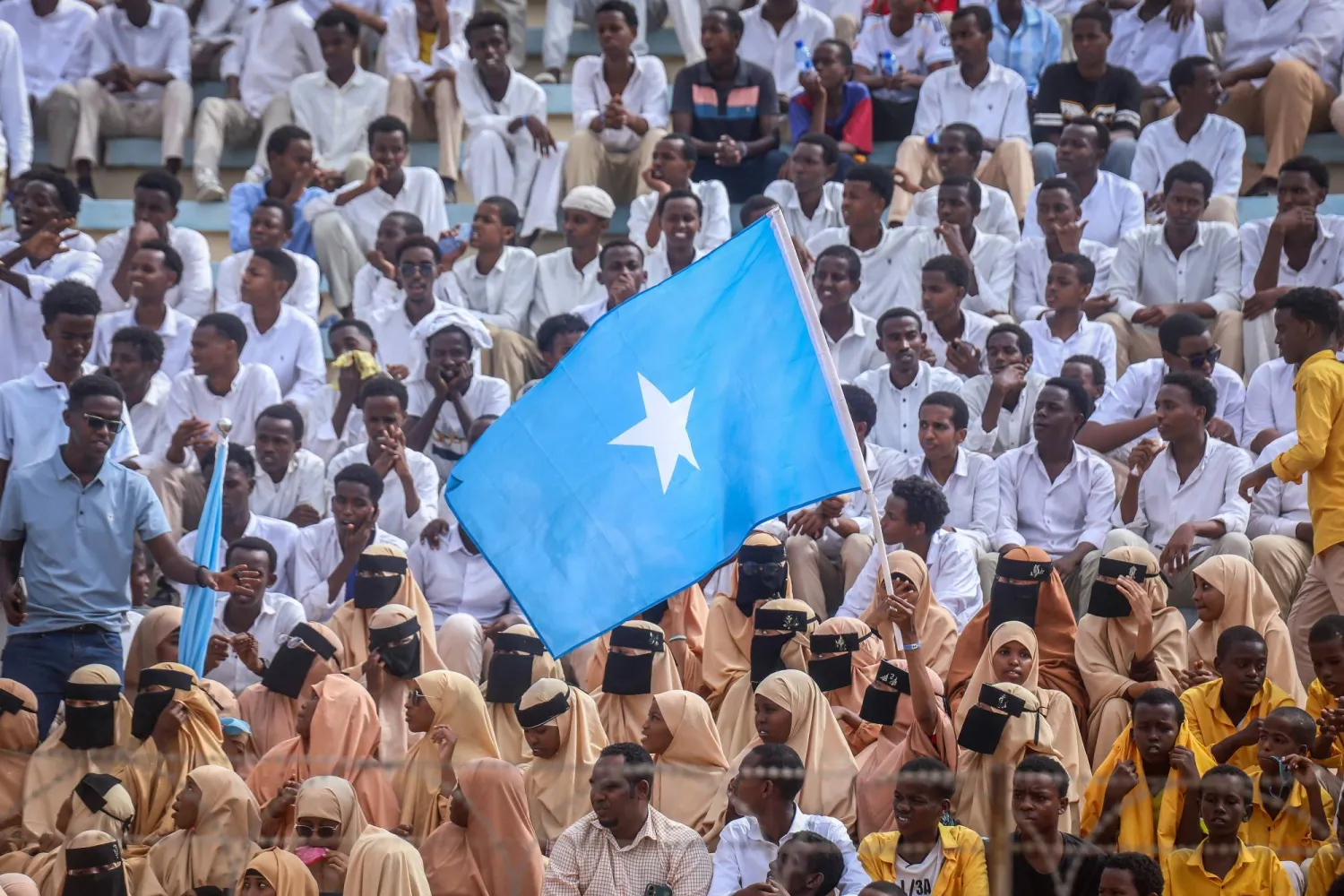
Residents wave Somali flags as they attend a rally denouncing Israel's recent announcement recognizing the breakaway Somaliland region, during a gathering calling for Somalia's territorial unity at Mogadishu Stadium in Mogadishu on December 30, 2025. (AFP)
TT

Egypt Stresses Full Support for Somalia's Unity, Sovereignty

Residents wave Somali flags as they attend a rally denouncing Israel's recent announcement recognizing the breakaway Somaliland region, during a gathering calling for Somalia's territorial unity at Mogadishu Stadium in Mogadishu on December 30, 2025. (AFP)

Egyptian Foreign Minister Badr Abdelatty underscored on Tuesday Cairo's full support for the unity, sovereignty, and inviolability of Somali territory, describing it as a fundamental pillar for the stability of the Horn of Africa and the Red Sea region.

He stressed Egypt's rejection of any unilateral measures or attempts to impose parallel entities or create a new political reality outside internationally recognized legal frameworks.

He made his remarks during his participation in the session of the African Peace and Security Council (PSC), held virtually at Egypt’s request, in support of the unity, sovereignty, and territorial integrity of Somalia.

Abdelatty said that Israel's unilateral and unlawful recognition of what is termed the "Somaliland region" is a flagrant violation of Somalia's sovereignty, unity, and territorial integrity.

It undermines the principles of international law, the United Nations (UN) Charter, and the Constitutive Act of the African Union (AU), he declared. Moreover, it sets a dangerous precedent threatening regional and international peace and security.

This demands a unified stance in support of Somalia and concerted efforts to achieve security and stability in Somalia and the Horn of Africa region, urged Abdelatty.

He called on the African PSC to adopt a strong and unified position condemning the recognition of so-called "Somaliland" and urged all AU member states to categorically reject any measures arising from the Israeli recognition.

He also underlined the need for full and unconditional support for the sovereignty, unity, and territorial integrity of Somalia.



Israel Strikes Gaza Rocket Launch Site, Ceasefire Deal under Strain

Rockets are fired by Palestinian militants into Israel, amid Israeli-Palestinian fighting, in Gaza City August 5, 2022. REUTERS/Mohammed Salem
TT

Israel Strikes Gaza Rocket Launch Site, Ceasefire Deal under Strain

Rockets are fired by Palestinian militants into Israel, amid Israeli-Palestinian fighting, in Gaza City August 5, 2022. REUTERS/Mohammed Salem

Israel's military said on Thursday it had carried out a targeted strike on a rocket launch site near Gaza City after identifying a failed launch, as questions mount over when the next phase of the Gaza ceasefire will begin.

The military said the projectile did not cross into Israeli territory and that the launch site was struck shortly after the attempt was detected.

It accused Hamas of violating the ceasefire twice in the past ‌24 hours. A ‌source from the Palestinian militant group told Reuters it ‌was ⁠checking ​the ‌allegation.

Further highlighting the fragility of the ceasefire deal, local Palestinian health authorities said two people, a woman and a boy, had been injured on Thursday in two separate shooting incidents by Israeli forces in southern and northern Gaza.

There was no immediate Israeli comment on the report.

Israel is awaiting the handover of the final body due under the current stage of the truce. An Israeli official close to Prime Minister Benjamin Netanyahu has said Israel ⁠will not move to the next phase of the ceasefire until Hamas returns the remains of the last Israeli ‌hostage still held in Gaza.

Israel has yet to open ‍the Rafah crossing between Gaza and Egypt, ‍which is another condition of the US-backed plan, saying it will only do ‍so once the remains are returned.

CEASEFIRE LOOKING FRAGILE

Israel and Hamas have accused each other of major breaches of the ceasefire deal and remain far apart on the more difficult steps envisaged for the next phase.

Israel has continued to carry out air strikes and targeted operations across Gaza. ​The Israeli military said it views "with utmost severity" any attempts by militant groups in Gaza to attack Israel.

A Hamas official told Reuters on ⁠Thursday the group had documented more than 1,100 Israeli violations of the ceasefire since October and had urged mediators to intervene.

The violations include killings, injuries, artillery and aerial strikes, home demolitions and detention of people, he said.

Hamas has refused to disarm and has been reasserting its control as Israeli troops remain entrenched in about half the Gaza Strip. Israel has said it will resume military action if Hamas is not disarmed peacefully.

More than 400 Palestinians, mostly civilians, have been killed since the truce, according to Gaza health officials, as well as three Israeli soldiers.

Hamas-led militants killed some 1,200 people and abducted 251 others in an assault on Israel on October 7, 2023, according to Israeli figures. More than 71,000 Palestinians ‌have been killed in Israel's offensive in Gaza since then, according to the territory's health ministry.


Libya’s Presidential Council Adopts National Reconciliation Charter Amid Rising Divisions

Menfi during the adoption of the National Reconciliation Charter in Tripoli (Presidential Council)
TT

Libya’s Presidential Council Adopts National Reconciliation Charter Amid Rising Divisions

Menfi during the adoption of the National Reconciliation Charter in Tripoli (Presidential Council)

Libya’s Presidential Council Chairman Mohamed al-Menfi on Wednesday adopted the National Reconciliation Charter, describing it as “the beginning of a new phase of serious work toward achieving social peace and justice,” despite escalating political tensions and deepening divisions.

The announcement comes as disputes persist between the House of Representatives and the High Council of State. The latter has urged the United Nations mission to maintain neutrality, defending its unilateral move to reconstitute the board of the High National Elections Commission and warning against any “reproduction of past crises.”

Speaking at a ceremony in Tripoli, Menfi said the charter was the result of national efforts grounded in dialogue and tolerance, and marked the start of translating reconciliation principles into daily practice.

He voiced support for the High Council for Peace and Reconciliation to implement the charter, rebuild trust, and address grievances. Menfi also declared January 7 a National Day for Peace and Reconciliation, calling reconciliation a religious, national, and strategic obligation that ensures the future of coming generations.

Under the 2021 Geneva agreement, the national reconciliation file formally falls under the Presidential Council’s authority. However, little tangible progress has been made over the past five years amid political fragmentation, despite multiple preparatory meetings and conferences sponsored by the African Union.

Renewed talk of reconciliation has coincided with intensified political escalation between the House of Representatives and the High Council of State, following the latter’s unilateral election of a new board for the High National Elections Commission. The move prompted sharp criticism from the UN mission, which expressed serious concern over rising tensions between the two bodies over the commission’s leadership.

In response, the High Council of State expressed surprise at the UN statement. While reaffirming the mission’s role in supporting Libya’s political process, it stressed that the sovereign powers of Libyan institutions, as defined by the constitutional declaration and its amendments, must not be bypassed or handled outside established constitutional and legal frameworks.

The council said reconstituting the elections commission falls within its core competencies and is consistent with constitutional procedures and the 2015 Skhirat Political Agreement, noting that the House of Representatives had taken similar steps in the past without drawing international criticism.

Observers say the dispute reflects an escalating struggle between Libya’s rival institutions over sovereign posts and the electoral track, highlighting growing tensions between national ownership of the political process and international involvement, as elections remain central to the contest for power and legitimacy.


Pay Cuts and Layoffs: UNRWA Faces Sudden Crisis with Palestinian Institutions

Israeli soldiers stand outside UNRWA’s headquarters in the Gaza Strip (AFP)
TT

Pay Cuts and Layoffs: UNRWA Faces Sudden Crisis with Palestinian Institutions

Israeli soldiers stand outside UNRWA’s headquarters in the Gaza Strip (AFP)

A crisis has erupted between the United Nations Relief and Works Agency for Palestine Refugees (UNRWA) and several Palestinian institutions following a decision by the agency to lay off hundreds of employees and cut the salaries of others.

UNRWA informed its local staff from the Gaza Strip who are currently outside the territory that their employment would be terminated immediately and officially, citing the severe monetary crisis facing the agency.

Employees and organizations monitoring UNRWA’s work circulated a decision signed by Sam Rose, acting director of UNRWA affairs in Gaza, announcing the termination of contracts for more than 600 employees under an “exceptional leave” provision in accordance with regulations governing local staff.

The decision stated that UNRWA Commissioner-General Philippe Lazzarini had approved the move as formal notice of termination, while pledging to preserve employees’ financial rights through a mechanism yet to be agreed upon.

The decision cited a crippling financial shortfall that has left UNRWA unable to secure sufficient funds to continue paying salaries and meeting its programmatic obligations.

According to Palestinian sources specializing in refugee and UNRWA affairs, the decision affects 622 employees, the majority of them education staff who were forced to leave Gaza with their families because of the war. Most are currently in Egypt.

The Joint Refugee Committee described the move as “arbitrary and inhumane,” saying it constitutes “a direct assault on employees’ dignity and their right to work and live in safety.” It stressed that staff did not leave Gaza by choice, but fled war, bombardment, starvation, and disease, noting that many are ill or caring for sick relatives.

The committee held Lazzarini fully responsible for the decision, which comes near the end of his term, and called for its immediate reversal and the reinstatement of dismissed staff.

The Refugee Affairs Department of the Palestine Liberation Organization also rejected the decision, describing it as “a dangerous approach that goes beyond a funding crisis to amount to systematic administrative execution.”

Ahmad Abu Houli, a member of the PLO Executive Committee and head of the Refugee Affairs Department, said the 20 percent salary cuts for Gaza and West Bank staff, the termination of contracts for 570 Gaza employees abroad, and the replacement of UNRWA guards in Amman with a private security company amounted to “a stab in the back” of employees who had served as a safety valve for the agency and lost 382 colleagues killed under Israeli bombardment.

Palestinian factions, including Fatah and Hamas, also condemned the decision, calling it an unjustified escalation that violates employees’ rights and deepens their suffering amid war and siege. Palestinian human rights groups likewise denounced the move as illegal under wartime conditions in Gaza.