

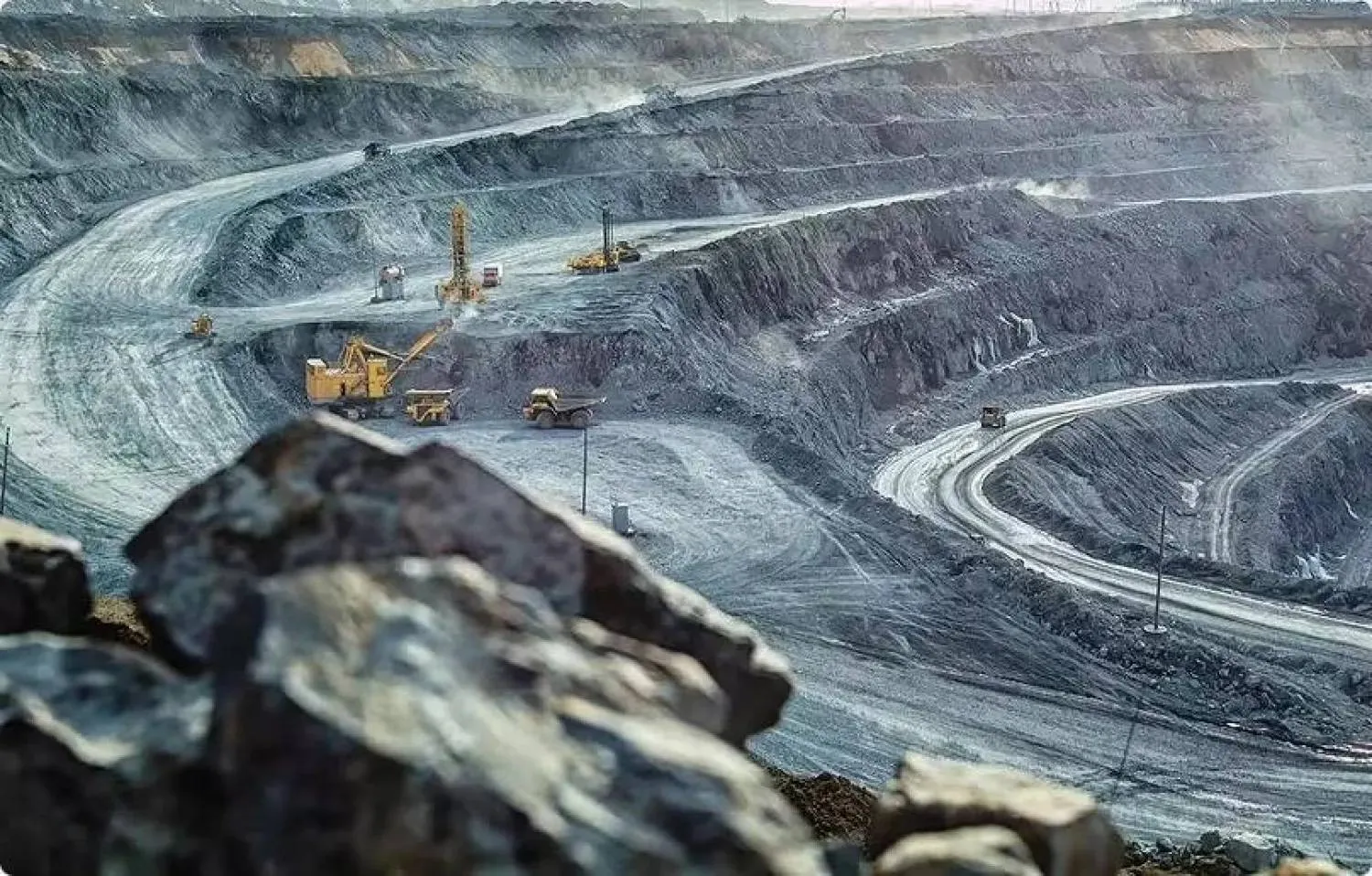

Saudi Minerals Program Accelerates Unlocking Trillions Beneath the Desert

Saudi Arabia maps mining exploration zones (Asharq Al-Awsat)
TT

Saudi Minerals Program Accelerates Unlocking Trillions Beneath the Desert

Saudi Arabia maps mining exploration zones (Asharq Al-Awsat)

Economic experts said the Saudi Cabinet’s approval of the draft rules and procedures governing the National Minerals Program marks a decisive step that will accelerate the development of the Kingdom’s vast mineral resources, estimated at around 9 trillion riyals, or $2.4 trillion.

They said the move firmly positions mining as the third pillar of national industry and a key engine of non-oil growth.

Khalid Al-Mudayfer, Deputy Minister of Industry and Mineral Resources for Mining Affairs, said the approval builds on sustained government support for the mining and minerals industries. He said the program will act as a primary enabler to ensure sufficient current and future mineral supplies and to address gaps across value chains.

The regulatory push comes as economic circles look ahead to the fifth edition of the International Mining Conference, set to take place in Riyadh from Jan. 13 to 15, 2026, under the patronage of Custodian of the Two Holy Mosques King Salman bin Abdulaziz.

The event is expected to generate exceptional momentum, with around 150 memorandums of understanding and strategic agreements anticipated, alongside participation from more than 200 exhibitors and sponsors.

From regulation to strategic planning

Mohammed Al-Duleim, chairman of the National Mining Committee at the Federation of Saudi Chambers, told Asharq Al-Awsat that the Cabinet’s approval reflects the government’s determination to build a strong, well-regulated and sustainable mining sector capable of matching the ambitions of the Saudi economy at this stage.

He said the decision represents a qualitative shift in a sector that has become part of strategic economic activities linked to industry and several other sectors, making a positive contribution to non-oil growth.

Al-Duleim said the timing of the program is critical, as global competition for minerals intensifies, echoing earlier competition for oil. He said the Kingdom has moved early from a focus on regulation and governance toward forward planning and long term sustainability.

He added that the program guarantees the timely availability of mineral supplies at stable prices, offering investors a high degree of clarity and helping to manage risks. He said Saudi Arabia has now emerged as a global minerals hub, driven by the outcomes of the International Mining Conference and a successful partnership between the public and private sectors.

Strong domestic demand underpins the new program, which centers on securing mineral needs on time and at stable prices, Al-Duleim said.

The Cabinet decision, he added, enhances transparency and confidence for investors and reinforces the state’s comprehensive approach to managing the sector, from planning to value maximization, in line with Vision 2030 targets.

He said the Kingdom’s status as a global minerals center has been reinforced by mega projects and by the government’s success in building public private partnerships, positioning Saudi Arabia as a major international destination through the annual International Mining Conference in Riyadh.

Unifying procedures

Economist Ahmed Al-Shahri told Asharq Al-Awsat that the new program represents a regulatory step aimed at strengthening governance of the sector and improving management mechanisms.

He said it supports exploration and development of mineral resources valued at more than 9 trillion riyals, or $2.4 trillion.

He said the National Minerals Program provides a government framework that organizes the sector and defines coordination mechanisms among relevant authorities, adding that Cabinet approval will lead to unified procedures and faster licensing.

Al-Shahri stated that the program aims to transform mining into a key economic pillar, aligning with government objectives, while also attracting both domestic and foreign investment. He said it also focuses on maximizing local value added from mineral resources.

He said the decision reflects a structured, long term approach to developing the minerals sector, strengthening exploration, environmental governance and sustainability.

In conclusion, the National Minerals Program stands as a key mechanism to enhance the efficiency of developing Saudi Arabia’s mineral wealth, combining strict governance with flexible planning.

Analysts said this approach will help channel the necessary investment to deliver significant gains in the sector’s contribution to the country's gross domestic product in the coming years.



Iraq’s Oil Minister Says Talks Ongoing with Chevron on West Qurna 2 Oilfield

A Chevron logo at the Chevron building in Houston, Texas, US August 19, 2025. (Reuters)
TT

Iraq’s Oil Minister Says Talks Ongoing with Chevron on West Qurna 2 Oilfield

A Chevron logo at the Chevron building in Houston, Texas, US August 19, 2025. (Reuters)

Iraq's oil minister said on Saturday that talks were ‌ongoing ‌with ‌US ⁠major Chevron regarding ‌the Lukoil-operated West Qurna-2 field, the Russian company's ⁠largest foreign ‌asset.

Chevron ‍and ‍Exxon Mobil ‍are among potential bidders for Lukoil's overseas assets following US ⁠sanctions on the Russian oil producer.


China’s Consumer Inflation Scales 3-Year High but Deflation Battle Far from Over

 Chinese girls dressed in Qing Dynasty attire take pictures outside the Forbidden City in Beijing, China, Wednesday, Jan. 7, 2026. (AP)
Chinese girls dressed in Qing Dynasty attire take pictures outside the Forbidden City in Beijing, China, Wednesday, Jan. 7, 2026. (AP)
TT

China’s Consumer Inflation Scales 3-Year High but Deflation Battle Far from Over

 Chinese girls dressed in Qing Dynasty attire take pictures outside the Forbidden City in Beijing, China, Wednesday, Jan. 7, 2026. (AP)
Chinese girls dressed in Qing Dynasty attire take pictures outside the Forbidden City in Beijing, China, Wednesday, Jan. 7, 2026. (AP)

China's annual consumer price inflation accelerated to a 34-month high in December, but the full-year rate slumped to the lowest in 16 years while producer deflation persisted, backing market expectations for more stimulus to shore up soft demand.

Imbalances in the $19 trillion economy have worsened over the past year even as growth is on course to meet Beijing's target of "around 5%" for 2025, buoyed by policy support and resilient goods exports.

US President Donald Trump's global trade war has added to persistently soft consumer demand, which has remained a drag on confidence and growth for years amid a prolonged property crisis.

The December consumer price index (CPI) rose 0.8% from the same month in 2024, National Bureau of Statistics (NBS) data showed on Friday, matching expectations in a Reuters poll and perking up from the 0.7% increase in November.

The rise was mainly driven by food prices, especially those of fresh vegetables and beef, which expanded 18.2% ‌and 6.9% respectively, Dong ‌Lijuan, a statistician at NBS, said in a statement. Pre-New Year holiday shopping ‌and ⁠supportive policies also helped ‌boost consumer prices, Dong added.

Chinese policymakers have repeatedly pledged to support a rebound in prices with monetary policy and have cracked down on excessive competition. They have also vowed to boost people's income to unleash consumption potential and better align the country's supply and demand.

Yet, the underlying demand impulse in the economy remains weak.

"Despite expectations of a recovery, inflation remains relatively low and should not preclude further monetary easing this year," said Lynn Song, ING's chief economist for Greater China.

Zichun Huang, China economist at Capital Economics, said the elevated headline CPI was not due to the government campaign to curb so-called "involution", adding that overcapacity and deflationary pressures will persist in the coming ⁠years in the absence of stronger demand-side measures.

WHERE HAS INFLATION GONE?

Indeed, for the entire 2025, consumer price growth was flat, well below the "around 2%" goal policymakers were ‌aiming for, a sign that stimulus measures, such as a consumer goods trade-in scheme, ‍have yielded only modest results in lifting sentiment and containing ‍deflationary pressure.

Prices of gold jewellery surged 68.5%, NBS data showed.

Core inflation, ‍which excludes volatile prices of food and fuel, rose 1.2% year-on-year last month, unchanged from November.

Goldman Sachs economists estimate that core price gauge excluding gold prices edged down in December from the prior month.

Annual growth in China's consumer prices has for years failed to meet policymakers' targets as the economy struggled to recover from the pandemic.

A prolonged property market crisis and a weak job market have contributed to lackluster household demand as well as overcapacity and price competition among producers.

On a monthly basis, CPI climbed 0.2% in December, compared with a 0.1% dip the previous month and a forecast for a 0.1% rise.

The producer ⁠price index (PPI) fell 1.9% year-on-year in December, remaining in a deflationary funk for more than three years even as it eased from a 2.2% drop in November. The gauge was expected to have fallen 2% in the Reuters poll.

NBS's Dong attributed the moderation in factory-gate deflation to both global commodity prices, including rising prices of non-ferrous metals, and policies for controlling capacity in key industries.

Capital Economics' Huang, however, said there hasn't been "any fundamental improvement in overcapacity."

"Prices of consumer durables continued to fall at a faster pace than during the depths of the global financial crisis, highlighting that the issue of excess supply remains unresolved in much of the manufacturing sector," she said.

For the whole year, PPI fell 2.6%.

Given the slowdown in economic momentum in the second half of last year, the market is watching for signs of additional government support measures in 2026 as top leaders have committed to pursuing a more proactive macroeconomic policy framework.

The central government has allocated 62.5 billion yuan ($8.95 billion) from special treasury bond proceeds to local governments to ‌keep funding the consumer goods trade-in scheme in 2026.

The government has also pledged to flexibly use monetary policy tools, such as cuts to interest rates and banks' reserve requirement ratio, to keep liquidity ample and spur growth.


Business-Friendly Climate Draws 123,000 New Commercial Registrations in Saudi Arabia

 Employees at the Saudi Business Center (SPA). 
 Employees at the Saudi Business Center (SPA). 
TT

Business-Friendly Climate Draws 123,000 New Commercial Registrations in Saudi Arabia

 Employees at the Saudi Business Center (SPA). 
 Employees at the Saudi Business Center (SPA). 

Saudi Arabia’s business environment attracted 123,000 new commercial registrations in the fourth quarter of 2025, pushing the total number of active registrations past 1.8 million by year-end. Foreign investment in the healthcare sector surged by nearly 560 percent over the past three years, highlighting strong international confidence in the Saudi market.

According to a recent report by the Ministry of Commerce, reviewed by Asharq Al-Awsat, the number of active sole proprietorship registrations reached 1.26 million by the end of 2025, reflecting 20 percent growth over the past five years.

Active limited liability companies (LLCs) totaled 571,000, with a sharp 183 percent increase over five years. Meanwhile, the number of joint-stock companies grew 50 percent over the same period to 4,733 active registrations.

Regional and Sectoral Performance

Riyadh led the Kingdom in new commercial registrations during the final quarter of 2025 with 45,600 records, followed by the Eastern Province with more than 20,000, and Makkah Region with 19,200.

The construction sector topped all industries, with more than 66,000 registrations issued during the quarter. It was followed by wholesale and retail trade with 24,900, and manufacturing industries with 23,700, while the remainder was spread across other activities.

The report also highlighted a strong rise in e-commerce sales conducted via Mada cards in October, which hit a record SAR 30.7 billion ($8.1 billion) - a 68 percent year-on-year increase, up SAR 12.4 billion ($3.3 billion) from October 2024, according to data from the Saudi Central Bank (SAMA).

Healthcare Sector Momentum

The Ministry of Commerce said Saudi Arabia continues to roll out development projects aimed at improving healthcare quality and capacity by strengthening national talent, adopting innovative digital solutions, and upgrading medical facilities.

The Kingdom ranks first regionally in healthcare investment, with agreements signed at the recent Global Health Exhibition in Riyadh valued at about SAR 133 billion ($35.4 billion). Foreign investment in the sector has expanded by more than 560 percent in three years, with healthcare contributing 5 percent of GDP.

Healthcare-related activities saw strong growth in the fourth quarter, including medical laboratories (+33%), pharmaceutical manufacturing (+31%), physiotherapy centers (+31%), and telemedicine and remote care services (+30%).

E-Commerce and High-Growth Sectors

Active e-commerce registrations rose 9 percent year-on-year to 43,800 by the end of the fourth quarter, up from 40,000 in the same period of 2024. Strengthening the e-commerce ecosystem is a key objective of the National Transformation Program, with Saudi Arabia ranked among the world’s top 10 fastest-growing e-commerce markets.

Promising sectors highlighted by the report include artificial intelligence, gaming, cybersecurity, health software, and electric vehicle charging stations. AI-related registrations grew 34 percent to more than 19,000, while gaming rose 27 percent to 841 registrations. UI/UX design activities climbed 28 percent to 18,900.

Cybersecurity registrations increased 27 percent to 9,700, while health and medical software surged 85 percent to 4,300. Power generation and distribution activities grew 27 percent, and EV charging station operations expanded 26 percent to 4,300 registrations.

Investment Deals and Forums

The report cited the success of the Biban Forum, recently held in Riyadh, which generated agreements and launches exceeding SAR 38 billion ($10.1 billion). Investment deals worth SAR 22.2 million ($5.9 million) benefited 55 startups, with participation from 1,021 companies across 66 countries.

It also highlighted the Northern Borders Forum, which offered more than 240 investment opportunities valued at SAR 40 billion ($10.6 billion) across sectors including livestock, food, mining and energy, tourism, environment, and logistics.