


Award-Winning Game Studio Chief Rules Out AI Art

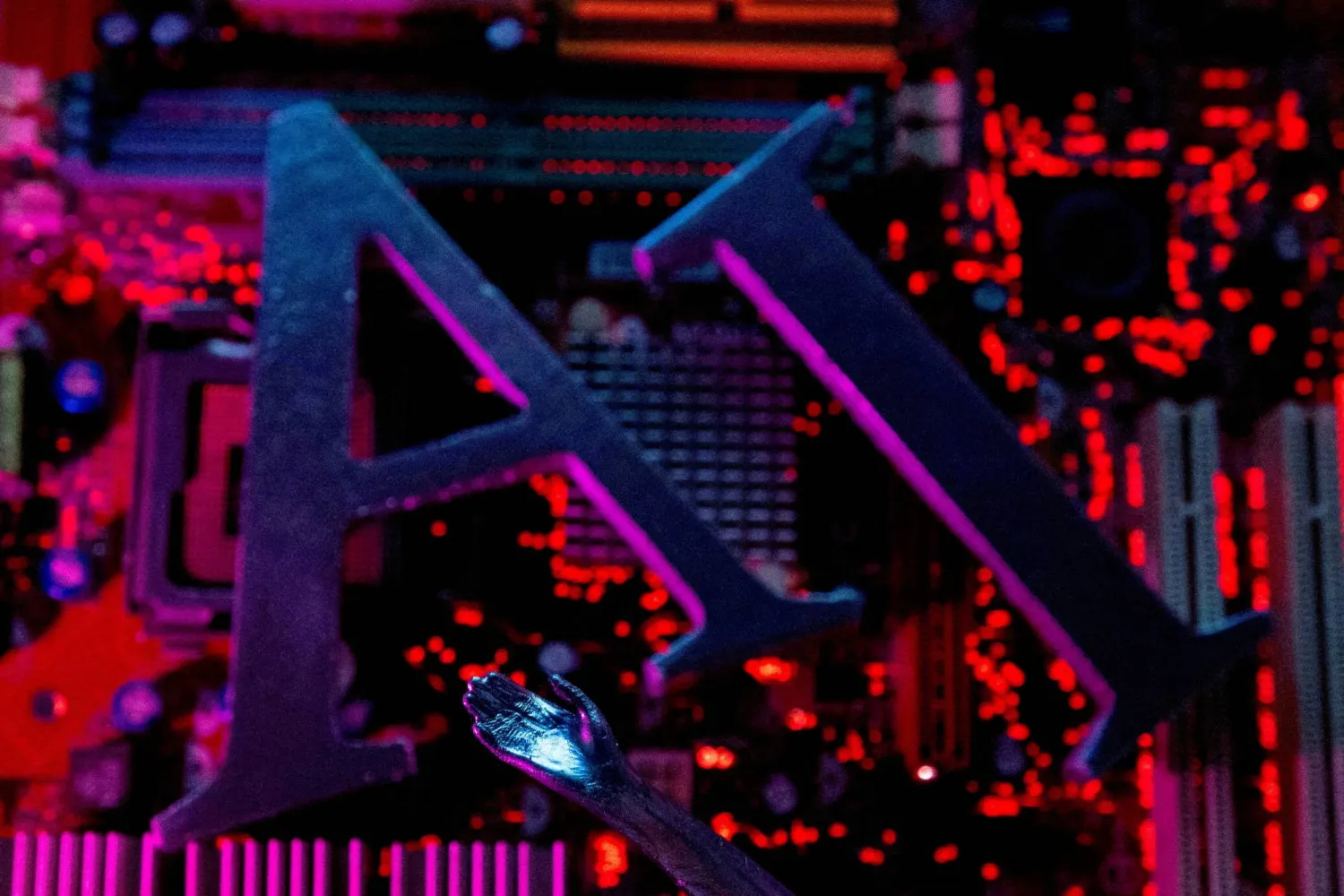
AI (Artificial Intelligence) letters and robot hand are placed on computer motherboard in this illustration created on June 23, 2023. (Reuters)
TT

Award-Winning Game Studio Chief Rules Out AI Art

AI (Artificial Intelligence) letters and robot hand are placed on computer motherboard in this illustration created on June 23, 2023. (Reuters)

The head of Larian Studios, the developers behind 2023's game of the year "Baldur's Gate 3", has vowed to ban any use of AI art in the outfit's upcoming project "Divinity".

The intervention by Swen Vincke follows repeated episodes of fan outrage over AI art in games in recent months -- with this year's game of the year winner "Clair Obscur: Expedition 33" stripped of its Indie Game Awards wins over alleged use of generative AI.

"There is not going to be any GenAI (generative AI) art in 'Divinity'," Vincke said Friday in an "Ask Me Anything" session on discussion site Reddit.

Fans had blasted Larian last month after Vincke told Bloomberg some generative AI was being used during development.

"We already said this doesn't mean the actual concept art is generated by AI, but we understand it created confusion," Vincke posted on Friday.

"To ensure there is no room for doubt, we've decided to refrain from using GenAI tools during concept art development," he added.

Vincke had said in December that the team's use of generative AI was "to explore references, just like we use Google and art books... at the very early ideation stages".

The new "Divinity" -- revealed to great fanfare at the December 11 Game Awards in Los Angeles -- is hotly awaited by gamers enthralled by the sprawling story and engaging characters of "Baldur's Gate 3", which has sold more than 20 million copies.

Despite his commitment on AI art, Vincke said that generative AI "can help" with other aspects of development, as studios "continuously try to improve the speed with which we can try things out".

He insisted that would benefit gamers through "a more focused development cycle, less waste, and ultimately, a higher-quality game".

Some executives believe generative AI's infusion into the industry will lead to a flowering of more ambitious titles that cost less to produce.

But they are running up against artists' fears that they will be pushed out of work and some gamers' concern that AI use will make for blander, less creative work.

French title "Expedition 33" saw its Indie Game Awards titles including "game of the year" withdrawn last year over some AI-generated art assets, which developers Sandfall Interactive insists were placeholders that it replaced in an update to the final game.



China Is Closing in on US Technology Lead Despite Constraints, AI Researchers Say

 Visitors look at robots on display at robotics company Unitree's first retail store in Beijing in January 9, 2026. (AFP)
Visitors look at robots on display at robotics company Unitree's first retail store in Beijing in January 9, 2026. (AFP)
TT

China Is Closing in on US Technology Lead Despite Constraints, AI Researchers Say

 Visitors look at robots on display at robotics company Unitree's first retail store in Beijing in January 9, 2026. (AFP)
Visitors look at robots on display at robotics company Unitree's first retail store in Beijing in January 9, 2026. (AFP)

China can narrow its technological gap with the US driven by growing risk-taking and innovation, though the lack of advanced chipmaking tools is hobbling the sector, the country's leading artificial intelligence researchers said on Saturday.

China's so-called "AI tiger" startups MiniMax and Zhipu AI had strong debuts on the Hong Kong Stock Exchange this week, reflecting growing confidence in the sector as Beijing fast-tracks AI and chip listings to bolster domestic alternatives to advanced US technology.

Yao Shunyu, a former senior researcher at ChatGPT maker OpenAI ‌who was named ‌technology giant Tencent's chief AI scientist in December, ‌said ⁠there was a ‌high likelihood of a Chinese firm becoming the world's leading AI company in the next three to five years but said the lack of advanced chipmaking machines was the main technical hurdle.

"Currently, we have a significant advantage in electricity and infrastructure. The main bottlenecks are production capacity, including lithography machines, and the software ecosystem," Yao said at an AI conference in Beijing.

China has completed a working prototype of an extreme-ultraviolet lithography ⁠machine potentially capable of producing cutting-edge semiconductor chips that rival the West's, Reuters reported last month. However, the ‌machine has not yet produced working chips and may ‍not do so until 2030, people with ‍knowledge of the matter told Reuters.

MIND THE INVESTMENT GAP

Yao and other ‍Chinese industry leaders at the Beijing conference on Saturday also acknowledged that the US maintains an advantage in computing power due to its hefty investments in infrastructure.

"The US computer infrastructure is likely one to two orders of magnitude larger than ours. But I see that whether it's OpenAI or other platforms, they're investing heavily in next-generation research," said Lin Junyang, technical lead for Alibaba's flagship Qwen large language model.

"We, ⁠on the other hand, are relatively strapped for cash; delivery alone likely consumes the majority of our computer infrastructure," Lin said during a panel discussion at the AGI-Next Frontier Summit held by the Beijing Key Laboratory of Foundational Models at Tsinghua University.

Lin said China's limited resources have spurred its researchers to be innovative, particularly through algorithm-hardware co-design, which enables AI firms to run large models on smaller, inexpensive hardware.

Tang Jie, founder of Zhipu AI which raised HK$4.35 billion in its IPO, also highlighted the willingness of younger Chinese AI entrepreneurs to embrace high-risk ventures - a trait traditionally associated with Silicon Valley - as a positive development.

"I think if we can improve this environment, ‌allowing more time for these risk-taking, intelligent individuals to engage in innovative endeavors ... this is something our government and the country can help improve," said Tang.


Brew, Smell, and Serve: AI Steals the Show at CES 2026

German group Bosch presented its fully automated 800 Series coffee machine (sold from $1,700) that can be synchronized with Amazon's Alexa voice assistant. Thomas URBAIN / AFP
TT

Brew, Smell, and Serve: AI Steals the Show at CES 2026

German group Bosch presented its fully automated 800 Series coffee machine (sold from $1,700) that can be synchronized with Amazon's Alexa voice assistant. Thomas URBAIN / AFP

AI took over CES 2026, powering coffee machines to brew the perfect espresso, a device to create your perfect scent, and ball-hitting tennis robots that make you forget it's human against machine.

Alexa, make me an espresso

German group Bosch presented a new feature for its fully automated 800 Series coffee machine (sold from $1,700) that can be synchronized with Amazon's Alexa voice assistant, said AFP.

After a short night's sleep, users can order a double espresso with voice commands only, and the coffee maker will deliver. Some 35 different espresso options are available.

"We're one of the first manufacturers to really lean in with AI," explained Andrew de Lara, spokesperson for Bosch.

The century-old company, positioned at the high end of the market in the United States, wants to gradually bring AI into the kitchen, notably through its Home Connect mobile app, which already allows users to control several appliances remotely.

Scent of AI

South Korean company DigitalScent has developed a machine, already available in some airports, that creates a personalized fragrance based on your mood and preferences.

Once you have picked your preferences, it releases a scent that gives you an idea of the final result. You can then make adjustments before making your final decision.

Once you have placed your order, the machine uses AI to produce a virtually unique fragrance in a matter of seconds, choosing from a range of over 1,150 combinations.

The fragrance is contained in a small, portable vial, costing $3 to $4, according to a spokesperson.

Game, set, AI

Several start-ups unveiled new-generation ball machines powered by artificial intelligence.

While Singapore-based Sharpa already offers a convincing humanoid table tennis robot with a reaction time of just two hundredths of a second, there is no equivalent on the market for tennis.

A few days ago, China's UBTech posted a video online of its Walker S2 robot playing rallies with a human, but at a slow speed and without any real movement.

UBTech's robots are designed for industrial use rather than tennis courts and, in all likelihood, the video was produced solely to demonstrate the agility of the Walker S2 to attract business customers.

While we wait for the humanoid robot that can volley at the net, another Chinese company, Tenniix, is marketing a robot that sends balls at speeds of up to 75 miles per hour (120.7 kilometers per hour).

It has 10 different shots, some with spin, and even a lob that reaches eight meters high.

The basic version, which can hold up to 100 balls, will set you back $699, but the most complete version, at $1,600, includes cameras and wheels that allow it to move around.

The fast-moving machine uses AI to analyze the trajectory of your cross-court forehand and fires off a ball from about where a real-life return shot would most likely come, giving the player the impression of a real rally.

"There's a real rhythm," says Run Kai Huang, spokesperson for Tenniix, "as if you were playing with a real person."


Lenovo Unveils AI Agent to Bridge PCs, Phones and Wearables at CES

Attendees gather for the annual Consumer Electronics Show (CES) in Las Vegas, Nevada, on January 6, 2026. (AFP)
TT

Lenovo Unveils AI Agent to Bridge PCs, Phones and Wearables at CES

Attendees gather for the annual Consumer Electronics Show (CES) in Las Vegas, Nevada, on January 6, 2026. (AFP)

Lenovo, the world's top PC maker, unveiled its own AI assistant Tuesday at the CES tech show in Las Vegas, promising a tool that follows users seamlessly across laptops, smartphones and connected devices.

The Beijing-based company commanded 28 percent of global PC market share in the third quarter of 2025, ahead of rivals HP at 21.5 percent and Dell at 14.5 percent, according to US research firm Gartner.

Lenovo's new artificial intelligence agent, dubbed Qira, is designed as an autonomous interface capable of performing tasks rather than simply generating content on demand, a move Lenovo hopes will showcase the breadth of its product portfolio.

Unlike rivals focused on single categories, Lenovo was the only major manufacturer whose offering spanned laptops, tablets and smartphones -- under its Motorola brand, acquired in 2014 -- as well as servers and even supercomputers.

The company also unveiled prototypes of connected glasses and an AI-powered pendant, still in testing, that captures "important moments" with user consent by recording conversations, said Motorola's Angelina Gomez.

Codenamed the AI Perceptive Companion, the pendant features a microphone and camera and "sees what you see and hears what your hear," Lenovo vice president Luca Rossi told reporters.

An interaction with Qira can start via the pendant, continue on a smartphone and end on a laptop, with the agent retaining user context across devices.

It can summarize the highlights of a user's day, draft and send emails, or even select photos from archives to post on social media.

Lenovo stressed it is not positioning Qira as a rival to Microsoft's Copilot and announced the integration of Copilot into Motorola smartphones.

For major hardware makers, the challenge now is proving the utility of generative AI in everyday applications rather than simply flaunting cutting-edge tech.

Amid lingering geopolitical tensions with Washington, Lenovo was the only Chinese firm to take center stage at CES, choosing Las Vegas's futuristic Sphere venue for its showcase.

Executives emphasized the company's global footprint, with most revenue generated outside China and several top managers from overseas.