


How the US Could Take Over Greenland and the Potential Challenges

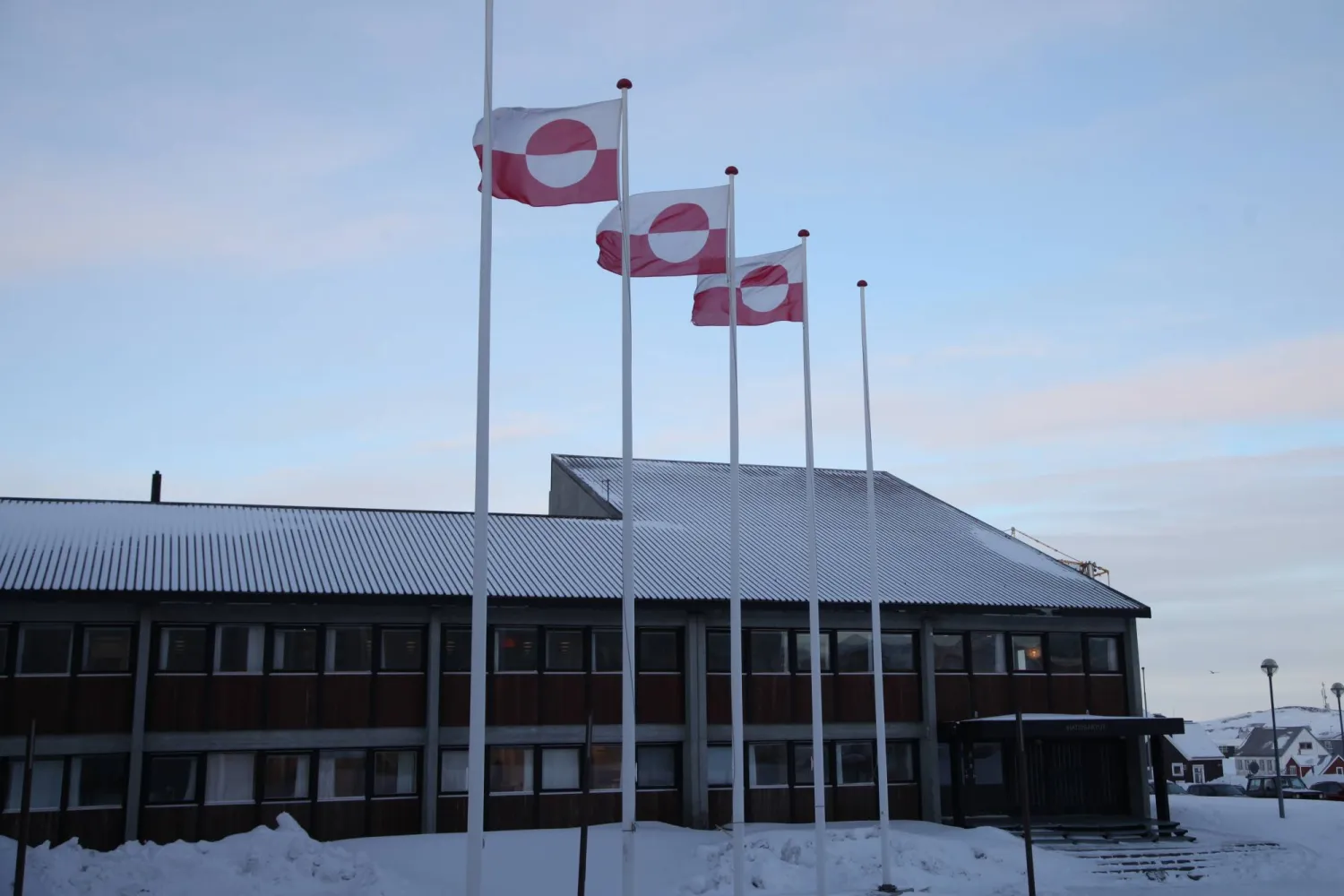
05 February 2025, Greenland, Nuuk: Greenlandic flags fly in front of the Inatsisartut parliament in the capital Nuuk. (dpa)
TT

How the US Could Take Over Greenland and the Potential Challenges

05 February 2025, Greenland, Nuuk: Greenlandic flags fly in front of the Inatsisartut parliament in the capital Nuuk. (dpa)

US President Donald Trump wants to own Greenland. He has repeatedly said the United States must take control of the strategically located and mineral-rich island, which is a semiautonomous region that's part of NATO ally Denmark.

Officials from Denmark, Greenland and the United States met Thursday in Washington and will meet again next week to discuss a renewed push by the White House, which is considering a range of options, including using military force, to acquire the island.

Trump said Friday he is going to do “something on Greenland, whether they like it or not.”

If it's not done “the easy way, we're going to do it the hard way," he said without elaborating what that could entail. In an interview Thursday, he told The New York Times that he wants to own Greenland because “ownership gives you things and elements that you can’t get from just signing a document.”

Danish Prime Minister Mette Frederiksen has warned that an American takeover of Greenland would mark the end of NATO, and Greenlanders say they don't want to become part of the US.

This is a look at some of the ways the US could take control of Greenland and the potential challenges.

Military action could alter global relations

Trump and his officials have indicated they want to control Greenland to enhance American security and explore business and mining deals. But Imran Bayoumi, an associate director at the Atlantic Council’s Scowcroft Center for Strategy and Security, said the sudden focus on Greenland is also the result of decades of neglect by several US presidents towards Washington's position in the Arctic.

The current fixation is partly down to “the realization we need to increase our presence in the Arctic, and we don’t yet have the right strategy or vision to do so,” he said.

If the US took control of Greenland by force, it would plunge NATO into a crisis, possibly an existential one.

While Greenland is the largest island in the world, it has a population of around 57,000 and doesn't have its own military. Defense is provided by Denmark, whose military is dwarfed by that of the US.

It's unclear how the remaining members of NATO would respond if the US decided to forcibly take control of the island or if they would come to Denmark's aid.

“If the United States chooses to attack another NATO country militarily, then everything stops,” Frederiksen has said.

Trump said he needs control of the island to guarantee American security, citing the threat from Russian and Chinese ships in the region, but “it's not true” said Lin Mortensgaard, an expert on the international politics of the Arctic at the Danish Institute for International Studies, or DIIS.

While there are probably Russian submarines — as there are across the Arctic region — there are no surface vessels, Mortensgaard said. China has research vessels in the Central Arctic Ocean, and while the Chinese and Russian militaries have done joint military exercises in the Arctic, they have taken place closer to Alaska, she said.

Bayoumi, of the Atlantic Council, said he doubted Trump would take control of Greenland by force because it’s unpopular with both Democratic and Republican lawmakers, and would likely “fundamentally alter” US relationships with allies worldwide.

The US already has access to Greenland under a 1951 defense agreement, and Denmark and Greenland would be “quite happy” to accommodate a beefed-up American military presence, Mortensgaard said.

For that reason, “blowing up the NATO alliance” for something Trump has already, doesn’t make sense, said Ulrik Pram Gad, an expert on Greenland at DIIS.

Bilateral agreements may assist effort

US Secretary of State Marco Rubio told a select group of US lawmakers this week that it was the Republican administration’s intention to eventually purchase Greenland, as opposed to using military force. Danish and Greenlandic officials have previously said the island isn't for sale.

It's not clear how much buying the island could cost, or if the US would be buying it from Denmark or Greenland.

Washington also could boost its military presence in Greenland “through cooperation and diplomacy,” without taking it over, Bayoumi said.

One option could be for the US to get a veto over security decisions made by the Greenlandic government, as it has in islands in the Pacific Ocean, Gad said.

Palau, Micronesia and the Marshall Islands have a Compact of Free Association, or COFA, with the US.

That would give Washington the right to operate military bases and make decisions about the islands’ security in exchange for US security guarantees and around $7 billion of yearly economic assistance, according to the Congressional Research Service.

It's not clear how much that would improve upon Washington's current security strategy. The US already operates the remote Pituffik Space Base in northwestern Greenland and can bring as many troops as it wants under existing agreements.

Influence operations expected to fail

Greenlandic politician Aaja Chemnitz told The Associated Press that Greenlanders want more rights, including independence, but don't want to become part of the US.

Gad suggested influence operations to persuade Greenlanders to join the US would likely fail. He said that is because the community on the island is small and the language is “inaccessible.”

Danish Foreign Minister Lars Løkke Rasmussen summoned the top US official in Denmark in August to complain that “foreign actors” were seeking to influence the country’s future. Danish media reported that at least three people with connections to Trump carried out covert influence operations in Greenland.

Even if the US managed to take control of Greenland, it would likely come with a large bill, Gad said. That’s because Greenlanders currently have Danish citizenship and access to the Danish welfare system, including free health care and schooling.

To match that, “Trump would have to build a welfare state for Greenlanders that he doesn’t want for his own citizens,” Gad said.

Disagreement unlikely to be resolved

Since 1945, the American military presence in Greenland has decreased from thousands of soldiers over 17 bases and installations to 200 at the remote Pituffik Space Base in the northwest of the island, Rasmussen said last year. The base supports missile warning, missile defense and space surveillance operations for the US and NATO.

US Vice President JD Vance told Fox News on Thursday that Denmark has neglected its missile defense obligations in Greenland, but Mortensgaard said that it makes “little sense to criticize Denmark,” because the main reason why the US operates the Pituffik base in the north of the island is to provide early detection of missiles.

The best outcome for Denmark would be to update the defense agreement, which allows the US to have a military presence on the island and have Trump sign it with a “gold-plated signature,” Gad said.

But he suggested that's unlikely because Greenland is “handy” to the US president.

When Trump wants to change the news agenda — including distracting from domestic political problems — “he can just say the word ‘Greenland’ and this starts all over again,” Gad said.



A Son of Iran’s Late Supreme Leader Is a Possible Candidate to Replace His Father as War Rages

Mojtaba Khamenei, the son of Iranian Supreme Leader Ali Khamenei, center, attends the annual Quds, or Jerusalem Day rally in Tehran, Iran, on May 31, 2019. (AP)
TT

A Son of Iran’s Late Supreme Leader Is a Possible Candidate to Replace His Father as War Rages

Mojtaba Khamenei, the son of Iranian Supreme Leader Ali Khamenei, center, attends the annual Quds, or Jerusalem Day rally in Tehran, Iran, on May 31, 2019. (AP)

Mojtaba Khamenei, a son of Iran's late Supreme Leader Ali Khamenei has long been considered a contender to the post of the country's next paramount ruler — even before an Israeli strike killed his father at the start of the war last week and despite the fact he's has never been elected or appointed to a government position.

A secretive figure within the Islamic Republic, Mojtaba Khamenei has not been seen publicly since Saturday, when the Israeli airstrike targeting the supreme leader's offices killed his 86-year-old father. Also killed were the younger Khamenei's wife, Zahra Haddad Adel, who came from a family long associated with the country's theocracy.

Khamenei is believed to still be alive and has likely has gone into hiding as American and Israeli airstrikes continue to pound Iran, though state-run Iranian media have not reported on his whereabouts.

Profile of Khamenei's son rises after airstrike

Mojtaba Khamenei's name continues to circulate as a possible candidate to replace his father, something that had been criticized in the past as potentially creating a theocratic version of Iran's former hereditary monarchy.

But now with his father and wife considered by hard-liners as martyrs in the war against America and Israel, Khamenei's stock likely has risen with the aging clerics of the 88-seat Assembly of Experts who will select the country's next supreme leader.

Whoever becomes the leader will gain control of an Iranian military now at war and a stockpile of highly enriched uranium that could be used to build a nuclear weapon — should he choose to decree it.

Khamenei had occupied a similar role to that of Ahmad Khomeini, a son of Iran's first Supreme Leader Khomeini — "a combination of aide-de-camp, confidant, gatekeeper and power broker,” according to United Against Nuclear Iran, a US-based pressure group.

Born into dissent

Born in 1969 in the city of Mashhad, some 10 years before the 1979 revolution that would sweep Iran, Khamenei grew up as his father agitated against Shah Mohammad Reza Pahlavi of Iran.

An official biography on Ali Khamenei's life recounts one moment when the shah's secret police, the SAVAK, broke into their home and beat the cleric. Woken up after, Mojtaba and the rest of Khamenei's children were told their father was going on vacation.

“But I told them, ‘There is no need to lie.’ I told them the truth,” the elder Khamenei was quoted as saying.

After the fall of the shah, Khamenei's family moved to Tehran, Iran's capital. Khamenei would go on to fight in the Iran-Iraq war with the Habib ibn Mazahir Battalion, a division of Iran's paramilitary Revolutionary Guard that would see several of its members ascend to powerful intelligence positions within the force, likely with the backing of the Khamenei family.

His father became supreme leader in 1989 and soon Mojtaba Khamenei and his family had access to the billions of dollars and business assets spread across Iran's many bonyads, or foundations funded from state industries and other wealth once held by the shah.

Power rises with his father's

His own power rose alongside his father's, working within his offices in downtown Tehran. US diplomatic cables published by WikiLeaks in the late 2000s began referring to the younger Khamenei as “the power behind the robes.” One recounted an allegation that Khamenei actually tapped his own father's phone, served as his “principal gatekeeper” and had been forming his own power base within the country.

Khamenei “is widely viewed within the regime as a capable and forceful leader and manager who may someday succeed to at least a share of national leadership; his father may also see him in that light,” a 2008 cable read, also noting his lack of theological qualifications and age.

“Mojtaba is, however, due to his skills, wealth, and unmatched alliances, reportedly seen by a number of regime insiders as a plausible candidate for shared leadership of Iran upon his father’s demise, whether that demise is soon or years in the future,” it said.

Khamenei has worked closely with Iran's paramilitary Revolutionary Guard, both with commanders of its expeditionary Quds Force and its all-volunteer Basij that violently suppressed nationwide protests in January, the US Treasury has said.

The United States sanctioned him in 2019 during the first term of USPresident Donald Trump over working to “advance his father’s destabilizing regional ambitions and oppressive domestic objectives.”

That includes allegations that Khamenei from behind the scenes supported the election of hard-line President Mahmoud Ahmadinejad in 2005 and his disputed re-election in 2009 that sparked the Green Movement protests.

Mahdi Karroubi, who was a presidential candidate in 2005 and 2009, denounced Khamenei as “a master's son” and alleged he interfered in both votes. His father reportedly at the time said Khamenei was “a master himself, not a master’s son."

Powers of supreme leader at stake

There has been only one other transfer of power in the office of supreme leader of Iran, the paramount decision-maker since the country’s 1979 revolution. Khomeini died at age 86 after being the figurehead of the revolution and leading Iran through its eight-year war with Iraq.

Now the new leader will come on board after the 12-day war with Israel and as a US-Israeli war with Iran is seeking to eliminate Iran's nuclear threat and military power, hoping also the Iranian people will rise up against the Iranian theocracy.

The supreme leader is at the heart of Iran’s complex power-sharing theocracy and has final say over all matters of state. He also serves as the commander-in-chief of the country’s military and the Guard, a paramilitary force that the United States designated a terrorist organization in 2019, and which his father empowered during his rule.

The Guard, which has led the self-described “Axis of Resistance,” a series of militant groups and allies across the Middle East meant to counter the US and Israel, also has extensive wealth and holdings in Iran. It also controls the country's ballistic missile arsenal.


Iran's 'Axis of Resistance' under Threat after US-Israeli War

Members of Iraq's pro-Iran paramilitary group Kataib Hezbollah march with the group's banners in a funeral for slain fighters killed in a US-Israeli airstrike on their headquarters in al-Qaim near the border with Syria, during a ceremony in Baghdad on March 2, 2026. (AFP)
TT

Iran's 'Axis of Resistance' under Threat after US-Israeli War

Members of Iraq's pro-Iran paramilitary group Kataib Hezbollah march with the group's banners in a funeral for slain fighters killed in a US-Israeli airstrike on their headquarters in al-Qaim near the border with Syria, during a ceremony in Baghdad on March 2, 2026. (AFP)

Iran once boasted that it controlled four Arab capitals: Baghdad, Damascus, Beirut and Sanaa in an alliance dubbed the "Axis of Resistance".

But the network -- long used as a regional force against Israel -- has been weakened since the Gaza war and now risks collapse, upending the regional balance, analysts said.

"The axis of resistance is over," said Atlantic Council researcher Nicholas Blanford.

Two days after Hamas launched its October 7, 2023 attack on Israel, Prime Minister Benjamin Netanyahu said his country's response would "change the Middle East".

Backed by Israel's powerful ally, the United States, the Israeli leader did not just intend to defeat the Iran-backed Palestinian group, but the entire axis.

The weakening of Lebanon's Hezbollah after its 2024 war with Israel and the fall of Syrian ruler Bashar al-Assad paved the way for Israel to aim directly at Iran.

Since Saturday, the country has been the target of a major US-Israeli offensive, which even killed Iran's supreme leader Ali Khamenei.

Most of the axis's members like Hezbollah, Yemen's Houthis or Iraqi Shiite groups are "trying to understand how to survive", Renad Mansour, senior research fellow at the Chatham House international affairs think-tank, told AFP.

- 'Defensive approach' -

Since deciding to enter the war by launching rockets at Israel on Monday, Hezbollah brought a major Israeli retaliation, which saw bombings across Lebanon and an Israeli ground incursion to create a buffer zone.

"Naim Qassem doesn't want to get involved in this fight," Blanford, who wrote a book on Hezbollah, said, referring to the group's chief.

However, the analyst said Tehran may have forced Qassem to intervene.

Iraq, a longtime battlefield between Washington and Tehran, saw Iran-backed groups claim dozens of drone attacks on US bases, though many were downed.

To Mansour, these groups lack "the necessary military capabilities to inflict significant damage" while the most prominent ones are now "intertwined in the Iraqi state".

The Houthis in Yemen have so far stayed away from the conflict.

"The Houthis are in a calculated holding pattern, or perhaps a defensive approach," said Ahmed Nagi, senior analyst at the International Crisis Group.

However, Nagi believes that while the axis "is facing an existential threat, that does not necessarily mean it will disintegrate".

"The network operates on more than a military level; its political, social and religious ties remain deeply rooted among its groups and are unlikely to unravel because of battlefield setbacks alone."

The regional upheavals will depend on the outcome of this war, particularly the collapse or survival of the Iranian regime.


Netanyahu’s Political Future at Stake with Iran War, Say Experts

03 March 2020, Israel, Tel Aviv: Israeli Prime Minister Benjamin Netanyahu delivers an address. (dpa)
TT

Netanyahu’s Political Future at Stake with Iran War, Say Experts

03 March 2020, Israel, Tel Aviv: Israeli Prime Minister Benjamin Netanyahu delivers an address. (dpa)

With elections approaching in Israel, the war with Iran has handed Prime Minister Benjamin Netanyahu an opportunity to restore an image deeply scarred by Hamas's October 7, 2023 attack, experts say.

But any political dividend would depend on how the conflict unfolds and how long it lasts, they said according to AFP.

A day after Iran's supreme leader Ali Khamenei was killed in a wave of US-Israeli strikes, Netanyahu said that his close ties with Washington had enabled Israel to "do what I have long aspired to do for 40 years: to strike the terrorist regime decisively".

The Gaza war, sparked by Hamas's unprecedented attack on Israel on October 7, 2023, eroded Netanyahu's popularity.

Critics have accused him of seeking to evade responsibility for the authorities' failure to prevent the deadliest day in Israel's history.

At 76, the leader of the right-wing Likud party is Israel's longest-serving prime minister, with more than 18 cumulative years in office across multiple stints.

Known for his political resilience, Netanyahu has been without a parliamentary majority since the summer, amid a crisis with his ultra-Orthodox religious allies.

He is also standing trial in a long-running corruption case and has sought a presidential pardon, with US President Donald Trump repeatedly pressuring President Isaac Herzog to grant one.

- 'Total victory' -

Elections must be held by October 27 at the latest.

Netanyahu will call early elections, says Emmanuel Navon, a political analyst at Tel Aviv University.

"It's obvious. He won't wait until October given the commemoration of the October 7 anniversary," Navon said.

"If Netanyahu was at rock bottom after the Hamas attack, he has since gradually turned the tide," he added, citing heavy blows dealt by the Israeli military to Hamas, Hezbollah and Iran since the start of the Gaza war.

A Likud party led by Netanyahu would emerge ahead in elections held today, opinion polls suggest.

That would likely see him tasked with forming the next government, though he would still lack a majority with his current allies.

A victory over Iran could change that calculus, experts say.

"This offensive undeniably reinforces the image Netanyahu seeks to cultivate, the one associated with his 'total victory' slogan," independent geopolitical analyst Michael Horowitz told AFP.

"Netanyahu wants to show that this is not a campaign slogan but a reality. It is his national agenda and his electoral strategy," he added.

- 'Iran remains Iran' -

Raviv Druker, a prominent journalist on Channel 13 television, argued that Netanyahu "will try to convince people that the victory is total even if that is an illusion," noting that "Hamas still runs Gaza, and Iran remains Iran even after Saturday's strike".

On the popular news website Walla, journalist Ouriel Deskal went further, suggesting Netanyahu may have chosen the timing of the hostilities to automatically delay -- under a state of emergency -- the March 30 deadline for passing a budget for which he has struggled to secure a majority.

Without a budget, the government would fall on April 1 and elections would be called.

In that scenario, Netanyahu would enter the campaign from a position of weakness.

By contrast "if this war against Iran is a success for Israel, it will be a political victory for Netanyahu," Navon said.

But should the war drag on, the picture could shift dramatically, Horowitz warned.

"Public tolerance for a long war with heavy casualties, combined with a high cost of living, remains extremely low," he said.

During the war last June, Iranian missiles killed 30 people in Israel. Since Saturday, 10 people have been killed in Iran's retaliatory strikes.

"Israel's victories are primarily attributed to the army and to civilian resilience, which enabled the country to wage the longest war in its history," Horowitz noted.

"The army's popularity is rising, not necessarily Netanyahu's."