


As Protests Rage, Iran Pulls the Plug on Contact with the World

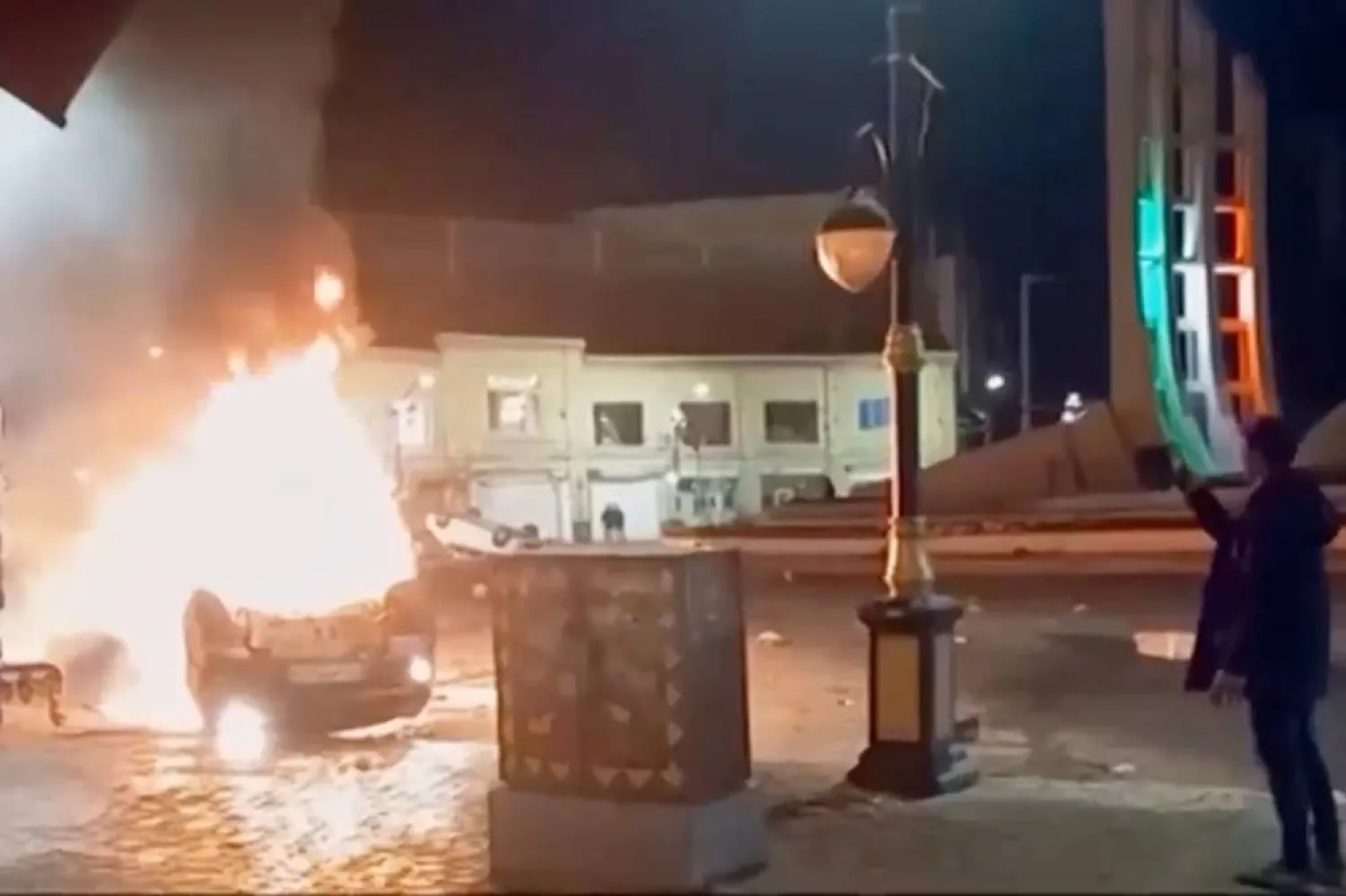
 This frame grab from a video released Friday, Jan. 9, 2026, by Iranian state television shows a man holding a device to document burning vehicles during a night of mass protests in Zanjan, Iran. (Iranian state TV via AP)
This frame grab from a video released Friday, Jan. 9, 2026, by Iranian state television shows a man holding a device to document burning vehicles during a night of mass protests in Zanjan, Iran. (Iranian state TV via AP)
TT

As Protests Rage, Iran Pulls the Plug on Contact with the World

 This frame grab from a video released Friday, Jan. 9, 2026, by Iranian state television shows a man holding a device to document burning vehicles during a night of mass protests in Zanjan, Iran. (Iranian state TV via AP)
This frame grab from a video released Friday, Jan. 9, 2026, by Iranian state television shows a man holding a device to document burning vehicles during a night of mass protests in Zanjan, Iran. (Iranian state TV via AP)

Just after 8 p.m. Thursday, Iran's theocracy pulled the plug and disconnected the country's 85 million people from the rest of the world.

Following a playbook used both in demonstrations and in war, Iran severed the internet connections and telephone lines that connect its people to the vast diaspora in the United States, Europe and elsewhere. Until now, even while facing strict sanctions over the country's nuclear program, Iranians still could access mobile phone apps and even websites blocked by the theocracy, using virtual private networks to circumvent restrictions.

Thursday's decision sharply limits people from sharing images and witness accounts of the nationwide protests over Iran's ailing economy that have grown to pose the biggest challenge to the government in years. It also could provide cover for a violent crackdown after the Trump administration warned Iran's government about consequences for further deaths among demonstrators.

As the country effectively goes dark, loved ones abroad are frantic for any scrap of news, especially as Iran’s attorney general warned on Saturday that anyone taking part in protests will be considered an “enemy of God,” a death-penalty charge

“You can’t understand our feelings. My brothers, my cousins, they will go on the street. You can’t imagine the anxiety of the Iranian diaspora,” said Azam Jangravi, a cybersecurity expert in Toronto who opposes Iran's government. “I couldn’t work yesterday. I had meetings but I postponed them because I couldn’t focus. I was thinking of my family and friends.”

Her voice cracked as she added: “A lot of people are being killing and injured by Iran, and we don’t know who.”

Even Starlink is likely being jammed

This is the third time Iran has shut down the internet from the outside world. The first was in 2019, when demonstrators angry about a spike in government-subsidized gasoline prices took to the streets. Over 300 people reportedly were killed.

Then came the protests over the 2022 death of Mahsa Amini following her arrest by the country’s morality police over allegedly not wearing her hijab, or headscarf, to the liking of authorities. A monthslong crackdown killed more than 500 people.

While the connectivity offered by Starlink played a role in the Amini demonstrations, the deployment of its receivers is now far greater in Iran. That's despite the government never authorizing Starlink to function, making the service illegal to possess and use.

A year ago, an Iranian official estimated tens of thousands of Starlink receivers in the country, a figure that Los Angeles-based internet freedom activist Mehdi Yahyanejad said sounded right.

While many receivers likely are in the hands of business people and others wanting to stay in touch with the outside world for their livelihoods, Yahyanejad said some are now being used to share videos, photos and other reporting on the protests.

“In this case, because all those things have been disrupted, Starlink is playing the key for getting all these videos out,” Yahyanejad said.

However, Starlink receivers are facing challenges. Since its 12-day war with Israel last June, Iran has been disrupting GPS signals, likely in a bid to make drones less effective. Starlink receivers use GPS signals to position themselves to connect to a constellation of low-orbit satellites.

Amir Rashidi, director of digital rights and security at the Miaan Group and an expert on Iran, said that since Thursday he had seen about a 30% loss in packets being sent by Starlink devices — basically units of data that transmit across the internet. In some areas of Iran, Rashidi said there had been an 80% loss in packets.

“I believe the Iranian government is doing something beyond GPS jamming, like in Ukraine where Russia tried to jam Starlink,” Rashidi said. He suggested Iran may be using a mobile jammer, like it did in previous decades to disrupt satellite television receivers.

The International Telecommunication Union, a United Nations agency, has called on Iran to stop jamming in the past.

Meanwhile, Iran has been advocating at the ITU for Starlink service to the country to be stopped.

Help ‘needs to come soon’

It appears that the majority of information coming out of Iran since Thursday night is being transmitted via Starlink, which is now illegal. That carries dangers for those possessing the devices.

“It’s really hard to use it because if they arrest a person, they can execute the person and say this person is working for Israel or the United States,” Jangravi said.

Not using it, however, means the world knows even less about what's happening inside Iran at a pivotal moment.

“This sort of nonviolent protest is not sustainable when the violence (by security forces) is so extreme,” Yahyanejad said. “Unless something changes in the next two or three days, these protests can die down, too. If there’s any help, it needs to come soon.”



Police Warn Sydney Protesters ahead of Israeli President’s Visit

 01 February 2026, Australia, Sydney: A protester holds a poster during a Free Palestine rally protesting the invitation of Isaac Herzog to Australia at the State Library of Victoria in Melbourne. (Jay Kogler/AAP/dpa)
01 February 2026, Australia, Sydney: A protester holds a poster during a Free Palestine rally protesting the invitation of Isaac Herzog to Australia at the State Library of Victoria in Melbourne. (Jay Kogler/AAP/dpa)
TT

Police Warn Sydney Protesters ahead of Israeli President’s Visit

 01 February 2026, Australia, Sydney: A protester holds a poster during a Free Palestine rally protesting the invitation of Isaac Herzog to Australia at the State Library of Victoria in Melbourne. (Jay Kogler/AAP/dpa)
01 February 2026, Australia, Sydney: A protester holds a poster during a Free Palestine rally protesting the invitation of Isaac Herzog to Australia at the State Library of Victoria in Melbourne. (Jay Kogler/AAP/dpa)

Australian authorities warned protesters to avoid violence in Sydney's streets when Israeli President Isaac Herzog visits on Monday to honor victims of the Bondi Beach mass shooting.

Police say they will deploy in large numbers for the Israeli head of state's visit following the December 14 attack on a Jewish Hanukkah celebration that killed 15 people.

"It's really important that there's no clashes or violence on the streets in Sydney," New South Wales Premier Chris Minns told reporters on Saturday.

"Our clear message is in an unambiguous way that we're hoping that people can remain calm and respectful during that presidential visit."

The state premier promised a "massive policing presence" in Sydney on Monday afternoon.

State police declared the Sydney visit to be a "major event", a designation that allows them to separate different groups to reduce the risk of confrontation.

Herzog has said he will "express solidarity and offer strength" to the Jewish community in Australia during his four-day visit, which starts Monday.

The trip has been welcomed by many Jewish Australians.

"His visit will lift the spirits of a pained community," said Alex Ryvchin, co-chief executive of the Executive Council of Australian Jewry, the community's peak body.

Pro-Palestinian activists have called for protests nationwide, however, including in parts of central Sydney where police have refused to authorize demonstrations under new powers granted after the Bondi Beach attack.

- 'Full immunity' -

Amnesty International Australia has also urged supporters to rally for an end to "genocide" against Palestinians, and urged Herzog be investigated for alleged war crimes.

High-profile Australian human rights lawyer Chris Sidoti -- a member of a UN-established inquiry into rights abuses in Israel and the Palestinian territories -- called this week for Herzog's invitation to be withdrawn, or for his arrest on arrival.

The UN's Independent International Commission of Inquiry found in 2025 that Herzog "incited the commission of genocide" by saying all Palestinians -- "an entire nation" -- were responsible for the Hamas attack on October 7, 2023.

Australia's federal police have ruled out an arrest, with senior officials telling lawmakers this week that they received legal advice Herzog had "full immunity" covering civil and criminal matters, including genocide.

Critics have accused Prime Minister Anthony Albanese's center-left government of moving too slowly to protect Jewish Australians ahead of the Bondi Beach shooting despite a rise in antisemitic attacks since 2023.

Alleged Bondi Beach gunman Sajid Akram, 50, was shot and killed by police during the attack.

An Indian national, he entered Australia on a visa in 1998.

His 24-year-old son Naveed, an Australian-born citizen who remains in prison, has been charged with terrorism and 15 murders.


Cuba to Protect Essential Services as US Moves to Cut Off Oil Supply

 People wait for transportation as Cubans brace for fuel scarcity measures after US tightens oil supply blockade, in Havana, Cuba, February 6, 2026. (Reuters)
People wait for transportation as Cubans brace for fuel scarcity measures after US tightens oil supply blockade, in Havana, Cuba, February 6, 2026. (Reuters)
TT

Cuba to Protect Essential Services as US Moves to Cut Off Oil Supply

 People wait for transportation as Cubans brace for fuel scarcity measures after US tightens oil supply blockade, in Havana, Cuba, February 6, 2026. (Reuters)
People wait for transportation as Cubans brace for fuel scarcity measures after US tightens oil supply blockade, in Havana, Cuba, February 6, 2026. (Reuters)

Cuba detailed a wide-ranging plan on Friday to protect essential services and ration fuel as the communist-run government dug in its heels in defiance of a US effort to cut off oil supply to the Caribbean island.

The rationing measures are the first to be announced since President Donald Trump threatened to slap tariffs on the US-bound products of any country exporting fuel to Cuba and suggested hard times ahead for Cubans already suffering severe shortages of food, fuel ‌and medicine.

Government ‌ministers said the measures would guarantee ‌fuel supply ⁠for key sectors, ‌including agricultural production, education, water supply, healthcare and defense.

Commerce Minister Oscar Perez-Oliva struck a defiant tone as he laid out details of the government plan.

"This is an opportunity and a challenge that we have no doubt we will overcome," Perez-Oliva told a television news program. "We are not going to collapse."

The government will supply fuel to the ⁠tourism and export sectors, including for the production of Cuba's world-famous cigars, to ensure ‌the foreign exchange necessary to fund other basic ‍programs, Perez-Oliva said, adding, "If we ‍don't have income, then we will not overcome this situation."

Domestic ‍and international air travel will not be immediately affected by the fuel rationing, although drivers will see cutbacks at the pump until supply normalizes, he said.

The government said it would protect ports and ensure fuel for domestic transportation in a bid to protect the island nation's import and export sectors.

Perez-Oliva also announced an ambitious ⁠plan to plant 200,000 hectares (500,000 acres) of rice to guarantee "an important part of our demand," but acknowledged fuel shortfalls would push the country to depend more on renewable energy for irrigation needs and animal-power for tilling fields.

Education Minister Naima Ariatne, appearing on the same program, said infant-care centers and primary schools would remain open and in person, but secondary schools and higher education would implement a hybrid system that would require more "flexibility" and vary by institution and region.

"As a priority, we want to leave (open) our primary schools," Ariatne said.

Top officials said ‌health care would also be prioritized, with special emphasis on emergency services, maternity wards and cancer programs.


Trump Signs Order Preparing for Tariffs on Iran’s Trade Partners

A man walks past a mural depicting the US Statue of Liberty with the torch-bearing arm broken, painted on the outer walls of the former US embassy, in Tehran on February 6, 2026. (AFP)
TT

Trump Signs Order Preparing for Tariffs on Iran’s Trade Partners

A man walks past a mural depicting the US Statue of Liberty with the torch-bearing arm broken, painted on the outer walls of the former US embassy, in Tehran on February 6, 2026. (AFP)

US President Donald Trump on Friday signed an executive order threatening tariffs on Iran's trade partners, after he pledged a further round of talks with Tehran next week.

The order, effective from Saturday, called for a fresh "imposition of tariffs" on countries still doing business with Iran.

It comes amid heightened tensions between Washington and Tehran, with an American naval group led by an aircraft carrier in Middle Eastern waters and indirect talks held on Tehran's nuclear program in Oman on Friday.

The levies "may be imposed on goods imported into the United States that are products of any country that directly or indirectly purchases, imports, or otherwise acquires any goods or services from Iran", the order said.

Trump issued a threat of 25 percent tariffs on any country trading with Iran last month.

This order establishes a process for his administration to impose tariffs on goods from those countries.

The rate is to be determined by Secretary of State Marco Rubio, although the order specifies that it could be "for example" 25 percent, the level first mentioned by the US president in mid-January.

Tariffs would affect trade with a number of countries including Russia, Germany, Türkiye and the United Arab Emirates.

More than a quarter of Iran's trade is with China, with $18 billion in imports and $14.5 billion in exports in 2024, according to World Trade Organization data.

The talks on Friday in Muscat, mediated by Oman, were the first between the two foes since the United States joined Israel's war with Iran in June with strikes on nuclear sites.

"We likewise had very good talks on Iran," Trump told reporters on board Air Force One en route to his Mar-a-Lago resort in Florida, adding, "we're going to meet again early next week."

Diplomatic relations between Iran and the US broke down with the 1979 revolution that brought the current government into power after hostages were taken at the US embassy in Tehran for 444 days.

Direct engagement has been rare in the decades since.

Iran remains under an internet blackout amid a harsh government crackdown on economic protests that began in December across the country.

The US-based Human Rights Activists News Agency (HRANA) said Friday it has confirmed 6,505 protesters were killed, as well as 214 members of the security forces and 61 bystanders.