


What to Know about the Protests Shaking Iran as Govt Shuts Down Internet and Phone Networks

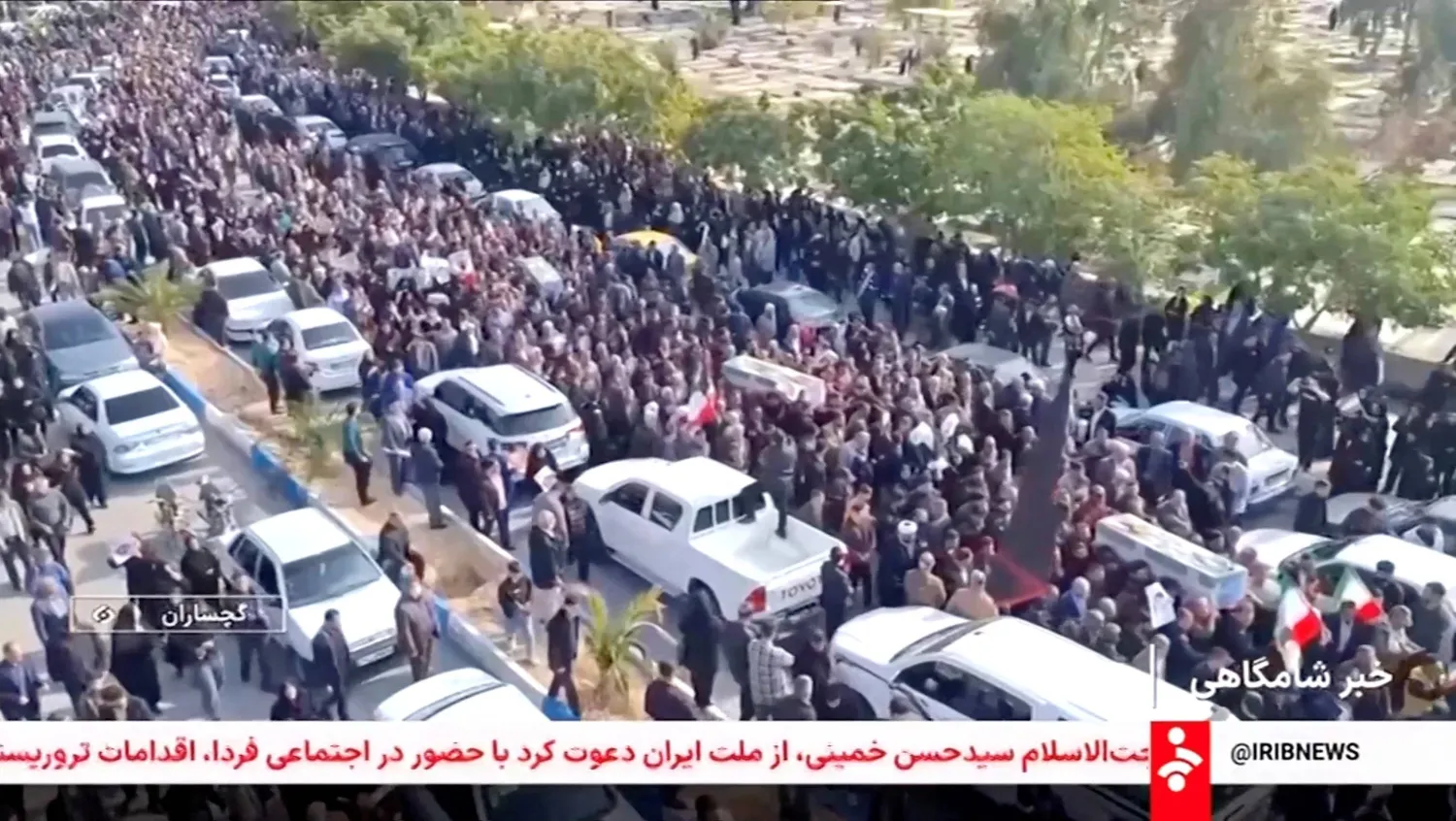
Mourners carry coffins during a funeral procession for members of security forces and civilians said to be killed in protests on Sunday, amid evolving anti-government unrest, in Tehran, Iran, in this screengrab from a video released on January 11, 2026.  IRIB/Handout via REUTERS
Mourners carry coffins during a funeral procession for members of security forces and civilians said to be killed in protests on Sunday, amid evolving anti-government unrest, in Tehran, Iran, in this screengrab from a video released on January 11, 2026. IRIB/Handout via REUTERS
TT

What to Know about the Protests Shaking Iran as Govt Shuts Down Internet and Phone Networks

Mourners carry coffins during a funeral procession for members of security forces and civilians said to be killed in protests on Sunday, amid evolving anti-government unrest, in Tehran, Iran, in this screengrab from a video released on January 11, 2026.  IRIB/Handout via REUTERS
Mourners carry coffins during a funeral procession for members of security forces and civilians said to be killed in protests on Sunday, amid evolving anti-government unrest, in Tehran, Iran, in this screengrab from a video released on January 11, 2026. IRIB/Handout via REUTERS

Nationwide protests in Iran sparked by the country’s ailing economy are putting new pressure on its theocracy as it has shut down the internet and telephone networks.

Tehran is still reeling from a 12-day war launched by Israel in June that saw the United States bomb nuclear sites in Iran. Economic pressure, which has intensified since September when the United Nations reimposed sanctions on the country over its atomic program, has sent Iran's rial currency into a free fall, now trading at over 1.4 million to $1.

Meanwhile, Iran's self-described “Axis of Resistance” — a coalition of countries and militant groups backed by Tehran — has been decimated since the start of the Israel-Hamas war in 2023.

A threat by US President Donald Trump warning Iran that if Tehran “violently kills peaceful protesters” the US “will come to their rescue," has taken on new meaning after American troops captured Venezuela's Nicolás Maduro, a longtime ally of Tehran.

“We're watching it very closely,” Trump has warned. “If they start killing people like they have in the past, I think they're going to get hit very hard by the United States.”

Here's what to know about the protests and the challenges facing Iran's government.

How widespread the protests are

More than 500 protests have taken place across all of Iran’s 31 provinces, the US-based Human Rights Activists News Agency reported early Monday. The death toll had reached at least 544, it said, with more than 10,600 arrests. The group relies on an activist network inside of Iran for its reporting and has been accurate in past unrest.

The Iranian government has not offered overall casualty figures for the demonstrations. The Associated Press has been unable to independently assess the toll, given that internet and international phone calls are now blocked in Iran.

Understanding the scale of the protests has been difficult. Iranian state media has provided little information about the demonstrations. Online videos offer only brief, shaky glimpses of people in the streets or the sound of gunfire. Journalists in general in Iran also face limits on reporting such as requiring permission to travel around the country, as well as the threat of harassment or arrest by authorities. The internet shutdown has further complicated the situation.

But the protests do not appear to be stopping, even after Supreme Leader Ali Khamenei said “rioters must be put in their place.”

Why the demonstrations started

The collapse of the rial has led to a widening economic crisis in Iran. Prices are up on meat, rice and other staples of the Iranian dinner table. The nation has been struggling with an annual inflation rate of some 40%.

In December, Iran introduced a new pricing tier for its nationally subsidized gasoline, raising the price of some of the world’s cheapest gas and further pressuring the population. Tehran may seek steeper price increases in the future, as the government now will review prices every three months.

Meanwhile, food prizes are expected to spike after Iran’s Central Bank in recent days ended a preferential, subsidized dollar-rial exchange rate for all products except medicine and wheat.

The protests began in late December with merchants in Tehran before spreading. While initially focused on economic issues, the demonstrations soon saw protesters chanting anti-government statements as well. Anger has been simmering over the years, particularly after the 2022 death of 22-year-old Mahsa Amini in police custody that triggered nationwide demonstrations.

Some have chanted in support of Iran's exiled Crown Prince Reza Pahlavi, who called for protests Thursday and Friday night.

Iran's alliances are weakened

Iran's “Axis of Resistance," which grew in prominence in the years after the 2003 US-led invasion and subsequent occupation of Iraq, is reeling.

Israel has crushed Hamas in the devastating war in the Gaza Strip. Hezbollah, the Shiite militant group in Lebanon, has seen its top leadership killed by Israel and has been struggling since. A lightning offensive in December 2024 overthrew Iran’s longtime stalwart ally and client in Syria, President Bashar Assad, after years of war there. Yemen's Iranian-backed Houthis also have been pounded by Israeli and US airstrikes.

China meanwhile has remained a major buyer of Iranian crude oil, but hasn't provided overt military support. Neither has Russia, which has relied on Iranian drones in its war on Ukraine.

The West worries about Iran’s nuclear program Iran has insisted for decades that its nuclear program is peaceful. However, its officials have increasingly threatened to pursue a nuclear weapon. Iran had been enriching uranium to near weapons-grade levels before the US attack in June, making it the only country in the world without a nuclear weapons program to do so.

Tehran also increasingly cut back its cooperation with the International Atomic Energy Agency, the UN's nuclear watchdog, as tensions increased over its nuclear program in recent years. The IAEA's director-general has warned Iran could build as many as 10 nuclear bombs, should it decide to weaponize its program.

US intelligence agencies have assessed that Iran has yet to begin a weapons program, but has “undertaken activities that better position it to produce a nuclear device, if it chooses to do so.”

Iran recently said it was no longer enriching uranium at any site in the country, trying to signal to the West that it remains open to potential negotiations over its atomic program to ease sanctions. But there's been no significant talks in the months since the June war.

Why relations between Iran and the US are so tense

Iran decades ago was one of the United States’ top allies in the Mideast under Shah Mohammad Reza Pahlavi, who purchased American military weapons and allowed CIA technicians to run secret listening posts monitoring the neighboring Soviet Union. The CIA fomented a 1953 coup that cemented the shah’s rule.

But in January 1979, the shah fled Iran as mass demonstrations swelled against his rule. Then came the Iranian Revolution led by Khomeini, which created Iran’s theocratic government.

Later that year, university students overran the US Embassy in Tehran, seeking the shah’s extradition and sparking the 444-day hostage crisis that saw diplomatic relations between Iran and the US severed.

During the Iran-Iraq war of the 1980s, the US backed Saddam Hussein. During that conflict, the US launched a one-day assault that crippled Iran at sea as part of the so-called “Tanker War,” and later shot down an Iranian commercial airliner that the US military said it mistook for a warplane.

Iran and the US have seesawed between enmity and grudging diplomacy in the years since. Relations peaked with the 2015 nuclear deal, which saw Iran greatly limit its program in exchange for the lifting of sanctions. But Trump unilaterally withdrew America from the accord in 2018, sparking tensions in the Mideast that intensified after Hamas' Oct. 7, 2023, attack on Israel.



Lebanon’s Latest Conflict Brings Rare Public Backlash Against Hezbollah as War Flares Again

Two women look at the sea as boxes of food prepared for Iftar during Ramadan lie on a bench along the Corniche, following an escalation between Hezbollah and Israel amid the US-Israeli conflict with Iran, in Beirut, Lebanon, March 10, 2026. (Reuters)
TT

Lebanon’s Latest Conflict Brings Rare Public Backlash Against Hezbollah as War Flares Again

Two women look at the sea as boxes of food prepared for Iftar during Ramadan lie on a bench along the Corniche, following an escalation between Hezbollah and Israel amid the US-Israeli conflict with Iran, in Beirut, Lebanon, March 10, 2026. (Reuters)

The Lebanese mother of two had just awakened to prepare the pre-dawn meal before another day of fasting during the holy month of Ramadan when Israeli warplanes began attacking southern Lebanon in retaliation for rockets and drones launched by Hezbollah.

The family quickly packed up and headed toward Beirut, seeking safety from another deadly war between Israel and Hezbollah. With tens of thousands of others fleeing on that March 2 day, the usually one-hour trip from the southern city of Nabatiyeh took 15 hours.

“I am against giving pretexts to Israel,” said the 45-year-old woman, who spoke on condition of anonymity for fear of reprisals from the Hezbollah supporters she lives among.

“I am totally against Hezbollah’s decision to start with the first strike,” said the woman, who is now living with her husband, their 17- and 12-year-old children, and her mother-in-law inside a school turned into a shelter in the Lebanese capital.

As Hezbollah enters a new round of fighting with Israel just 15 months after the last Israel-Hezbollah war ended with a November 2024 US-brokered ceasefire, the Iran-backed group and political party is facing increasing grassroots discontent within its base and problems with the Lebanese authorities.

Population still reeling from the previous war

On March 2, two days after Israel and the US launched attacks on Iran, igniting a war in the Middle East, Hezbollah fired missiles and drones into Israel for the first time in more than a year.

Hundreds of thousands of residents of southern Lebanon, the eastern Bekaa valley and Beirut’s southern suburbs have fled their homes after Israeli warnings that their neighborhoods, towns and villages would be targeted.

The new round of fighting comes as Shiite communities that suffered the brunt of the last conflict are still reeling from it. The last Israel-Hezbollah war killed more than 4,000 people in Lebanon and caused $11 billion in damage, according to the World Bank.

Unlike in the past, when many people were afraid to publicly criticize Hezbollah, some Lebanese Shiites are openly blaming the group for their current misery as they find themselves living in the street, on public squares, or with relatives or friends amid cold weather and fasting during Ramadan.

For Hussein Ali, it was the second time in less than two years that he was forced to leave his house in Beirut’s southern suburb of Haret Hreik. During the last Israel-Hezbollah war, the apartment where he lived was destroyed and now the vegetable vendor is worried the same thing will happen again.

“No one wanted this war,” said the man, who is also staying in the school and relying on aid to survive. “People haven’t recovered from the previous war."

Government takes a harsher stance

After the end of Lebanon's civil war in 1990, militias were required to disarm, but Hezbollah was exempted because it was fighting Israel's occupation of southern Lebanon at the time.

Now the Lebanese government has sought to crack down on the group’s armed wing and end its status as a parallel armed force outside of state control.

The shift was clear when, on March 2, the Lebanese government moved to declare Hezbollah’s military activities illegal, with all but two of the 24 Cabinet ministers voting in favor; only the two Hezbollah ministers voted no. Even ministers from Hezbollah’s strongest ally, the Amal group of Parliament Speaker Nabih Berri, voted to approve the measure.

“The government confirms that the decision of war and peace is only in the hand of the state,” Prime Minister Nawaf Salam said, adding that the government “orders the immediate ban on all of Hezbollah’s military activities as they are illegal and it should be forced to hand over its weapons to the Lebanese state.”

The Lebanese army has since begun to crack down and last week arrested three Hezbollah members who were found transporting weapons at a checkpoint. But the men were released on bail Monday.

Government officials have accused Hezbollah of repeatedly taking unilateral military actions that should be under state authority. On Oct. 8, 2023, the group began attacking Israel a day after the assault led by the Iranian-backed Hamas on southern Israel triggered the war in Gaza.

Now, the group has entered the fray on behalf of Iran to avenge the killing of its supreme leader, Ali Khamenei, as well as in retaliation, it says, for Israeli violations of the November 2024 ceasefire.

Some Hezbollah supporters see the war as justified

Ali al-Amin, a Lebanese journalist who is a harsh critic of Hezbollah, said that while some people are now criticizing the armed group more than in the past, many still remain quiet out of fear for their safety.

“Criticism could have a high cost and not all people express their opinions,” said al-Amin, a Shiite from south Lebanon, who added that many poor Shiites rely on assistance that could be cut off anytime by Hezbollah or the allied Amal movement.

In the past, people who criticized Hezbollah on social media were sometimes roughed up by its supporters and forced to make new videos saying they were wrong.

But the group still has many supporters. They say that Hezbollah's decision to strike was justified because Israel had not abided by the November 2024 ceasefire.

Since the ceasefire, Israel has continued to carry out almost daily airstrikes against Hezbollah, which have killed about 400 people, including dozens of civilians, and that have also prevented the reconstruction of destroyed areas.

“We cannot tolerate that anymore,” said Ali Saleh who was displaced from a southern village near Nabatiyeh. “I pray for God to protect our young men and make them victorious against Israel."

Even the Shiite woman who criticized Hezbollah's move to strike first said that if the party hadn't, the result might have been the same.

“If we attack they will attack us and if we don’t attack they would have attacked us,” she said.

Sadek Nabulsi, a political science professor at the Lebanese University whose thinking aligns with Hezbollah, said the latest complaints are nothing new and don’t represent a fissure in grassroots support for the Iranian-allied groups. There was a similar outcry during the 14-month Israel-Hezbollah war that ended in 2024 and the monthlong war in 2006, he said.

“Hezbollah’s base of support is known for ... tolerating pain,” Nabulsi said. “If you look at this base of support, despite all the harsh conditions, it is still coherent, patient and waiting for salvation.”


Gaza Patients Face Death Again as Rafah Crossing Stays Closed

Palestinian patients sit in wheelchairs in the courtyard of the Red Crescent Hospital in Khan Younis while waiting to leave for treatment (AFP)
TT

Gaza Patients Face Death Again as Rafah Crossing Stays Closed

Palestinian patients sit in wheelchairs in the courtyard of the Red Crescent Hospital in Khan Younis while waiting to leave for treatment (AFP)

Patients and wounded in Gaza are facing increasingly harsh conditions after Israeli authorities again closed the Rafah land crossing, which had been partially reopened for a short period under a ceasefire agreement following a prolonged shutdown that prevented tens of thousands from leaving for medical treatment.

The crossing’s reopening at the beginning of February had raised hopes among patients and the wounded that they would be able to travel abroad for treatment. However, Israeli restrictions on the number of people permitted to leave further complicated the situation.

Those hopes faded when the crossing was closed again following the start of the war with Iran on the 28th of last month.

Twelve-year-old Asmaa al-Shawish, who suffers from a rare disease known as Sanfilippo syndrome, has for years faced the threat of death as her health has recently deteriorated sharply, her mother told Asharq Al-Awsat.

Her mother said the girl had obtained a medical referral to receive treatment abroad in 2023, shortly before the war began, but did not manage to travel in time. She remained inside Gaza, and her condition has continued to worsen day by day.

She said her daughter is losing the ability to drink water and suffers from brain atrophy as well as enlargement of the liver and spleen. The child also experiences constant seizures and requires daily treatment in hospitals in an effort to keep her alive as long as possible. Her condition, she added, is deteriorating rapidly.

“When the Rafah crossing opened, we felt a little hope that we might be able to travel again,” she said. “But the large number of patients and wounded waiting like us delayed our departure until the occupation closed it again, leaving us to face our fate on our own.”

“Every time I see my daughter in this condition, I grieve over her harsh circumstances,” she added. “I see her taking her last breaths, and she could die at any moment.”

20,000 Patients

According to the Gaza Health Ministry, more than 20,000 patients and wounded people urgently need treatment abroad. Deaths are already being recorded among those waiting for the crossing to reopen regularly, as it operated before the war, so they can travel and save their lives.

The ministry said hospitals in the enclave lack the medical capabilities needed to save these patients amid the difficult conditions imposed by the Israeli blockade. It added that some medicines have completely run out, while others are close to being depleted.

According to the government media office, the total number of travelers and returnees during the period when the Rafah land crossing was partially open reached 1,148 out of the 3,400 expected to travel in both directions. This represents about 33% compliance with the agreement that was supposed to be implemented after the ceasefire.

Government sources from Hamas told Asharq Al-Awsat that there are “no promises to reopen the Rafah land crossing, even partially.”

Hazem Qassem, a spokesman for Hamas, said the continued closure of the Rafah crossing “under flimsy security pretexts and false claims” represents a “blatant and dangerous violation” of the ceasefire agreement and a retreat from commitments made to mediators, particularly Egypt.

He said the move is part of efforts to “tighten the blockade” imposed on the enclave, preventing tens of thousands of wounded people from traveling to receive what he described as their natural right to medical treatment.

Continued Killings

On the ground, Israel has continued its escalation, killing more Palestinians and striking multiple targets across the enclave.

The Israeli military said on Tuesday it had killed six Palestinians, three of whom it said had crossed the “yellow line” north of the enclave, and three armed Hamas members in tunnels in Rafah.

The number of Palestinian deaths since the ceasefire has risen to more than 656, including at least 20 killed since the start of the war with Iran. The cumulative toll since Oct. 7, 2023, has reached 72,134 deaths.

This coincided with Israeli airstrikes, artillery shelling and gunfire in several areas on both sides of the yellow line in the enclave. For the second consecutive day, bulldozers were seen demolishing what remained of homes east of Khan Younis, about 20 meters from Salah al-Din Road.

A warplane also struck a house whose residents had evacuated following an Israeli order in northern Khan Younis. Another strike hit a mobile phone charging point and an internet service station in an empty area next to tents housing displaced people southwest of Gaza City.


Trump’s Tough Test: Is Military Success Enough to End the War?

US President Donald Trump dances during a private celebration with the Republican majority in the House of Representatives in Florida on Monday (AFP)
TT

Trump’s Tough Test: Is Military Success Enough to End the War?

US President Donald Trump dances during a private celebration with the Republican majority in the House of Representatives in Florida on Monday (AFP)

On the eleventh day of the war, the conflict with Iran looks closer to a military decision than a political settlement. By most circulating estimates, the US and Israel have dealt heavy blows to Iran’s missile infrastructure, air defenses and military command structure, sharply reducing Tehran’s ability to strike its neighbors as it did in the opening days.

But the key question remains unanswered: is military success enough to end the war?

Here, the ambiguity of US President Donald Trump comes into view. He says the war “will end soon” and suggests he could talk to Iran. Yet he also insists Washington “has won in many ways, but not enough,” warning of tougher strikes if Tehran continues threatening shipping and energy flows.

The contradiction is not just rhetorical. It reveals a real dilemma: a battlefield achievement that still lacks the political formula to turn it into a stable endgame.

Iran, meanwhile, does not appear to be winning militarily. The appointment of Mojtaba Khamenei as a new supreme leader, widely read as a defiant signal, was followed by statements from senior officials pledging to continue the fight and rejecting negotiations.

The regime’s response to the strikes has not been compromise but tighter alignment with the Revolutionary Guards.

Tehran’s calculation is straightforward: political survival matters more than battlefield losses. If it prevents its adversaries from forcing total surrender, endurance itself can be seen as a form of victory.

Oil: Iran’s Most Powerful Card

As Iran loses conventional military tools, oil remains its most potent weapon. The Strait of Hormuz is not merely a shipping lane; it is a critical chokepoint for global energy markets. Any disruption there reverberates instantly through prices, shipping costs, insurance premiums and political nerves in Washington and Western capitals.

That is why markets have quickly become part of the war.

Iran knows it cannot match the United States and Israel in airpower or technology. What it can do is raise the economic and political price of the conflict, for both its adversaries and the world.

As oil prices climb, pressure builds inside the United States and Europe to end the war quickly. Not because Iran has prevailed militarily, but because it has turned energy into a strategic lever.

This is what makes the decision to stop the bombing so sensitive. If Washington halts the war simply because oil prices spike or political pressures grow, Tehran will draw a clear lesson: threatening energy flows ensures survival.

That would be more consequential than any short-term battlefield gain. It would mean Iran, even after losing much of its arsenal, still holds a deterrent capable of helping it rebuild its position later.

If, however, the US and Israel continue the pressure until Iran loses the ability to threaten shipping and disrupt energy markets, the regime would be stripped of its last major lever. Only then would halting the strikes resemble ending a war rather than freezing it.

The “Day After” Question

The central criticism aimed at Trump in Washington and abroad is simple: he lacks a coherent plan for the day after.

Who governs Iran? Who prevents chaos? Who signs ceasefire arrangements and nuclear restrictions? And who ensures the country does not slide into instability like that in Iraq or Syria?

The question is legitimate, but it may not match Trump’s own logic.

The US president does not appear interested in rebuilding Iran or managing a political transition there, as Washington attempted in earlier post-September 11 interventions. His approach seems simpler and harsher: destroy the regime’s ability to threaten US and regional interests.

What happens to power in Tehran afterward may not be a direct American responsibility.

In that sense, Washington does not seem intent on toppling the regime and then inheriting the burden of governing the country. The objective appears to be weakening it enough that it can no longer pose the same threat.

If the regime collapses internally, that would be an added bonus. If it survives but with far fewer capabilities, that too can be framed as a win.

This approach is less about nation-building and more about strategic punishment followed by withdrawal.

But such a method carries risks. There is no strong evidence that the regime is close to collapse despite visible fractures in its leadership. Nor is there an organized alternative ready to take its place.

Pushing Iran toward internal fragmentation or civil conflict could open the door to far wider instability, displacement and regional violence.

For that reason, the absence of a detailed day-after plan may not mean the administration lacks a goal. It may simply mean it has deliberately lowered its political ambitions.

The promise is not a new, stable and democratic Iran—only a weaker one.

Such a gamble will succeed only if Iran accepts the new reality, or proves unable to resist it. So far, Tehran shows little sign of doing so.

Three Possible Endings

The first scenario is a conditional ceasefire after the core strikes are completed. Operations would continue for days or weeks until Washington and Tel Aviv conclude that Iran’s missile, nuclear and military structures have been damaged enough. Indirect channels would then open to impose a ceasefire formula on US-Israeli terms.

This is the most rational outcome. It would allow Trump to claim victory without becoming trapped in a regime-change operation or the occupation of a large, complex country.

The second scenario is a longer war than Washington wants. That would happen if Mojtaba Khamenei rejects any settlement that looks like surrender and continues betting on exhausting markets and raising costs for the Gulf and the wider world.

Iran might not win militarily. But it could pursue a political objective: pushing the US to stop before turning its battlefield gains into a full strategic victory.

The third, and perhaps most likely, scenario is a victory without resolution.

The US and Israel would destroy a significant share of Iran’s capabilities and curb its ability to threaten shipping and its neighbors. Yet the regime survives – more hard-line and more tightly bound to the Revolutionary Guard, convinced that survival requires rebuilding deterrence later.

In that case, the conflict is not solved at its roots. It is merely postponed. What changes is the balance of power, not the conflict itself.

Will Trump Stop the Bombing Now?

The most realistic answer: not yet, but not indefinitely either.

Stopping now under pressure from oil markets and financial panic would allow Tehran to claim it succeeded in setting limits on Washington. Continuing indefinitely without a political horizon could turn military success into an open-ended drain.

Trump is therefore operating in the gray zone between those outcomes: seeking enough strikes to claim a decisive military victory while avoiding the burdens of the “day after” that previous US administrations accepted.

The risk is that this middle path produces only an incomplete victory.

Iran would be weaker but not politically defeated. The war would fade, but its deeper causes would remain.

The coming days will determine not only when the war ends, but also what its ending means: a settlement imposing new realities on Iran, or merely a pause from which the regime emerges wounded yet convinced that oil leverage saved it.

That is the real test facing Trump, not in the number of targets destroyed, but in the kind of ending he ultimately delivers.