


Trump Sees Iranian Crackdown Easing, Tehran Denies Man to Be Executed

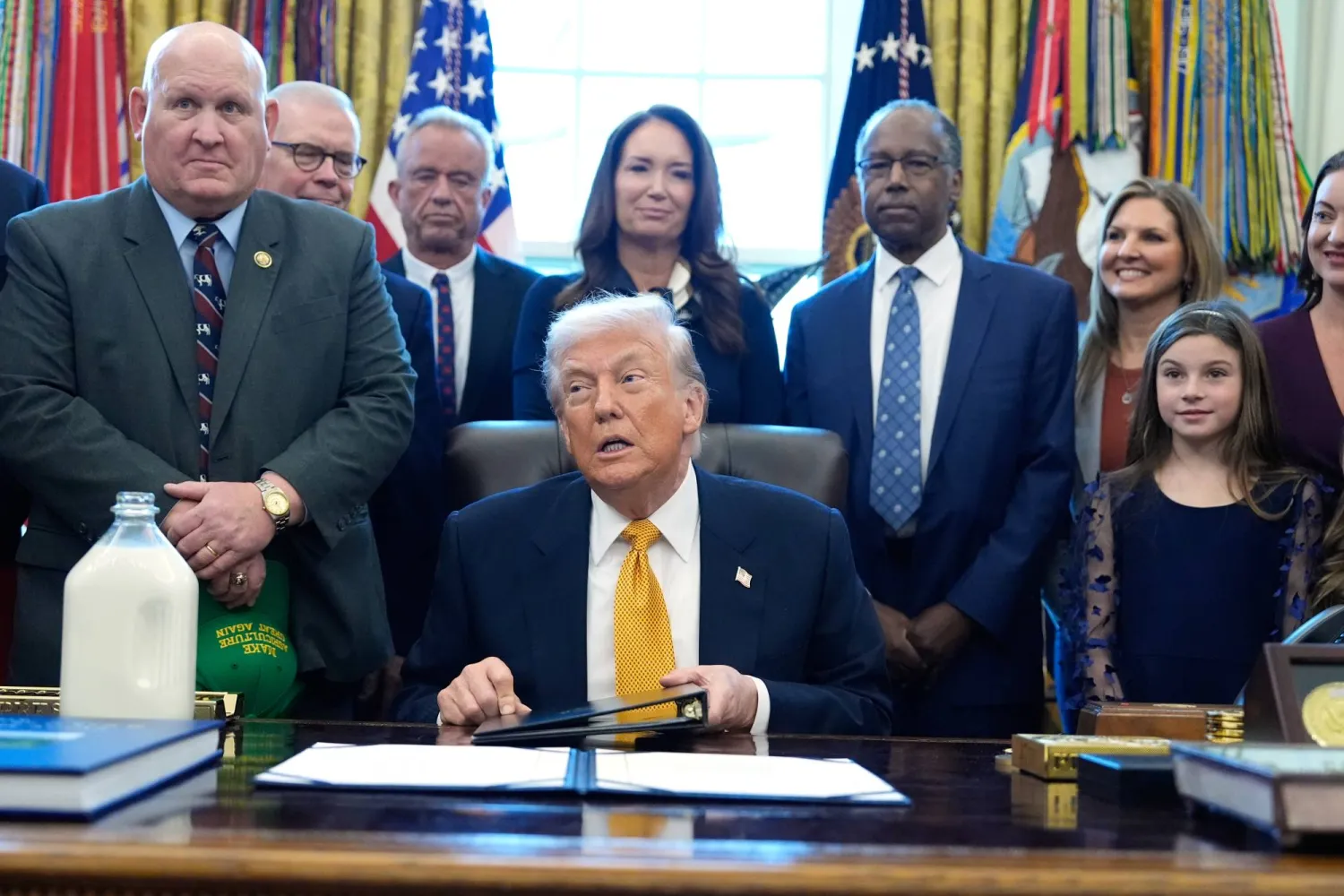
President Donald Trump speaks in the Oval Office of the White House, Wednesday, Jan. 14, 2026, in Washington. (AP Photo/Alex Brandon)
TT

Trump Sees Iranian Crackdown Easing, Tehran Denies Man to Be Executed

President Donald Trump speaks in the Oval Office of the White House, Wednesday, Jan. 14, 2026, in Washington. (AP Photo/Alex Brandon)

US President Donald Trump said he had been told that killings in Iran’s crackdown on protests were easing and that he believed there was no current plan for large-scale executions, adopting a wait-and-see posture after earlier threatening intervention. 

After Iran's foreign minister said Tehran had "no plan" to hang people, Iranian state media on Thursday reported that a 26-year-old man arrested during protests in the city of Karaj would not be given the death sentence. 

Rights organization Hengaw, which reported earlier this week that Erfan Soltani was due to be executed on Wednesday, said a previously communicated order for his execution had been postponed, citing his relatives. 

In a social media post on Thursday, Trump responded to a news report that an Iranian protester was no longer being sentenced to death, writing: "This is good news. Hopefully, it will continue!" 

Iranian state media said that while Soltani was being charged with colluding against "internal security and propaganda activities against the regime", the death penalty does not apply to such charges. 

Trump's comments on Wednesday led oil prices to retreat from multi-month highs and gold eased from a record peak on Thursday. Trump has repeatedly threatened to intervene on behalf of protesters in Iran, where the clerical establishment has cracked down hard on nationwide unrest since December ‌28. 

PROTESTS APPEAR TO ‌ABATE, NEW US SANCTIONS 

People inside Iran, reached by Reuters on Wednesday and Thursday, said protests appeared to have ‌abated ⁠since Monday. Information flows have ‌been hampered by an internet blackout for a week. 

President Masoud Pezeshkian said on Thursday the government was trying to address some of the economic problems that first spurred the protests, adding that it intended to tackle issues of corruption and foreign exchange rates and that this would improve purchasing power for poorer people. 

Despite this, Washington tightened pressure on Tehran on Thursday by imposing sanctions on five Iranian officials it accused of being behind the crackdown, and said it was tracking Iranian leaders' funds being wired to banks around the world. 

The US Treasury Department imposed sanctions on the Secretary of the Supreme Council for National Security as well as the Revolutionary Guard Corps and law enforcement forces commanders. 

"US Treasury knows, that like rats on a sinking ship, you are frantically wiring funds stolen from Iranian families to banks and financial institutions around the world. Rest assured, we will track them and you," Treasury Secretary ⁠Scott Bessent said in a video. "But there's still time, if you choose to join us. As President Trump has said, stop the violence and stand with the people of Iran." 

Sanctions were also imposed on Fardis Prison, where the US ‌State Department said women have "endured cruel, inhuman, and degrading treatment". 

The Group of Seven countries said it was ‍prepared to impose additional restrictive measures on Iran if it continued to crack down. 

Tensions ‍had risen on Wednesday, with Iran saying it had warned neighbors it would hit American bases in the region in the event of US strikes, and ‍a US official saying the United States was withdrawing some personnel from bases in the region. 

Trump said he had been told by "very important sources on the other side" that killings in the crackdown were subsiding. 

He did not rule out potential US military action but said his administration had received a "very good statement" from Iran. 

TRUMP UNCERTAIN ABOUT SUPPORT IN IRAN FOR SHAH'S SON 

Paul Salem, a senior fellow at the Middle East Institute think-tank, said that while Trump has appeared to back away from action against Iran, he remained unpredictable. 

Iran's government is at "a strategic dead end, but I don't think they are at immediate risk of state collapse or regime change," he added. 

In comments to Reuters, Trump expressed uncertainty over whether Reza Pahlavi, the son of the late shah of Iran and a prominent figure in Iran's fractured opposition, would be ⁠able to muster support within Iran to eventually take over. 

Trump told Reuters it was possible Iran's government could fall but that in truth "any regime can fail." 

Türkiye, one of several states in the region where the US has forces, expressed opposition to the use of violence against Iran and said the priority was to avoid destabilization. 

Saudi Foreign Minister Prince Faisal bin Farhan bin Abdullah spoke to Iranian Foreign Minister Abbas Araghchi by phone on Thursday and discussed ways to support security and stability in the region, Saudi state media reported. 

The security warning level at the US Al Udeid air base in Qatar has been lowered after a heightened alert triggered on Wednesday, three sources briefed on the situation told Reuters on Thursday. US aircraft that were moved out of Al Udeid are gradually returning to the base, one of the sources added. 

MOST VIOLENT UNREST SINCE 1979 REVOLUTION 

The US-based HRANA rights group says it has verified the deaths of 2,435 protesters and 153 government-affiliated individuals in the unrest that began with protests over soaring prices before turning into one of the biggest challenges to the clerical establishment since the 1979 revolution. 

Iranian authorities said the demonstrations turned from legitimate protest at economic grievances into unrest fomented by its foreign ‌enemies, accusing people it described as terrorists of attacking the security forces and public property. 

The intelligence ministry urged people on Thursday to report any suspicious activities, state media reported. 


Nigeria's President to Make a Sate Visit to the UK in March

Nigeria’s President Bola Tinubu gives a joint statement with Brazil’s President Luiz Inacio Lula da Silva, at the Planalto presidential palace, in Brasilia, Brazil, Aug. 25, 2025. (AP Photo/Eraldo Peres, File)
TT

Nigeria's President to Make a Sate Visit to the UK in March

Nigeria’s President Bola Tinubu gives a joint statement with Brazil’s President Luiz Inacio Lula da Silva, at the Planalto presidential palace, in Brasilia, Brazil, Aug. 25, 2025. (AP Photo/Eraldo Peres, File)

Nigeria’s president is set to make a state visit to the UK in March, the first such trip by a Nigerian leader in almost four decades, Britain’s Buckingham Palace said Sunday.

Officials said President Bola Tinubu and first lady Oluremi Tinubu will travel to the UK on March 18 and 19, The AP news reported.

King Charles III and Queen Camilla will host them at Windsor Castle. Full details of the visit are expected at a later date.

Charles visited Nigeria, a Commonwealth country, four times from 1990 to 2018 before he became king. He previously received Tinubu at Buckingham Palace in September 2024.m

Previous state visits by a Nigerian leader took place in 1973, 1981 and 1989.

A state visit usually starts with an official reception hosted by the king and includes a carriage procession and a state banquet.

Last year Charles hosted state visits for world leaders including US President Donald Trump, French President Emmanuel Macron and German President Frank-Walter Steinmeier.


Iran Strikes Hard Line on US Talks, Saying Tehran's Power Comes From Saying 'No'

Traffic moves through a street in Tehran on February 7, 2026. (Photo by ATTA KENARE / AFP)
TT

Iran Strikes Hard Line on US Talks, Saying Tehran's Power Comes From Saying 'No'

Traffic moves through a street in Tehran on February 7, 2026. (Photo by ATTA KENARE / AFP)

Iran's top diplomat insisted Sunday that Tehran's strength came from its ability to “say no to the great powers," striking a maximalist position just after negotiations with the United States over its nuclear program and in the wake of nationwide protests.

Foreign Minister Abbas Araghchi, speaking to diplomats at a summit in Tehran, signaled that Iran would stick to its position that it must be able to enrich uranium — a major point of contention with President Donald Trump, who bombed Iranian atomic sites in June during the 12-day Iran-Israel war.

Iran will never surrender the right to enrich uranium, even if war "is imposed on us,” he noted.

"Iran has paid a very heavy price for its peaceful nuclear program and for uranium enrichment." 

Israeli Prime Minister Benjamin Netanyahu is expected to travel to Washington this week, with Iran expected to be the major subject of discussion, his office said.

While Iranian President Masoud Pezeshkian praised the talks Friday in Oman with the Americans as “a step forward,” Araghchi's remarks show the challenge ahead. Already, the US moved the aircraft carrier USS Abraham Lincoln, ships and warplanes to the Middle East to pressure Iran into an agreement and have the firepower necessary to strike the Islamic Republic should Trump choose to do so, according to The AP news.

“I believe the secret of the Islamic Republic of Iran’s power lies in its ability to stand against bullying, domination and pressures from others," Araghchi said.

"They fear our atomic bomb, while we are not pursuing an atomic bomb. Our atomic bomb is the power to say no to the great powers. The secret of the Islamic Republic’s power is in the power to say no to the powers.”

‘Atomic bomb’ as rhetorical device Araghchi's choice to explicitly use an “atomic bomb” as a rhetorical device likely wasn't accidental. While Iran has long maintained its nuclear program is peaceful, the West and the International Atomic Energy Agency say Tehran had an organized military program to seek the bomb up until 2003.

Iran had been enriching uranium up to 60% purity, a short, technical step to weapons-grade levels of 90%, the only non-weapons state to do so. Iranian officials in recent years had also been increasingly threatening that Tehran could seek the bomb, even while its diplomats have pointed to Iranian Supreme Leader Ali Khamenei’s preachings as a binding fatwa, or religious edict, that Iran wouldn’t build one.

Pezeshkian, who ordered Araghchi to pursue talks with the Americans after likely getting Khamenei's blessing, also wrote on X on Sunday about the talks.

“The Iran-US talks, held through the follow-up efforts of friendly governments in the region, were a step forward,” the president wrote. “Dialogue has always been our strategy for peaceful resolution. ... The Iranian nation has always responded to respect with respect, but it does not tolerate the language of force.”

It remains unclear when and where, or if, there will be a second round of talks. Trump, after the talks Friday, offered few details but said: “Iran looks like they want to make a deal very badly — as they should.”

Aircraft carrier in the Arabian Sea During Friday's talks, US Navy Adm. Brad Cooper, the head of the American military's Central Command, was in Oman. Cooper's presence was apparently an intentional reminder to Iran about US military power in the region. Cooper later accompanied US special envoy Steve Witkoff and Jared Kushner, Trump's son-in-law, to the Lincoln out in the Arabian Sea after the indirect negotiations.

Araghchi appeared to be taking the threat of an American military strike seriously, as many worried Iranians have in recent weeks. He noted that after multiple rounds of talks last year, the US “attacked us in the midst of negotiations."

“If you take a step back (in negotiations), it is not clear up to where it will go,” Araghchi said.


Russia: Man Suspected of Shooting Top General Detained in Dubai

An investigator works outside a residential building where the assassination attempt on Russian Lieutenant General Vladimir Alexeyev took place in Moscow, Russia February 6, 2026. REUTERS/Anastasia Barashkova
TT

Russia: Man Suspected of Shooting Top General Detained in Dubai

An investigator works outside a residential building where the assassination attempt on Russian Lieutenant General Vladimir Alexeyev took place in Moscow, Russia February 6, 2026. REUTERS/Anastasia Barashkova

Russia's Federal Security Service (FSB) said on Sunday that the man suspected of shooting top Russian military intelligence officer Vladimir Alexeyev in Moscow has been detained in Dubai and handed over to Russia.

Lieutenant General Vladimir Alexeyev, deputy head of the GRU, ⁠Russia's military intelligence arm, was shot several times in an apartment block in Moscow on Friday, investigators said. He underwent surgery after the shooting, Russian media ⁠said.

The FSB said a Russian citizen named Lyubomir Korba was detained in Dubai on suspicion of carrying out the shooting.

Russian Foreign Minister Sergei Lavrov accused Ukraine of being behind the assassination attempt, which he said was designed to sabotage peace talks. ⁠Ukraine said it had nothing to do with the shooting.

Alexeyev's boss, Admiral Igor Kostyukov, the head of the GRU, has been leading Russia's delegation in negotiations with Ukraine in Abu Dhabi on security-related aspects of a potential peace deal.
