


Social Media Addiction's Surprising Challenger? Anti-doomscrolling Influencers

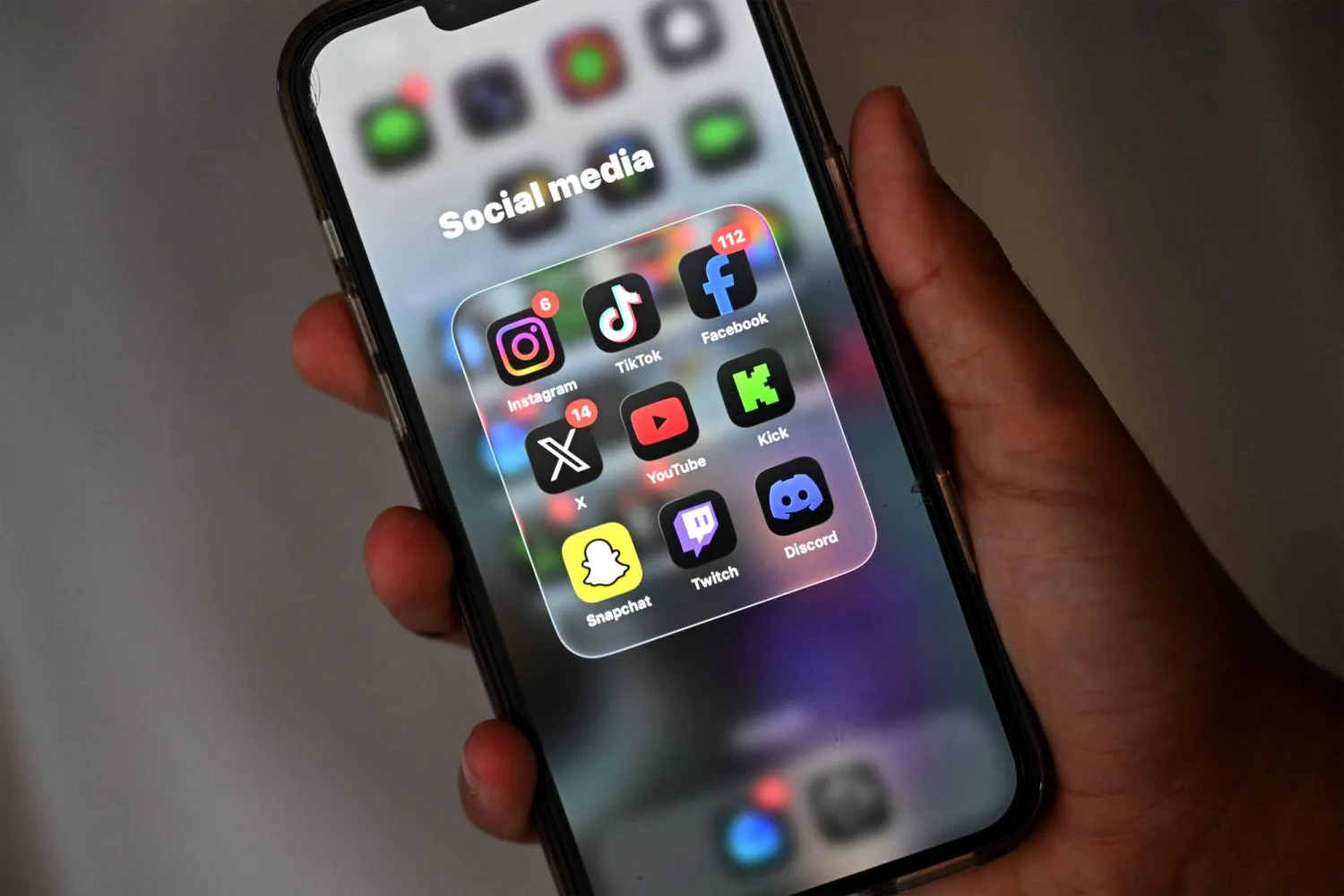
A 13-year-old boy poses at his home as he looks at social media on his mobile phone in Sydney on December 8, 2025.  (Photo by Saeed KHAN / AFP)
A 13-year-old boy poses at his home as he looks at social media on his mobile phone in Sydney on December 8, 2025. (Photo by Saeed KHAN / AFP)
TT

Social Media Addiction's Surprising Challenger? Anti-doomscrolling Influencers

A 13-year-old boy poses at his home as he looks at social media on his mobile phone in Sydney on December 8, 2025.  (Photo by Saeed KHAN / AFP)
A 13-year-old boy poses at his home as he looks at social media on his mobile phone in Sydney on December 8, 2025. (Photo by Saeed KHAN / AFP)

It’s simple to accidentally become entranced by an endless loop of videos on Instagram or TikTok. But sometimes, that mindless scroll is interrupted by a reminder that what you thought was a 10-minute break spent on your phone was closer to 30 minutes.

Olivia Yokubonis, armed with a kind voice and scientific research, often pops up in feeds on social platforms, gently reminding viewers that they might not remember the video they saw two videos before she appeared on the screen.

Yokubonis is a content creator who goes by the name Olivia Unplugged online, making videos to combat overuse or mindless use of social media. For the most part, people who view her videos welcome the disruption from the endless loop of content, treating it as a wake-up call to get off their phones. Other times, they are snarky, The Associated Press said.

“People will comment and they’ll be like, ’Oh, (it’s) ironic that you’re posting. And I’m like, ‘Where else am I supposed to find you, Kyle? Outside? You’re not outside. You are here, sitting here,’” she said. “For us to actually be seen, we have to be where people are.”

Yokubonis’ content responds to the feeling many people have, that they spend too much time on social media or apps.

“Most people have no clue how much time they spend on social media,” said Ofir Turel, a professor of information systems management at the University of Melbourne who has been studying social media use for years. Through his research, Turel found that when he presented people with their screen time information, they were practically “in a state of shock” and many people voluntarily reduced their usage afterwards.

Yokubonis is part of a growing group of content creators who make videos encouraging viewers to close out the app they’re on. Some are aggressive in their approach, some more tame; some only occasionally post about social media overuse, and some, like Yokubonis, devote their accounts to it.

She works for Opal, a screen time app designed to help users “reclaim their focus,” she said, but those who engage with her content might not have any idea she is working for the company. Brand logos, constant plugs to download the app and other signs of branding are almost entirely absent from her page. “People love hearing from people,” she said. Millions of views on her videos point to that being true.

“It’s a fine line and a balance of finding a way to be able to cut through that noise but also not adding to the noise,” she added.

Ian A. Anderson, a postdoctoral scholar at California Institute of Technology, said he finds this kind of content interesting, but is curious whether it's disruptive enough to prompt action. He also said he wonders whether those with the strongest scrolling habits are “thoughtless about the way (they're) intaking information.”

“If they're paying full attention, I feel like it could be an effective disruption, but I also think there is a degree to which, if you are really a habitual scroller, maybe you aren’t fully engaging with it,” he said. “I can think of all sorts of different variables that could change the effectiveness, but it does sound like an interesting way to intervene from the inside.”

With billions of active users across TikTok, Instagram, YouTube and other social media platforms, talk of cutting down on screen time is perennial, as is the idea of addiction to social platforms. But there’s tremendous disagreement over whether social media addiction actually exists.

Is social media “addiction” real? Researchers, psychologists and other experts agree some people spend too much time on social media, but the agreement tends to stop there. Some researchers question whether addiction is the appropriate term to describe heavy use of social media, arguing that a person must be experiencing identifiable symptoms, like strong, sometimes uncontrollable urges and withdrawal, to qualify as addiction. Others, like Turel, acknowledge the term seems to resonate with more people and is often used colloquially.

Anderson said he recognized the prevalence of casual mentions of being addicted to phones and was curious to see if that talk was “benign.”

A recent study of his suggests the debate extends further than academic discourse. In a representative sample of active Instagram users, Anderson found that people often overestimate whether they are “addicted” to the app. On a self-report scale, 18% of participants agreed that they were at least somewhat addicted to Instagram and 5% indicated substantial agreement, but only 2% of participants were deemed at risk of addiction based on their symptoms. Believing you are addicted also impacts how you address that issue, Anderson said.

“If you perceive yourself as more addicted, it actually hurts your ability to control your use or your perception of that ability and makes you kind of blame yourself more for overuse,” Anderson said. “There are these negative consequences to addiction perception.”

Cutting down on screen time

For those looking to curb their social media habits, Anderson suggests making small, meaningful, changes to stop from opening your social media app of choice. Moving the app’s place on your phone or turning off notifications are “light touch interventions,” but more involved options, like not bringing your phone into the bedroom — or other places where you often use it — could also help.

Plenty of intervention methods have been offered to consumers in the form of products or services. But those interventions require self awareness and a desire to cut down on use. Content creators who infiltrate social media feeds with information about the psychology behind why people scroll for hours a day can plant those early seeds.

Cat Goetze, who goes by CatGPT online, makes “non-pretentious, non-patronizing” content about artificial intelligence, building off her experience in the tech industry. But she’s also been on a lengthy road to cut down her own screen time. She often makes videos about why the platforms are so compelling and why we tend to spend longer than we anticipate on them.

“There’s a whole infrastructure — there’s an army of nerds whose only job is to get you to increase your time spent on that platform,” she said. “There’s a whole machine that’s trying to get you to be that way and it’s not your fault and you’re not going to win this just (through) willpower.”

Goetze also founded the business Physical Phones, which makes Bluetooth landline phones that connect to smartphones, encouraging people to spend less time on their devices. The inside of the packaging reads “offline is the new luxury.”

She was able to build the business at an accelerated pace thanks to her social media audience. But the early success of Physical Phones also demonstrates the demand for solutions to high screen time, she said.

“Social media will always play a part in our lives. I don’t necessarily think that’s a bad thing. If we can get the average screen time down from, if it’s 10 hours for a person to one hour, or from three hours to 30 minutes, that is going to be a net positive benefit for that individual and for society,” Goetze said. “That being said, I’d love to be the person that they’re watching for those 30 minutes.”



US Astronaut to Take her 3-year-old's Cuddly Rabbit Into Space

FILE PHOTO: An evening launch of a SpaceX Falcon 9 rocket carrying 20 Starlink V2 Mini satellites, from Space Launch Complex at Vandenberg Space Force Base is seen over the Pacific Ocean from Encinitas, California, US, June 23, 2024. REUTERS/Mike Blake/File Photo
TT

US Astronaut to Take her 3-year-old's Cuddly Rabbit Into Space

FILE PHOTO: An evening launch of a SpaceX Falcon 9 rocket carrying 20 Starlink V2 Mini satellites, from Space Launch Complex at Vandenberg Space Force Base is seen over the Pacific Ocean from Encinitas, California, US, June 23, 2024. REUTERS/Mike Blake/File Photo

When the next mission to the International Space Station blasts off from Florida next week, a special keepsake will be hitching a ride: a small stuffed rabbit.

American astronaut and mother, Jessica Meir, one of the four-member crew, revealed Sunday that she'll take with her the cuddly toy that belongs to her three-year-old daughter.

It's customary for astronauts to go to the ISS, which orbits 250 miles (400 kilometers) above Earth, to take small personal items to keep close during their months-long stint in space.

"I do have a small stuffed rabbit that belongs to my three-year-old daughter, and she actually has two of these because one was given as a gift," Meir, 48, told an online news conference.

"So one will stay down here with her, and one will be there with us, having adventures all the time, so that we'll keep sending those photos back and forth to my family," AFP quoted her as saying.

US space agency NASA says SpaceX Crew-12 will lift off on a SpaceX Falcon 9 rocket from Cape Canaveral in Florida to the orbiting scientific laboratory early Wednesday.

The mission will be replacing Crew-11, which returned to Earth in January, a month earlier than planned, during the first medical evacuation in the space station's history.

Meir, a marine biologist and physiologist, served as flight engineer on a 2019-2020 expedition to the space station and participated in the first all-female spacewalks.

Since then, she's given birth to her daughter. She reflected Sunday on the challenges of being a parent and what is due to be an eight-month separation from her child.

"It does make it a lot difficult in preparing to leave and thinking about being away from her for that long, especially when she's so young, it's really a large chunk of her life," Meir said.

"But I hope that one day, she will really realize that this absence was a meaningful one, because it was an adventure that she got to share into and that she'll have memories about, and hopefully it will inspire her and other people around the world," Meir added.

When the astronauts finally get on board the ISS, they will be one of the last crews to live on board the football field-sized space station.

Continuously inhabited for the last quarter century, the aging ISS is scheduled to be pushed into Earth's orbit before crashing into an isolated spot in the Pacific Ocean in 2030.

The other Crew-12 astronauts are Jack Hathaway of NASA, European Space Agency astronaut Sophie Adenot, and Russian cosmonaut Andrey Fedyaev.


iRead Marathon Records over 6.5 Million Pages Read

Participants agreed that the number of pages read was not merely a numerical milestone - SPA
TT

iRead Marathon Records over 6.5 Million Pages Read

Participants agreed that the number of pages read was not merely a numerical milestone - SPA

The fifth edition of the iRead Marathon achieved a remarkable milestone, surpassing 6.5 million pages read over three consecutive days, in a cultural setting that reaffirmed reading as a collective practice with impact beyond the moment.

Hosted at the Library of the King Abdulaziz Center for World Culture (Ithra) and held in parallel with 52 libraries across 13 Arab countries, including digital libraries participating for the first time, the marathon reflected the transformation of libraries into open, inclusive spaces that transcend physical boundaries and accommodate diverse readers and formats.

Participants agreed that the number of pages read was not merely a numerical milestone, but a reflection of growing engagement and a deepening belief in reading as a daily, shared activity accessible to all, free from elitism or narrow specialization.

Pages were read in multiple languages and formats, united by a common conviction that reading remains a powerful way to build genuine connections and foster knowledge-based bonds across geographically distant yet intellectually aligned communities, SPA reported.

The marathon also underscored its humanitarian and environmental dimension, as every 100 pages read is linked to the planting of one tree, translating this edition’s outcome into a pledge of more than 65,000 trees. This simple equation connects knowledge with sustainability, turning reading into a tangible, real-world contribution.

The involvement of digital libraries marked a notable development, expanding access, strengthening engagement, and reinforcing the library’s ability to adapt to technological change without compromising its cultural role. Integrating print and digital reading added a contemporary dimension to the marathon while preserving its core spirit of gathering around the book.

With the conclusion of the iRead Marathon, the experience proved to be more than a temporary event, becoming a cultural moment that raised fundamental questions about reading’s role in shaping awareness and the capacity of cultural initiatives to create lasting impact. Three days confirmed that reading, when practiced collectively, can serve as a meeting point and the start of a longer cultural journey.


Imam Turki bin Abdullah Royal Reserve Launches Fifth Beekeeping Season

Jazan’s Annual Honey Festival - File Photo/SPA
TT

Imam Turki bin Abdullah Royal Reserve Launches Fifth Beekeeping Season

Jazan’s Annual Honey Festival - File Photo/SPA

The Imam Turki bin Abdullah Royal Nature Reserve Development Authority launched the fifth annual beekeeping season for 2026 as part of its programs to empower the local community and regulate beekeeping activities within the reserve.

The launch aligns with the authority's objectives of biodiversity conservation, the promotion of sustainable environmental practices, and the generation of economic returns for beekeepers, SPA reported.

The authority explained that this year’s beekeeping season comprises three main periods associated with spring flowers, acacia, and Sidr, with the start date of each period serving as the official deadline for submitting participation applications.

The authority encouraged all interested beekeepers to review the season details and attend the scheduled virtual meetings to ensure organized participation in accordance with the approved regulations and the specified dates for each season.