
Al-Mahrami: Saudi Arabia Backs the Solution for Southern Yemen without Preconditions

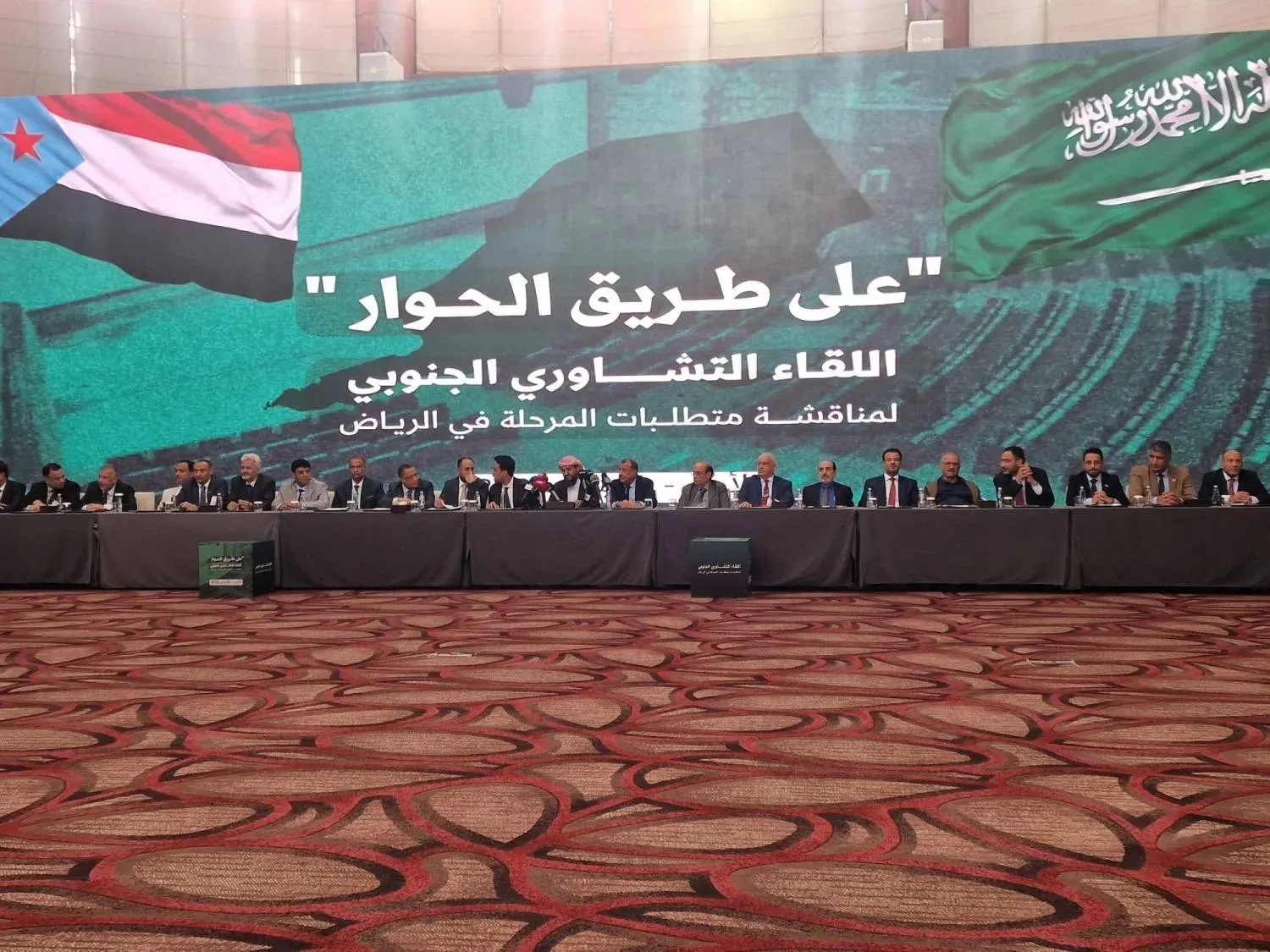
Officials are seen at the consultative meeting on southern Yemen in Riyadh on Sunday. (Asharq Al-Awsat)
TT

Al-Mahrami: Saudi Arabia Backs the Solution for Southern Yemen without Preconditions

Officials are seen at the consultative meeting on southern Yemen in Riyadh on Sunday. (Asharq Al-Awsat)

A consultative meeting on southern Yemen kicked off in Riyadh on Sunday. The meeting brings together leaderships, elders and senior figures from southern Yemen. 

In a statement, the gatherers said the meeting reflects the South’s “collective will to search for a just, secure and guaranteed solution” to the southern cause “away from escalation or attempts to create secondary conflicts that do not serve the South and its future.” 

They praised Saudi Arabia’s “clear” support for their cause as demonstrated in direct meetings with its leaders and officials, said the statement that was read by member of Yemen’s Presidential Leadership Council (PLC) Abou Zaraa Al-Mahrami. 

Saudi Arabia’s positions “align completely with the just demands of the people of the South and back their right to reach a comprehensive political solution that guarantees their dignity, security, stability and future without preconditions or political demands.” 

These positions allow the people to determine their political fate and destiny, including reclaiming full sovereignty, added the statement. 

Al-Mahrami said the upcoming Saudi-sponsored intra-southern dialogue “is a rare historic opportunity that should not be squandered or undermined through sparking internal southern disputes.” 

He cautioned against antagonizing the Kingdom or creating disputes with it, saying this “serves the parties that are opposed to our cause.” 

Furthermore, he stressed that no one will be marginalized, explaining that the dialogue is based on the greatest possible partnership and representation of the South. 

“Since arriving in Riyadh, we sensed clear and sincere support for the southern cause. Our presence here played a direct role in meeting the demands of our people and forces,” he continued. 

Al-Mahrami noted the Kingdom’s keenness on supporting the Yemeni people’s daily needs, as well as the country’s economy. 

“We also received direct assurances from Saudi officials that support for the southern forces will continue,” he added. The forces are protecting the South and its security and are deployed at battlefronts. 

The support will consolidate the stability of the South and block attempts to weaken the southern front or raise doubts about its people, he went on to say. 

The statement said Saudi Arabia’s economic and development support “are the pillars for the future partnership” between the South and the Kingdom. 

“Today’s meeting will pave the way for a real strategic future based on security, stability and development,” it stressed. 

Moreover, the statement noted that Saudi Arabia had been at the forefront in protecting the South against all threats. “It is the main partner in maintaining its security and stability and backing its just cause,” it added. 

“Saudi Arabia’s stances have proven that the Kingdom has and continues to be a sincere supporter and guarantor of the South’s security and stability,” it said. 

“The real danger against the South lies in the Houthi militias and their expansionist agendas against the South and entire region,” it warned. The statement also warned against the threat of ISIS and al-Qaeda. 

“We therefore categorically reject any attempts that aim to raise doubts against the Kingdom’s role,” it said, while also dismissing campaigns against the southern military and security forces led by the Giants Brigades and National Shield forces. 


Iranian Attacks on Gulf Intensify, Kuwait Bears Brunt

Smoke rises near Kuwait International Airport after a drone strike targeted a fuel depot. (File photo/AFP)
TT

Iranian Attacks on Gulf Intensify, Kuwait Bears Brunt

Smoke rises near Kuwait International Airport after a drone strike targeted a fuel depot. (File photo/AFP)

Iranian attacks on Gulf states have intensified sharply in recent days, with Kuwait bearing the brunt as fighting between the United States and Iran resumed and tensions rose in the Strait of Hormuz.

From the renewed escalation last Wednesday through early Thursday, Kuwaiti forces detected about 77 hostile drones and 18 missiles in the country’s airspace, according to an Asharq Al-Awsat tally.

The missiles included eight ballistic missiles and 10 cruise missiles. Kuwaiti forces intercepted or otherwise dealt with the threats.

The latest attacks stood out for causing casualties and damage.

Kuwait said several Iranian strikes targeted vital facilities and scattered debris across multiple locations, causing material damage and injuring six people, including four members of the Kuwaiti armed forces.

Three land border posts in northern Kuwait were also attacked, causing further damage and one injury.

Kuwaiti Defense Minister Sheikh Abdullah Al-Sabah checks on the health condition of those injured as a result of the Iranian aggression. KUNA

Kuwait’s consulate general in the southern Iraqi city of Basra was targeted again on Monday.

Kuwait condemned the attack and acknowledged the Iraqi government’s efforts to confront such incidents. It also called for “immediate and decisive” action to hold those responsible accountable and prevent a recurrence.

The continued attacks drew broad condemnation and expressions of solidarity from Gulf states.

Calls to strike back at launch sites

Academic and political researcher Ayed al-Manaa said Gulf Cooperation Council states should prepare for further Iranian retaliation following US attacks.

Speaking to Asharq Al-Awsat, al-Manaa urged Gulf states to respond to the sources of fire rather than remain on the defensive.

He said the escalation showed that Tehran had gone too far, particularly during the 40-day war.

Iran, he added, could retaliate against nearby US forces or Israel instead of targeting Gulf states.

Al-Manaa said Iran’s conduct reflected a lack of respect for Gulf sovereignty and a disregard for fraternal ties, neighborly relations and shared religious bonds.

Gulf states are peaceful countries that maintain normal relations, trade and neighborly ties with Iran, he said.

Tehran had treated that position with disdain, he added, making it necessary for Gulf states to raise their level of readiness and prepare to confront and respond to further attacks.

Fragile truce, vague memorandum

Political analyst Khaled al-Habbas said the renewed fighting between Washington and Tehran, and the failure of the ceasefire to hold, showed that the memorandum of understanding reached in mid-June was broad and highly ambiguous.

He said the uncertainty was most evident in provisions dealing with the Strait of Hormuz, Iran’s nuclear program, sanctions on Tehran and its frozen assets.

Al-Habbas said other factors were also driving the crisis.

These included “the deep hostility and mistrust between the two sides, the aggressive nature of the Iranian regime and the sharp divisions between hardline leaders within the Revolutionary Guards and other officials who support negotiations with the United States.”

Doubts over Iran’s commitment to a deal

“The continuation of Iranian aggression against some Gulf states, alongside attacks on shipping in the Strait of Hormuz, indicates that the Iranian side is not serious about reaching a final agreement,” al-Habbas said.

He said the negotiations also faced major obstacles, while the ceasefire remained fragile.

Tension and instability would therefore continue to define the regional landscape for now, he added.

Al-Habbas did not rule out further exchanges of military action in the region, although he said both sides appeared keen to avoid a return to full-scale war.

“The danger remains, however, and all possibilities are still open. This is why Gulf states are following these developments with concern,” he said.

He praised Gulf states for successfully confronting Iranian attacks while continuing to support diplomatic efforts to prevent a return to war and the risks it would pose to the region.

Al-Habbas called for greater regional and international diplomatic pressure on Iran to isolate it politically and expose what he described as its aggression.

He said Iran should be held responsible for the damage caused by “this blatant aggression,” while Gulf states retained the right to defend themselves at a time and place of their choosing.


Saudi Arabia: Iranian Attacks on Kuwait, Bahrain and Jordan Threaten Regional Security

Kuwait City. (KUNA)
Kuwait City. (KUNA)
TT

Saudi Arabia: Iranian Attacks on Kuwait, Bahrain and Jordan Threaten Regional Security

Kuwait City. (KUNA)
Kuwait City. (KUNA)

Saudi Arabia strongly condemned Iran's continued "unjustified attacks" on Kuwait, Bahrain and Jordan, reaffirming its full support for the measures taken by the three countries in response to what it described as Iran's blatant attacks.

Kuwaiti civil defense personnel work to contain a fire at Kuwait International Airport following the Iranian attack on fuel storage tanks. (File photo: KUNA)

In a statement, the Saudi Ministry of Foreign Affairs reiterated its condemnation of what it described as Iran's actions threatening regional security and stability and violating the principles of international law and good-neighborliness.

It stressed the importance of an immediate halt to all forms of military escalation and called for a return to dialogue and the resolution of disputes through diplomatic means.


Saudi Minister of Defense Offers Condolences to Emir of Qatar


Saudi Minister of Defense Prince Khalid bin Salman bin Abdulaziz and Qatari Emir Sheikh Tamim bin Hamad Al Thani - AAWSAT
TT

Saudi Minister of Defense Offers Condolences to Emir of Qatar


Saudi Minister of Defense Prince Khalid bin Salman bin Abdulaziz and Qatari Emir Sheikh Tamim bin Hamad Al Thani - AAWSAT

Saudi Minister of Defense Prince Khalid bin Salman bin Abdulaziz made a phone call on Thursday to Emir of the State of Qatar Sheikh Tamim bin Hamad Al Thani.

During the call, the minister expressed his condolences and sympathy to the amir over the death of Sheikh Hamad bin Khalifa Al Thani.