


Europeans Reeling as Trump Imposes Tariffs on 8 Countries Over Greenland Dispute

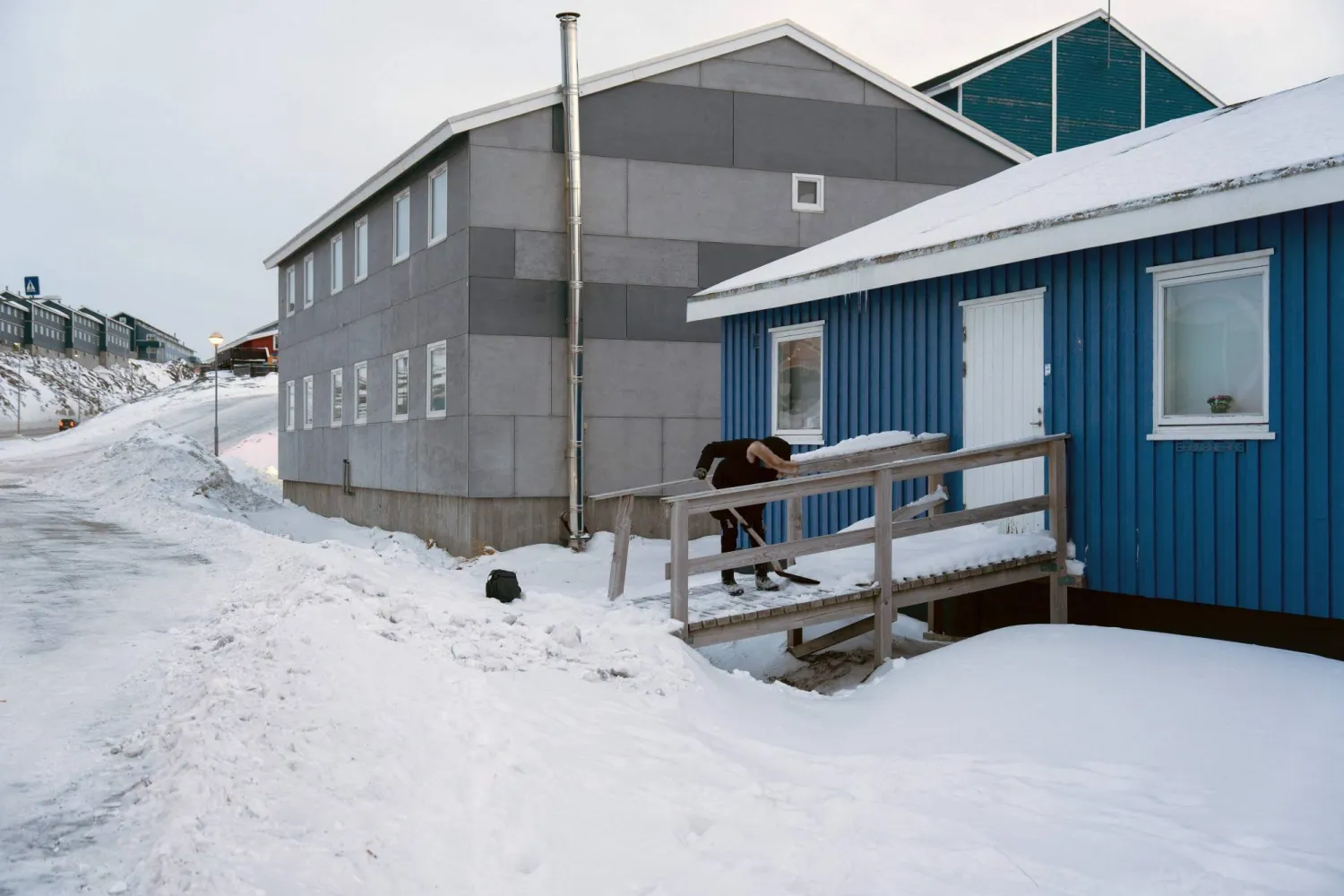
A woman uses a shovel to clear a footpath from now and ice on January 16, 2026 in Nuuk, Greenland. (AFP)
TT

Europeans Reeling as Trump Imposes Tariffs on 8 Countries Over Greenland Dispute

A woman uses a shovel to clear a footpath from now and ice on January 16, 2026 in Nuuk, Greenland. (AFP)

Europeans were reeling Sunday from US President Donald Trump's announcement that eight countries will face 10% tariff for opposing American control of Greenland.

The responses to Trump's decision on Saturday ranged from saying it risked “a dangerous downward spiral” to predicting that “China and Russia must be having a field day.”

Trump's threat sets up a potentially dangerous test of US partnerships in Europe. Several European countries have sent troops to Greenland in recent days, saying they are there for Arctic security training. Trump's announcement came Saturday as thousands of Greenlanders were wrapping up a protest outside the US Consulate in the capital, Nuuk.

The Republican president appeared to indicate that he was using the tariffs as leverage to force talks with Denmark and other European countries over the status of Greenland, a semiautonomous territory of NATO ally Denmark that he regards as critical to US national security. Denmark, Norway, Sweden, France, Germany, the United Kingdom, the Netherlands and Finland would face the tariff.

There are immediate questions about how the White House could try to implement the tariffs because the EU is a single economic zone in terms of trading, according to a European diplomat who was not authorized to comment publicly and spoke on the condition of anonymity. It was unclear, too, how Trump could act under US law, though he could cite emergency economic powers that are currently subject to a US Supreme Court challenge.

European Union foreign policy chief Kaja Kallas said China and Russia will benefit from the divisions between the US and the Europe. She added in a post on social media: “If Greenland’s security is at risk, we can address this inside NATO. Tariffs risk making Europe and the United States poorer and undermine our shared prosperity."

Trump's move also was panned domestically.

US Sen. Mark Kelly, a former US Navy pilot and Democrat who represents Arizona, posted that Trump’s threatened tariffs on US allies would make Americans “pay more to try to get territory we don’t need.”

“Troops from European countries are arriving in Greenland to defend the territory from us. Let that sink in,” he wrote on social media. “The damage this President is doing to our reputation and our relationships is growing, making us less safe. If something doesn’t change we will be on our own with adversaries and enemies in every direction.”

‘Risk a dangerous downward spiral’

Norway and the UK are not part of the 27-member EU, which operates as a single economic zone in terms of trading. It was not immediately clear if Trump's tariffs would impact the entire bloc. EU envoys scheduled emergency talks for Sunday evening to determine a potential response.

António Costa, president of the European Council, and Ursula von der Leyen, president of the European Commission, pledged to continue their full solidarity with Denmark and Greenland.

“Tariffs would undermine transatlantic relations and risk a dangerous downward spiral. Europe will remain united, coordinated, and committed to upholding its sovereignty,” they wrote in a joint statement late Saturday.

The tariff announcement even drew blowback from Trump's populist allies in Europe.

Jordan Bardella, president of Marine Le Pen’s far-right National Rally party in France and also a European Parliament lawmaker, posted that the EU should suspend last year’s tariff deal with the US, describing Trump’s threats as “commercial blackmail.”

Trump also achieved the rare feat of uniting Britain’s main political parties, including the hard-right Reform UK party, all of whom criticized the tariff threat.

“We don’t always agree with the US government and in this case we certainly don’t. These tariffs will hurt us,” Reform UK leader Nigel Farage, a longtime champion and ally of Trump, wrote on social media. He stopped short of criticizing Trump's designs on Greenland.

Meanwhile, UK Prime Minister Keir Starmer, who leads the center-left Labour Party, said the tariffs announcement was “completely wrong” and his government would “be pursuing this directly with the US administration.”

The foreign ministers of Denmark and Norway are also expected to address the crisis Sunday in Oslo during a news conference.



Aljadaan: Emerging Markets Account for 70% of Global Growth

Al-Jadaan speaking to the attendees at the "AlUla Conference for Emerging Market Economies" (Asharq Al-Awsat
TT

Aljadaan: Emerging Markets Account for 70% of Global Growth

Al-Jadaan speaking to the attendees at the "AlUla Conference for Emerging Market Economies" (Asharq Al-Awsat

Saudi Minister of Finance Mohammed Aljadaan stressed Sunday that the world economy is going through a “profound transition,” saying emerging markets and developing economies now account for nearly 60 percent of the global Gross Domestic Product (GDP) in purchasing power terms and over 70 percent of global growth.

In his opening remarks at the AlUla Conference for Emerging Market Economies, organized by the Saudi Ministry of Finance and the IMF in AlUla, the minister said these economies have become an increasingly important driver of global growth with their share of global economy more than doubling since 2010.

“Today, the 10 emerging economies in the G20 alone account for more than half of the world growth. Yet, they face a more complex and fragmented environment, elevated debt levels, slower trade growth and increasing exposure to geopolitical shocks.”

“Unfortunately, more than half of low income countries are either in or at the risk of debt distress. At the same time global trade growth has slowed at around half of what it was pre the pandemic,” Aljadaan added.

The Finance Minister stressed that the Saudi experience over the past decade has reinforced three lessons that may be relevant to the discussions at the two-day conference, which brings together a select group of ministers and central bank governors, leaders of international organizations, leading investors and academics.

“First, macroeconomic stability is not the enemy of growth. It is actually the foundation,” he said.

“Structural reforms deliver results only when institutions deliver. So there is no point of reforming ... if the institutions are unable to deliver,” he stated.

Finally, he said that “international cooperation matters more, not less, in a fragmented world.”


Georgieva from AlUla: Growth Still Lacks Pre-pandemic Levels

Kristalina Georgieva speaking to attendees at the second edition of the AlUla Conference for Emerging Market Economies (Asharq Al-Awsat)
TT

Georgieva from AlUla: Growth Still Lacks Pre-pandemic Levels

Kristalina Georgieva speaking to attendees at the second edition of the AlUla Conference for Emerging Market Economies (Asharq Al-Awsat)

International Monetary Fund (IMF) Managing Director Kristalina Georgieva said Sunday that world growth still lacks pre-pandemic levels, expressing concern as she expected more shocks amid high spending and rising debt levels in many countries.

Georgieva spoke at the AlUla Conference for Emerging Market Economies, organized by the Saudi Ministry of Finance and the IMF in AlUla.

The two-day conference brings together a select group of ministers and central bank governors, leaders of international organizations, leading investors and academics to deliberate on policies to global stability, prosperity, and multilateral collaboration.

Georgieva said that the conference was launched last year in recognition of the growing role of emerging market economies in a world of sweeping transformations.

“I came out of this gathering .... With a sense of hope for the pragmatic attitude and determination to pursue good policies and build strong institutions,” she said.

Georgieva stressed that “good policies pay off,” and said that growth rates across emerging economies reached four percent this year, exceeding by a large margin those of advanced economies that are around 1.5 percent.


Saudi Arabia’s flynas, Syrian Civil Aviation Authority Partner to Launch 'flynas Syria'

The new airline will operate commercial air transport services in accordance with approved regulations and standards (flynas)
TT

Saudi Arabia’s flynas, Syrian Civil Aviation Authority Partner to Launch 'flynas Syria'

The new airline will operate commercial air transport services in accordance with approved regulations and standards (flynas)

Saudi budget carrier flynas has signed an agreement with the Syrian General Authority of Civil Aviation and Air Transport to establish a new commercial airline under the name "flynas Syria," with operations scheduled to begin in the fourth quarter of 2026.

Saturday’s agreement comes within the framework of bilateral cooperation between Saudi Arabia and Syria, as well as the strategic investment agreements between the two countries, coordinated with the Saudi Ministry of Investment and the Syrian General Authority of Civil Aviation and Air Transport.

The new airline will operate commercial air transport services in accordance with approved regulations and standards, meeting the highest safety and aviation security requirements. All licensing and operational procedures will be completed in coordination with the relevant authorities.

The carrier will be established as a joint venture, with 51% ownership held by the Syrian General Authority of Civil Aviation and Air Transport and 49% by flynas.

The new airline will operate flights to several destinations across the Middle East, Africa, and Europe. This expansion aims to bolster air traffic to and from Syria, enhance regional and international connectivity, and meet growing demand for air travel.

"This step is part of our commitment to supporting high-quality cross-border investments. The aviation sector is a key enabler of economic development, and the establishment of 'flynas Syria' serves as a model for constructive investment cooperation,” said Saudi Minister of Investment Khalid Al-Falih.

“This partnership enhances economic integration and market connectivity and supports development goals by advancing air transport infrastructure, ultimately serving the mutual interests of both nations and promoting regional economic stability,” he added.

President of the Syrian General Authority of Civil Aviation and Air Transport Omar Hosari also stated that the establishment of flynas Syria represents a strategic step within a comprehensive national vision aimed at rebuilding and developing Syria's civil aviation sector on modern economic and regulatory foundations.

“This will be achieved while balancing safety requirements, operational sustainability, investment stimulation, and passenger services. The partnership reflects the state's orientation toward smart cooperation models with trusted regional partners, ensuring the transfer of expertise, the development of national capabilities, and the enhancement of Syria's air connectivity with regional and international destinations, in line with global best practices in the air transport industry."

flynas Chairman Ayed Al-Jeaid stated that the company continues to pursue strategies aimed at growth and international expansion, describing the agreement as a historic milestone in the company's journey and a promising investment model in partnership with Syria.

flynas CEO Bander Al-mohanna said the step represents a qualitative leap in the company's strategy and financial performance, highlighting the transfer of the company's low-cost aviation experience to the Syrian market to support regional and international air connectivity.

flynas currently operates 23 weekly flights from Riyadh, Jeddah, and Dammam to Damascus, including two daily direct flights from Riyadh, one daily flight from Jeddah, and two weekly flights from Dammam.

The airline made history on June 5, 2025, by adding the Syrian capital to its network, becoming the first Saudi carrier to resume scheduled flights to Damascus.