


Syrian Government Announces Ceasefire with Kurdish-led SDF

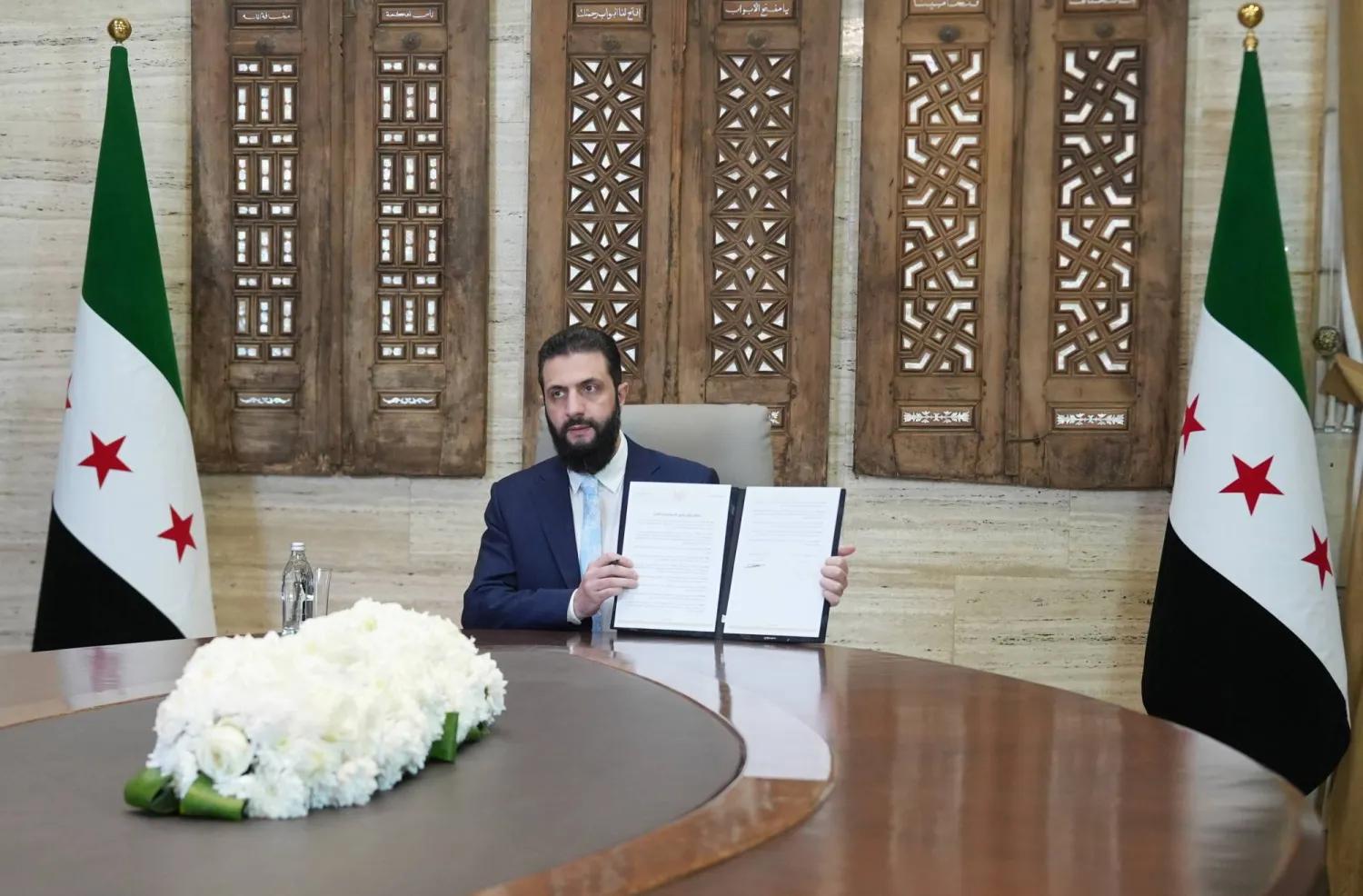
Syrian President Ahmed al-Sharaa after signing an agreement at the presidential palace in Damascus on January 18, 2026. (EPA)
TT

Syrian Government Announces Ceasefire with Kurdish-led SDF

Syrian President Ahmed al-Sharaa after signing an agreement at the presidential palace in Damascus on January 18, 2026. (EPA)

The Syrian government Sunday announced a ceasefire with the Syrian Democratic Forces, taking almost full control of the country and dismantling the Kurdish-led forces that controlled the northeast for over a decade.

The announcement comes as tensions between government forces and the SDF boiled over earlier this month, eventually resulting in a major push by government forces toward the east. The SDF appeared to have largely retreated after initial clashes on a tense front line area in eastern Aleppo province.

Hours after the government announced the deal, SDF leader Mazloum Abdi confirmed it in a video statement, saying the group had accepted the agreement, which stipulates their withdrawal from Raqqa and Deir Ezzor provinces “to stop the bloodshed.”

“We will explain the terms of the agreement to our people in the coming days,” he said.

Syria’s Defense Ministry said it ordered the fighting to halt on the front lines after the agreement was announced.

Syria’s new leaders, since toppling Bashar al-Assad in December 2024, have struggled to assert their full authority over the war-torn country. An agreement was reached in March that would merge the SDF with Damascus, but it didn't gain traction as both sides accused each other of violating the deal.

Since the push, the government has largely asserted control of the Deir Ezzor and Raqqa provinces, critical areas under the SDF that include oil and gas fields, river dams along the Euphrates, and border crossings.

Syria’s state-run news agency SANA showed President Ahmed al-Sharaa signing and holding the agreement. Abdi, who was scheduled to meet with the president in Damascus was not seen, though his signature appeared on the document.

Sharaa told journalists that Abdi could not travel due to bad weather and will visit Damascus on Monday.

“It’s a victory for all Syrians of all backgrounds,” Sharaa told journalists in Damascus after signing the agreement. “Hopefully Syria will end its state of division and move to a state of unity and progress.”

US Envoy Tom Barrack met with Sharaa earlier Sunday as government forces were sweeping into the city of Raqqa and across Deir Ezzor. Abdi reportedly joined the meeting over the phone.

Barrack praised the agreement, saying it will lead to “renewed dialogue and cooperation toward a unified Syria,” ahead of working on the details of implementing the integration.

“This agreement and ceasefire represent a pivotal inflection point, where former adversaries embrace partnership over division,” said Barrack in a post on X.

The agreement includes dismantling the SDF and having its forces join Syria’s military and security forces, while senior military and civilian officials would be given high-ranking positions in state institutions.

The SDF would have to give up the Raqqa and Deir Ezzor provinces — both Arab-majority areas — to the Syrian military and government, as well as its border crossings and oil and gas fields.

Hassakah province, the heartland of the Kurdish population, is only expected to give its civilian administration back to Damascus, while the Kurdish-led agencies that handled prisons and sprawling camps with thousands of detained ISIS group fighters and families would be handed over to Damascus.

Agreement will be implemented gradually

There was no clear timeline on when and how the different elements of the agreement will take effect. Sharaa told journalists that it will be gradually implemented, beginning with the cessation of hostilities.

It appeared that tensions following clashes in Aleppo earlier this month had calmed after Abdi announced that his troops will withdraw east of the Euphrates River, and Sharaa issued a presidential decree that would strengthen Kurdish rights in the country.

Initially the withdrawal appeared to be going as planned, but then new clashes broke out and the Syrian military seized Tabqa, continuing into Raqqa province.

A senior Syrian government official who spoke on condition of anonymity because he was not authorized to speak publicly said government forces pushed eastward because the SDF despite saying they will withdraw east of the Euphrates by 7 a.m. did not do so.

Armed Arab clans in Raqqa and Deir Ezzor that largely do not support the SDF backed Damascus. By Sunday evening, the SDF lost control of large swaths of its territory and infrastructure, including dams and oil and gas fields.

The SDF took Raqqa from the ISIS group in 2017 as part of its military campaign to take down the group’s so-called "caliphate", which at its peak stretched across large parts of Syria and Iraq.

An Associated Press reporter in the area said that large military convoys swept into Raqqa city Sunday evening and were greeted by residents. It appeared that the SDF had withdrawn.

Raqqa celebrates

Crowds in Raqqa celebrated in the streets late into the evening, waving Syrian flags and setting off fireworks, while some fired into the air.

“Today, everyone is born anew,” said Yahya Al Ahmad, who was among the revelers.

A couple of thousand Kurdish families who lived in the areas captured by government forces fled to the SDF-controlled city of Qamishli amid the offensive. Many of them had previously been displaced from other areas multiple times during Syria’s 14-year civil war and were living in tents camps. A cultural center in the city was turned into a temporary shelter for them.

Residents of Qamishli expressed both hope and skepticism about the deal.

“The Kurds have become victims of international agreements and international deception,” said Goran Ibrahim, a doctor. But he said, “With regards to this agreement, the positive part is the end of the fighting in the region.”

Syria's ambassador to the UN, Ibrahim Olabi, told the AP, “Really this is now a moment to show that Syrians are able to put differences aside and move ahead...It’s a victory for Syria.”



Rescue Teams Search for Survivors in Building Collapse that Killed at Least 2 in Northern Lebanon

A Lebanese flag is pictured, in the aftermath of a massive explosion, in Beirut's damaged port area, Lebanon August 17, 2020. REUTERS/Hannah McKay
TT

Rescue Teams Search for Survivors in Building Collapse that Killed at Least 2 in Northern Lebanon

A Lebanese flag is pictured, in the aftermath of a massive explosion, in Beirut's damaged port area, Lebanon August 17, 2020. REUTERS/Hannah McKay

At least two people were killed and four rescued from the rubble of a multistory apartment building that collapsed Sunday in the city of Tripoli in northern Lebanon, state media reported.

Rescue teams were continuing to dig through the rubble. It was not immediately clear how many people were in the building when it fell.

The bodies pulled out were of a child and a woman, the state-run National News Agency reported.

Dozens of people crowded around the site of the crater left by the collapsed building, with some shooting in the air.

The building was in the neighborhood of Bab Tabbaneh, one of the poorest areas in Lebanon’s second largest city, where residents have long complained of government neglect and shoddy infrastructure. Building collapses are not uncommon in Tripoli due to poor building standards, according to The AP news.

Lebanon’s Health Ministry announced that those injured in the collapse would receive treatment at the state’s expense.

The national syndicate for property owners in a statement called the collapse the result of “blatant negligence and shortcomings of the Lebanese state toward the safety of citizens and their housing security,” and said it is “not an isolated incident.”

The syndicate called for the government to launch a comprehensive national survey of buildings at risk of collapse.


Israel to Take More West Bank Powers and Relax Settler Land Buys

A view of Israeli settlement of Maale Adumim, in the West Bank, Sunday, June 18, 2023. (AP)
TT

Israel to Take More West Bank Powers and Relax Settler Land Buys

A view of Israeli settlement of Maale Adumim, in the West Bank, Sunday, June 18, 2023. (AP)

Israel's security cabinet approved a series of steps on Sunday that would make it easier for settlers in the occupied West Bank to buy land while granting Israeli authorities more enforcement powers over Palestinians, Israeli media reported.

The West Bank is among the territories that the Palestinians seek for a future independent state. Much of it is under Israeli military control, with limited Palestinian self-rule in some areas run by the Western-backed Palestinian Authority (PA).

Citing statements by Finance Minister Bezalel Smotrich and Defense Minister Israel Katz, Israeli news sites Ynet and Haaretz said the measures included scrapping decades-old regulations that prevent Jewish private citizens buying land in the West Bank, The AP news reported.

They were also reported to include allowing Israeli authorities to administer some religious sites, and expand supervision and enforcement in areas under PA administration in matters of environmental hazards, water offences and damage to archaeological sites.

Palestinian President Mahmoud Abbas said the new measures were dangerous, illegal and tantamount to de-facto annexation.

The Israeli ministers did not immediately respond to requests for comment.

The new measures come three days before Prime Minister Benjamin Netanyahu is scheduled to meet in Washington with US President Donald Trump.

Trump has ruled out Israeli annexation of the West Bank but his administration has not sought to curb Israel's accelerated settlement building, which the Palestinians say denies them a potential state by eating away at its territory.

Netanyahu, who is facing an election later this year, deems the establishment of any Palestinian state a security threat.

His ruling coalition includes many pro-settler members who want Israel to annex the West Bank, land captured in the 1967 Middle East war to which Israel cites biblical and historical ties.

The United Nations' highest court said in a non-binding advisory opinion in 2024 that Israel's occupation of Palestinian territories and settlements there is illegal and should be ended as soon as possible. Israel disputes this view.


Arab League Condemns Attack on Aid Convoys in Sudan

A general view shows the opening session of the meeting of Arab foreign ministers at the Arab League Headquarters (Reuters)
TT

Arab League Condemns Attack on Aid Convoys in Sudan

A general view shows the opening session of the meeting of Arab foreign ministers at the Arab League Headquarters (Reuters)

Arab League Secretary-General Ahmed Aboul Gheit strongly condemned the attack by the Rapid Support Forces on humanitarian aid convoys and relief workers in North Kordofan State, Sudan.

In a statement reported by SPA, secretary-general's spokesperson Jamal Rushdi quoted Aboul Gheit as saying the attack constitutes a war crime under international humanitarian law, which prohibits the deliberate targeting of civilians and depriving them of their means of survival.

Aboul Gheit stressed the need to hold those responsible accountable, end impunity, and ensure the full protection of civilians, humanitarian workers, and relief facilities in Sudan.