

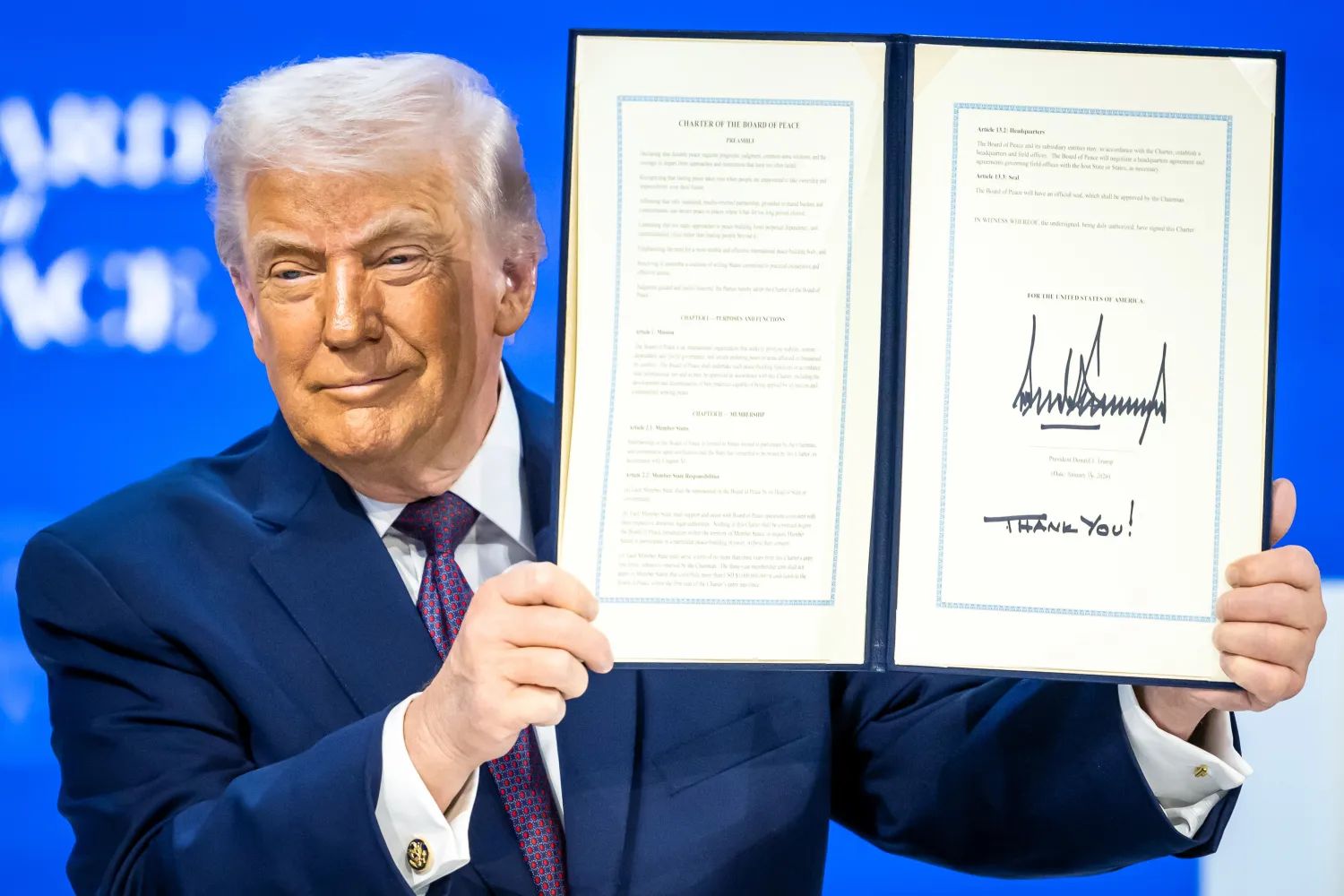

Trump Launches 'Board of Peace' at Davos

President Donald Trump, center, holds up a signed Board of Peace charter during the Annual Meeting of the World Economic Forum in Davos, Switzerland, Thursday, Jan. 22, 2026. (Gian Ehrenzeller/Keystone via AP)
TT

Trump Launches 'Board of Peace' at Davos

President Donald Trump, center, holds up a signed Board of Peace charter during the Annual Meeting of the World Economic Forum in Davos, Switzerland, Thursday, Jan. 22, 2026. (Gian Ehrenzeller/Keystone via AP)

US President Donald Trump kicked off his new "Board of Peace" at Davos on Thursday, with a signing ceremony for a body with a $1 billion membership fee and a controversial list of invitees. 

A group of leaders and senior officials from 19 countries -- including Trump allies from Argentina and Hungary -- gathered on stage with Trump to put their names to the founding charter of the body, AFP said. 

Trump -- who is the chairman of the Board of Peace -- said they were "in most cases very popular leaders, some cases not so popular. That's the way it goes in life." 

Originally meant to oversee peace in Gaza after the war between Hamas and Israel, the board's charter envisions a wider role in resolving international conflicts, sparking concerns that Trump wants it to rival the United Nations. 

Trump however said the organization would work "in conjunction" with the UN. 

The Board of Peace's potential membership has however proved controversial, with Trump having invited Russian President Vladimir Putin, who invaded Ukraine four years ago. 

Trump said Putin had agreed to join, while the Russian leader said he was still studying the invite. 

Permanent members must also pay $1 billion to join, leading to criticisms that the board could become a "pay to play" version of the UN Security Council. 

- UK, France snub signing - 

Key US allies including France and Britain have expressed skepticism, with the UK saying Thursday it would not attend the ceremony. 

The members on stage largely held close ties to Trump, including Hungary's Viktor Orban and Argentina's Javier Milei, or a wish to show their allegiance to the US president. 

Israeli Prime Minister Benjamin Netanyahu, who faces an International Criminal Court arrest warrant over the war in Gaza, has said he will join but was not at the ceremony. 

US Secretary of State Marco Rubio told the ceremony that the board's focus was "first and foremost on making sure that this peace deal in Gaza becomes enduring." 

Trump however said Hamas to disarm under the next phase of the Gaza ceasefire accord or it will be the "end of them." 

The launch of the board comes against the backdrop of Trump's frustration at having failed to win the Nobel Peace Prize, despite his disputed claim to have ended eight conflicts. 

- Trump to meet Zelensky - 

The inclusion of Putin has caused particular concern among US allies, but especially in Ukraine as it seeks an end to Moscow's nearly four-year-old invasion. 

Trump will meet Ukrainian President Volodymyr Zelensky in Davos after the "Board of Peace" ceremony to discuss a ceasefire in Ukraine -- the major peace deal that continues to elude him. 

Trump's special envoy Steve Witkoff, who is due to travel to Moscow to meet Putin later Thursday, said in Davos that talks to end the war had made a "lot of progress" and were down to one issue. 

"I think we've got it down to one issue, and we have discussed iterations of that issue, and that means it's solvable," said Witkoff, without saying what the issue was. 

Zelensky has meanwhile voiced fears that Trump's push to seize Greenland -- which has dominated Davos so far and threatened to unravel the transatlantic alliance -- could divert focus away from Russia's invasion of his country. 

Trump however said late Wednesday he had reached a "framework of a future deal" after meeting NATO chief Mark Rutte, and that he would therefore waive tariffs scheduled to hit European allies on February 1. 

He gave no further details, leaving Europeans drawing only cautious sighs of relief. A source close to the talks told AFP that a 1951 Greenland defenسe pact would be renegotiated as part of the deal. 


6 Killed in Swiss Bus Blaze after Person Reportedly Sets Themselves on Fire

Emergency personnel work at the site of a deadly bus fire in Kerzers, Switzerland, March 10, 2026. STATE OF FREIBURG/Handout via REUTERS
TT

6 Killed in Swiss Bus Blaze after Person Reportedly Sets Themselves on Fire

Emergency personnel work at the site of a deadly bus fire in Kerzers, Switzerland, March 10, 2026. STATE OF FREIBURG/Handout via REUTERS

At least six people died and three others were injured in a bus fire on Tuesday in a small town in western Switzerland, in what police said may have been a deliberate act following reports that a person on board set fire to themselves.

Police said the bus became engulfed in flames on a road in Kerzers, a town in the canton of Fribourg, about 20 km (12 miles) from the Swiss capital, Bern.

"At this stage, we have ⁠elements suggesting a ⁠deliberate act by a person who was inside the bus," said Frederic Papaux, a spokesperson for Fribourg police.

Investigators were looking into reports that a person had poured fuel on themselves, said Christa Bielmann, another local police spokesperson. It was too early to say whether the incident was terror-related, ⁠she told a press conference.

Three injured people were taken to hospital, Reuters quoted police as saying. Two other people caught up in the blaze also received attention but did not need to be hospitalized.

Passengers were seen escaping from the burning bus, panicked and injured, Papaux said, adding that no other vehicle was involved.

Swiss media outlet 20 Minutes said it had seen a video taken at the scene in which an injured person said: "A man set himself on fire. He poured gasoline ⁠over himself ⁠and then lit himself."

Video after the flames were extinguished showed the charred remains of the vehicle, a yellow so-called Postauto.

Swiss President Guy Parmelin offered his condolences and said the incident was being investigated.

"It shocks and saddens me that once again people have lost their lives in a serious fire in Switzerland," he said in a statement on X, noting investigations were under way. In January, Switzerland was rocked by a fire in a bar in the Swiss ski resort of Crans Montana that killed 41 people and injured 115.


Iran Police Chief Says Anti-Government Protesters Treated as ‘Enemies’

 People walk past closed shops at the nearly empty Tajrish traditional bazaar in northern Tehran, Iran, Tuesday, March 10, 2026. (AP)
People walk past closed shops at the nearly empty Tajrish traditional bazaar in northern Tehran, Iran, Tuesday, March 10, 2026. (AP)
TT

Iran Police Chief Says Anti-Government Protesters Treated as ‘Enemies’

 People walk past closed shops at the nearly empty Tajrish traditional bazaar in northern Tehran, Iran, Tuesday, March 10, 2026. (AP)
People walk past closed shops at the nearly empty Tajrish traditional bazaar in northern Tehran, Iran, Tuesday, March 10, 2026. (AP)

Iranian protesters will be treated as enemies if they support Tehran's foes, the country's top police officer warned, as the Middle East war sparked fears mass anti-government rallies could reignite.

"If anyone comes forward in line with the wishes of the enemy, we will no longer see them as merely a protester, we will see them as an enemy," said national police chief Ahmad-Reza Radan in comments aired by state broadcaster IRIB late on Tuesday.

"And we will do to them what we do to an enemy. We will deal with them in the same way we deal with enemies," he added.

"All our forces are also ready, with their hands on the trigger, prepared to defend their revolution."

His warning comes after the government cracked down on anti-government protests in January, sparked a month before over economic grievances in the sanctions-hit country.

The authorities deemed the protests to be "riots" and Radan at one point issued an ultimatum to protesters to hand themselves in or face the full force of the law.

Iranian authorities acknowledge more than 3,000 deaths in the unrest, including members of the security forces and bystanders, but say the violence was caused by "terrorist acts" fueled by Iran's enemies.

The US-based Human Rights Activists News Agency (HRANA), however, has recorded more than 7,000 killings in the crackdown, the vast majority protesters, though the toll may be far higher. More than 50,000 have been arrested, it says.

US President Donald Trump had initially cheered on the protesters, threatening to intervene on their behalf as authorities launched a deadly crackdown, but his threats soon shifted to Iran's nuclear program.

Washington launched strikes with Israel on Iran on February 28, sparking retaliatory strikes by Tehran against Israel and US bases across the Gulf region.


UN Warns Hormuz Standstill Will Hit World’s Most Vulnerable

 The Parnassos crude oil tanker sits anchored as the traffic is down in the Strait of Hormuz, amid the US-Israeli conflict with Iran, in Muscat, Oman, March 10, 2026. (Reuters)
The Parnassos crude oil tanker sits anchored as the traffic is down in the Strait of Hormuz, amid the US-Israeli conflict with Iran, in Muscat, Oman, March 10, 2026. (Reuters)
TT

UN Warns Hormuz Standstill Will Hit World’s Most Vulnerable

 The Parnassos crude oil tanker sits anchored as the traffic is down in the Strait of Hormuz, amid the US-Israeli conflict with Iran, in Muscat, Oman, March 10, 2026. (Reuters)
The Parnassos crude oil tanker sits anchored as the traffic is down in the Strait of Hormuz, amid the US-Israeli conflict with Iran, in Muscat, Oman, March 10, 2026. (Reuters)

The standstill in the Strait of Hormuz caused by the Middle East war could hammer some of the world's most vulnerable people, the United Nations warned Tuesday.

The strait is the only sea passage from the Gulf towards the Indian Ocean, through which nearly a quarter of the world's seaborne oil supplies pass, as well as a significant amount of cargo.

Iran has all but blocked the waterway following the launch of the February 28 US-Israeli airstrikes on the country that triggered the war.

"The current shock comes at a time when many developing economies struggle to service their debt, face a tightening of fiscal space and limited capacity to absorb new price shocks," the UN trade and development agency UNCTAD said.

"Higher energy, fertilizer and transport costs -- including freight rates, bunker fuel prices and insurance premiums -- may increase food costs and intensify cost-of-living pressures, particularly for the most vulnerable," it said.

UNCTAD added that, in terms of seaborne trade volume, in the week before the conflict 38 percent of crude oil, 29 percent of liquified petroleum gas, 19 percent of liquified natural gas and 19 percent refined oil products went through the strait.

But while an average of 129 ships transited daily through the passage between February 1 and 27, that number dropped to just three on March 3.

UNCTAD said the disruptions underscored the vulnerability of critical maritime chokepoints and their potential for disruption to them to send shocks across supply chains and commodity markets.

"Rising energy, transport and food costs could strain public finances and increase pressure on household budgets, potentially heightening economic and social pressures... particularly in economies heavily dependent on imported energy, fertilizers and staple foods," it said.

- Food aid hit -

UN rights chief Volker Turk echoed the alarm for the effect the plunge in commercial shipping activity could have, "particularly for the world's most vulnerable".

"The impact of an oil price surge will have a knock-on effect for macro-economic and social stability in many countries, particularly those already experiencing debt distress," he said.

The UN's World Food Program said the costs and time lost to the Strait of Hormuz disruptions were already impacting its humanitarian operations.

"This is nothing less than another seminal moment in global supply chain history," Jean-Martin Bauer, the director of WFP's food and nutrition analysis service, told reporters in Geneva.

Speaking from the WFP's Rome headquarters, he said shipping lines were diverting services and adding surcharges, leading to congestion "in places that are very far from Hormuz".

"We're seeing congestion in Asia. It's quite a severe disruption that's taking place right now," Bauer said.

"We're needing to go the long way around the Cape of Good Hope to reach some of our key geographies."

WFP's biggest operation is in Sudan, but now it is facing approximately 25 days of additional shipping time.

"It's basically 50 percent more than we would usually have. So that's really extending the supply chain and adding to cost," said Bauer.
