


Kushner's Vision for Rebuilding Gaza Faces Major Obstacles

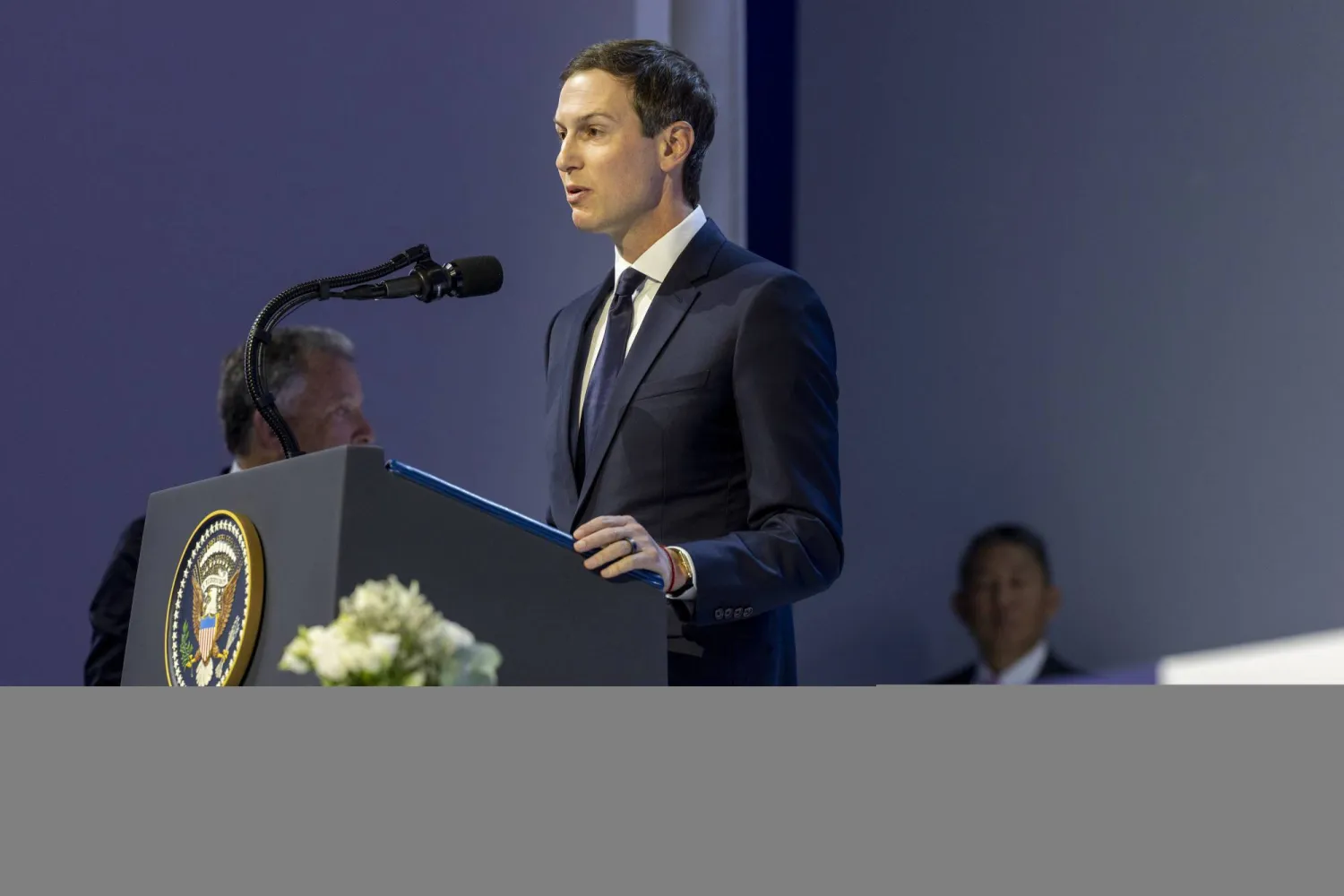
22 January 2026, Switzerland, Davos: Former Senior Advisor to the US President Jared Kushner speaks during the "Board of Peace" initiative at the World Economic Forum Annual Meeting in Davos. Photo: Benedikt von Loebell/World Economic Forum/dpa
TT

Kushner's Vision for Rebuilding Gaza Faces Major Obstacles

22 January 2026, Switzerland, Davos: Former Senior Advisor to the US President Jared Kushner speaks during the "Board of Peace" initiative at the World Economic Forum Annual Meeting in Davos. Photo: Benedikt von Loebell/World Economic Forum/dpa

Modern cities with sleek high-rises, a pristine coastline that attracts tourists and a state-of-the-art port that jut into the Mediterranean. This is what Jared Kushner, President Donald Trump's son-in-law and Middle East adviser, says Gaza could become, according to a presentation he gave at an economic forum in Davos, Switzerland.

In his 10-minute speech on Thursday, Kushner claimed it would be possible - if there's security - to quickly rebuild Gaza's cities, which are now in ruins after more than two years of war between Israel and Hamas, The Associated Press said.

“In the Middle East, they build cities like this ... in three years," said Kushner, who helped broker the ceasefire in place since October. “And so stuff like this is very doable, if we make it happen.”

That timeline is at odds with what the United Nations and Palestinians expect will be a very long process to rehabilitate Gaza. Across the territory of roughly 2 million people, former apartment blocks are hills of rubble, unexploded ordnance lurks beneath the wreckage, disease spreads because of sewage-tainted water and city streets look like dirt canyons.

The United Nations Office for Project Services says Gaza has more than 60 million tons of rubble, enough to fill nearly 3,000 container ships. That will take over seven years to clear, they say, and then additional time is needed for demining.

Kushner spoke as Trump and an assortment of world leaders gathered to ratify the charter of the Board of Peace, the body that will oversee the ceasefire and reconstruction process.

Here are key takeaways from the presentation, and some questions raised by it:

Reconstruction hinges on security Kushner said his reconstruction plan would only work if Gaza has “security” — a big “if.”

It remains uncertain whether Hamas will disarm, and Israeli troops fire upon Palestinians in Gaza on a near-daily basis.

Officials from the militant group say they have the right to resist Israeli occupation. But they have said they would consider “freezing” their weapons as part of a process to achieve Palestinian statehood.

Since the latest ceasefire took effect Oct. 10, Israeli troops have killed at least 470 Palestinians in Gaza, including young children and women, according to the territory's Health Ministry. Israel says it has opened fire in response to violations of the ceasefire, but dozens of civilians have been among the dead.

In the face of these challenges, the Board of Peace has been working with Israel on “de-escalation,” Kushner said, and is turning its attention to the demilitarization of Hamas - a process that would be managed by the US-backed Palestinian committee overseeing Gaza.

It's far from certain that Hamas will yield to the committee, which goes by the acronym NCAG and is envisioned eventually handing over control of Gaza to a reformed Palestinian Authority. Hamas says it will dissolve the government to make way, but has been vague about what will happen to its forces or weapons. Hamas seized control of Gaza in 2007 from the Palestinian Authority.

Another factor that could complicate disarmament: the existence of competing armed groups in Gaza, which Kushner's presentation said would either be dismantled or “integrated into NCAG.” During the war, Israel has supported armed groups and gangs of Palestinians in Gaza in what it says is a move to counter Hamas.

Without security, Kushner said, there would be no way to draw investors to Gaza and or stimulate job growth. The latest joint estimate from the UN, the European Union and the World Bank is that rebuilding Gaza will cost $70 billion.

Reconstruction would not begin in areas that are not fully disarmed, one of Kushner’s slides said.

Kushner's plan avoids mention of what Palestinians do in meantime. When unveiling his plan for Gaza's reconstruction, Kushner did not say how demining would be handled or where Gaza’s residents would live as their areas are being rebuilt. At the moment, most families are sheltering in a stretch of land that includes parts of Gaza City and most of Gaza's coastline.

In Kushner's vision of a future Gaza, there would be new roads and a new airport — the old one was destroyed by Israel more than 20 years ago — plus a new port, and an area along the coastline designated for “tourism” that is currently where most Palestinians live. The plan calls for eight “residential areas” interspersed with parks, agricultural land and sports facilities.

Also highlighted by Kushner were areas for “advanced manufacturing,” “data centers,” and an “industrial complex,” though it is not clear what industries they would support.

Kushner said construction would first focus on building “workforce housing” in Rafah, a southern city that was decimated during the war and is currently controlled by Israeli troops. He said rubble-clearing and demolition were already underway there.

Kushner did not address whether demining would occur. The United Nations says unexploded shells and missiles are everywhere in Gaza, posing a threat to people searching through rubble to find their relatives, belongings, and kindling.

Rights groups say rubble clearance and demining activities have not begun in earnest in the zone where most Palestinians live because Israel has prevented the entry of heavy machinery.

After Rafah will come the reconstruction of Gaza City, Kushner said, or “New Gaza,” as his slide calls it. The new city could be a place where people will “have great employment," he said.

Will Israel ever agree to this? Nomi Bar-Yaacov, an international lawyer and expert in conflict resolution, described the board’s initial concept for redeveloping Gaza as “totally unrealistic” and an indication Trump views it from a real estate developer's perspective, not a peacemaker's.

A project with so many high-rise buildings would never be acceptable to Israel because each would provide a clear view of its military bases near the border, said Bar-Yaacov, who is an associate fellow at the Geneva Centre for Security Policy.

What's more, Kushner’s presentation said the NCAG would eventually hand off oversight of Gaza to the Palestinian Authority after it makes reforms. But Prime Minister Benjamin Netanyahu has adamantly opposed any proposal for postwar Gaza that involves the Palestinian Authority.



Israel Aims to Ensure More Palestinians Are Let Out of Gaza than Back In

People stand at the gate of the border crossing between Egypt and the Gaza Strip, in Rafah, Egypt, February 11, 2025. REUTERS/Amr Abdallah Dalsh
TT

Israel Aims to Ensure More Palestinians Are Let Out of Gaza than Back In

People stand at the gate of the border crossing between Egypt and the Gaza Strip, in Rafah, Egypt, February 11, 2025. REUTERS/Amr Abdallah Dalsh

Israel wants to restrict the number of Palestinians entering Gaza through the border crossing with Egypt to ensure that more are allowed out than ​in, three sources briefed on the matter said ahead of the border's expected opening next week.

The head of a transitional Palestinian committee backed by the US to temporarily administer Gaza, Ali Shaath, announced on Thursday that the Rafah Border Crossing - effectively the sole route in or out of Gaza for nearly all of the more than 2 million people who live there - would open next week.

The border was supposed to have opened during the initial phase of President Donald Trump's plan to end the war, under a ceasefire reached in October between Israel and Hamas.

Earlier this month, Washington announced that the plan had now ‌moved into the ‌second phase, under which Israel is expected to withdraw troops further from ‌Gaza ⁠and ​Hamas ‌is due to yield control of the territory's administration. The Gaza side of the crossing has been under Israeli military control since 2024.

The three sources, who spoke on condition of anonymity due to the sensitivity of the issue, said it was still not clear how Israel planned to enforce limits on the number of Palestinians entering Gaza from Egypt, or what ratio of exits to entries it aimed to achieve, Reuters reported.

Israeli officials have spoken in the past about encouraging Palestinians to emigrate from Gaza, although they deny intending to transfer the population out by force. Palestinians ⁠are highly sensitive to any suggestion that Gazans could be expelled, or that those who leave temporarily could be barred from returning.

The Rafah ‌Crossing is expected to be staffed by Palestinians affiliated with the ‍Ramallah-based Palestinian Authority and monitored by EU personnel, ‍as took place during an earlier, weeks-long ceasefire between Israel and Hamas early last year.

The Israeli ‍prime minister's office did not immediately respond to a request for comment for this story. The military referred questions to the government, declining to comment.

The three sources said that Israel also wants to establish a military checkpoint inside Gaza near the border, through which all Palestinians entering or leaving would be required to pass and be subjected to Israeli ​security checks.

Two other sources also said that Israeli officials had insisted on setting up a military checkpoint in Gaza to screen Palestinians moving in and out.

The US Embassy in ⁠Israel did not immediately respond to a request for comment on whether Washington supported Israel in limiting the number of Palestinians entering Gaza or setting up a checkpoint to screen those entering and leaving.

Under the initial phase of Trump's plan, the Israeli military partially pulled back its forces within Gaza but retained control of 53% of the territory including the entire land border with Egypt. Nearly all of the territory's population lives in the rest of Gaza, under Hamas control and mostly in makeshift tents or damaged buildings.

The sources said that it was not clear how individuals would be dealt with if they were blocked by Israel's military from passing through its checkpoint, particularly those entering from Egypt.

The Israeli government has repeatedly objected to the opening of the border, with some officials saying Hamas must first return the body of an Israeli police officer held in Gaza, the ‌final human remains of a hostage due to be transferred under the ceasefire's first phase.

US officials in private say that Washington, not Israel, is driving the rollout of the president's plan to end the war.


Syrian Government Says It Controls Prison in Raqqa with ISIS-linked Detainees

A Syrian army soldier stands guard as Kurdish-led Syrian Democratic Forces (SDF) forces withdraw from al-Aqtan prison on the outskirts of the northeastern city of Raqqa, bound for Kobani, on January 23, 2026. (AFP)
TT

Syrian Government Says It Controls Prison in Raqqa with ISIS-linked Detainees

A Syrian army soldier stands guard as Kurdish-led Syrian Democratic Forces (SDF) forces withdraw from al-Aqtan prison on the outskirts of the northeastern city of Raqqa, bound for Kobani, on January 23, 2026. (AFP)

Syria's Interior Ministry said on Friday it had taken over al-Aqtan prison in the city of Raqqa ​in northeastern Syria, a facility that was formerly under the control of Kurdish-led Syrian Democratic Forces (SDF).

The prison has been holding detainees linked to the ISIS group, and witnessed clashes in Its vicinity this week between advancing Syrian government forces and the SDF.

It ‌was not ‌immediately clear how many ‌ISIS ⁠detainees ​remain in al-Aqtan ‌prison as the US military has started transferring up to 7,000 prisoners linked to the extremist group from Syrian jails to neighboring Iraq. US officials say the detainees are citizens of many countries, including in Europe.

"Specialized teams were ⁠formed from the counter-terrorism department and other relevant authorities to ‌take over the tasks of guarding ‍and securing the prison ‍and controlling the security situation inside it," ‍the Interior Ministry said in a statement.

Under a sweeping integration deal agreed on Sunday, responsibility for prisons housing ISIS detainees was meant to be transferred to ​the Syrian government.

The SDF said on Monday it was battling Syrian government forces near ⁠al-Aqtan and that the seizure of the prison by the government forces "could have serious security repercussions that threaten stability and pave the way for a return to chaos and terrorism".

The US transfer of ISIS prisoners follows the rapid collapse of Kurdish-led forces in northeast Syria. Concerns over prison security intensified after the escape on Tuesday of roughly 200 low-level ISIS fighters from Syria's ‌Shaddadi prison. Syrian government forces later recaptured many of them.


Lebanese Judiciary Summons Hezbollah Supporters Following Insults to Aoun

Hezbollah supporters carry a Hezbollah flag as they flash the victory sign during a rally in a southern suburb of Beirut, Lebanon, 21 January 2026. (EPA)
TT

Lebanese Judiciary Summons Hezbollah Supporters Following Insults to Aoun

Hezbollah supporters carry a Hezbollah flag as they flash the victory sign during a rally in a southern suburb of Beirut, Lebanon, 21 January 2026. (EPA)

The Lebanese judiciary issued on Thursday summons of Hezbollah supporters who had slandered President Joseph Aoun in wake of his criticism of the Iran-backed party.

Aoun has made repeated statements in recent weeks over the need to impose state monopoly over weapons, effectively disarming Hezbollah.

The government had last year taken a landmark decision to impose state monopoly over arms. Hezbollah has refused to lay down its weapons, putting it at odds with the state, and most recently Aoun.

Lebanon is keen on preventing itself from being dragged into "suicidal adventures, whose price we paid dearly for in the past," he said on Tuesday, which was seen as an indirect reference to Hezbollah.

A judicial source told Asharq Al-Awsat that the judiciary summoned on Thursday a Lebanese journalist who is close to Hezbollah over a video he posted online. The journalist ignored the summons, saying that as a journalist he does not have to appear before the judicial police, but rather the "Press Court".

The source added that another summons will be made over insults levelled against the president.

Lebanon's Public Prosecution allows the judiciary to act without prompting in three cases: the first over attacks against the character of the president, the second, attacks against the army and third, attacks against the judiciary.

Attacks and slander against any other parties are addressed when a complaint is filed. The source said the presidency did not file a complaint to the judiciary over the campaign against Aoun.

Hezbollah supporters had been vocally criticizing Aoun on social media over his recent stances. The posts did not shy away from using offensive language against the president.

Lebanese law allows summons when insults are made against the president in order to protect constitutional institutions. Any country, during strained political times, is concerned with protecting its constitutional figures and entities while still respecting freedom of expression and the press.

The recent summons are not aimed at undermining freedom of expression, but drawing a line between how much criticism can be levelled and between insulting the president's character and infringing on a constitutional figure, explained the source. Political criticism is acceptable, but a line is drawn when personal insults are made.

Lawyer Farouk al-Moghrabi told Asharq Al-Awsat that the Lebanese judiciary clearly details the measures that should be taken when it comes to the president.

The president has the right to file a complaint or the Public Prosecution can act without being prompted when he comes under attack, he added.