
Massive Winter Storm Threatens Heavy Snow, Freezing Rain, to More than 170 million People Across US

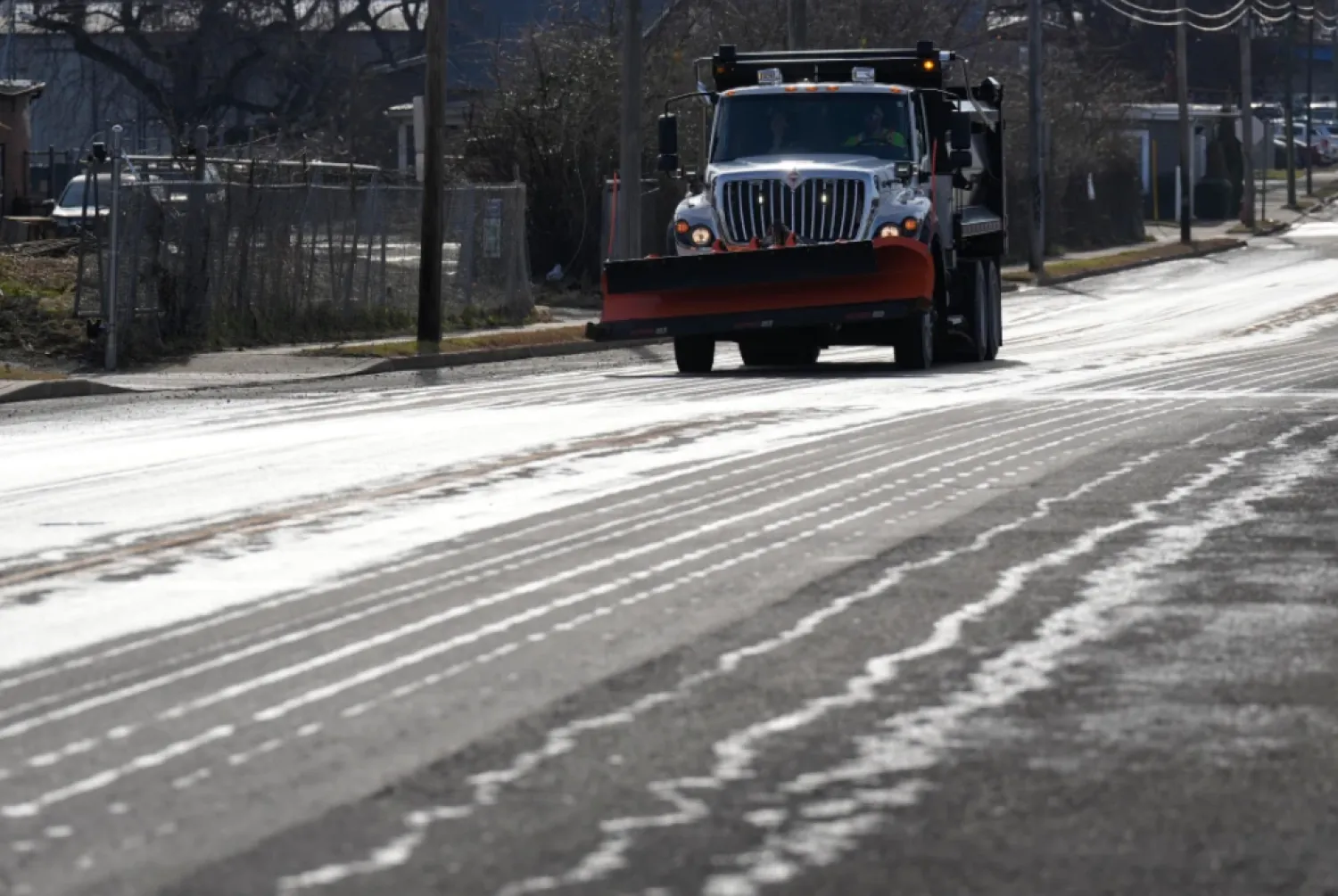
A Nashville Department of Transportation truck applies salt brine to a roadway Thursday, Jan. 22, 2026, in Nashville, Tenn. ahead of a winter storm expected to hit the state over the weekend. (AP Photo/George Walker IV)
TT

Massive Winter Storm Threatens Heavy Snow, Freezing Rain, to More than 170 million People Across US

A Nashville Department of Transportation truck applies salt brine to a roadway Thursday, Jan. 22, 2026, in Nashville, Tenn. ahead of a winter storm expected to hit the state over the weekend. (AP Photo/George Walker IV)

Texas and Oklahoma braced for heavy snow and ice that could make roadways treacherous Friday in what is expected to be some of the initial effects of a huge, dayslong winter storm threatening catastrophic damage, extensive power outages and bitterly cold weather to more than 170 million people across the nation, the National Weather Service says — about half the population.

A combination of heavy snow, freezing rain and sleet is in store from the Southern Rockies to New England through Monday, the agency said.

And even when that's over, a round of extremely cold air will hit areas of the Southern Plains to the Northeast next week, the weather service said.

More than 800 flights within, into, or out of the United States were delayed or canceled for Friday in advance of the storm, including at airports in Dallas, Atlanta, and Oklahoma, according to the flight tracking website FlightAware, according to The AP news.

Oklahoma's Department of Transportation pretreated roads with salt brine. The state Highway Patrol canceled days off for troopers so more will be out assist and said it was partnering with the National Guard to send teams out to help stranded drivers.

“Travel is going to become more and more treacherous starting late Friday afternoon and lasting through the rest of the weekend,” the National Weather Service in Norman, Oklahoma, posted online.

Oklahoma City Public Schools officials canceled all classes and activities Friday due to predicted deteriorating road conditions. Frigid temperatures closed Houston schools Friday with an e-learning day for public school students. In Dallas, schools were expected to open, but officials said after-school activities were canceled Friday and throughout the weekend.

In the Houston area, a utility company had 3,300 employees ready to work the winter storm.

“It’s all hands on deck,” Houston Mayor John Whitmire posted online. “We’re hoping for the best, but prepared for the worst.”

Snow, freezing rain, sleet and low temps for many The massive storm system is expected to bring a crippling ice storm from Texas through parts of the South, potentially more than a foot (30 centimeters) of snow from Oklahoma through Washington, D.C., New York and Boston, and then a final punch of bitterly cold air that could drop wind chills to minus 50 degrees Fahrenheit (minus 46 Celsius) in parts of Minnesota and North Dakota.

Forecasters are warning the damage, especially in areas pounded by ice, could rival a hurricane. Many people were under winter storm or cold weather watches or warnings — and in many places both.

Cold air streaming down from Canada caused Chicago Public Schools and Des Moines Public Schools in Iowa to cancel classes Friday, as well. Wind chills predicted to be as low as minus 35 degrees Fahrenheit (minus 37 Celsius) could cause frostbite within 10 minutes, making it too dangerous to walk to school or wait for the bus.

The cold punch coming after means it will take a while to thaw out, an especially dangerous prospect in places where ice and snow weighs down tree branches and power lines and cuts electricity, perhaps for days. Roads and sidewalks could remain icy well into next week.

Ice can add hundreds of pounds to power lines and branches and make them more susceptible to snapping, especially in windy weather.

Freezing temperatures are expected all the way to Florida, forecasters said.

A severe cold snap five years ago took down much of the power grid in Texas, leaving millions without power for days and resulting in hundreds of deaths. Gov. Greg Abbott said Thursday that won't happen again, saying the power system “has never been stronger.”

Winter storms can be notoriously tricky to forecast, with forecasters saying the places with the worst weather can't be pinned down until the event starts.

States of emergency declared in Georgia and Mississippi Governors in Georgia and Mississippi have declared states of emergency.

In Huntsville, Alabama, employees from Jomo’s Power Equipment, Parts & Service Inc. sold dozens of generators within about a day and ordered an emergency shipment to meet customer demand.

“I’d say 95% of the calls were generator-related or either service or ‘Do you have any generators in stock,’” Bryan Hill, the store's manager, said Thursday.

Lindsay Sylvester in Toney, Alabama, stocked up early in the week on bread and other supplies at her home and sent her son, who is in college, bread, gloves, candles and hand warmers.

Sylvester said she went to the store early in the week because she knew supplies would be depleted close to the weekend.

“A couple of people I heard talking about they had gone to Walmart and there was no milk, no bread,” she said. “All the necessities were gone.”

As a precaution, North Carolina’s largest public school system prepared for potentially several days out of physical classrooms next week, telling its teachers to create three days of assignments accessible online or through paper copies.

Virginia Gov. Abigail Spanberger told residents to prepare for days without power or the ability to leave their neighborhoods. And in a nod to the politics of the time, the newly inaugurated Democrat said people should not be scared to call 911 in an emergency just because of the immigration crackdowns going on in places like Minnesota.

Arkansas Department of Transportation spokesperson Dave Parker pleaded for people to be patient and stay home if possible once the storm hits.

At a busy grocery store near downtown Dallas, Kennedi Mallard and Frank Green loaded two shopping carts full of supplies into their car. They said there were some bare shelves inside.

“No water, no eggs, no butter, no ground meat,” Green said.


New York Seeks Rights for Beloved but Illegal ‘Bodega Cats’

Guest Dan Rimada, founder of Bodega Cats of New York holds a cat named Ashley in a bodega corner store on December 17, 2025 in New York City. (AFP)
TT

New York Seeks Rights for Beloved but Illegal ‘Bodega Cats’

Guest Dan Rimada, founder of Bodega Cats of New York holds a cat named Ashley in a bodega corner store on December 17, 2025 in New York City. (AFP)

Simba, a large cat with thick ginger and white fur, is one of thousands of felines that live in New York's corner shops known as "bodegas" -- even if their presence is illegal.

Praised for warding off pests, so-called bodega cats are also a cultural fixture for New Yorkers, some of whom are now pushing to enshrine legal rights for the little store helpers.

"Simba is very important to us because he keeps the shop clean of the mice," Austin Moreno, a shopkeeper in Manhattan, told AFP from behind his till.

The fluffy inhabitant also helps to entice customers.

"People, very often, they come to visit to ask, what is his name? The other day, some girls saw him for the first time and now they come every day," said Moreno.

Around a third of the city's roughly 10,000 bodegas are thought to have a resident cat despite being liable to fines of $200-$350 for keeping animals in a store selling food, according to Dan Rimada, founder of Bodega Cats of New York.

Rimada photographs the felines for his social media followers and last year launched a petition to legalize bodega cats, which drew nearly 14,000 signatures.

"These cats are woven into the fabric of New York City, and that's an important story to tell," he said.

- Pressure point -

Inspired by Rimada's petition, New York City council member Keith Powers has proposed a measure to shield the owners of bodega cats from penalties.

His legislation would also provide free vaccinations and spay or neuter services to the felines.

But animal shelters and rights groups say this wouldn't go far enough.

While Simba can nap in the corner of his shop with kibble within paw's reach, many of his fellow cats are locked in basements, deprived of food or proper care, and abandoned when they grow old or fall ill.

Becky Wisdom, who rescues cats in New York, warned that lifting the threat of fines could remove "leverage" to encourage bodega owners to better care for the animals.

She also opposes public funds being given to business owners rather than low-income families who want their cats spayed or neutered.

The latter is a big issue in New York, where the stray cat population is estimated at around half a million.

- Radical overhaul -

Regardless of what the city decides, it is the state of New York that has authority over business rules, said Allie Taylor, president of Voters for Animal Rights.

Taylor said she backs another initiative proposed by state assembly member Linda Rosenthal, a prominent animal welfare advocate, who proposes allowing cats in bodegas under certain conditions.

These would include vet visits, mandatory spaying or neutering, and ensuring the cats have sufficient food, water and a safe place to sleep.

Beyond the specific case of bodega cats, Taylor is pushing for a more radical overhaul of animal protection in New York.

"Instead of focusing on one subset of cats, we need the city to make serious investments, meaning tens of millions of dollars per year into free or low cost spay, neuter and veterinary care," she said.


Warming Climate Threatens Greenland’s Ancestral Way of Life

Musher Nukaaraq Lennert Olsen offers some dry food to his dogs after a ride near the "dog town" ofSisimiut, Greenland on January 31, 2026. (AFP)
TT

Warming Climate Threatens Greenland’s Ancestral Way of Life

Musher Nukaaraq Lennert Olsen offers some dry food to his dogs after a ride near the "dog town" ofSisimiut, Greenland on January 31, 2026. (AFP)

Standing in his boat with binoculars in hand, hunter Malik Kleist scans the horizon for seals. But this February, the sea ice in southwestern Greenland has yet to freeze, threatening traditional livelihoods like his.

"Normally the seals are on the ice or in the more calm waters. But today we had to sail all the way into the fjords to find them," the 37-year-old tells AFP.

The Arctic region is on the frontline of global warming, heating up four times faster than the rest of the planet since 1979, according to a 2022 study in scientific journal Nature, causing the sea ice to retreat.

Seals rely on pack ice to give birth, to rest and for protection.

Hunters increasingly have to sail farther along the jagged coast of Sisimiut, navigating into the fjords for several hours to find them.

Traditionally, hunters' boats would head straight out to sea, slowly pushing through the ice and creating holes that attract seals coming up for air.

But without any ice, "it's too windy and the waves are too big," Kleist says.

Last year was exceptionally warm in the vast autonomous territory, with several temperature records beaten, according to the Danish Meteorological Institute (DMI).

In December, the Summit Station, located at the height of Greenland's ice sheet, recorded an average temperature of -30.9 degrees C (-23.6 Fahrenheit), 8.1C higher than the December average during the period 1991-2020.

"It affects everything we do. Because normally around November, December the ice comes. And this year there's no ice, so it affects our living a lot," Kleist says.

- Financial woes -

For the same reason, the government has also had to postpone the annual winter musk ox hunt that was due to start on January 31.

There wasn't enough snow and ice to transport the massive animals that roam the Arctic tundra back from Kangerlussuaq where they are predominantly found, around 165 kilometers (103 miles) away. Greenland has no roads connecting its towns.

That has left some Sisimiut hunters with less income than usual.

"This time of year there is not much to hunt. So we rely on musk ox meat and skin," Kleist says.

"Many of my fellow hunters are struggling with money right now."

Every part of the animal, from the fur to the meat, is either used or sold.

The summer hunting season has therefore gained importance, enabling Greenlanders to fill their freezers to get them through the winter months, he tells AFP over a steaming bowl of fish stew.

The shorter winter season has also impacted another key activity in Greenland, one that has become increasingly important to the tourism sector: dogsled tours.

In the Sisimiut neighborhood where the dogs are kept, their thunderous barking mounts as Nukaaraq Olsen, a 21-year-old musher, attaches them to the sled.

Raring to get going, his 18 dogs are hard to hold back. Twenty minutes later, the group bounds off.

But the road is bumpy, and several times Olsen has to get up to manually push the sled, stuck on the tundra's rocks in patches where there is no ice.

"This year we had a lot of hot, warm days, even though it's December or January," he says.

Other parts of the route are no longer safe to use, due to repeated melting and freezing of snowfall which causes uneven layers, he explains.

- Dehydrated dogs -

The dogs' health is also affected by the changing climate.

They are used to quenching their thirst with snow, but with little or no snowfall, they can easily get dehydrated. Mushers have to take that into account when caring for their animals.

Many have even had to get rid of their dogs, the business of maintaining them no longer profitable with the dogsled season shrinking to just two months, says Emilie Andersen-Ranberg, a researcher at the University of Copenhagen who runs a dog clinic in Sisimiut.
Others, such as 72-year-old Johanne Bech, are finding novel ways to adapt.

She plans to put wheels on her sled to continue running dogsled tours during the summer period.

That solution is growing in popularity, as "the window with snow is getting more and more narrow," the veterinarian says.

Over the past 20 years, the number of sleddogs has been halved from 25,000 to 13,000, according to a 2024 article from the University of Greenland in 2024.

Yet Johanne Bech remains optimistic about the future.

"I hope this is just for a short time, so we can go back to a little more stable snow or more ice in the future."


January Was Fifth Hottest on Record despite Cold Snap

This handout photo taken on February 7, 2026 and received on February 10 from Japan's Ministry of Defense shows members of the Japan Ground Self-Defense Force's 5th Infantry Regiment, stationed in Aomori Prefecture, carrying out snow removal work in a town within Aomori Prefecture. (Photo by Handout / Japan's Ministry of Defense / AFP)
TT

January Was Fifth Hottest on Record despite Cold Snap

This handout photo taken on February 7, 2026 and received on February 10 from Japan's Ministry of Defense shows members of the Japan Ground Self-Defense Force's 5th Infantry Regiment, stationed in Aomori Prefecture, carrying out snow removal work in a town within Aomori Prefecture. (Photo by Handout / Japan's Ministry of Defense / AFP)

The planet experienced its fifth-hottest January on record despite a cold snap that swept across the United States and Europe, the EU's climate monitor said Tuesday.

The Northern Hemisphere was hit by severe cold waves in the final weeks of January as a polar jet stream blew icy air into Europe and North America, according to the Copernicus Climate Change Service.

But monthly temperatures were above average over much of the globe, including in large parts of the Arctic and western North America, according to Copernicus.

"January 2026 delivered a stark reminder that the climate system can sometimes simultaneously deliver very cold weather in one region, and extreme heat in another," said Samantha Burgess, strategic lead for climate at the European Centre for Medium-Range Weather Forecasts (ECMWF).

The average global temperature in January was 1.47C above preindustrial times.

Europe endured its coldest January since 2010, with an average temperature of 2.34C, the service said.

The United States, meanwhile, was hit by a monster winter storm that dumped snow and crippling ice from New Mexico to Maine. It was linked to more than 100 deaths.

The planet remains in an extended run of human-driven warming, with 2024 setting a record high, 2023 ranking second 2025 now third warmest.