


Hamas Disarmament, Reconstruction Plan Hinge on Gaza Truce Understandings

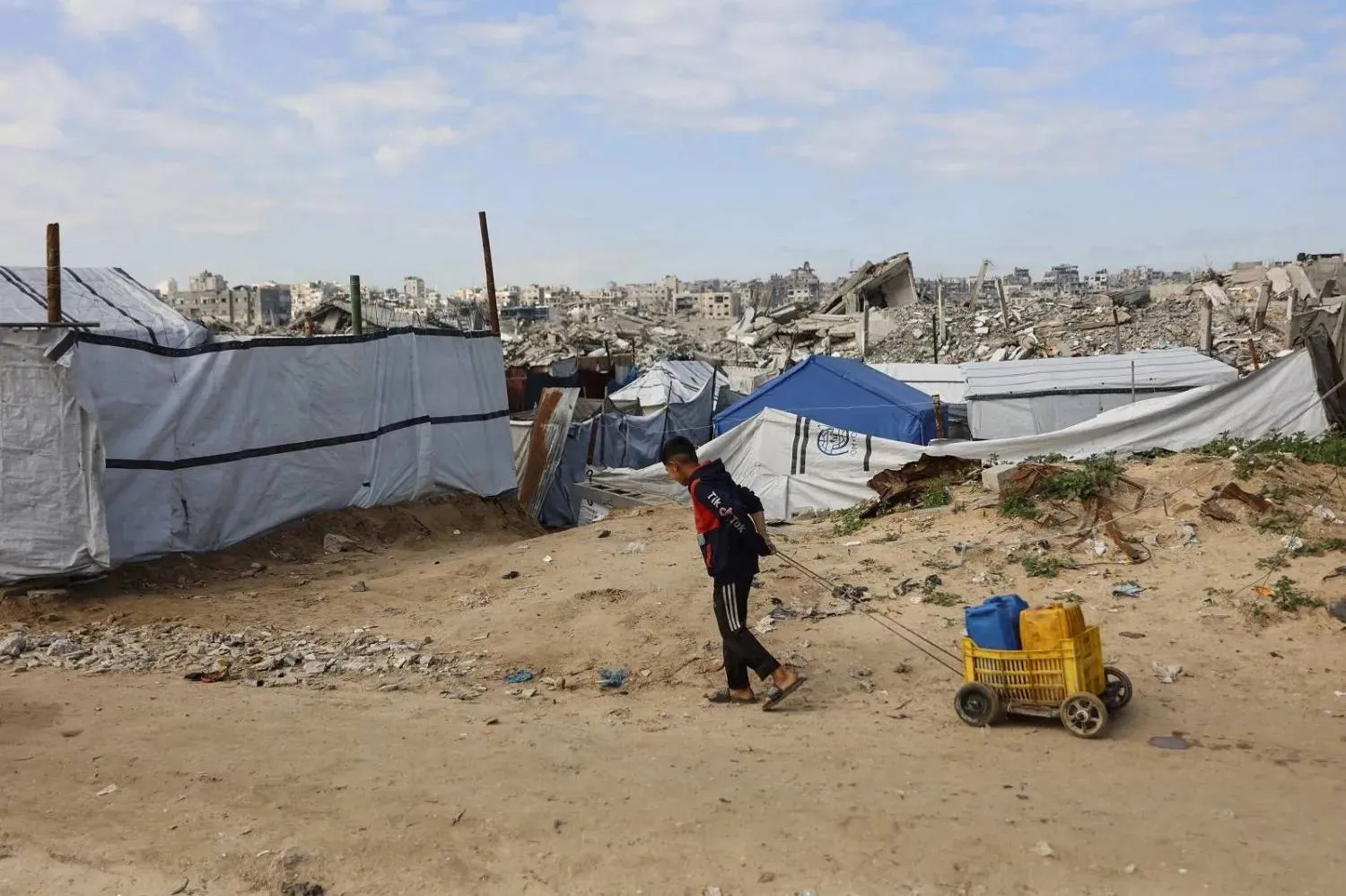
A Palestinian child pulls containers filled with water at the Jabalia refugee camp in the northern Gaza Strip (AFP)
TT

Hamas Disarmament, Reconstruction Plan Hinge on Gaza Truce Understandings

A Palestinian child pulls containers filled with water at the Jabalia refugee camp in the northern Gaza Strip (AFP)

Attention is once again turning to the stalled second phase of the Gaza ceasefire agreement, as momentum builds toward its long-delayed implementation and questions mount over how its most contentious provisions will be handled, notably those concerning the disarmament of Hamas and the reconstruction of the war-ravaged enclave.

The anticipated provisions, unfolding amid ongoing Israeli obstacles and violations since the agreement took effect months ago, require further understanding to push the ceasefire forward, experts told Asharq Al-Awsat.

They estimated that Washington would exert significant pressure to complete the agreement, driven by its need to do so to support its presidency of the Peace Council, whose role remains disputed between the United States and Western countries.

Egyptian Foreign Minister Badr Abdelatty, in a phone call with his Emirati counterpart Sheikh Abdullah bin Zayed Al Nahyan, voiced support for US President Donald Trump’s initiative to launch the Peace Council and welcomed the move, according to a statement by Egypt’s Foreign Ministry on Friday.

Abdelatty stressed the importance of moving ahead with the requirements of the second phase of the US president’s plan, backing the national committee to administer Gaza, and swiftly deploying an international stabilization force to monitor the ceasefire, paving the way for early recovery and reconstruction.

Meanwhile, Israel’s i24NEWS website reported on Thursday that “understandings are taking shape between the United States and Hamas regarding disarmament in the Gaza Strip.” It said an upcoming meeting between US envoy Steve Witkoff and senior Hamas official Khalil al-Hayya would seek to bridge gaps between the two sides and examine whether a disarmament agreement could be advanced while preserving Israel’s security and reducing security threats.

Witkoff is expected to meet al-Hayya soon to discuss a draft agreement that includes, among other issues, arrangements for dismantling weapons in the enclave, including distinguishing between heavy and light arms, to sign what would be called an “understanding agreement” on firearms, rather than a weapons surrender deal.

Disarmament is not the only issue under discussion. Talk has also intensified over reconstruction, which Egypt and Arab states insist should cover the entire Gaza Strip, in line with the Egyptian plan approved by Arab leaders in March 2025.

By contrast, US President Trump’s son-in-law, Jared Kushner, said on Thursday in Davos that Washington envisions a “new Gaza,” transforming the war-ravaged territory into a luxury resort within three years.

Said Okasha, a political analyst specializing in Israeli affairs at the Al-Ahram Center for Political and Strategic Studies, said the remaining provisions of the Gaza agreement clearly require further understandings, especially on Hamas disarmament and reconstruction, given the current uncertainty over Israel’s positions.

He said Israel accepts low-intensity attacks but rejects any withdrawal or reconstruction without the complete disarmament of Hamas. Any gradual disarmament understandings may not be accepted and could obstruct the phase, pushing the parties back to new negotiations with mediators. Still, he said, there is no alternative to continuing talks at this critical time.

Palestinian political analyst Nizar Nazzal said the US understanding of Hamas’ weapons differs from Israel’s zero-tolerance approach, and that understandings may emerge from the Witkoff-al-Hayya meeting to freeze or manage the arms issue.

He expected Hamas to find common ground with Washington on the matter, bolstering implementation of the agreement.

In his speech at the Davos forum on Thursday, Kushner stressed that Hamas disarmament is one of the ceasefire provisions in force since Oct. 10, saying it would encourage companies and donors to commit to the enclave.

He outlined what he called a “new Gaza” within three years and called for at least $25 billion in investments to rebuild infrastructure and public services.

Okasha said Kushner’s plan may be the most likely to move forward, provided understandings are reached with mediators on how to implement it.

Nazzal, however, cast doubt on Kushner’s remarks, saying he presented videos depicting Gaza as a paradise, but that Washington’s track record in resolving the Israeli-Palestinian conflict does not inspire confidence, raising expectations that fighting could resume.

Amid these concerns, Israel’s public broadcaster reported on Thursday that Israel had settled the issue of operating the Rafah border crossing with Egypt, saying it would establish an additional crossing, “Rafah 2,” adjacent to the existing one and operated by Israel itself.

The broadcaster said the main crossing would be run by the European Union Border Assistance Mission, with participation from officers of the Palestinian Authority’s General Intelligence Service. In contrast, the new crossing would be subject to Shin Bet checks and Israeli remote screening procedures, including facial imaging and identity card verification.

Okasha said the new crossing would likely be built inside Palestinian territory rather than on the Egyptian border, possibly near the Karni crossing, noting that Cairo would reject any arrangement on its border with Israel.

He added that Israel does not want to take any additional steps under the agreement, but that US pressure remains decisive in implementing its provisions.

Nazzal said Israel does not want more crossings but seeks to assert its sovereignty through control over any crossing, using it to apply pressure in future solutions that advance its gains.

He stressed that the United States would not allow Israel or others to derail the “Trump plan,” predicting Israeli withdrawals, increased aid, the reopening of Rafah, and further positive developments.



Building Collapse in Lebanon's Tripoli Kills 13, Search for Missing Continues

Rescue workers and residents search for survivors in the rubble of a building that collapsed in the northern city of Tripoli, Lebanon, Sunday, Feb. 8, 2026. (AP Photo)
TT

Building Collapse in Lebanon's Tripoli Kills 13, Search for Missing Continues

Rescue workers and residents search for survivors in the rubble of a building that collapsed in the northern city of Tripoli, Lebanon, Sunday, Feb. 8, 2026. (AP Photo)

The death toll from the collapse of a residential building in the Lebanese city of Tripoli rose to 13, as rescue teams continued to search for missing people beneath the rubble, Lebanon's National News ‌Agency reported ‌on Monday. 

Rescue ‌workers ⁠in the ‌northern city's Bab al-Tabbaneh neighborhood have also assisted nine survivors, while the search continued for others still believed to be trapped under the ⁠debris, NNA said. 

Officials said on ‌Sunday that two ‍adjoining ‍buildings had collapsed. 

Abdel Hamid Karameh, ‍head of Tripoli's municipal council, said he could not confirm how many people remained missing. Earlier, the head of Lebanon's civil defense rescue ⁠service said the two buildings were home to 22 residents, reported Reuters. 

A number of aging residential buildings have collapsed in Tripoli, Lebanon's second-largest city, in recent weeks, highlighting deteriorating infrastructure and years of neglect, state media reported, ‌citing municipal officials. 


Salam Concludes Visit to South Lebanon: Region Must Return to State Authority

Lebanon's Prime Minister Nawaf Salam (L) holds bouquets of flower as he stands next to the mayor of the heavily-damaged southern village of Kfar Shouba, near the border with Israel, during his visit on February 8, 2026. (AFP)
TT

Salam Concludes Visit to South Lebanon: Region Must Return to State Authority

Lebanon's Prime Minister Nawaf Salam (L) holds bouquets of flower as he stands next to the mayor of the heavily-damaged southern village of Kfar Shouba, near the border with Israel, during his visit on February 8, 2026. (AFP)

Lebanese Prime Minister Nawaf Salam vowed on Sunday to work on rebuilding infrastructure in southern villages that were destroyed by Israel during its last war with Hezbollah.

On the second day of a tour of the South, he declared: “We want the region to return to the authority of the state.”

He was warmly received by the locals as he toured a number of border villages that were destroyed by Israel during the conflict. His visit included Kfar Kila, Marjeyoun, Kfar Shouba and Kfar Hamam. He kicked off his tour on Saturday by visiting Tyre and Bint Jbeil.

The visit went above the differences between the government and Hezbollah, which has long held sway over the South. Throughout the tour, Salam was greeted by representatives of the “Shiite duo” of Hezbollah and its ally the Amal movement, as well as MPs from the Change bloc and others opposed to Hezbollah.

In Kfar Kila, the locals raised a banner in welcome of the PM, also offering him flowers and an olive branch. The town was the worst hit during the war with Israel, which destroyed nearly 90 percent of its buildings and its forces regularly carrying out incursions there.

Salam said the town was “suffering more than others because of the daily violations and its close proximity to the border.”

He added that its residents cannot return to their homes without the reconstruction of its infrastructure, which should kick off “within the coming weeks.”

“Our visit underlines that the state and all of its agencies stand by the ruined border villages,” he stressed.

“The government will continue to make Israel commit” to the ceasefire agreement, he vowed. “This does not mean that we will wait until its full withdrawal from occupied areas before working on rehabilitating infrastructure.”

Amal MP Ali Hassan Khalil noted that the people cannot return to their town because it has been razed to the ground by Israel and is still coming under its attacks.

In Marjeyoun, Salam said the “state has long been absent from the South. Today, however, the army has been deployed and we want it to remain so that it can carry out its duties.”

“The state is not limited to the army, but includes laws, institutions, social welfare and services,” he went on to say.

Reconstruction in Marjeyoun will cover roads and electricity and water infrastructure. The process will take months, he revealed, adding: “The state is serious about restoring its authority.”

“We want this region to return to the fold of the state.”

MP Elias Jarade said the government “must regain the trust of the southerners. This begins with the state embracing and defending its people,” and protecting Lebanon’s sovereignty.

MP Firas Hamdan said the PM’s visit reflects his keenness on relations with the South.

Ali Murad, a candidate who ran against Hezbollah and Amal in Marjeyoun, said the warm welcome accorded to Salam demonstrates that the “state needs the South as much as the people of the South need the state.”

“We will always count on the state,” he vowed.

Hezbollah MP Hussein Jishi welcomed Salam’s visit, hoping “it would bolster the southerners’ trust in the state.”

Kataeb leader MP Sami Gemayel remarked that the warm welcome accorded to the PM proves that the people of the South “want the state and its sovereignty. They want legitimate institutions that impose their authority throughout Lebanon, without exception.”


Three Dead After Flooding Hits Northwest Syria

A child watches as civil defense teams open flooded roads in Idlib. (SANA)
TT

Three Dead After Flooding Hits Northwest Syria

A child watches as civil defense teams open flooded roads in Idlib. (SANA)

Two children and a Syrian Red Crescent volunteer have died as a result of flooding in the country's northwest, state media said on Sunday.

The heavy rains in Syria's Idlib region and the coastal province of Latakia have also wreaked havoc in displacement camps, according to authorities, who have launched rescue operations and set up shelters in the areas.

State news agency SANA reported "the death of a Syrian Arab Red Crescent volunteer and the injury of four others as they carried out their humanitarian duties" in Latakia province.

The Syrian Red Crescent said in a statement that the "a mission vehicle veered into a valley", killing a female volunteer and injuring four others, as they went to rescue people stranded by flash floods.

"A fifth volunteer was injured while attempting to rescue a child trapped by the floodwaters," it added.

SANA said two children died on Saturday "due to heavy flooding that swept through the Ain Issa area" in the north of Latakia province.

Authorities said Sunday they were working to clear roads in displacement camps in flooded parts of Idlib province.

The emergencies and disaster management ministry said 14 displacement camps in part of Idlib province were affected, with tents swamped, belongings swept away and around 300 families directly impacted.

Around seven million people remain internally displaced in Syria, according to the United Nations refugee agency, some 1.4 million of them living in camps and sites in the country's northwest and northeast.

The December 2024 ouster of longtime ruler Bashar al-Assad after more than 13 years of civil war revived hopes for many to return home, but the destruction of housing and a lack of basic infrastructure in heavily damaged areas has been a major barrier.