

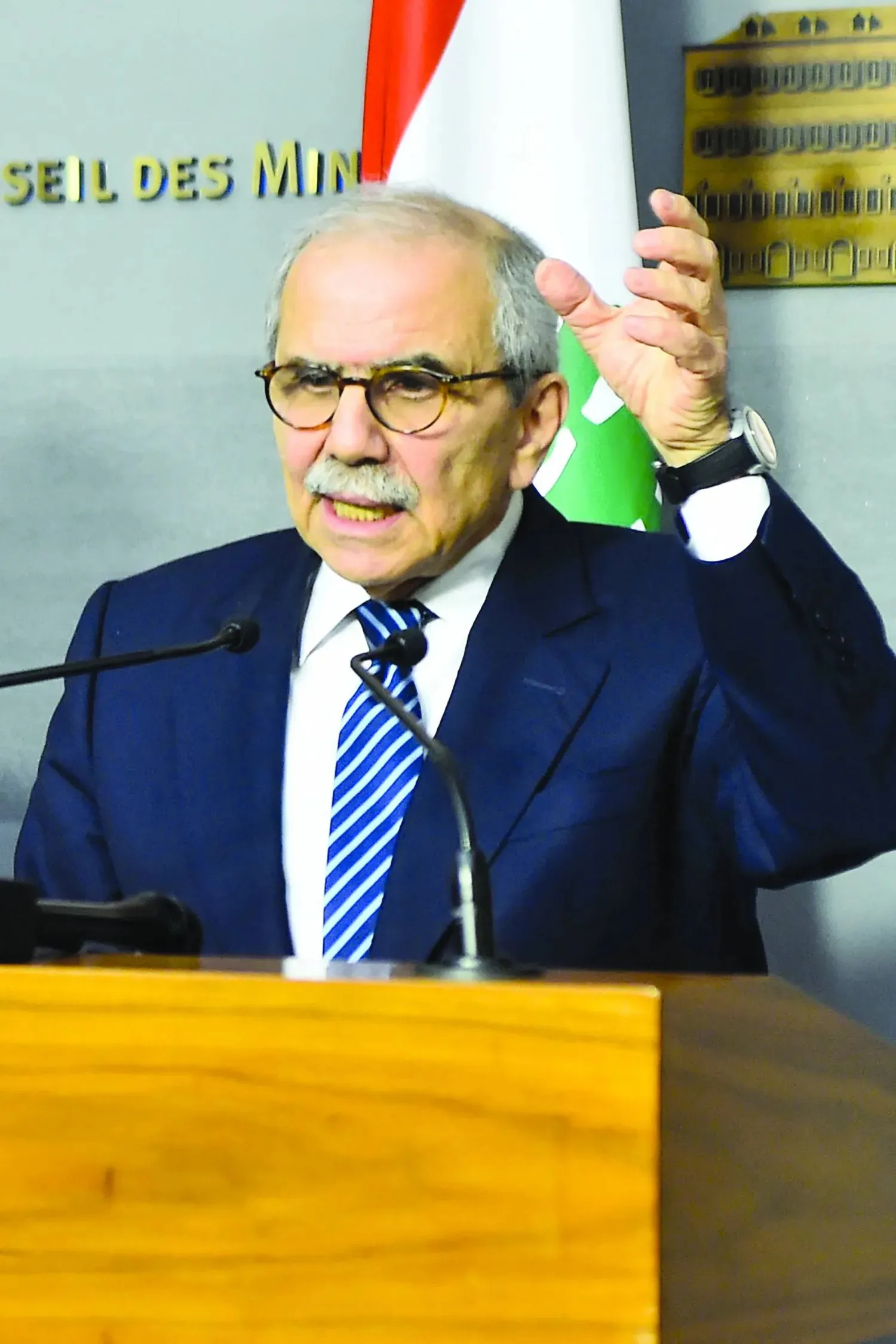

Lebanon PM Says IMF Wants Rescue Plan Changes as Crisis Deepens

A photograph released by the Lebanese Government Press Office on December 26, 2025, show Lebanon's Prime Minister Nawaf Salam speaking during a press conference following a cabinet session in Beirut on December 26, 2025. (Photo by Handout / Lebanese Government Press Office / AFP)
TT

Lebanon PM Says IMF Wants Rescue Plan Changes as Crisis Deepens

A photograph released by the Lebanese Government Press Office on December 26, 2025, show Lebanon's Prime Minister Nawaf Salam speaking during a press conference following a cabinet session in Beirut on December 26, 2025. (Photo by Handout / Lebanese Government Press Office / AFP)

The International Monetary Fund has demanded amendments to a draft rescue law aimed at hauling Lebanon out of its worst financial crisis on record and giving depositors access to savings frozen for six years, Prime Minister Nawaf Salam said.

The "financial gap" law is part of a series of reform measures required by the IMF in order to access its funding and aims to allocate the losses from Lebanon's 2019 crash between the state, the central bank, commercial banks and depositors.

Salam told Reuters the IMF wants clearer provisions in the hierarchy of claims, which is a core element of the draft legislation designed to determine how losses are allocated.

"We want to engage with the IMF. We want to improve. This is a draft law," ‌Salam said in ‌an interview at the World Economic Forum annual meeting ‌in ⁠the Swiss mountain ‌resort of Davos.

"They wanted the hierarchy of claims to be clearer. The talks are all positive," Salam added.

In 2022, the government put losses from the financial crisis at about $70 billion, a figure that analysts and economists forecast is now likely to be higher.

Salam stressed that Lebanon is still pushing for a long-delayed IMF program, but warned the clock is ticking as the country has already been placed on a financial 'grey list' and risks falling onto the 'black ⁠list' if reforms stall further.

"We want an IMF program and we want to continue our discussions until we get ‌there," he said, adding: "International pressure is real ... The longer we ‍delay, the more people's money will evaporate".

The ‍draft law, which was passed by Salam's government in December, is under parliamentary ‍review. It aims to give depositors a guaranteed path to recovering their funds, restart bank lending, and end a financial crisis that has left nearly a million accounts frozen and confidence in the system shattered.

The roadmap would repay depositors up to $100,000 over four years, starting with smaller accounts, while launching forensic audits to determine losses and responsibility.

Lebanon's Finance Minister Yassine Jaber, who is driving the reform push with Salam, told Reuters it was ⁠essential to salvage a hollowed-out banking system, and to stop the country from sliding deeper into its cash-only, paralyzed economy.

The aim, Jaber said, is to give depositors clarity after years of uncertainty and to end a system that has crippled Lebanon's international standing.

He framed the law as part of a broader reckoning: the first time a Lebanese government has confronted a combined collapse of the banking sector, the central bank and the state treasury.

Financial reforms have been repeatedly derailed by political and private vested interests over the last six years and Jaber said the responsibility now lies with lawmakers.

Failure to act, he said, would leave Lebanon trapped in "a deep, dark tunnel" with no way back to a functioning system.

"Lebanon ‌has become a cash economy, and the real question is whether we want to stay on the grey list, or sleepwalk into a black list," Jaber added.



Israeli Strikes Damage Hospital in Lebanon

File photo: Destroyed houses that were hit in an Israeli airstrike in Saksakiyeh village, south Lebanon, Friday, April 3, 2026. (AP Photo/Hussein Malla)
TT

Israeli Strikes Damage Hospital in Lebanon

File photo: Destroyed houses that were hit in an Israeli airstrike in Saksakiyeh village, south Lebanon, Friday, April 3, 2026. (AP Photo/Hussein Malla)

A hospital in the coastal Lebanese city of Tyre was damaged by Israeli airstrikes on nearby buildings that wounded 11 people, the health ministry said on Saturday.

The director of the Lebanese Italian Hospital told the state-run National News Agency (NNA) that it would "remain open to provide the necessary medical care" despite the damage.

Strikes destroyed two buildings nearby, an AFP correspondent saw, shattering windows and causing suspended ceilings to collapse in the hospital, the facility's management said.

A series of attacks hit the Tyre region on Saturday, including one on its port that struck a small boat and damaged others moored nearby, the AFP correspondent said.

Israel has been carrying out strikes across Lebanon and launched a ground invasion in the south after Hezbollah entered the war in the Middle East on the side of its backer Iran on March 2.

Tens of thousands of people have left Tyre, but around 20,000 remain, including 15,000 displaced from surrounding villages, despite Israeli evacuation warnings covering most of the city and a broad swathe of southern Lebanon.

The NNA also reported that Israeli forces abducted a man in Shebaa, near the Israeli border in the east, at around 3:00 am on Saturday.


Indonesia Slams 'Unacceptable' Peacekeeper Casualties in Lebanon

FILE PHOTO: UNIFIL vehicles drive on a main road in Qlayaa, amid escalating hostilities between Israel and Hezbollah, as the US-Israel conflict with Iran continues, in Qlayaa, southern Lebanon, March 27, 2026. REUTERS/Karamallah Daher/File Photo
TT

Indonesia Slams 'Unacceptable' Peacekeeper Casualties in Lebanon

FILE PHOTO: UNIFIL vehicles drive on a main road in Qlayaa, amid escalating hostilities between Israel and Hezbollah, as the US-Israel conflict with Iran continues, in Qlayaa, southern Lebanon, March 27, 2026. REUTERS/Karamallah Daher/File Photo

The Indonesian government on Saturday slammed as "unacceptable" an explosion that injured three of its peacekeepers in Lebanon within days of three other blue helmets from the Southeast Asian nation being killed.

The United Nations Interim Force in Lebanon (UNIFIL) said three peacekeepers were wounded in a blast that occurred inside a UN facility near Adaisseh on Friday afternoon, and rushed to hospital.

Two were seriously wounded.

The UN Information Center in Jakarta said the "origin of the explosion" was unknown but identified the injured soldiers as Indonesian.

"Repeated attacks or incidents of this kind are unacceptable," the Indonesian foreign ministry said in a statement.

"Regardless of their cause, these events underscore the urgent need to strengthen protection for UN peacekeeping forces amid an increasingly dangerous conflict situation."

The government urged the UN Security Council to investigate the events and "to immediately convene a meeting of troop-contributing countries to UNIFIL to conduct a review and take measures to enhance the protection of personnel serving with UNIFIL".

Friday's incident came just days after an Indonesian peacekeeper died when a projectile exploded on March 29 in southern Lebanon, where Israel and Hezbollah have been fighting since Lebanon was drawn into the Middle East war.

A UN security source told AFP on condition of anonymity Tuesday that fire from an Israeli tank was responsible for that attack.

A day later, two more Indonesian peacekeepers died after an explosion struck a UNIFIL logistics convoy, also in southern Lebanon.

The father of one of the two fallen soldiers, 33-year-old Zulmi Aditya Iskandar, said this week he was shocked that peacekeepers were losing their lives in the conflict.

"We were really sad and regretful, because this is a UN troop, a peacekeeping troop, not deployed for war," 60-year-old Iskandarudin told reporters at his house in West Java province.

The bodies of the three peacekeepers are scheduled to arrive in Jakarta on Saturday evening, according to the military.

The Indonesian National Armed Forces has said it will deploy more than 750 personnel to Lebanon next month as part of the scheduled UNIFIL peacekeeping troop rotation.


Strike Kills One Iraqi Fighter near Syria Border

Mourners attend the funeral of members of Iraq's Hashed al-Shaabi, who were killed in an airstrike in the town of al‑Qaim near the Syrian border, amid heightened regional tensions due to the US-Israel conflict with Iran, in Baghdad, Iraq, March 12, 2026. REUTERS/Stringer
TT

Strike Kills One Iraqi Fighter near Syria Border

Mourners attend the funeral of members of Iraq's Hashed al-Shaabi, who were killed in an airstrike in the town of al‑Qaim near the Syrian border, amid heightened regional tensions due to the US-Israel conflict with Iran, in Baghdad, Iraq, March 12, 2026. REUTERS/Stringer

An attack killed one fighter from the former paramilitary coalition Hashed al-Shaabi on Saturday, the alliance said, blaming the US and Israel.

Iraq has been dragged into the war between the United States, Israel and Iran, with strikes targeting both US interests and pro-Iran groups in the country, reported AFP.

"This treacherous attack resulted in the martyrdom of one PMF fighter and the wounding of four others, as well as a member of the ministry of defense," said a short statement from the group, which is also known as the Popular Mobilization Forces (PMF), adding it was a "Zionist-American attack".

The PMF is a coalition of armed groups -- formed in 2014 to fight extremists-- that is now part of Iraq's regular army, but also contains pro-Iran factions who have a reputation for acting independently.

PMF positions have been repeatedly targeted since the outbreak of war, with the group consistently blaming the attacks on the US and Israel.

According to the group's statement, the latest attack targeted a position in western Anbar province of the 45th Brigade, which belongs to the US-blacklisted, pro-Iran Kataeb Hezbollah group.

Kataeb Hezbollah is part of the umbrella movement known as the Islamic Resistance in Iraq, which has been claiming daily attacks since the start of the war on US interests in Iraq and the region.

The Pentagon has said helicopters have carried out strikes against pro-Iran armed groups in Iraq during the war.

Washington has strongly denied claims it has targeted Iraqi security forces.