India’s Prime Minister Says It Has Reached a Free Trade Deal with the EU

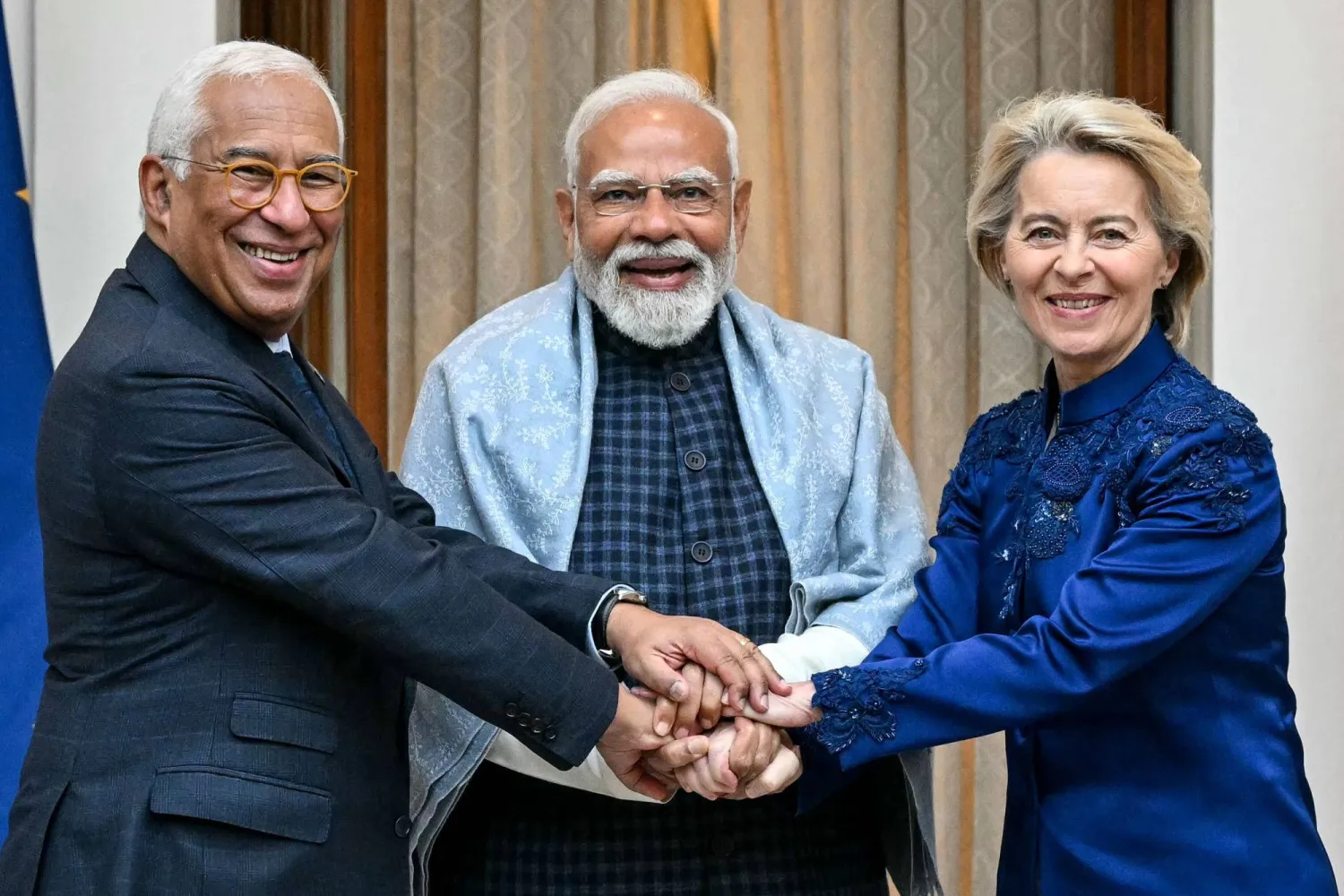
India's Prime Minister Narendra Modi (C) poses for a photograph with European Commission President Ursula von der Leyen (R) and European Council President Antonio Costa before their meeting at the Hyderabad House in New Delhi on January 27, 2026. (AFP)
TT

India’s Prime Minister Says It Has Reached a Free Trade Deal with the EU

India's Prime Minister Narendra Modi (C) poses for a photograph with European Commission President Ursula von der Leyen (R) and European Council President Antonio Costa before their meeting at the Hyderabad House in New Delhi on January 27, 2026. (AFP)

Prime Minister Narendra Modi said Tuesday that India and the European Union have reached a free trade agreement to deepen their economic and strategic ties.

The accord, which touches a whopping 2 billion people, was concluded after nearly two decades of negotiations. It was dubbed the “mother of all deals” by both sides.

It is one of the biggest bilateral engagements on commerce. The timing comes as Washington targets both India and the EU with steep import tariffs.

“This agreement will bring major opportunities for the people of India and Europe. It represents 25% of the global GDP and one-third of global trade,” Modi said while virtually addressing an energy conference.

The deal comes at a time when Washington is targeting both India and the EU with steep tariffs, disrupting established trade flows and pushing major economies to seek alternate partnerships.

Modi was scheduled to meet with European Commission President Ursula von der Leyen later Tuesday to jointly announce the agreement.

India has stepped up efforts to diversify its export destinations as part of a broader strategy to offset the impact of higher US tariffs.

The tariffs include an extra 25% levy on Indian goods for its unabated purchases of discounted Russian oil, bringing the combined tariffs imposed by the United States on its ally to 50%.

The deal gives the EU expanded access to one of the world’s fastest-growing major economies, helping European exporters and investors to reduce their reliance on more volatile markets.

“Ultimately, the agreement is about creating a stable commercial corridor between two major markets at a time the global trading system is fragmenting,” said Indian trade analyst Ajay Srivastava.

The EU is still reeling from the aggressive approach of its once-stalwart ally across the Atlantic. There’s a widespread sense of betrayal across the 27-nation bloc from US President Donald Trump's onslaught of higher tariffs, embrace of far-right parties, and belligerence over Greenland.

Brussels has accelerated its outreach to markets around the world: Over the past year, von der Leyen has signed deals with Japan, Indonesia, Mexico, and South America under the catchphrase “strategic autonomy,” which in practice is akin to decoupling from a US seen by most European leaders as erratic.

“We are showing a fractured world that another way is possible,” she posted on X after arriving in India on Sunday.


Saudi GDP Surges to SAR 4.7 Trillion, More Than Doubling in Less Than a Decade

Saudi Investment Minister Khalid Al-Falih speaks during the fourth annual Future Investment Initiative in Riyadh, Saudi Arabia, January 27, 2021. (Reuters)
TT

Saudi GDP Surges to SAR 4.7 Trillion, More Than Doubling in Less Than a Decade

Saudi Investment Minister Khalid Al-Falih speaks during the fourth annual Future Investment Initiative in Riyadh, Saudi Arabia, January 27, 2021. (Reuters)

Saudi Minister of Investment Khalid Al-Falih said the Kingdom’s gross domestic product (GDP) rose to SAR 4.7 trillion ($1.25 trillion) by the end of 2024, up from SAR 2.6 trillion ($693 billion) in 2016, the year the Vision 2030 reform program was launched, representing growth of more than double in less than a decade.

Speaking at a government press conference in Riyadh on Monday, Al-Falih said the economic leap was not merely reflected in headline figures, but was underpinned by far-reaching reforms that strengthened the labor market and enhanced private-sector competitiveness.

The Saudi economy has created 800,000 new jobs, he said, highlighting the vitality of emerging sectors and their ability to generate employment opportunities.

He added that foreign investment had quadrupled by the end of 2024 and is expected to reach SAR 150 billion ($40 billion) in 2025.

Al-Falih said the number of Saudi investors has surpassed 1.86 million, which shows growing engagement in economic activity and the availability of growth incentives, particularly for small and medium-sized enterprises.

He noted that the number of registered foreign investors has reached 62,000, while emphasizing that Saudi nationals remain the dominant participants in the business sector.

Moreover, the minister also revealed that more than 700 multinational companies had obtained licenses to establish regional headquarters in Saudi Arabia by the end of 2025.

Al-Falih highlighted significant progress in national workforce participation, noting that women’s contribution to the Saudi economy has doubled. He also pointed to an important indicator of job quality: average wages for Saudi nationals in the private sector have risen by 45 percent.

As part of its drive to diversify income sources, Al-Falih said Saudi Arabia has reduced its reliance on oil, with non-oil sectors accounting for 56 percent of the national economy for the first time in the Kingdom’s history, an indication that the country has begun to reap the benefits of Vision 2030.

Commenting on Saudi Arabia’s recent participation in the World Economic Forum in Davos, Switzerland, Al-Falih said the Saudi economy had a strong and positive presence at a time when pessimism and uncertainty dominated many delegations’ views of the global economic outlook.


Saudi Arabia Brings Global Leaders Together to Shape Future of Labor Markets

 Delegates attend the meeting bringing together 40 labor ministers (The Global Labor Market Conference). 
 Delegates attend the meeting bringing together 40 labor ministers (The Global Labor Market Conference). 
TT

Saudi Arabia Brings Global Leaders Together to Shape Future of Labor Markets

 Delegates attend the meeting bringing together 40 labor ministers (The Global Labor Market Conference). 
 Delegates attend the meeting bringing together 40 labor ministers (The Global Labor Market Conference). 

Under the patronage of the Custodian of the Two Holy Mosques, King Salman bin Abdulaziz, the third edition of the Global Labor Market Conference opened on Monday in Riyadh, bringing together labor ministers, policymakers and experts from around the world.

The event reflects Saudi Arabia’s growing role in steering global discussions on labor-market transformation and future economic challenges.

Held on Jan. 26–27, the conference serves as a high-level platform to address rapid technological change, artificial intelligence, shifting trade patterns, evolving skills systems and the need to build more resilient and sustainable labor markets. A central theme is youth empowerment, which is a key driver of future economic growth.

Opening the conference, Saudi Minister of Human Resources and Social Development Ahmed Al-Rajhi said global labor markets are undergoing unprecedented change driven by technological progress, demographic shifts and evolving skills requirements. He stressed the importance of international cooperation and deeper knowledge exchange to respond effectively to these transformations.

Al-Rajhi noted that the conference has moved beyond dialogue to developing practical, evidence-based solutions that strengthen labor-market readiness, particularly amid the accelerating adoption of digital technologies and AI.

He highlighted this year’s themes, including the impact of trade transformation on employment, informal economies, global skills systems, the effects of AI on jobs, employment during crises and the development of flexible labor markets, adding that the event aligns with Saudi Arabia’s Vision 2030 reform agenda.

On the sidelines of the conference, Saudi Minister of Industry and Mineral Resources Bandar Alkhorayef emphasized the growing role of governments in establishing regulatory frameworks for emerging jobs, advanced technologies and evolving business models. He called for integrated systems that align efforts across government, the private sector, educational institutions and the workforce.

Alkhorayef said sustainable labor markets rest on three pillars: effective government policies, alignment between education outcomes and future labor needs, and individual readiness to compete globally. He added that Saudi Arabia faces not a shortage of jobs in industry and mining but a need for highly qualified talent, noting that the future of these sectors is closely linked to technology and advanced skills development.

Saudi Minister of Tourism Ahmed Al-Khateeb said tourism has been a key driver in reducing unemployment to record lows comparable with OECD and G20 levels. He added that the sector has created 250,000 jobs for Saudis since the launch of the National Tourism Strategy in 2019, raising total employment in tourism to more than one million by the end of last year. He also highlighted Vision 2030’s focus on economic diversification and people-centered development, noting that tourism is among the most attractive sectors for youth and women.

Mamta Murthi, Vice President for People at the World Bank Group, noted that workforce systems must evolve in line with rapid global economic shifts. She described Saudi Arabia’s cooperation with the World Bank as a model for translating evidence-based policies into tangible economic opportunities while supporting inclusive job growth.

Murthi highlighted persistent challenges in skills development, including mismatches between education and labor-market needs, outdated training programs and limited scalability of effective solutions, warning against supply-driven approaches disconnected from real market demand.

The ministerial meeting held within the framework of the conference, chaired by Al-Rajhi and attended by 40 labor ministers, alongside ILO Director-General Gilbert F. Houngbo, focused on aligning employment policies with future-readiness, sharing practical experiences and strengthening coherence in labor-market strategies.

The meeting concluded with agreement on six priority actions, including improving skills recognition and portability, promoting responsible use of AI, adapting social-protection systems to support career mobility, strengthening data-driven workforce planning and expanding pathways to first employment and re-entry into the labor market.

The first day also marked the graduation of the inaugural cohort of the Global Labor Market Academy, representing 34 countries.

Established in partnership with the World Bank and Takamol Holding, the academy combines in-person training with international knowledge exchange. With participation from 31 countries in the new cohort, the initiative now includes 50 countries and aims to expand to more than 75 by 2028, reinforcing a global model for turning policy dialogue into measurable impact.


300,000 New Homes to Restore Market 'Balance' in Riyadh

Saudi Minister of Municipalities and Housing Majed Al-Hogail speaks at Monday's forum in Riyadh. (Asharq Al-Awsat)
TT

300,000 New Homes to Restore Market 'Balance' in Riyadh

Saudi Minister of Municipalities and Housing Majed Al-Hogail speaks at Monday's forum in Riyadh. (Asharq Al-Awsat)

Saudi Arabia plans to inject more than 300,000 new housing units into Riyadh over the next three years as part of a broader government strategy to stabilize the capital’s real estate market, announced Majed Al-Hogail, Minister of Municipalities and Housing and Chairman of the Board of the General Real Estate Authority.

Speaking at the opening of the fifth edition of the Real Estate Future Forum 2026 in Riyadh on Monday, Al-Hogail said the capital already has more than 100 million square meters of developed, ready-to-build land.

The forum brought together decision-makers, experts and investors from more than 140 countries, with around 300 speakers from government, business and the public and private sectors, highlighting the growing global prominence of Saudi Arabia’s real estate industry.

Al-Hogail stressed that the Kingdom has adopted “real estate balance” as a strategic policy aimed at improving efficiency and fairness in the sector through precise regulatory tools and informed analysis of market dynamics.

He highlighted a historic surge in mortgage financing, which rose from SAR 82 billion in 2017 to nearly SAR 900 billion (about $240 billion) by 2025, making real estate finance a major pillar of the national economy, accounting for around 27 per cent of Saudi banks’ total loan portfolios.

Homeownership

On homeownership, Al-Hogail said the rate of Saudi citizens owning homes exceeded 66 percent in 2025, with more than one million beneficiaries of government housing support programs. He outlined ambitious targets to support an additional 367,000 beneficiaries and raise the homeownership rate to 70 percent by 2030.

Riyadh has over 100 million square meters of developed land ready for use and is expected to receive more than 300,000 new housing units within three years, he went on to say.

He also highlighted the role of the National Housing Company, the region’s largest real estate developer, which has delivered around 300,000 housing units across 16 cities and plans to add another 300,000 units in the next phase.

This growth, he said, reflects the maturity of the market and rising confidence among investors and citizens alike.

Real estate investment

Saudi Minister of Investment Khalid Al-Falih described real estate as a safe haven for economic stability amid global geo-economic uncertainty and volatile markets.

The real estate and construction sector forms a “solid foundation” for national growth, contributing about 13 percent of Saudi Arabia’s GDP, he stressed. This momentum is supported by large-scale investments led by the Public Investment Fund (PIF), which have exceeded $400 billion since the launch of Vision 2030.

Tourism projects and urban transformation

Saudi Minister of Tourism Ahmed Al Khateeb said the Kingdom is now “leading global change” in urban development and the creation of major tourism destinations.

Saudi Vision 2030 has transformed the concept of city design, shifting from merely serving local residents to also welcoming visitors and meeting their needs, he remarked.

He cited mega-projects such as NEOM, the Red Sea project and Diriyah as examples of this transformation, arguing that the Kingdom’s ability to develop previously untouched regions, such as Tabuk and the Red Sea islands, gives it a unique advantage in delivering architectural and technological models that inspire the world.

Quality of life

Al Khateeb also noted the launch of the Global Quality of Life Index, developed in partnership with UN-Habitat. The index is the first of its kind to measure quality of living based on comprehensive criteria, including infrastructure and essential services.

Rather than assessing happiness or education in isolation, it evaluates the overall ecosystem of services that matter to residents and visitors, focusing on accessibility, affordability and quality.

Al Khateeb stressed the importance of sustainability in the economy, employment and the environment, describing it as the most critical component of quality of life and a core responsibility embedded in national visions.

Tourism has been a key driver in reducing unemployment in Saudi Arabia to record lows comparable to OECD and G20 countries, with the sector creating 250,000 new jobs for Saudis since the launch of the national tourism strategy in 2019, he added.

Partnerships and agreements

Abdullah Al-Hammad, Chief Executive Officer of the General Real Estate Authority, said the sector has become an influential player in the global economy.

He noted that the forum coincides with the implementation of regulations allowing non-Saudis to own real estate, opening unprecedented global opportunities for the Saudi market and showcasing the Kingdom’s geographical diversity and cultural depth.

Al-Hammad added that previous editions of the forum resulted in agreements and partnerships worth more than $50 billion (SAR 187.5 billion), describing the figure as clear evidence that discussions at the forum are transforming into concrete decisions, investments and projects on the ground.